Benchmarking Generative AI Adoption: Industry Comparisons and Maturity Stages
 Feb, 26 2026
Generative AI isn’t just a buzzword anymore. By early 2026, it’s moved past the hype cycle and into boardrooms where leaders are asking one simple question: Are we getting a return on this investment? The answer isn’t the same across industries. Some companies are seeing 3.7x ROI on every dollar spent. Others are stuck in pilot purgatory, watching tools gather dust because no one knew how to connect them to real workflows. This isn’t about which model is smarter. It’s about who’s using it right - and why.
Where Generative AI Is Delivering Real Results
The clearest wins are in customer service and eCommerce. Companies using AI to handle routine support queries report 37% faster response times and 92% customer satisfaction - even better than human agents in some cases. Why? Because these roles are repetitive, predictable, and tied directly to revenue. A chatbot that answers shipping questions or processes returns doesn’t need to be perfect. It just needs to be faster and cheaper than a human.
Meanwhile, manufacturing is seeing gains in operational efficiency. One factory in Sweden cut unplanned downtime by 22% by using AI to predict equipment failures. But here’s the catch: they had to fix their sensor data first. For months, the AI kept giving useless predictions because the input data was messy. Once they cleaned it up, the model started saving them $1.2 million a year. This pattern repeats across industries - the tech works, but only if the foundation is solid.
Industry-by-Industry Adoption Rates
Not all sectors are moving at the same pace. Here’s how adoption breaks down as of Q1 2026:
- Customer Service & eCommerce: 78% adoption - highest ROI, fastest scaling
- Manufacturing: 18-22% - strong ROI in high-volume operations
- Finance: 15-18% - cautious, governed deployments due to compliance
- Healthcare: 15-20% - focused on admin tasks, not patient-facing AI
- Construction: 1.4% - barely started, low digital infrastructure
- Agriculture: Under 2% - limited data, fragmented operations
Sweden’s data shows an even starker contrast. The ICT sector has 87.9% of companies using generative AI. Meanwhile, Transport & Storage? Just 12.2%. Why? Because software companies live on data. Trucking companies still file paperwork by hand.
How Mature Is Your Organization?
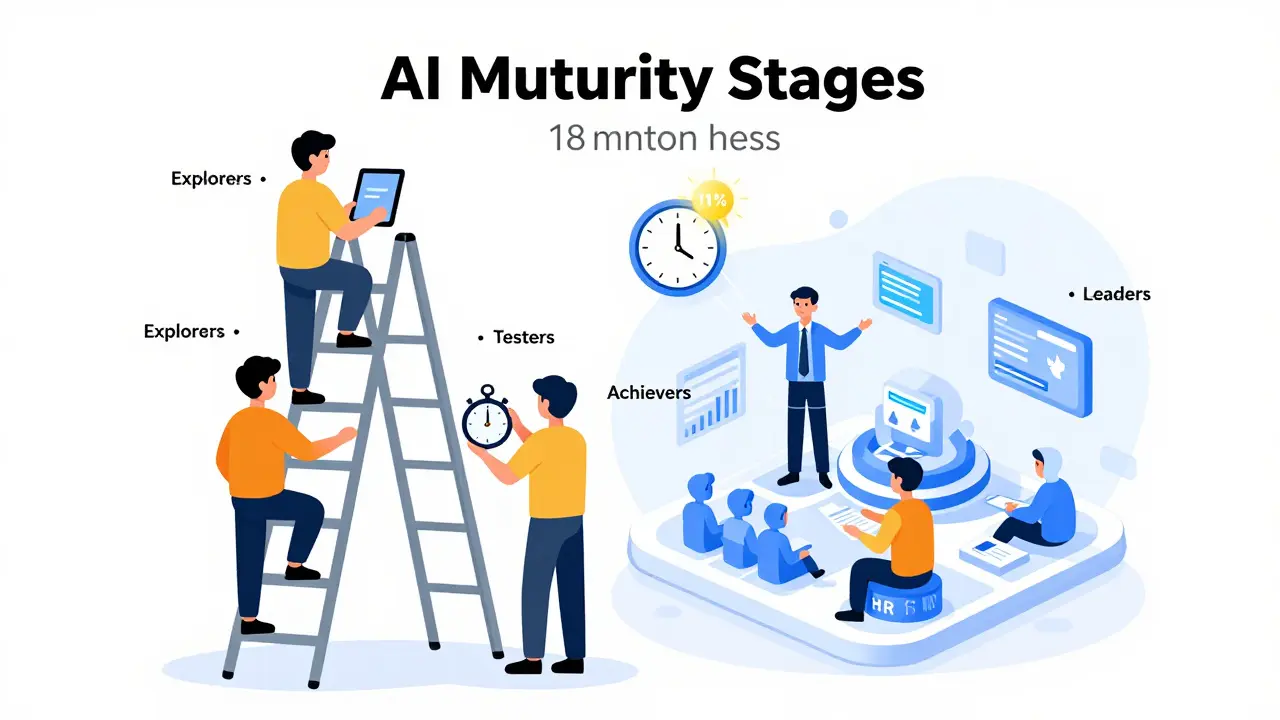
Adoption isn’t binary. It’s a ladder with four stages:
- Explorers: Running small pilots. No clear metrics. 34% of companies here.
- Testers: Deploying in one department. Measuring time saved. 29%.
- Achievers: Scaling across teams. ROI tracked. 26%.
- Leaders: AI embedded in core systems. Full governance. 11%.
Only 11% are true leaders. That’s not because they’re smarter. It’s because they started early, invested in data, and trained their teams. B2C companies are 32% more likely to be leaders than B2B ones. Why? They’re closer to customers. Their feedback loops are faster. If a chatbot annoys a shopper, they hear about it immediately. If it messes up an internal report? Nobody notices until quarterly review.
Why Most AI Projects Fail
Here’s the brutal truth: 70% of AI pilots never make it to production. The reasons aren’t technical. They’re organizational.
- Lack of expertise: 74.7% of non-adopters say they don’t have the right people. Not just engineers - domain experts who know how the business actually works.
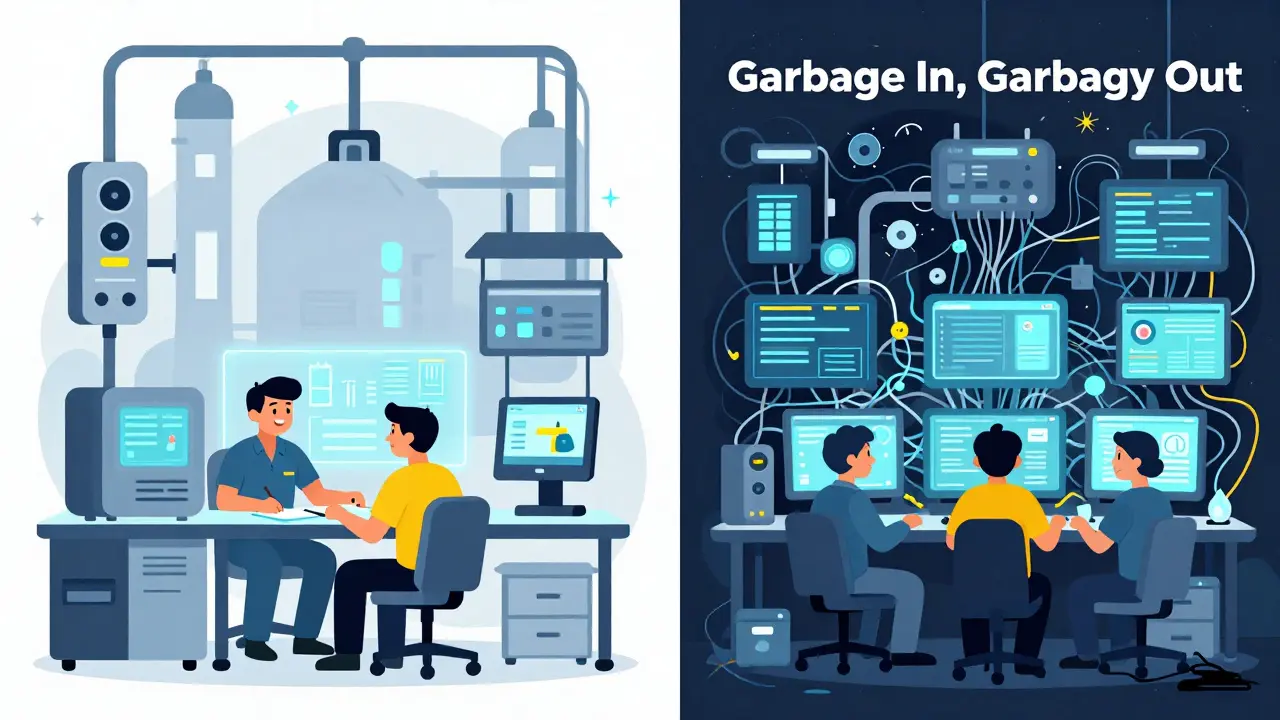
- Poor data quality: 44.3% of Swedish companies cite this as their biggest barrier. AI doesn’t guess. It repeats what it’s fed. Garbage in, garbage out.
- Integration gaps: One Reddit user wrote: “Our marketing team’s GenAI pilot failed because we didn’t integrate with CRM. Outputs were generic.” That’s not AI’s fault. That’s a process failure.
- No governance: 47% of enterprises admit they lack clear rules on who can use what, and when. That leads to chaos - or worse, legal risk.
Success stories all have one thing in common: they started small, with a single, high-impact task. Not “Let’s automate everything.” But “Let’s make our returns process 50% faster.” Then they measured, refined, and scaled.
What You Need to Succeed
If you’re trying to get AI working in your company, here’s what actually matters:
- Start with a bottleneck: Pick one task that eats up time, costs money, or frustrates customers. Not the flashiest one. The most painful one.
- Fix the data first: If your CRM is messy, your AI will be useless. Clean it before you buy a tool.
- Train your team: 77% of Swedish companies offer AI training. You need more than tech skills. You need prompt engineering. You need to know how to audit outputs.
- Build in human oversight: No AI should make final decisions without a human in the loop - especially in regulated industries.
- Measure everything: Track time saved, error rates, customer satisfaction, and cost per interaction. If you can’t measure it, you can’t improve it.
It takes 3-6 months to get a basic system running. But 12-18 months to make it stick. That’s the real timeline. No shortcuts.
The Future: What’s Next?
By 2028, Gartner predicts 40% of enterprise apps will have AI agents built in. That doesn’t mean every company will have a robot assistant. It means your CRM, your ERP, your HR system - they’ll all have smart helpers quietly doing the boring stuff. You won’t notice them. You’ll just notice things are faster.
But here’s the risk: if companies keep skipping the hard work - data, training, governance - then trust will erode. One high-profile failure, like an AI denying a loan incorrectly, could set adoption back years. The winners won’t be the ones with the fanciest models. They’ll be the ones who treated AI like a process, not a magic button.
The global AI market is on track to hit $1.81 trillion by 2030. But only if we stop chasing hype and start building systems that actually work.
What industries have the highest ROI from generative AI?
Customer service and eCommerce lead in ROI, with companies seeing up to 3.7x returns on investment. These sectors benefit because AI handles repetitive, high-volume tasks like answering FAQs, processing returns, and recommending products - all of which directly impact revenue. Manufacturing also sees strong returns when AI is used to predict equipment failures or optimize logistics, but only after data quality issues are resolved.
Why do most AI projects fail to move beyond pilots?
The biggest reason is poor integration with existing systems. Many teams deploy AI tools without connecting them to real data sources like CRM, ERP, or inventory systems. This leads to generic, inaccurate outputs that employees can’t trust. Other top causes include lack of employee training (74.7% of non-adopters cite this), poor data quality (44.3%), and no governance framework to guide usage.
How long does it take to implement generative AI successfully?
Basic deployment - like setting up a chatbot for customer service - can take 3 to 6 months. But full production integration, where AI is embedded across departments with proper oversight and data pipelines, typically takes 12 to 18 months. Speed isn’t the goal. Sustainability is.
What skills are most critical for AI implementation?
Data engineering is the most critical skill - cited by 83% of successful implementations. You need people who can clean, connect, and manage data. Prompt engineering comes second (76%), because how you ask AI for information determines the output quality. Domain expertise is third (69%). Knowing how your business works is more important than knowing how the AI works.
Is generative AI adoption higher in large companies or small businesses?
Large enterprises lead by far. In Sweden, 71.9% of large companies use generative AI, compared to 49.6% of medium-sized firms, 30.8% of small ones, and just 16.1% of micro businesses. The gap exists because large companies have the data infrastructure, budgets, and teams needed to support AI. Smaller firms often lack the resources to fix data issues or hire specialists.
What role does regulation play in AI adoption?
Regulation is a major factor, especially in finance and healthcare. In Sweden, 49.1% of companies cite data protection as a barrier to adoption. The EU AI Act is pushing organizations to implement governance, transparency, and human oversight. While this slows adoption in some areas, it also builds trust. Companies that comply early are positioning themselves as reliable partners - not just tech users.
Can generative AI increase labor productivity?
Yes. Users report saving the equivalent of 1.6% of total work hours across all tasks. For a company with 1,000 employees, that’s roughly 13,000 hours saved annually - equivalent to 6.5 full-time roles. While this won’t replace jobs, it frees up workers to focus on higher-value tasks like strategy, creativity, and customer relationships. The broader impact could raise global labor productivity by up to 1.3%.
mark nine
February 27, 2026 AT 18:42Tony Smith
February 28, 2026 AT 13:18Rakesh Kumar
March 2, 2026 AT 12:41Bill Castanier
March 3, 2026 AT 11:35Ronnie Kaye
March 4, 2026 AT 08:20