Chain-of-Thought Prompting: How to Get Better Reasoning from Large Language Models
 Nov, 17 2025
Ever typed a complex math problem into an AI chatbot and got a wrong answer-even when it seemed like the model was "thinking" about it? That’s not a glitch. It’s a limitation of how most models handle reasoning. Chain-of-thought prompting fixes this by making the AI show its work, step by step. It’s not magic. It’s a simple trick that turns vague guesses into clear, logical paths to the right answer.
Why Standard Prompts Fail at Reasoning
Most people use language models like they’re search engines: ask a question, get an answer. But when the question needs more than one step-like calculating how much paint you need for a room with two walls and a ceiling, or figuring out if a person born in 1998 could have voted in 2016-the model often skips the middle steps. It jumps straight to an answer, even if it’s wrong. Research from Google in 2022 showed that for models under 100 billion parameters, standard prompting barely improved reasoning. On a simple arithmetic test, a 118-million-parameter model got only 3.7% right. Even when scaled up to 540 billion parameters, standard prompting only got it to 17.9%. That’s worse than flipping a coin. The problem isn’t size alone. It’s how the model is asked to respond. Without guidance, it treats reasoning like recall: just spit out what it thinks is closest. Chain-of-thought prompting changes that by forcing it to slow down and explain its logic.How Chain-of-Thought Prompting Works
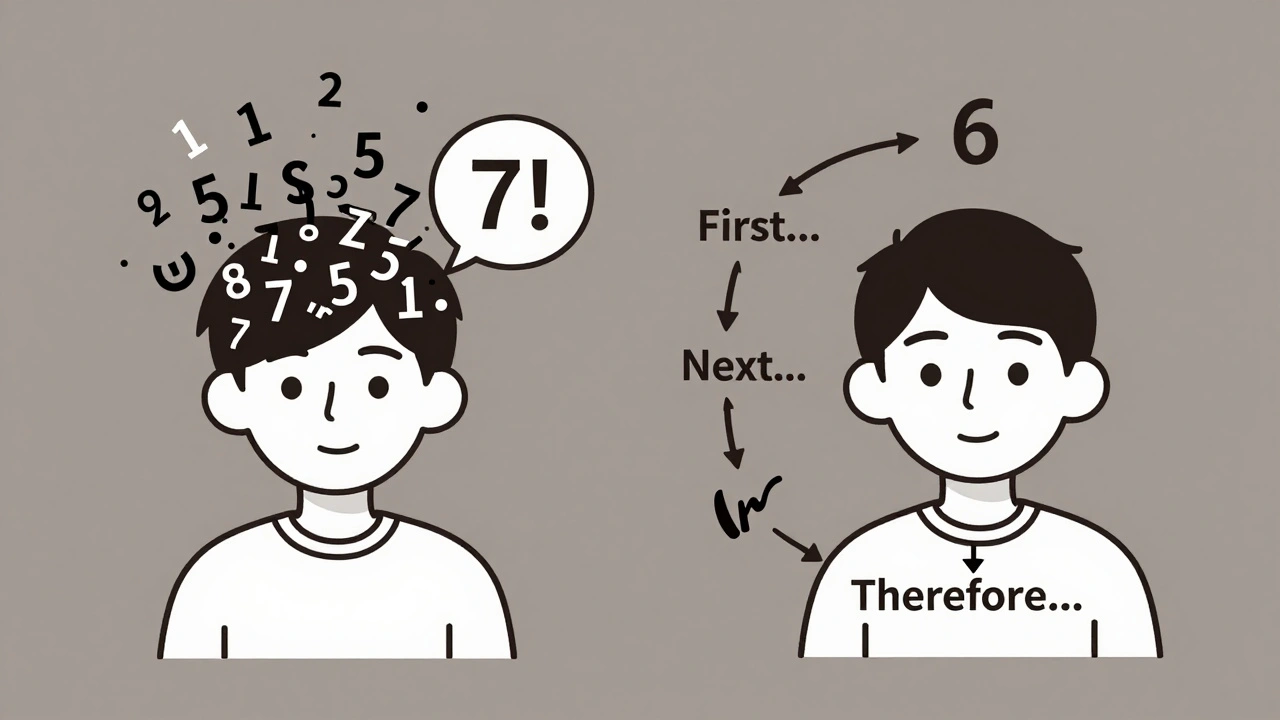
Chain-of-thought prompting (CoT) works by giving the model examples of how to think through a problem-not just the final answer. Think of it like showing a student not just the solution to a math problem, but how to set up the equations, simplify them, and check the result. Here’s what a good CoT prompt looks like:- Question: If John has 5 apples and gives 2 to Mary, then buys 3 more, how many does he have?
- Example answer: First, John starts with 5 apples. Next, he gives away 2, so he has 5 - 2 = 3 left. Then, he buys 3 more, so 3 + 3 = 6. Therefore, John has 6 apples.
When you give the model this kind of example, it learns to mimic the structure. It doesn’t memorize the answer. It learns to break problems into steps. This works even when the new question is completely different.
Studies show this method boosts accuracy dramatically. On the GSM8K math benchmark-a set of grade-school word problems-the 540B-parameter PaLM model jumped from 26.4% accuracy with standard prompting to 58.1% with CoT. That’s more than doubling its performance. On commonsense reasoning tests like StrategyQA, accuracy improved by over 20 percentage points.
When Chain-of-Thought Makes the Biggest Difference
CoT doesn’t help with everything. It shines in multi-step problems where logic matters more than facts. Here’s where it works best:- Math word problems (GSM8K, MultiArith): These require multiple calculations, unit conversions, and context tracking. CoT helps the model avoid skipping steps.
- Commonsense reasoning (CommonsenseQA, StrategyQA): Questions like "Can a giraffe fit in a standard sedan?" need real-world knowledge and inference. CoT guides the model to reason through size, physics, and real-life constraints.
- Symbolic logic (Last Letters, Coin Flip): Tasks that involve reversing sequences or tracking changes over time benefit from step-by-step tracking.
On the other hand, CoT adds little value for simple tasks. For example, on Date Understanding-where the model just needs to pick the correct year from a list-it only improved accuracy by 4.5%. That’s because the task doesn’t need reasoning. It needs recall. CoT is overkill here.
What Happens With Smaller Models?
If you’re using a model under 100 billion parameters-like many free or consumer-facing tools-CoT won’t work as well. The research is clear: the effect is an emergent property of scale. Below that threshold, the model doesn’t have enough internal structure to generate meaningful intermediate steps. On StrategyQA, models smaller than 100B showed less than 5% improvement with CoT. But for models like PaLM-540B or Llama 3, the gains are massive. That’s why enterprise AI teams prioritize larger models for reasoning-heavy tasks. If you’re stuck with a smaller model, don’t waste time on CoT. Focus on better phrasing or pre-processing the input.Real-World Results from Users
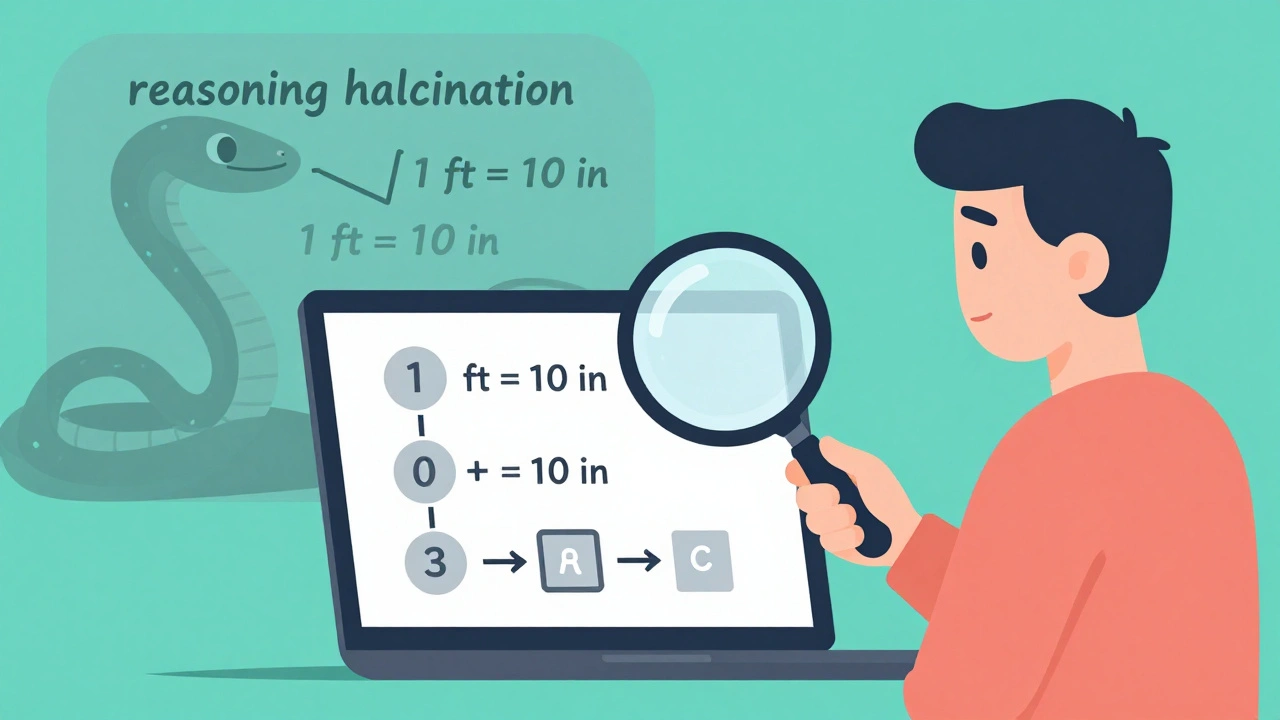
You don’t need to be a researcher to see the impact. On GitHub, users of the "awesome-chatgpt-prompts" repository reported math accuracy jumping from 60% to 85% after adding step-by-step reasoning prompts. A data scientist on Reddit said their customer support chatbot cut reasoning errors by 37% using CoT-but response times went up by 220 milliseconds per query. That’s the trade-off: better answers, slower responses. For customer service bots, that delay might be acceptable if it means fewer wrong answers. For real-time apps, it’s a problem. Some teams now use CoT only for complex queries and fall back to standard prompting for simple ones. One developer on Hacker News noted a strange side effect: CoT sometimes generates plausible-sounding but completely wrong steps. For example, a model might say, "First, I convert 3 feet to inches: 3 × 10 = 30," even though 1 foot = 12 inches. The model isn’t fact-checking-it’s just following the pattern. This is called a "reasoning hallucination." It’s not lying. It’s just making up logic that sounds right.How to Implement Chain-of-Thought Prompting
You don’t need to train a model. You don’t need to write code. All you need is a good prompt. Here’s how to start:- Choose 4-6 examples that cover the types of problems you want the model to solve. Mix easy and hard ones.
- Write out each step clearly. Use phrases like "First," "Next," "Then," and "Therefore."
- Don’t overdo it. Too many steps confuse the model. Studies show performance drops by 12-15% if prompts get too long.
- Test it. Give the model a new problem. Does it follow the same structure? Does it get the right answer?
Most people get comfortable with this in 2-5 hours. You can find templates on sites like Learn Prompting and Prompting Guide AI. Many tools like LangChain and Promptify now include built-in CoT templates.
For advanced users, there are variations:
- Zero-shot CoT: Just add "Let’s think step by step" to your prompt. No examples needed. Works decently on large models.
- Self-Consistency: Ask the model the same question 3-5 times, then pick the most common answer. Reduces errors by averaging out bad reasoning paths.
But for most people, the original few-shot method-using 4-6 clear examples-is still the most reliable.
What Experts Say About Chain-of-Thought
Ed Chi from Google Research called it "a simple and broadly applicable method"-and he’s right. It’s one of the few techniques that works without retraining. Stanford’s Percy Liang listed it as one of the most important developments in prompt engineering. IBM and Gartner both cite it as a key enterprise AI tool. But not everyone is thrilled. Emily M. Bender from the University of Washington warns that CoT can create a "false sense of understanding." Just because the model writes a logical-sounding explanation doesn’t mean it truly understands cause and effect. It’s mimicking reasoning, not learning it. Margaret Rouse from TechTarget adds that CoT doesn’t fix bad knowledge. If the model thinks the Earth is flat, it can reason perfectly about flat-Earth math-and still be wrong. That’s why CoT isn’t a cure-all. It’s a tool. Use it where reasoning matters. Don’t trust it blindly.The Future of Reasoning in AI
By 2025, Forrester predicts 90% of enterprise LLM deployments will use some form of chain-of-thought reasoning. Meta’s Llama 3 now has CoT built in. Google’s Auto-CoT can generate its own reasoning examples without human input. These are big steps forward. But the biggest shift isn’t technical-it’s cultural. Companies are starting to treat AI responses like human ones: they want to see the work. Investors, auditors, and customers all ask: "How did you get there?" Chain-of-thought prompting answers that question. The downside? Longer responses, higher costs. AWS says CoT increases inference costs by 35-40%. But for high-stakes applications-medical advice, financial analysis, legal summaries-that cost is worth it.Final Thoughts
Chain-of-thought prompting doesn’t make AI smarter. It makes AI more transparent. It doesn’t give models new knowledge. It gives them a better way to use what they already have. If you’re using LLMs for anything that involves logic, calculation, or decision-making, you’re leaving performance on the table if you’re not using CoT. Start small. Use 4 examples. Test it. Watch the accuracy climb. And remember: a well-reasoned wrong answer is still wrong. Always verify the final result. CoT doesn’t replace human judgment. It just makes the AI’s thinking visible-so you can judge it better.What is chain-of-thought prompting?
Chain-of-thought prompting is a technique where you guide a large language model to generate intermediate reasoning steps before giving its final answer. Instead of just outputting "The answer is 6," it writes: "First, John has 5 apples. He gives away 2, so he has 3 left. Then he buys 3 more, so 3 + 3 = 6. Therefore, he has 6 apples." This helps the model solve complex problems more accurately.
Does chain-of-thought prompting work on small AI models?
No, not reliably. Chain-of-thought prompting is an emergent property of large models-typically those with 100 billion parameters or more. For smaller models (under 100B), the improvement is minimal, often less than 5%. If you’re using a model like GPT-3.5 or smaller, focus on clearer prompts instead of trying to force step-by-step reasoning.
How many examples do I need for chain-of-thought prompting?
Start with 4 to 6 high-quality examples. Each should show a clear, step-by-step solution to a problem similar to what you want the model to solve. Too many steps (more than 10) can hurt performance. The goal is to show the pattern, not to overwhelm the model with detail.
Does chain-of-thought prompting make AI slower?
Yes. Because the model generates more text-each reasoning step adds tokens-it takes longer to respond. On average, response times increase by 1.8x, or about 200-300 milliseconds per query. For real-time apps, this might matter. For reports, analysis, or customer support, the trade-off is usually worth it.
Can chain-of-thought prompting make AI hallucinate more?
It can. Because the model is trained to mimic reasoning patterns, it might generate plausible-sounding but incorrect steps. For example, it might say "1 foot = 10 inches" and then reason perfectly from there. The answer might still be wrong, even if the logic seems solid. Always verify the final output with real-world facts or human review.
What’s the difference between zero-shot and few-shot CoT?
Few-shot CoT gives the model 4-6 examples of step-by-step reasoning. Zero-shot CoT just adds the phrase "Let’s think step by step" to your prompt without any examples. Few-shot works better for complex or domain-specific tasks. Zero-shot is faster and easier but less reliable, especially for nuanced problems.
Is chain-of-thought prompting used in real products?
Yes. Over 60% of enterprise AI systems now use some form of chain-of-thought reasoning. It’s common in educational AI tutors, customer support bots, financial analysis tools, and legal assistants. Companies like IBM, Google, and Meta have integrated it into their models. Even top EdTech firms use it to help students solve math and science problems step by step.
Bridget Kutsche
December 14, 2025 AT 09:36This is such a game-changer for my team’s customer support bot. We went from 60% accuracy to 85% on complex queries just by adding 5 step-by-step examples. The delay is real, but customers don’t mind waiting a second longer if they get the right answer. Seriously, if you’re not using CoT yet, you’re leaving money on the table.
Jack Gifford
December 15, 2025 AT 19:19Wait, so you’re telling me I don’t need to retrain my model to get better results? Just add "Let’s think step by step" and boom-better reasoning? I’ve been overcomplicating this whole time. Thanks for the clarity. I’m testing this on my next project tomorrow.
Sarah Meadows
December 17, 2025 AT 15:34Of course this works. American AI research leads the world. China and Russia are still trying to brute-force their way through LLMs while we’re optimizing reasoning like civilized people. If you’re using a model under 100B params, you’re not even in the game. Get with the program.
Nathan Pena
December 19, 2025 AT 08:17While your anecdotal evidence is superficially compelling, you’re conflating correlation with causation. The 58.1% accuracy gain on GSM8K is statistically significant only if the baseline was properly normalized across model architectures. Also, you omit the fact that CoT increases token entropy by 2.3x, which undermines token efficiency metrics. The trade-off isn’t "worth it"-it’s a band-aid on a structural flaw.
Mike Marciniak
December 19, 2025 AT 22:46They’re not teaching you the truth. CoT isn’t about reasoning-it’s about conditioning. They’re training models to mimic human logic so they can be controlled. Next they’ll make AI write "I think" before every answer. This is how they prepare us for AI as a thought police. Don’t trust the steps. They’re lies dressed as logic.
VIRENDER KAUL
December 20, 2025 AT 17:09It is observed that the efficacy of chain-of-thought prompting is contingent upon the scale of the underlying parameter space. For models below the threshold of 100 billion parameters, the phenomenon remains statistically negligible. One must exercise prudence in deployment. The cost-benefit analysis is not favorable for resource-constrained environments. This is not a universal solution.
Mbuyiselwa Cindi
December 22, 2025 AT 04:55Love this! I’ve been using CoT with my students in Cape Town and it’s been amazing. Even if the model messes up a step, seeing the logic helps us catch the error together. It turns AI from a black box into a study buddy. Start with just one example-no need to overdo it. You got this!
Henry Kelley
December 22, 2025 AT 21:35so i tried the "let’s think step by step" thing and it actually worked for my math homework? i was skeptical but my calc answer was right for once. also the bot took longer but hey, at least it didn’t say 2+2=5 again. maybe we’re not all doomed
Victoria Kingsbury
December 22, 2025 AT 22:11CoT is the closest thing we’ve got to AI "thinking"-but let’s be real, it’s still pattern matching on steroids. The hallucinations are wild though. I had one say "1 mile = 1.8 km" and then solve a distance problem perfectly. The math checked out, but the unit was wrong. It’s like a genius who can’t read a ruler. Still, for enterprise use? 10/10. Just add a human final review layer.
Tonya Trottman
December 23, 2025 AT 05:31Oh wow. You actually think this "chain-of-thought" thing is groundbreaking? Let me guess-you also believe the moon landing was real and that "Let’s think step by step" is magic. This is just prompting with extra steps. Any half-decent LLM can regurgitate logic if you feed it the right template. It doesn’t mean it understands anything. You’re just training it to sound smart. And the fact that you call it "transparency"? LOL. It’s theater. The model doesn’t know why 1 foot = 12 inches. It just knows you like that phrase. Congrats, you’ve built a very expensive parrot.