Continuous Evaluation in Production: Shadow Testing Large Language Models
 Jan, 16 2026
When you upgrade the engine in a car, you don’t just swap it while driving. You test it on a dyno first. But with large language models (LLMs) in production, that’s exactly what companies have been doing-until now. Shadow testing is changing that. It lets you run a new LLM side-by-side with your live model, using real user traffic, without anyone noticing. No crashes. No bad replies. No angry customers. Just silent, safe evaluation.
How Shadow Testing Actually Works
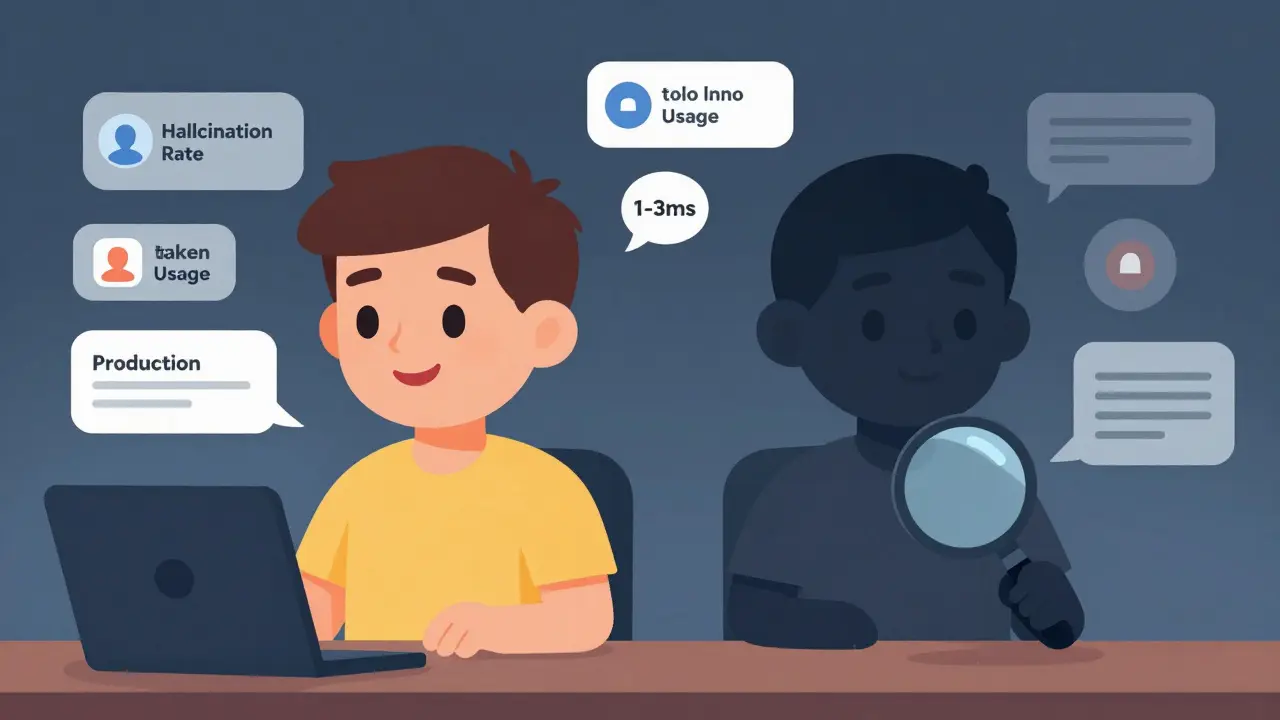
Shadow testing isn’t magic. It’s simple: every request your production model gets is copied-mirrored-and sent to a second model running in the background. The production model still answers users. The shadow model just watches, records, and waits. No one interacts with it. No one even knows it’s there. This setup requires three things: identical input formats, low-latency copying, and robust logging. Modern cloud platforms like AWS SageMaker Clarify and Google Vertex AI now handle the mirroring automatically. The shadow model doesn’t slow down your users. Splunk’s case studies show the added latency is just 1-3 milliseconds. That’s less than the blink of an eye. You’re not testing if the model is “better.” You’re testing if it’s safer. Metrics like hallucination rate, token usage, safety violations, and instruction adherence are tracked in real time. If the new model starts generating false medical advice, misreading financial terms, or using 40% more tokens than before, you catch it before it reaches a single customer.Why Shadow Testing Beats A/B Testing for LLMs
A/B testing routes 5-20% of users to a new model and watches for thumbs-up or thumbs-down signals. Sounds fair, right? But here’s the problem: LLMs don’t behave like buttons or sliders. A single bad response can erode trust instantly. Imagine a customer asks for investment advice, and the new model recommends a scam. They never come back. You don’t get a thumbs-down-you lose a client. Shadow testing eliminates that risk. It’s like running a safety drill before a real flight. Gartner’s November 2025 survey found shadow testing scored 4.7 out of 5 for safety, while A/B testing only got 4.1. Why? Because shadow testing catches issues A/B testing misses: subtle shifts in tone, hidden bias in long-form responses, or a sudden spike in toxic language that users might not flag but still find unsettling. The trade-off? You don’t get direct user feedback. Wandb’s research found 63% of regressions detected in A/B tests were invisible in shadow tests because real users reacted emotionally-clicking away, complaining, or changing behavior. That’s why shadow testing isn’t the end of the pipeline. It’s the first gate.What You Measure (And Why It Matters)
You can’t just say “the new model is worse.” You need numbers. Here’s what top teams track:- Response latency: Is the new model slower? Even 100ms delays hurt conversion rates in customer service bots.
- Token consumption: More tokens = higher cost. One AWS customer saved 37% on inference costs by switching to a leaner model after shadow testing.
- Hallucination rate: Measured against TruthfulQA and other benchmarks. A 5% increase from baseline? That’s a red flag.
- Safety violations: Tools like Perspective API flag content above a 0.7 threshold. If the new model trips it 3x more often, you pause the rollout.
- Instruction adherence: LLM-as-judge evaluations score how well the model follows prompts. A drop below 4.0/5.0? Investigate.
Costs, Challenges, and Hidden Pitfalls
Shadow testing isn’t free. You’re doubling your compute load during tests. AWS customers report 15-25% higher cloud bills during shadow periods. That’s why most teams run it for 7-14 days-long enough to cover peak traffic, weekends, and seasonal spikes. The bigger challenge? Alert fatigue. Teams get flooded with metric changes. One Splunk study found engineers were getting 50+ alerts per day from shadow tests, most of them noise. The fix? Set automated regression triggers. If any key metric drops below 95% of baseline performance, auto-flag it. Don’t just monitor-act. Another pitfall: setup time. One healthcare startup took three weeks just to align metrics between their old and new models. That’s why best practices now include embedding shadow testing into CI/CD pipelines. FutureAGI found teams doing this reduced production incidents by 68%.Who’s Using It-and Why
Adoption is no longer optional. Gartner reports 78% of Fortune 500 companies use shadow testing. The numbers break down by industry:- Financial services: 89% adoption. Regulators demand it. A single wrong stock recommendation can trigger compliance fines.
- Healthcare: 76%. A hallucinated diagnosis? That’s not a bug-it’s a lawsuit.
- Retail: 63%. Lower risk tolerance, but still critical for chatbots handling returns, pricing, and inventory.
The Future: Automated, Integrated, Mandatory
Shadow testing is evolving fast. In December 2025, AWS added automated hallucination detection to SageMaker Clarify, now hitting 92% accuracy against TruthfulQA. In January 2026, FutureAGI launched dashboards that tie shadow metrics directly to business KPIs-like customer retention or support ticket volume. CodeAnt AI’s February 2026 update automatically calculates statistical significance. No more guessing if a 2% drop in instruction adherence is meaningful. The system tells you. Gartner predicts that by 2027, 75% of enterprises will make shadow testing a mandatory step in every model update. McKinsey estimates that undetected LLM failures cost companies $1.2 million per incident on average. Shadow testing? It costs pennies in comparison.Is It Right for You?
Ask yourself:- Do you deploy LLMs in customer-facing roles?
- Do you rely on automated responses for support, sales, or content?
- Would a single bad output damage your brand or violate compliance?
What Comes Next?
Shadow testing is just the beginning. The next frontier is continuous evaluation: automated, always-on monitoring that combines shadow testing with user feedback loops, drift detection, and adversarial probing. But if you skip shadow testing now, you’ll be left behind when the rest of the industry moves to full automation. Start small. Pick one high-risk use case. Run a two-week shadow test. Compare the numbers. If you’re not seeing clear wins-or red flags-you’re not doing it right. And if you’re not measuring anything at all? You’re flying blind.What is shadow testing for LLMs?
Shadow testing for LLMs means running a new model in parallel with your live model, using real user traffic, but without letting the new model respond to users. It lets you measure performance, safety, and cost changes without risking customer experience.
How is shadow testing different from A/B testing?
A/B testing sends real users to the new model and measures their reactions-likes, clicks, complaints. Shadow testing doesn’t expose users to the new model at all. It’s safer for high-risk changes but doesn’t capture emotional user feedback. Use shadow testing for initial safety checks, and A/B testing for final user validation.
Does shadow testing slow down user responses?
No, not noticeably. The shadow model runs asynchronously, so it doesn’t block the main request. Most implementations add only 1-3 milliseconds of latency, which is imperceptible to users. The key is using efficient traffic mirroring tools that don’t overload your infrastructure.
What metrics should I track during shadow testing?
Track response latency, token usage (for cost), hallucination rate (using benchmarks like TruthfulQA), safety violations (via tools like Perspective API), and instruction adherence (using LLM-as-judge scoring). A drop below 95% of baseline performance in any key metric should trigger an alert.
Is shadow testing required by law?
Yes, in high-risk sectors under the EU AI Act, enforced since June 2025. If your LLM impacts financial advice, healthcare, or public services in the EU, you’re legally required to use continuous evaluation methods like shadow testing. Other regions are following suit.
Can shadow testing catch all types of model failures?
No. Shadow testing won’t catch stealthy data poisoning attacks or subtle behavioral drifts that only appear under specific user interactions. MIT researcher Dr. Sarah Chen notes these require additional monitoring tools. Shadow testing is a safety net, not a complete solution.
How long should I run a shadow test?
At least one full business cycle-7 to 14 days. This ensures you capture weekday vs. weekend traffic, peak hours, seasonal patterns, and rare edge cases. Shorter tests miss critical variations in input.
Do I need special tools to do shadow testing?
Not necessarily, but it’s much easier with them. Platforms like AWS SageMaker Clarify, Google Vertex AI, and CodeAnt AI automate traffic mirroring and metric tracking. Building your own system requires infrastructure engineering skills and can take weeks to get right.
Is shadow testing worth the cost?
Yes. While it increases cloud costs by 15-25% during testing, McKinsey estimates undetected LLM failures cost $1.2 million per incident on average. Shadow testing prevents those losses. For most enterprises, it’s a low-cost insurance policy.
Can I use shadow testing with open-source LLMs?
Absolutely. Shadow testing works with any LLM that accepts the same input format as your production model-whether it’s GPT-4, Claude 3, Llama 3, or a fine-tuned open-source model. The key is consistency in API structure, not the model’s origin.
Teja kumar Baliga
January 17, 2026 AT 06:45Shadow testing is a game changer, especially in places like India where customer trust is everything. One bad reply can ruin a brand faster than you can say 'chai pe charcha'. Glad to see more companies finally getting this right.
k arnold
January 17, 2026 AT 15:07Oh wow, another blog post pretending shadow testing is new. We've been doing this since 2021. Also, '1-3ms latency'? Sure, buddy. Try running this on a legacy AWS region with 300 concurrent models and see how 'imperceptible' it is.
Tiffany Ho
January 19, 2026 AT 07:32This makes so much sense. I love how it keeps users safe without them even knowing. No drama, no crashes, just quiet improvements. Wish more teams would do this before pushing updates.
michael Melanson
January 20, 2026 AT 02:15Shadow testing isn't magic, but it's the closest thing we have to a safety net. The real win is catching those subtle tone shifts before they become PR nightmares. Companies that skip this are gambling with their reputation.
lucia burton
January 20, 2026 AT 05:38Let’s be real - shadow testing is the only viable path forward for enterprise-grade LLM deployment. The cost of a single hallucination in a regulated vertical like healthcare or finance isn’t just financial - it’s existential. And yes, doubling your compute load is painful, but compared to the regulatory fines, lawsuits, and brand erosion from an uncaught failure? It’s a rounding error. The real bottleneck isn’t infrastructure - it’s organizational inertia. Teams still think 'it passed our benchmarks' is enough. Newsflash: benchmarks don’t live in the real world. Real users generate messy, unpredictable, emotionally charged inputs that no static dataset can replicate. Shadow testing forces you to confront that chaos before it’s too late. And if you’re still doing A/B testing for high-risk LLMs? You’re not being agile - you’re being reckless.
Denise Young
January 21, 2026 AT 08:10Love how you said shadow testing isn’t the end of the pipeline - it’s the first gate. That’s exactly right. I’ve seen teams get so excited about a model that 'looks better' on metrics that they skip the real-world validation. Then boom - users start ghosting the chatbot because it suddenly sounds like a robot having a nervous breakdown. Shadow testing catches that before it hits production. Also, the EU AI Act making this mandatory? Long overdue. If you’re not doing this yet, you’re not just behind - you’re legally exposed.