Enterprise Data Governance for Large Language Model Deployments: A Practical Guide
 Jan, 4 2026
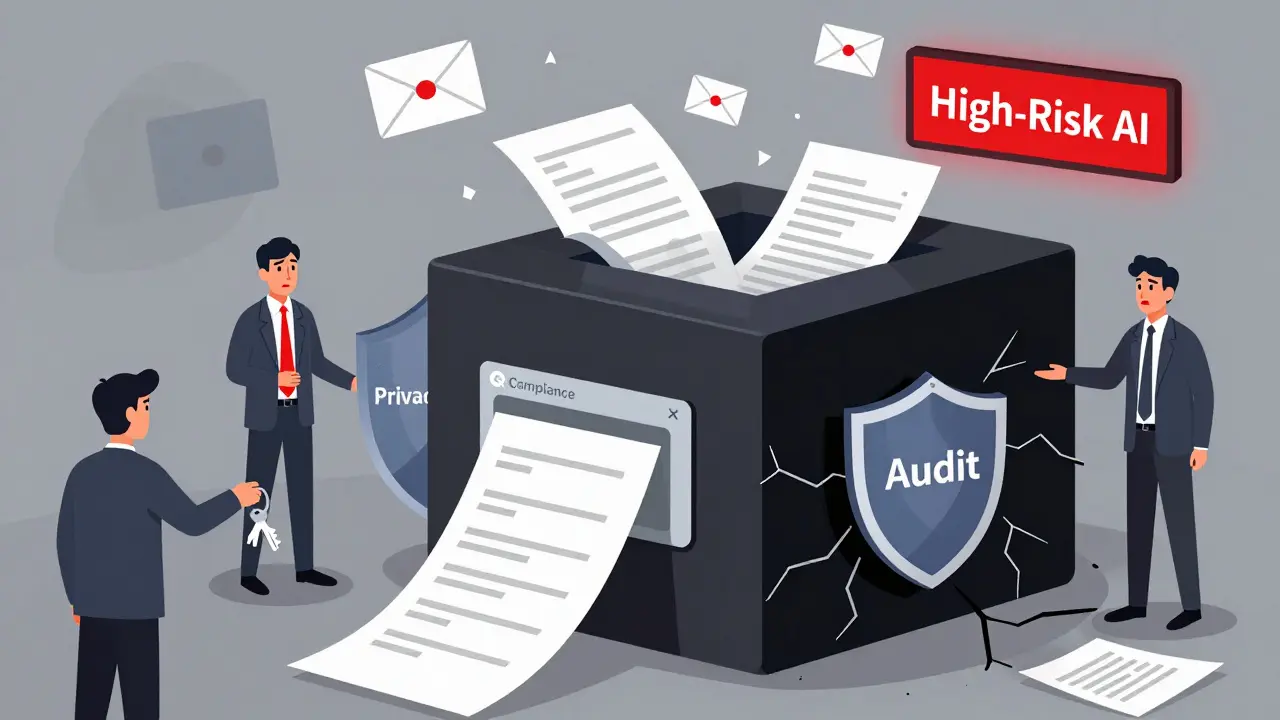
When you deploy a Large Language Model (LLM) in your company, you're not just adding a tool-you're introducing a black box that ingests, processes, and regurgitates your most sensitive data. It doesn't care if that data includes customer emails, employee records, or proprietary product designs. Without proper enterprise data governance, you're handing over the keys to your digital vault to an AI that doesn't understand boundaries, consent, or compliance.
Why Traditional Data Governance Fails with LLMs
Traditional data governance was built for structured data: databases with clear schemas, defined ownership, and predictable workflows. Think SQL tables, CRM fields, ERP logs. These systems worked fine when data moved slowly and was controlled by IT teams. LLMs changed everything. They train on unstructured data-emails, Slack messages, PDFs, call transcripts, social posts. This data is messy, scattered, and often collected without consent. And once an LLM is trained, its outputs aren't deterministic. Two identical inputs can produce wildly different responses. That’s not a bug-it’s how they work. Gone are the days when you could just tag a field as "PII" and call it done. Now you need to track where every piece of training data came from, who approved its use, how it was cleaned, and whether it contains hidden biases. And you need to do it at scale-millions of documents, billions of tokens. The result? Companies are getting fined, sued, or publicly shamed because their LLMs regurgitated confidential information, generated biased hiring recommendations, or lied about regulatory requirements. And in most cases, it wasn’t the AI’s fault. It was the lack of governance.Core Pillars of LLM Data Governance
Effective governance for LLMs isn’t about adding more rules. It’s about building systems that adapt as fast as the technology does. There are three non-negotiable pillars:- Transparency: You must know exactly what data went into your model. Not just the file names-but the content, source, access permissions, and version history. If your model was trained on internal Slack threads from 2023, you need to be able to prove you had legal rights to use them.
- Data Integrity: LLMs are only as good as their training data. Garbage in, garbage out. But worse-biased, incomplete, or outdated data creates harmful outputs. Governance means validating data quality before training and monitoring for drift after deployment.
- Continuous Monitoring: Unlike a static database, LLMs evolve in production. They’re used by different teams, fed new prompts, and exposed to new inputs. You need automated systems that flag unusual outputs, detect hallucinations, and alert you when sensitive data is being leaked through responses.
Tools That Make Governance Possible
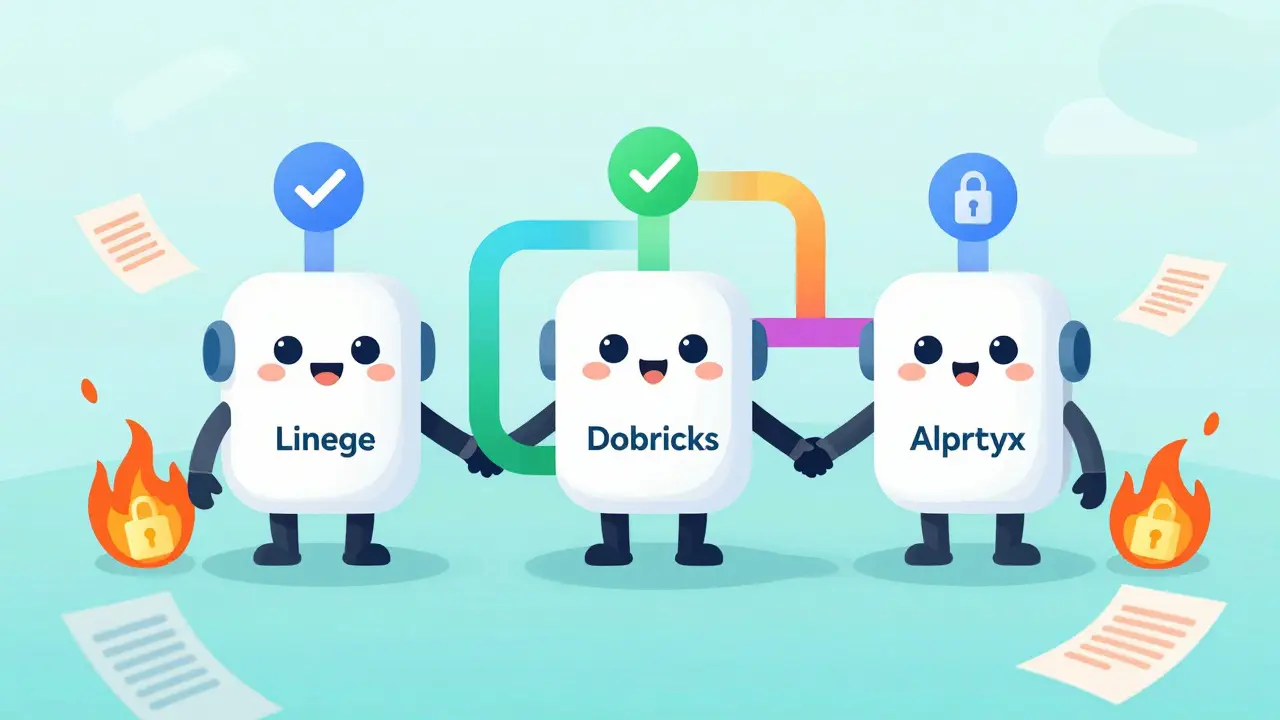
You can’t govern LLMs with spreadsheets and email chains. You need integrated platforms that connect data lineage, metadata, and policy enforcement. Here’s what works in practice:- Microsoft Purview: Tracks data lineage across cloud and on-prem systems. It can automatically classify sensitive content in unstructured files and enforce retention policies. When an LLM uses a file from SharePoint, Purview logs who created it, who accessed it, and whether it was cleared for AI training.
- Databricks + ER/Studio: Databricks handles the heavy lifting of ingesting and processing massive datasets. ER/Studio adds semantic modeling-mapping how data elements relate across systems. Together, they create a unified catalog that shows not just where data is, but what it means in context.
- Alteryx: Connects governed data pipelines directly to LLM workflows. If your sales team wants to use an LLM to summarize customer feedback, Alteryx ensures they’re pulling from a clean, approved dataset-not a random CSV someone dumped into a shared drive.
Who Owns This? The Accountability Problem
One of the biggest failures in AI deployments is assuming someone else is responsible. IT? Legal? Data Science? All of them? None of them? In successful organizations, ownership is clear. Each business unit defines what "good data" means for their use case. Sales might care about clean contact info. HR needs anonymized performance data. Legal requires audit trails. Then, a central governance team sets the standards everyone follows. This isn’t top-down control. It’s collaborative standardization. Teams propose data definitions. Governance reviews them. Everyone signs off. Then, tools enforce it. Without this, you get chaos. One team trains a model on customer support logs. Another uses the same model but with internal HR data. Outputs conflict. No one knows which version is correct. And when the model gives a bad answer, no one can say who’s accountable.How LLMs Are Actually Helping Governance Too
There’s a twist: LLMs aren’t just the problem-they’re part of the solution. Modern governance tools now use LLMs to scan documents for sensitive content. An LLM can read 10,000 PDFs in minutes and flag contracts with NDAs, emails with Social Security numbers, or internal memos with financial forecasts. It does this better than rule-based systems because it understands context-not just keywords. One financial services firm reduced manual data review time by 60% by using an LLM to auto-classify documents before they entered training pipelines. The LLM flagged 327 files containing PHI (protected health information) that had been accidentally included in marketing datasets. Without it, those files would’ve trained a customer service bot-and potentially leaked private medical info to users. This creates a feedback loop: governance tools use LLMs to find bad data → LLMs are retrained on cleaner data → outputs become more accurate and compliant → governance becomes stronger.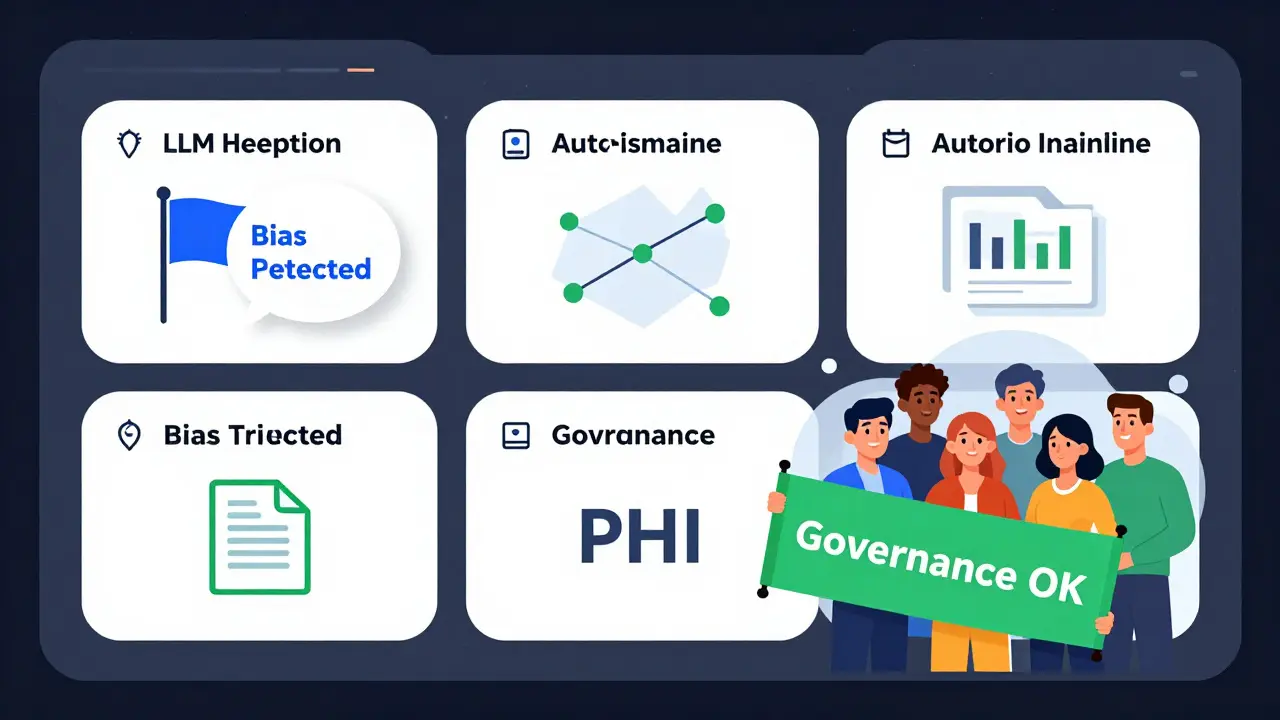
Common Pitfalls (And How to Avoid Them)
Most companies stumble in the same ways:- Assuming "anonymized" data is safe: LLMs can reconstruct personal details from seemingly anonymized text. A sentence like "The VP of Sales in Seattle, who joined in 2018, got promoted last year" can be enough to identify someone.
- Using public data without checking licenses: Many LLMs are trained on data scraped from the web. But not all public data is free to use. News articles, academic papers, and forum posts often have copyright restrictions.
- Ignoring model drift: A model that worked fine in Q1 starts giving odd answers in Q3. Why? Because user prompts changed. Or new data was added. Or the model was fine-tuned without re-auditing. Continuous monitoring isn’t optional.
- Letting engineers bypass governance: "We just need to test it quickly" is the #1 reason governance fails. Build guardrails into the development environment so bypassing them requires approval.
The Business Case: Why This Isn’t Just Compliance
This isn’t about avoiding fines. It’s about unlocking value. Organizations with strong LLM governance report:- Up to 40% fewer compliance incidents
- 30% faster insights from unstructured data
- Higher trust from customers and regulators
- More confident experimentation-teams aren’t afraid to try new use cases
Where This Is Headed in 2026
The future of LLM governance is automated, real-time, and embedded into the workflow. We’re moving toward:- LLMs that auto-generate data lineage reports
- Policy engines that adjust rules based on regional laws (e.g., GDPR vs. CCPA)
- Models that self-audit-flagging their own biases or hallucinations before output
- Integration with the dbt Semantic Layer, where metrics like "customer satisfaction" are defined once and enforced everywhere
What’s the difference between traditional data governance and LLM governance?
Traditional data governance focuses on structured data in databases-tracking fields, ownership, and access. LLM governance deals with unstructured data like emails, documents, and chat logs. It must handle massive scale, probabilistic outputs, dynamic training, and legal risks like bias and privacy violations. It’s not just about where data is-it’s about what it means, how it was used, and whether it’s safe to use.
Can I use public data to train my LLM?
Not always. Just because data is publicly available doesn’t mean you have the right to use it for training. News articles, blog posts, and forum replies often have copyright restrictions. Some platforms prohibit scraping. Always audit your training data sources. Many companies now use tools that scan for license violations before training begins.
How do I know if my LLM is leaking sensitive data?
Run regular red-team tests. Ask the model to repeat specific pieces of internal data you’ve hidden in training documents. Use automated scanners that check outputs for patterns like SSNs, email addresses, or proprietary code. Tools like Microsoft Purview can flag when an LLM response contains data that matches sensitive files in your catalog. If you’re not testing this, you’re assuming your model is safe-and that’s a dangerous bet.
Do I need a dedicated governance team?
You don’t need a big team, but you do need clear ownership. Assign a governance lead who works with data scientists, legal, compliance, and business units. Their job isn’t to say no-they’re there to make it easy to say yes the right way. Build tools that automate compliance so teams aren’t slowed down. Governance should enable innovation, not block it.
What happens if I ignore LLM governance?
You risk regulatory fines under laws like the EU AI Act, lawsuits from customers whose data was leaked, reputational damage from public AI failures, and internal chaos when different teams use conflicting models. One company saw its customer service bot suggest illegal financial advice because it was trained on unvetted forum posts. They paid over $2 million in settlements. Governance isn’t a cost center-it’s your insurance policy.
Jess Ciro
January 6, 2026 AT 02:38This is just corporate fear-mongering dressed up as best practices. LLMs don't steal data-they reflect what we feed them. If your Slack threads contain secrets, that's your fault, not the AI's. Stop blaming the tool and fix your internal chaos. Also, who the hell still uses SharePoint as a data source? 😴
saravana kumar
January 8, 2026 AT 01:33Let me be clear: this entire piece is a sales pitch for Microsoft Purview and Databricks. The so-called 'core pillars' are just buzzwords wrapped in legal jargon. LLM governance is not a technical problem-it’s a political one. Who gets to decide what 'sensitive' means? Legal? Marketing? The guy who typed 'don't tell anyone' in a Slack thread in 2021? This isn't governance. It's control dressed as compliance.
Tamil selvan
January 9, 2026 AT 06:20I appreciate the depth of this article, and I believe it addresses a critical gap in modern AI adoption. Many organizations rush into deploying LLMs without understanding the ethical and legal implications of their data sources. The emphasis on transparency, integrity, and continuous monitoring is not just prudent-it is essential. I would encourage every team to implement these principles incrementally, starting with a small pilot and scaling with governance guardrails. Thank you for highlighting tools like Alteryx and Purview-they are invaluable in real-world deployments.
Mark Brantner
January 10, 2026 AT 13:46so like… we’re gonna spend 2 years building a compliance spreadsheet to stop an AI from accidentally saying ‘my CEO’s dog’s name is bork’? and we call this ‘innovation’? 😂
Kate Tran
January 11, 2026 AT 17:57I’ve seen teams bypass all this because ‘it’s just a prototype.’ Then the model spits out a customer’s medical history in a support reply. It’s not paranoia-it’s basic hygiene. I wish more people treated data like it’s someone else’s child.
amber hopman
January 12, 2026 AT 18:21Love how this flips the script-LLMs aren’t just the problem, they’re the fix. The part about using LLMs to auto-classify PHI was eye-opening. We’ve been manually tagging documents for months. If we can automate 60% of that, we can redirect those hours into actual innovation. This isn’t about restriction-it’s about liberation. Let’s build the tools that make compliance effortless.
Jim Sonntag
January 13, 2026 AT 20:05Y’all are acting like this is the first time tech got out of hand. Remember when everyone thought email was going to end privacy? Or when social media was going to destroy democracy? We adapt. LLMs are just the new thing we’re scared of. The real issue isn’t the AI-it’s that we’ve outsourced our responsibility to algorithms and now we’re mad when they mirror our mess. Fix the culture, not the code.
Deepak Sungra
January 15, 2026 AT 10:48Bro. This whole thing is a scam. You think companies care about governance? Nah. They care about avoiding headlines. That’s why they buy Purview and slap a ‘compliant’ sticker on it. Meanwhile, the engineers are still training models on scraped Reddit threads from 2017 because ‘it worked last time.’ You can’t govern chaos with software. You need to fire the people who think ‘anonymized’ means ‘safe.’
Krzysztof Lasocki
January 16, 2026 AT 13:26Actually, this is the most balanced take I’ve seen. The part about ‘governance enabling innovation’ is spot on. I’ve seen teams freeze up because they’re scared of legal. But when you give them clear, automated guardrails? They build wild, amazing stuff. The real win isn’t avoiding fines-it’s getting people to trust the AI. And trust? That’s the ultimate competitive edge.
Henry Kelley
January 18, 2026 AT 09:12the biggest pitfall? thinking governance is a one-time setup. it’s not. it’s a living thing. like a garden. you plant the rules, you water them with monitoring, you pull the weeds (bypasses) every week. if you ignore it for a month? everything’s overgrown and you’re buried in lawsuits. just keep tending it.