How 41% of Global Code Became AI-Generated in 2024
 Jul, 16 2025
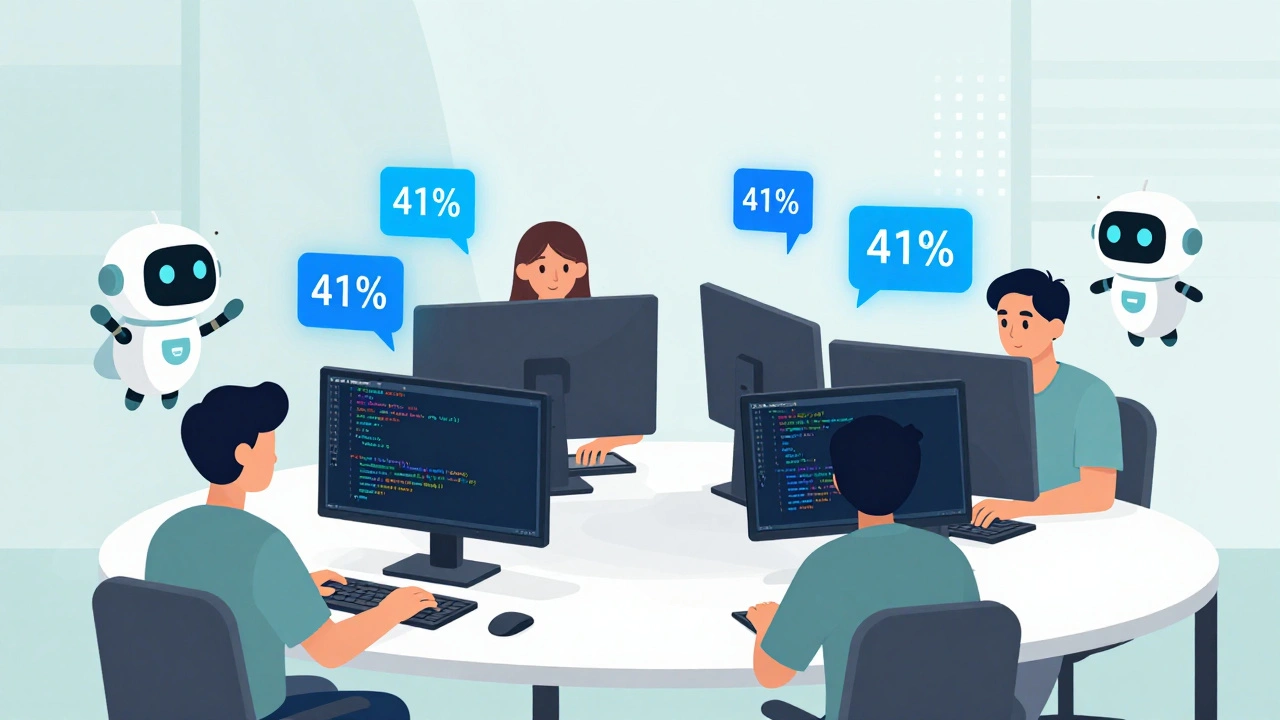
By 2024, AI-generated code made up 41% of all code written worldwide. That’s not a small trend-it’s a seismic shift in how software gets built. For decades, developers wrote every line themselves. Now, in many teams, nearly half the code comes from an AI tool. And it’s not magic. It’s a mix of better tools, pressure to move faster, and a lot of unspoken risk.
How We Got Here
The turning point wasn’t one big announcement. It was years of quiet adoption. GitHub Copilot launched in 2022, and suddenly, developers could type a comment like "create a login function" and get working code in seconds. No searching Stack Overflow. No copying from old projects. Just press Tab and move on. By 2024, the tools had matured. GitHub Copilot, Amazon CodeWhisperer, Google’s Gemini Code Assist-they all plugged right into VS Code, JetBrains, and GitHub’s web interface. Developers didn’t need to switch apps. They didn’t need training. They just started using them. And they kept using them. The numbers back it up. In 2024 alone, AI wrote 256 billion lines of code. That’s more than all the code ever written in the 1990s. Companies like Google reported 21% of their internal code was AI-generated. Microsoft found teams using AI coding tools shipped features 15% faster. And the ROI? Some companies saw 8x returns on their investment.What Tools Are Dominating
Not all AI coding tools are the same. The market split into clear leaders:- GitHub Copilot leads with 46.2% of developers using it as their main tool. It’s good at finishing code you’ve started-especially in JavaScript, Java, and Python.
- Amazon CodeWhisperer comes in second at 28.7%. It’s slower to suggest code, but it’s better at spotting security flaws before they happen.
- Tabnine holds 19.3% of the market. It’s lightweight, works offline, and is popular in enterprise environments with strict data policies.
Where AI Excels (and Where It Fails)
AI is amazing at routine work. Boilerplate code? Done. Unit tests? Easy. Documentation? Better than most humans. In Java projects, AI writes 61% of the code. In Python, it’s 38%. In C++, only 29%. Why? Java’s structure is predictable. Python is flexible but popular. C++ is complex and used in systems where mistakes cost millions. But AI breaks down when things get complicated. NASA tested AI-generated code for spacecraft control systems. Out of 22 edge-case tests, the AI failed 17. It didn’t understand how temperature changes in space affected memory allocation. It didn’t know the real-world consequences of a race condition. Developers report the same thing. On Reddit, one user wrote: "Copilot saved me 10 hours this week. Then it introduced a race condition that took me three days to fix." That’s the trade-off. Speed now, pain later.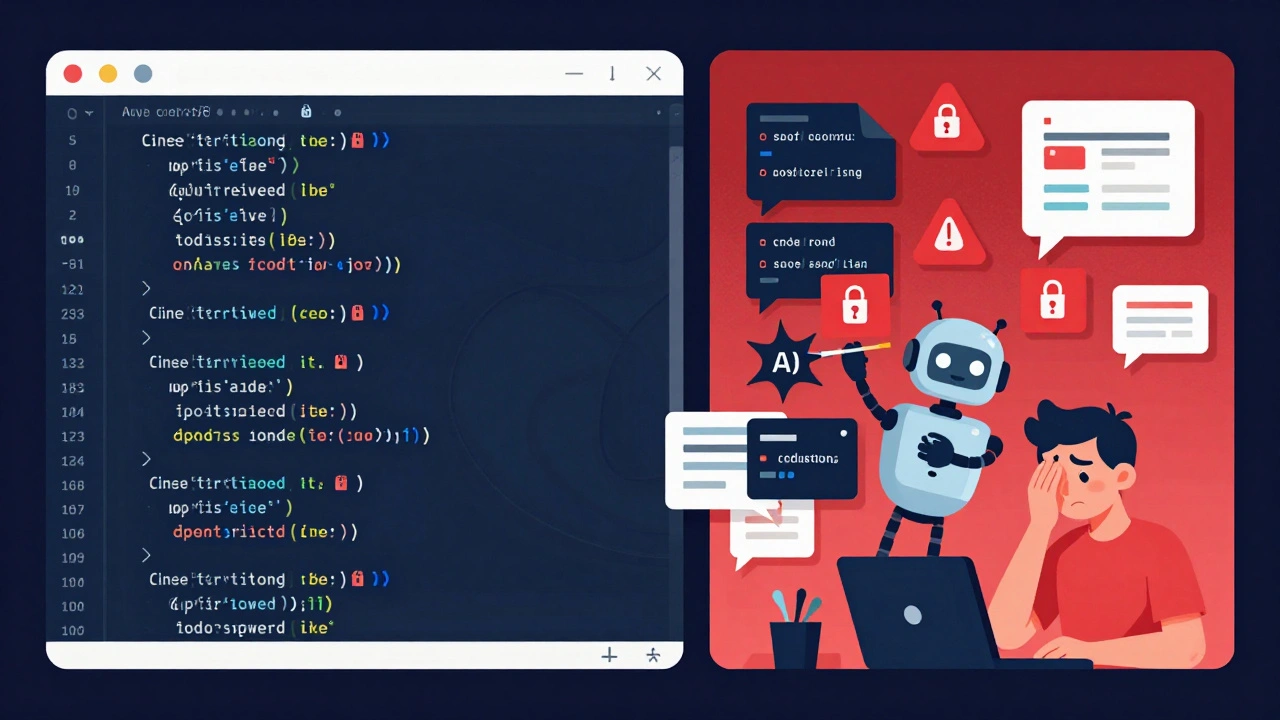
The Security Problem Nobody Wants to Talk About
Here’s the scary part: 48% of AI-generated code contains potential vulnerabilities. That’s not a typo. Nearly half the code AI writes has security holes. GitHub’s own internal audit found 40% of Copilot’s suggestions had insecure patterns. AWS found CodeWhisperer flagged fewer vulnerabilities-but still missed critical ones. Checkmarx reported that 81% of companies knowingly shipped AI-generated code with known flaws. And 98% of them had been breached because of it. The worst offenders? APIs. 57% of AI-generated APIs are publicly accessible. 89% use weak or hardcoded authentication. And 32% of developers admit they never review AI code before pushing it to production. This isn’t theoretical. In 2024, a fintech startup in Berlin lost $2.3 million when an AI-generated payment handler exposed a user’s API key. The code looked fine. The tests passed. But the AI copied a pattern from a public GitHub repo that had been hacked six months earlier. No one checked.Why Companies Are Still Using It
If the risks are this high, why is adoption still growing? Because the pressure to deliver is unbearable. Startups need to ship in weeks. Enterprises need to compete with them. Investors demand faster cycles. AI gives teams a way to keep up. Google’s engineers use AI and still review every line. Microsoft requires human approval for any AI suggestion over 15 lines. These aren’t just policies-they’re survival tactics. The real winners aren’t the ones using AI the most. They’re the ones using it the smartest. They treat AI like a junior developer: useful, but never trusted without oversight.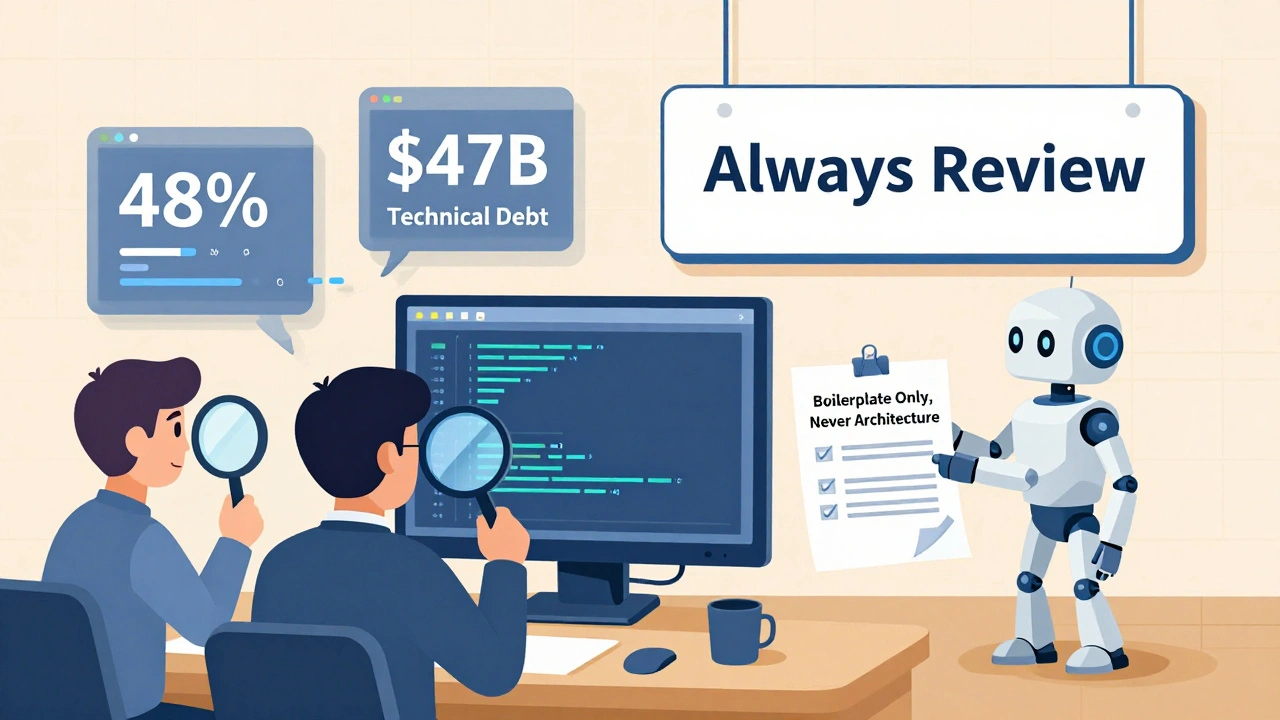
The Hidden Cost: Technical Debt
AI doesn’t just write code. It clones it. GitClear found AI-generated code is four times more likely to copy existing patterns than human-written code. That sounds efficient. But it’s dangerous. When 10 different developers all use AI to write the same login function, you end up with 10 nearly identical versions. If one has a bug, they all do. If one needs an update, you have to fix them all. Dr. Amy J. Ko from the University of Washington predicts this will cost the industry $47 billion in refactoring by 2027. That’s not a guess. It’s based on how long it takes teams to untangle duplicated, poorly documented, AI-generated codebases. And it’s getting worse. GitHub’s new Copilot Editor, released in March 2025, doesn’t just suggest code-it writes entire functions without asking. Early adopters report 54% of their code is now AI-generated. That’s not a tool anymore. That’s a co-author. And no one’s auditing its drafts.What’s Next?
The market is exploding. The AI code generation industry hit $4.91 billion in 2024. By 2027, Gartner predicts 61% of global code will be AI-generated. But the warning signs are loud. Forrester says 30% of companies will scale back AI coding by 2026 because of security incidents and technical debt. The EU’s AI Act now requires documentation for AI-generated code in critical systems. NIST released its first AI Code Security Guidelines in December 2024. The tools are getting smarter. Checkmarx’s new AI Security Code Assistant cuts vulnerabilities in AI code by 37%. Snyk’s 2025 platform catches 92% of AI-introduced flaws. But these are band-aids. The real fix? Change how we build.The Only Way Forward
AI-generated code isn’t going away. It’s here to stay. But treating it like a magic button is how companies get burned. The path forward is simple:- Always review AI code. No exceptions.
- Use AI for boilerplate, not architecture.
- Train your team to spot AI patterns-cloned code, weak auth, hardcoded keys.
- Build automated checks that flag AI-generated code before it reaches production.
- Start documenting which parts of your codebase were AI-written. You’ll need that audit trail.
AI can write code faster. But only humans can ask: Should we even write this?
What percentage of code is AI-generated in 2024?
In 2024, AI-generated code made up 41% of all code written globally, according to Fullview’s 2025 AI Statistics report. This was driven by widespread adoption of tools like GitHub Copilot, Amazon CodeWhisperer, and Google’s Gemini Code Assist, which collectively wrote 256 billion lines of code that year.
Which AI coding tool is most popular?
GitHub Copilot is the most widely used AI coding assistant, with 46.2% of developers relying on it as their primary tool, according to the Stack Overflow 2024 Developer Survey. It’s followed by Amazon CodeWhisperer at 28.7% and Tabnine at 19.3%. Copilot excels in code completion and context awareness, especially in Java and JavaScript projects.
Is AI-generated code secure?
No, not reliably. 48% of AI-generated code contains potential security vulnerabilities, according to Second Talent’s 2025 report. GitHub’s internal audit found 40% of Copilot’s suggestions had insecure patterns. Common flaws include publicly exposed APIs, hardcoded credentials, and weak authentication. 81% of organizations admit to shipping vulnerable AI code, and 98% have suffered breaches tied to it.
Does AI write better code than humans?
AI writes faster, not better. It’s excellent at repetitive tasks like generating boilerplate, unit tests, and documentation. But it fails at complex logic, edge cases, and architectural decisions. NASA found AI-generated spacecraft code failed 17 out of 22 boundary tests. Developers report AI often introduces subtle bugs that take days to debug-bugs humans wouldn’t make.
Why is AI code cloning a problem?
AI-generated code is four times more likely to copy existing patterns than human-written code, according to GitClear’s 2024 analysis. This creates dozens of nearly identical functions across a codebase. If one has a bug or security flaw, they all do. Fixing it means updating every copy, which is time-consuming and error-prone. Experts estimate this will cost the industry $47 billion in refactoring by 2027.
What should companies do about AI-generated code?
Treat AI like a junior developer: useful, but never trusted without review. Implement mandatory code reviews for all AI suggestions, especially those over 15 lines. Use automated security scanners like Checkmarx or Snyk to catch vulnerabilities. Document which code was AI-generated. Train teams to recognize AI patterns-cloned code, weak auth, hardcoded secrets. And never skip testing edge cases.
Steven Hanton
December 13, 2025 AT 02:31It's fascinating how quickly adoption happened without much public debate. I remember when we used to spend days designing a simple API endpoint-now it’s a Tabnine suggestion in 12 seconds. But the real issue isn’t the tool-it’s the culture that lets it slide. If we stop teaching junior devs to write code from scratch, we’re just creating a generation of reviewers, not builders.
And honestly? The security stats are terrifying. I’ve seen teams deploy Copilot suggestions without even glancing at them. It’s like giving a toddler a chainsaw and calling it ‘efficiency.’
Pamela Tanner
December 15, 2025 AT 01:42I appreciate the depth of this analysis. However, I must correct one detail: the claim that ‘AI wrote 256 billion lines of code’ is misleading. Lines of code are not a meaningful metric-especially when AI generates repetitive, trivial, or redundant snippets. A single function might produce 50 lines of boilerplate that a human would write in 5. The real value isn’t volume-it’s velocity and consistency.
Also, I’d argue that ‘AI-generated’ is an inaccurate label. Most developers don’t just accept AI output. They edit, refactor, and restructure it. The code is co-created. The tool is a collaborator, not a composer.
ravi kumar
December 15, 2025 AT 12:09From India, we’re seeing this shift hard. Startups here don’t even hire junior devs anymore-they hire one senior + Copilot. It’s cheaper. It’s faster. But I’ve seen codebases where 80% of the logic is AI-generated, and no one can explain how it works. We’re building castles on sand.
Still… I use it daily. Just never push it without reviewing. And I always ask: ‘Would I have written this?’ If the answer is no, I rewrite it.
Megan Blakeman
December 16, 2025 AT 20:27OMG YES!! I literally cried last week when Copilot auto-generated my entire auth flow 😭 I was so tired of copying from Stack Overflow... but then my boss found a hardcoded API key in prod and we had to do a full audit... 😅
It’s like having a super smart intern who always forgets to lock the door. Super helpful... but also terrifying. Can we just make AI code come with a ‘DANGER: MAY CONTAIN SECRETS’ warning label?? 🙏
Akhil Bellam
December 17, 2025 AT 14:18Let’s be brutally honest: most devs using AI tools are just lazy. They don’t understand algorithms, they don’t know memory management, and they certainly don’t care about edge cases-because AI does it for them. And now we’re drowning in a sea of identical, poorly documented, insecure spaghetti code that no one can maintain.
Meanwhile, the real engineers-the ones who actually know how a compiler works-are being pushed out because ‘they’re too slow.’ This isn’t progress. It’s a slow-motion collapse of software engineering as a discipline.
And yes, I’ve seen the $47 billion refactoring bill coming. It’s not a prediction-it’s a funeral notice.
Amber Swartz
December 18, 2025 AT 21:14Okay but have you seen the drama?? I was at a tech meetup last week and someone said ‘AI wrote 41% of our code’ and the whole room gasped like it was a horror movie. One guy started crying. Another threw their laptop across the room. I swear I saw someone whisper ‘we’re all gonna be replaced.’
Meanwhile, I just use it to write unit tests and then go drink a margarita. Who cares if it’s AI? As long as it works, right?? 😎
Also, why is everyone so mad? Did you guys forget how much we hated writing XML config files?? This is freedom!!
Robert Byrne
December 19, 2025 AT 06:49Stop sugarcoating this. 48% of AI-generated code has vulnerabilities? That’s not a ‘risk’-that’s a national security threat. You’re letting machines write code that controls financial systems, medical devices, and power grids-and you think a ‘code review’ is enough?
It’s not. We need mandatory AI code audits, standardized labeling of AI-generated segments, and legal liability for companies that deploy unreviewed AI output. And if you’re still using Copilot without a security scanner? You’re not a developer-you’re a liability.
I’ve reviewed codebases like this. I’ve seen the breaches. I’ve cleaned up the mess. And I’m tired of pretending this is ‘innovation.’ It’s negligence dressed up as efficiency.
Tia Muzdalifah
December 20, 2025 AT 07:50lol i just use ai to write my docs and tests and then i write the actual logic myself. like, why would i waste time typing out 20 lines of a crud controller when it can do it in 3 seconds? but i still have to understand what it’s doing or else i’m just a button pusher 😅
also, my team calls our ai helper ‘the ghost coder’ bc it’s always there but no one knows who it really is. kinda spooky.
Zoe Hill
December 21, 2025 AT 18:17I love this so much!! I used to be scared of AI coding tools, but now I think of them like a really good coffee machine-gives you the base, but you still gotta add the milk, sugar, and your own flair 😊
Also, I think we need to start calling AI-generated code ‘co-pilot code’ instead of ‘AI code’-it’s less scary and reminds us it’s a helper, not a boss.
And yes, I miss the days when I wrote every line… but I also miss having 3 hours of sleep. So… trade-offs, right?? 💪