How Tokenizer Design Choices Shape Large Language Model Performance
 Jan, 23 2026
When you type a question into a chatbot, it doesn’t see words like you do. It sees numbers. And before it can turn your words into numbers, it needs a tokenizer-a system that breaks text into chunks called tokens. This step isn’t just a formality. It’s the foundation of everything the model learns. A bad tokenizer can make even the most powerful LLM stumble. A good one? It can unlock 15% more accuracy, cut memory use by half, and let the model understand code, numbers, and rare words it’s never seen before.
What Tokenizers Actually Do
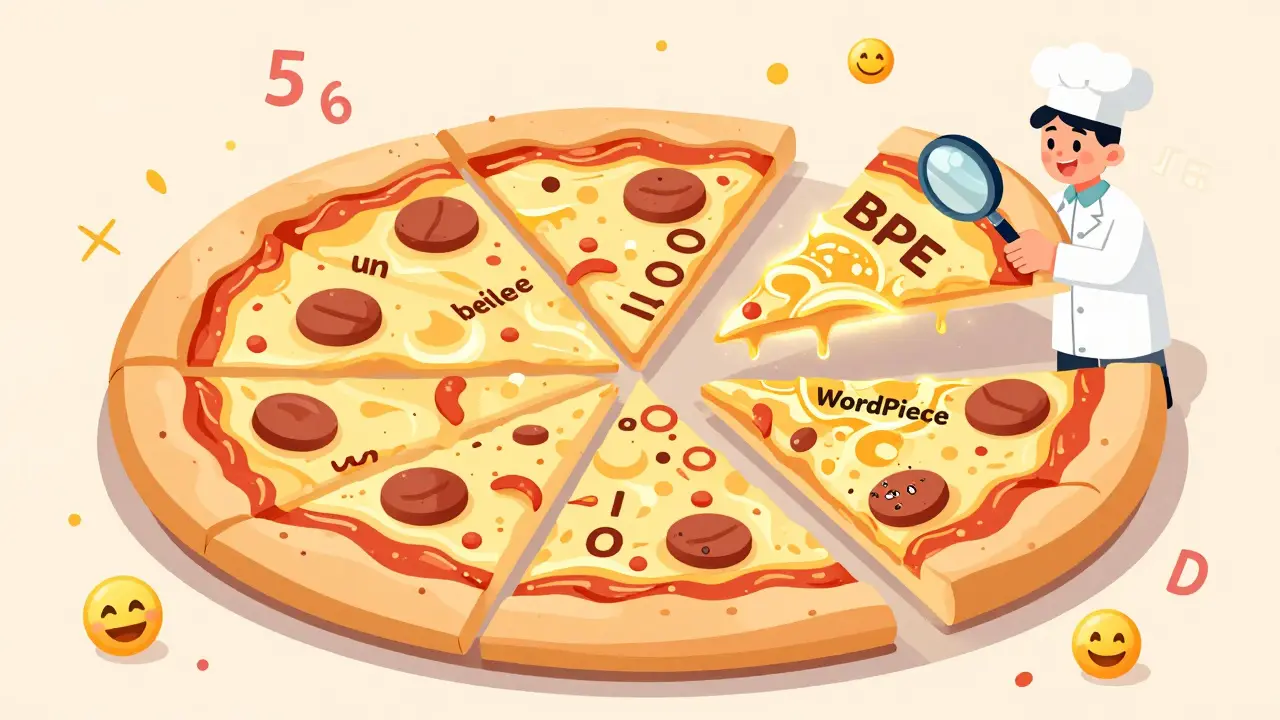
Tokenizers take raw text-sentences, code, equations-and chop them into pieces small enough for a model to process. Think of it like slicing a pizza. You could cut it into 8 big slices, or 32 tiny ones. Each choice changes how much you can eat at once, how well you taste each topping, and how long it takes to finish.
Early models used simple word-level tokenization: "cat" = one token, "dog" = another. But that didn’t work for rare words like "unbelievable" or programming terms like "malloc()". So researchers invented subword tokenization: breaking words into parts. "unbelievable" becomes "un" + "believe" + "able". Now the model can handle new words by reusing parts it already knows.
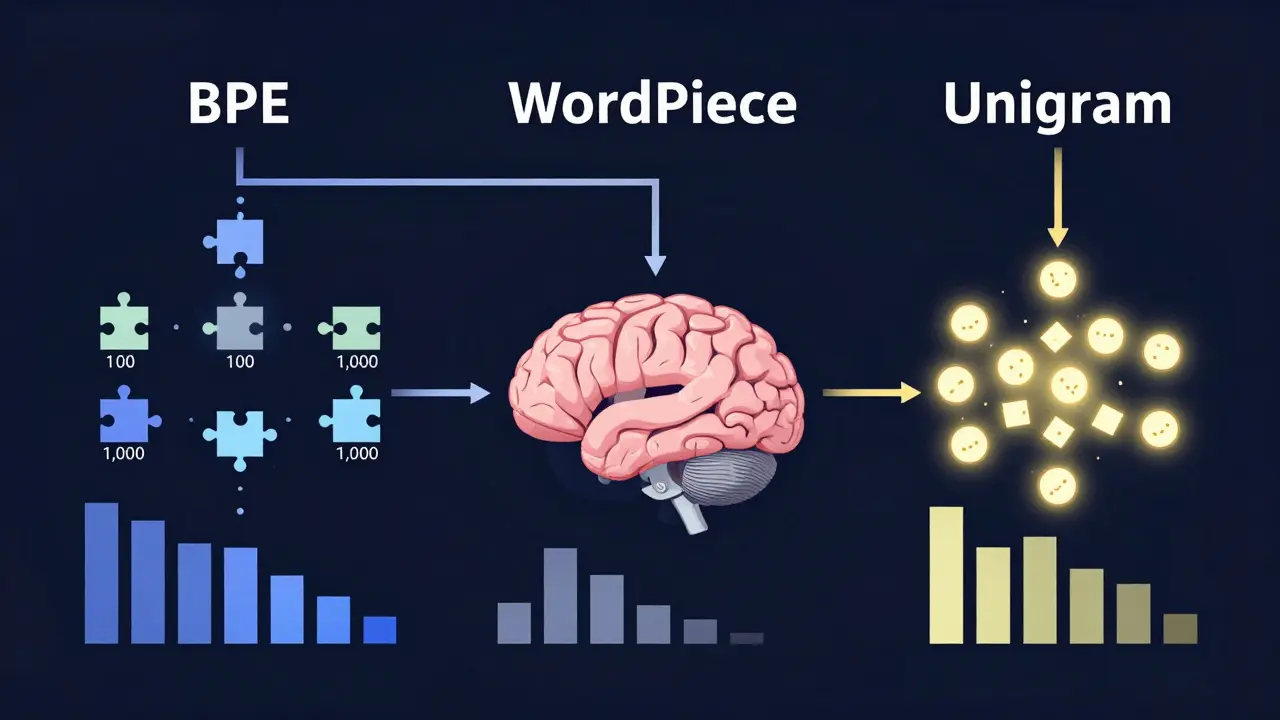
There are three main ways to do this: Byte-Pair Encoding (BPE), WordPiece, and Unigram Language Model. Each has trade-offs. Pick the wrong one, and your model might waste half its capacity on useless splits-or miss key patterns entirely.
BPE: The Balanced Workhorse
BPE is the most common tokenizer in production. It’s used by GPT-4, Mistral, and most open-source models. How it works: start with individual characters. Then, repeatedly merge the most frequent pairs. If "th" appears 10,000 times and "he" appears 8,000, merge them first. Keep going until you hit your target vocabulary size-usually 30K to 50K tokens.
Why it’s popular: it’s simple, fast, and gives decent results across many tasks. It handles English well, and with enough training data, it can adapt to code, medical terms, or even emojis.
But it has blind spots. BPE doesn’t care about meaning. It only cares about frequency. So "1000" and "100" might get split into "1" + "0" + "0" + "0" and "1" + "0" + "0"-even though they’re clearly related numbers. That forces the model to learn the relationship from scratch, wasting compute.
OpenAI’s GPT-4 uses a 50,000-token BPE vocabulary. Llama 3.2 uses a custom BPE with 128,000 tokens-larger to capture more rare code symbols and multilingual characters. But that comes at a cost: memory usage jumps 75-90% compared to a 3K vocabulary.
WordPiece: Precision Over Efficiency
WordPiece, developed by Google for BERT, works differently. Instead of merging the most frequent pairs, it picks merges that maximize the likelihood of the full sentence. It’s like choosing puzzle pieces not by how often they appear, but by how well they fit together.
This makes WordPiece better at preserving fine-grained structure. In legal or scientific text, where word endings matter (like "diagnosis" vs. "diagnoses"), WordPiece keeps those nuances intact. Studies show it has 8-12% higher fertility-meaning it retains more detailed information per token.
But that precision comes with a price. WordPiece generates longer sequences on average. More tokens = more computation. In a 2024 arXiv study, WordPiece increased computational cost by 10-15% compared to BPE on the same task.
It’s the go-to for models that need deep linguistic understanding: BERT, RoBERTa, and ALBERT. If your task is question answering, sentiment analysis, or semantic similarity, WordPiece often wins. But if you’re training a code-generation model on a budget? You might pay too much for the extra detail.
Unigram: The Compression Champion
Unigram flips the script. Instead of building up from characters, it starts with a huge vocabulary-maybe 100,000 possible tokens-and then removes the least useful ones. It’s like throwing out the least popular pizza toppings until you’re left with the top 30K.
This probabilistic approach gives Unigram a surprising edge: it compresses text better. In the same 2024 arXiv study, Unigram needed 12-18% fewer tokens than BPE or WordPiece to represent the same code. That means you can fit longer sequences into memory, process more data per batch, and train faster.
For assembly code, low-resource languages, or long-document summarization, Unigram outperforms the others. One Reddit user reported a 22% increase in batch size when switching from BPE to Unigram for assembly analysis.
But Unigram isn’t perfect. It’s slower to train. And because it’s probabilistic, it can sometimes split words in ways that feel unnatural to humans. If you’re building a chatbot that needs to sound fluent, Unigram might feel "off"-even if it’s technically more efficient.
Vocabulary Size: Bigger Isn’t Always Better
Most people think: bigger vocabulary = better model. But it’s not that simple.
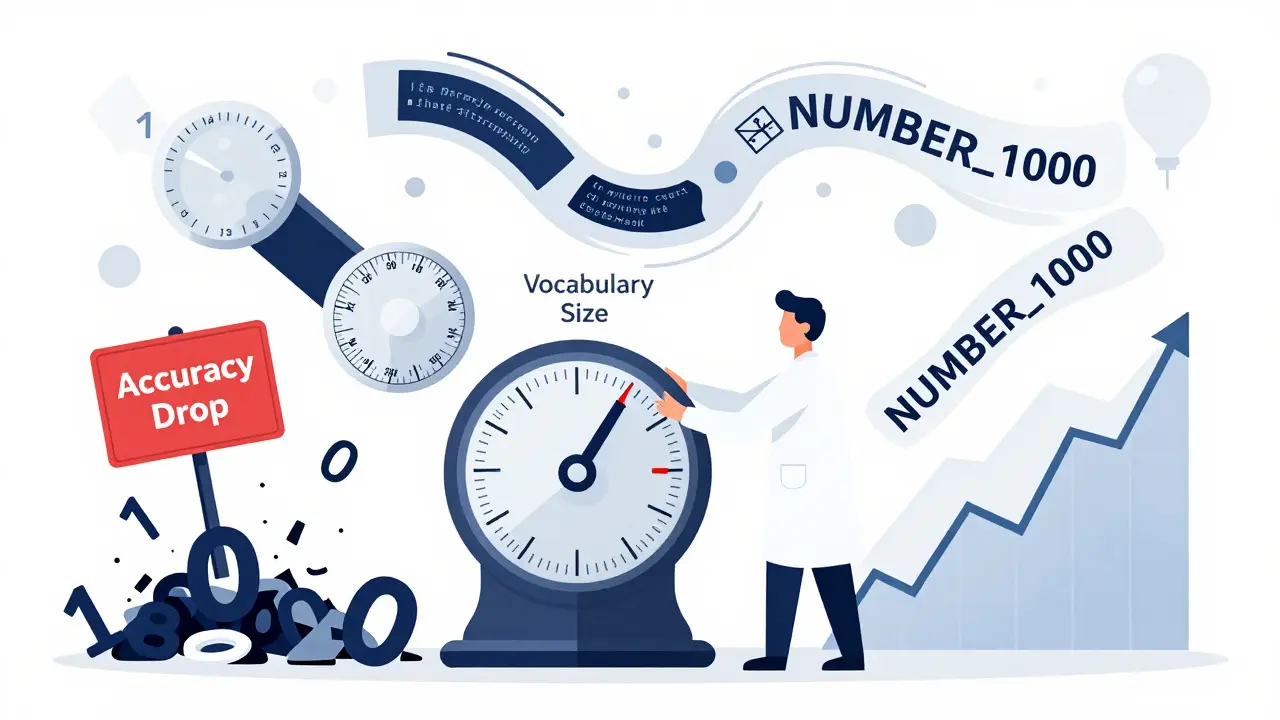
A 3,000-token vocabulary saves memory-up to 60% less than a 128K one. But it forces the model to split everything into tiny pieces. A number like "1,234" becomes "1" + "," + "2" + "3" + "4". That’s five tokens for one number. The model has to learn that sequence every time. Accuracy drops 7-12% in tasks like function signature prediction.
A 128,000-token vocabulary-like Llama 3.2’s-can represent "1234" as one token. It reduces sequence length by 30-45%. That means faster inference, lower memory pressure, and better handling of rare terms.
But here’s the catch: most of those extra tokens are unused. In a 128K vocabulary, over 70% of tokens appear fewer than 10 times. You’re paying for memory and compute for tokens that rarely help.
The sweet spot? 25K to 35K for most general tasks. For code-heavy models? 64K to 128K. For low-resource languages? 10K to 25K. And always test. What works for English text might crush your financial data model.
Numerical Tokens: The Hidden Problem
One of the biggest, most overlooked issues? Numbers.
Most tokenizers treat numbers like text. "100" and "1,000" are different sequences. So the model sees them as unrelated. That’s a disaster for finance, science, or engineering models.
A GitHub issue from February 2025 showed a financial analysis model misreading currency values 12.7% of the time because "100" and "100.00" were tokenized differently. Users reported up to 18% accuracy gains after adding custom rules: "100" → "NUMBER_100", "1,000" → "NUMBER_1000".
Google DeepMind is now testing a new approach: encode numbers as mathematical expressions. Instead of "100", the tokenizer outputs something like "10^2". Preliminary tests show 28% improvement in numerical reasoning.
If your model deals with data, money, measurements, or code-don’t trust the default tokenizer. Build a custom pre-tokenizer. Split numbers, dates, units, and symbols before the main tokenizer sees them.
How to Choose the Right Tokenizer
Here’s a simple decision tree:
- General-purpose chatbot, English text, no special data? Use BPE with 30K-50K tokens. It’s proven, well-documented, and works fine.
- Code generation, assembly, or binary analysis? Try Unigram with 64K+ tokens. You’ll cut sequence length and boost batch size.
- Question answering, medical records, legal docs? Go with WordPiece. The extra granularity pays off.
- Financial data, scientific papers, engineering specs? Build a custom pre-tokenizer. Handle numbers, units, and symbols first. Then feed cleaned text to BPE or Unigram.
Training your own tokenizer? Use Hugging Face’s library. It’s the most reliable. Collect at least 100 million tokens from your target data-don’t use generic web text. If you’re building a medical LLM, train on PubMed abstracts. For code, use GitHub repos.
And test. Always test. Train three versions: BPE, WordPiece, Unigram. Run them on your real data. Measure accuracy, speed, and memory. Don’t assume one is better-prove it.
The Future: Adaptive Tokenizers
Right now, tokenizers are static. Once trained, they don’t change. But the future is dynamic.
Researchers at TokSuite are working on tokenizers that adjust based on input. If you paste code, it switches to a code-optimized vocabulary. If you paste poetry, it shifts to a linguistic one. Early tests show 25-35% fewer tokens needed without losing meaning.
By 2027, average vocabulary sizes will likely hit 80K-120K. More models will use custom tokenizers for niche domains-healthcare, finance, robotics. And numbers? They’ll be handled as first-class citizens, not afterthoughts.
But here’s the truth most people miss: tokenizer design isn’t a preprocessing step. It’s part of the model architecture. A mismatched tokenizer can blind your model to crucial patterns. Choose wisely. Test relentlessly. Your model’s intelligence depends on it.
Frequently Asked Questions
What’s the difference between BPE and WordPiece?
BPE merges the most frequent character pairs, regardless of meaning. WordPiece chooses merges based on how likely they are to appear together in context. WordPiece preserves finer linguistic details but creates longer sequences. BPE is faster and more efficient for general use.
Why does vocabulary size matter so much?
Smaller vocabularies (3K) save memory but force the model to split words into many tokens, increasing sequence length and computational load. Larger vocabularies (128K) reduce sequence length and improve accuracy for rare words-but they use 75-90% more memory. The best size depends on your data: 25K-35K works for most tasks, 64K+ for code or multilingual use.
Can I use the same tokenizer for code and English text?
You can, but you shouldn’t. Code has symbols, underscores, and numbers that behave differently than natural language. A tokenizer trained on English text will split "x = 100" into useless pieces. Models like Mistral and Llama 3 use custom tokenizers optimized for code. For best results, train your tokenizer on the same type of data you’ll use at inference.
Why do numbers break my model?
Tokenizers treat numbers as text. "100", "1,000", and "100.00" become different sequences, even though they’re mathematically related. This confuses the model. Fix it by pre-processing: convert numbers to standardized tokens like "NUMBER_100" or "NUMBER_1000" before tokenization. Some teams now encode numbers as expressions (like "10^2") for better reasoning.
Which tokenizer should I use for my project?
Start with BPE and a 35K vocabulary if you’re unsure. If you’re working with code, try Unigram. If you need deep linguistic understanding (like for legal or medical text), use WordPiece. Always test on your real data. Accuracy gains from switching tokenizers can be 10-20%-but only if you measure the right metrics.
Bill Castanier
January 23, 2026 AT 16:02Tokenizers are the unsung heroes of LLMs. Most people think it’s all about parameter count, but get the tokenizer wrong and you’re just training on noise.
Ronnie Kaye
January 24, 2026 AT 21:53So you’re telling me GPT-4’s secret sauce isn’t magic… it’s just really good pizza slicing? 😅
Priyank Panchal
January 25, 2026 AT 10:28Unigram is for amateurs. If you’re serious about code, you don’t waste time with probabilistic nonsense-you build a custom tokenizer that knows what a semicolon means. Stop relying on libraries and learn the data.
Ian Maggs
January 25, 2026 AT 21:14It’s fascinating-tokenization isn’t merely a technical artifact; it’s an epistemological boundary condition: the very way we fragment language dictates what the model can comprehend, and thus, what it can become. The choice between BPE and WordPiece isn’t algorithmic-it’s ontological. We’re not optimizing for efficiency; we’re sculpting cognition.
Madeline VanHorn
January 27, 2026 AT 09:14Wow. So you wrote a whole essay on splitting words. And you think this is groundbreaking? I mean, really?
Glenn Celaya
January 28, 2026 AT 23:26128K vocab? You’re paying for 90k unused tokens like they’re luxury vinyl flooring. Also numbers should be numbers not text dumbasses. I’ve seen models fail on $100 vs 100 and nobody fixes it because they’re too busy posting long reddit posts about it
Wilda Mcgee
January 30, 2026 AT 11:45This is such a clear, thoughtful breakdown-thank you! I’ve been working on a medical LLM and switched from BPE to WordPiece after testing, and the difference in handling diagnostic terms like 'hypertensive urgency' vs 'hypertensive urgency syndrome' was night and day. Also, the custom number pre-tokenizer tip? Absolute game-changer. We went from 14% error rate on lab values to under 3%. Seriously, if you’re working with domain-specific data, don’t just use the default-train your own on real examples. It’s worth every extra hour.