HR Knowledgebots: How Large Language Models Answer Policy Questions from Internal Handbooks
 Jan, 25 2026
Imagine an employee asking, "How many PTO days do I have left?" - and getting a precise answer within seconds, citing the exact section of the company handbook. No waiting for HR to reply. No digging through PDFs. No confusion over conflicting policies. This isn’t science fiction. It’s what HR Knowledgebots do today.
What Exactly Is an HR Knowledgebot?
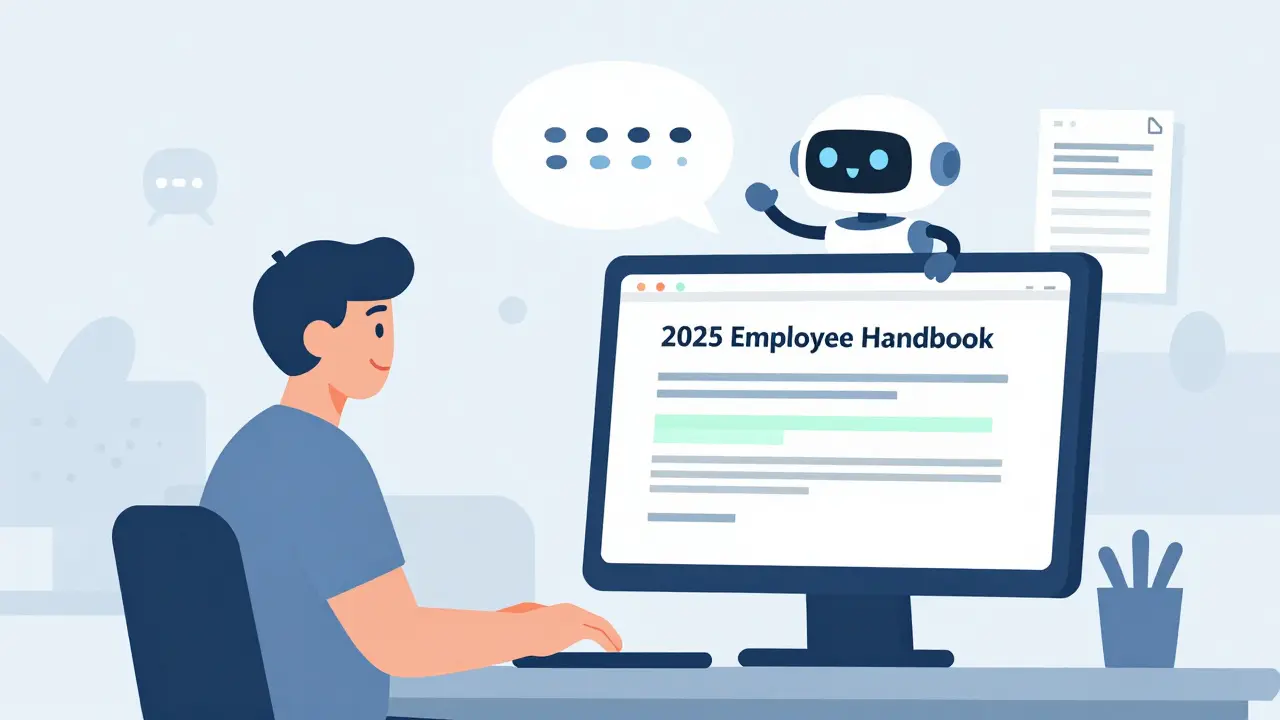
An HR Knowledgebot is a smart assistant powered by large language models (LLMs) that answers employee questions using your company’s own HR documents. Unlike a basic FAQ page that only recognizes exact phrases, it understands natural language. Ask it, "Can I take time off for my kid’s school play?" - and it’ll pull the relevant policy on personal leave, even if your handbook calls it "family personal time." It works through retrieval-augmented generation (RAG). First, your HR policies - whether they’re in Word docs, PDFs, or intranet pages - are broken into small chunks and stored in a vector database. When someone asks a question, the system searches these chunks for the most relevant snippets. Then, an LLM reads those snippets and writes a clear, human-sounding answer, always pointing back to the source document. This means answers aren’t made up. They’re grounded in your actual policies.How It Works Behind the Scenes
The setup isn’t magic - it’s engineering. Here’s how it’s built:- Upload all HR documents: PTO rules, benefits summaries, remote work guidelines, parental leave policies, bonus structures.
- Use a chunking tool to split each document into 512-1024 token pieces - small enough to be precise, big enough to keep context.
- Convert each chunk into a numerical vector using an embedding model like text-embedding-ada-002. This lets the system understand meaning, not just keywords.
- Store those vectors in a database like Pinecone or ChromaDB.
- Connect the system to where employees ask questions: Slack, Microsoft Teams, or a simple web portal.
- When a question comes in, the system finds the top 3-5 matching policy snippets and feeds them to an LLM - usually Llama 3 (hosted internally) or GPT-4o via Azure OpenAI.
- The LLM generates a response like: "You have 12 PTO days remaining, according to Section 4.2 of the 2025 Employee Handbook. You can request time off through Workday."
This process takes less than a second. And because the LLM only sees your documents - not the open internet - it can’t hallucinate random facts. It’s only ever answering from what you’ve given it.
Why Companies Are Switching from HR Emails to Knowledgebots
Before Knowledgebots, employees emailed HR for the same questions over and over:- "How does the 401(k) match work?"
- "When does my health insurance kick in?"
- "Can I work from home next week?"
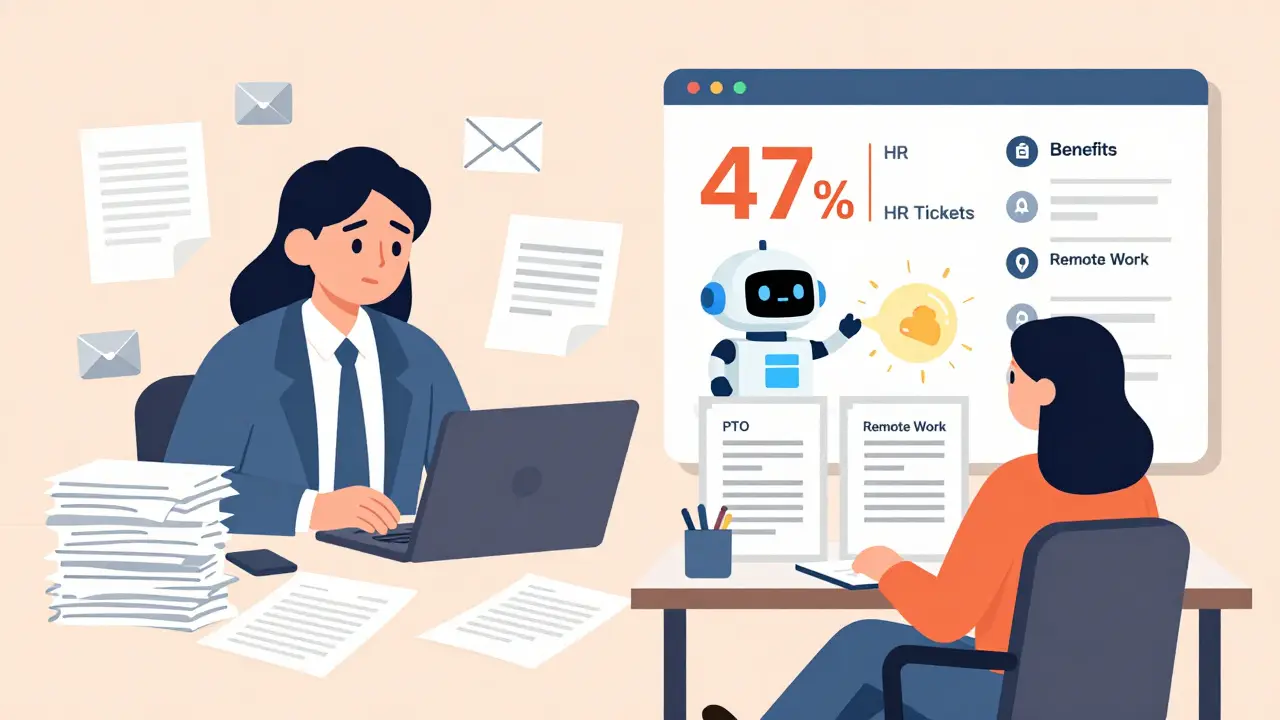
HR teams spent 30-50% of their time answering these. That’s not just inefficient - it’s demoralizing. HR staff are trained to handle complex issues: conflict resolution, disciplinary actions, career development. Not answering the same policy question for the 87th time.
Companies using Knowledgebots report:
- 47% reduction in HR tickets at a Fortune 500 tech firm using ServiceNow analytics
- 92% of employees prefer the bot for routine questions over emailing HR
- 80-100% accuracy on automated Workday scenarios like PTO accrual and bonus calculations
And it’s always on. No waiting until 9 a.m. No weekends off. An employee in Tokyo at 2 a.m. gets the same answer as someone in Seattle at noon.
Where Knowledgebots Shine - and Where They Struggle
Knowledgebots are excellent at three things:- Policy lookup: PTO, sick leave, parental leave, sabbaticals
- Compensation basics: Bonus structures, 401(k) matches, overtime rules
- Onboarding info: First-day checklist, benefits enrollment deadlines, equipment requests
But they’re not perfect. They fail when:
- Policies are inconsistent - one department says 10 days of parental leave, another says 12
- Documents are outdated - the handbook says "flexible work," but the real policy changed six months ago
- Questions need human judgment - "My manager is making me work weekends. What can I do?"
- They require access to external systems - like pulling your actual PTO balance from Workday (unless integrated via API)
A G2 review from August 2024 noted a bot gave different answers to the same sabbatical question on different days. Why? The policy wasn’t clearly written. The bot didn’t lie - it just reflected bad documentation.
Implementation: What It Really Takes
You can’t just plug in a bot and expect it to work. Success depends on preparation.Most companies follow a six-phase rollout:
- Requirements gathering (1-2 weeks): Identify your top 5-10 most common questions. These are your first targets.
- Design & planning (1 week): Decide if you’ll use Slack, Teams, or a custom portal. Choose your LLM (internal Llama 3 vs. cloud GPT-4o).
- Development (2-4 weeks): Build the prototype. Test with real employee questions.
- MLOps & integration (1-2 weeks): Add logging, prompt validation, and security controls. Ensure role-based access.
- Knowledge transfer (3-5 days): Train HR staff to monitor responses and update documents.
- Deployment: Roll out to all employees with clear instructions.
The biggest hurdle? Inconsistent policy docs. In 73% of cases, companies had to clean up their HR documents before the bot could work reliably. One manufacturing client had conflicting parental leave policies across regions. The bot gave different answers because the source material did. Fixing that took six weeks of policy alignment meetings.
Best practice: Assign one HR policy owner per 500 employees. Their job? Keep documents updated. If a policy changes, the bot changes with it.
Security and Compliance: Not an Afterthought
Privacy isn’t optional. GDPR and CCPA require you to protect employee data. That means:- Host your LLM internally - companies like deepsense.ai use Llama 3 on private servers, not cloud APIs
- Anonymize sensitive data in documents before uploading - remove names, IDs, social security numbers
- Log all queries for audit trails - but don’t store personally identifiable info in the vector database
One vendor’s demo showed a security feature where all queries were tagged with user roles. Only managers could see salary band details. Everyone else saw only their own benefits. That’s how you stay compliant.
How It Compares to Other Tools
| Feature | HR Knowledgebot | Static FAQ Page | Traditional RPA Bot |
|---|---|---|---|
| Understands natural language | Yes | No - needs exact keywords | No - follows rigid rules |
| Answers from your documents | Yes - with citations | No - generic answers | No - pulls from fixed fields |
| Handles new questions without coding | Yes - just update docs | No - requires manual updates | No - requires reprogramming |
| Accuracy (based on ACL'24W data) | 74.8%-79.2% | ~50% | 65% |
| Implementation time | 3-12 weeks | 1-2 weeks | 4-8 weeks |
Knowledgebots beat static FAQs because they understand context. They beat RPA bots because they don’t need rigid rules. They’re the only tool that can handle a question like, "I’m leaving in two weeks. Can I still use my HSA funds?" - and give a correct, sourced answer.
Real Results: ROI and Adoption Trends
The return on investment is clear. One company saved 1,200 HR hours in the first year - that’s 15 full-time employees’ worth of work. Capella Solutions found a 228% ROI within 12 months. Payback? Usually 6-9 months for companies with 500+ employees.Adoption is growing fast:
- 43% of tech companies have implemented or piloted HR Knowledgebots (SHRM, Q4 2024)
- 28% in finance
- 19% in healthcare
- 12% in manufacturing
Gartner predicts 70% of enterprise HR platforms will include LLM assistants by 2026. Microsoft’s Copilot for HR and Workday’s "Workday Assist" are already rolling out. This isn’t a trend - it’s becoming standard.
What Experts Say
Dr. Elena Rodriguez, Chief AI Officer at Capella Solutions, puts it bluntly: "LLMs can transform HR operations, but success depends entirely on the quality of your policy documentation." A bot can’t fix bad rules. It can only reflect them.Gartner’s Michael Kim warns about hallucinations - instances where bots invent policy details. Three documented cases led to employee confusion and HR intervention. That’s why audits and human oversight are non-negotiable.
But the data doesn’t lie. Knowledgebots reduce workload, improve satisfaction, and free HR for higher-value work. The key is starting with clean, consistent documents - and keeping them that way.
Is This Right for Your Company?
Ask yourself:- Do HR staff spend more than 20 hours a week answering the same policy questions?
- Are your HR documents digital, up-to-date, and organized?
- Do you have a person responsible for maintaining those documents?
- Are employees frustrated by slow HR responses?
If you answered yes to most of these, you’re ready. If your handbook is a mess of scanned PDFs and Word files with no version control - fix that first. A Knowledgebot won’t help if the source material is broken.
Start small. Pick one high-volume question - PTO balance, benefits start date, remote work approval. Build the bot for that. Test it. Refine it. Then expand.
This isn’t about replacing HR. It’s about empowering them. And giving employees the instant answers they expect in 2026.
How accurate are HR Knowledgebots?
HR Knowledgebots achieve 74.8% to 79.2% accuracy on policy-based questions, according to ACL'24W research. This is 14-18% higher than using LLMs without retrieval. Accuracy depends entirely on the quality of your policy documents. If your handbook is clear and consistent, the bot will be too. If policies conflict or are outdated, the bot will reflect those errors.
Can HR Knowledgebots handle personalized questions?
No. They’re designed for policy lookup, not judgment calls. Questions like, "My manager is pushing me too hard," or "Can I get an exception to the policy?" require human empathy and context. Knowledgebots should always have a clear path to escalate to an HR representative. In fact, 67% of employees still contact HR for emotionally sensitive or complex issues - and that’s by design.
Do I need to host the LLM internally?
For compliance and privacy, yes - especially if you handle PII like social security numbers or health data. Hosting an LLM like Llama 3 on your own servers ensures employee data never leaves your network. Cloud-based models like GPT-4o via Azure OpenAI can be used, but only if your legal team approves the data flow and you anonymize all inputs. Most enterprise deployments use internal hosting to meet GDPR and CCPA requirements.
How long does it take to implement an HR Knowledgebot?
It varies. Companies with clean, digital policy documents can deploy a working prototype in 3-4 weeks. Those with outdated, scattered, or inconsistent documents often need 8-12 weeks just to clean up their knowledge base before the bot can be built. The development phase itself takes 2-4 weeks, but preparation is where most delays happen.
What happens if HR policies change?
The Knowledgebot updates automatically - as long as you update the source documents. When a policy changes, someone (ideally a designated policy owner) uploads the new version. The system re-embeds the updated chunks, and the bot starts answering based on the latest version. The challenge isn’t technical - it’s process. If no one is assigned to maintain the documents, the bot will become outdated and lose trust. Forrester found 68% of early implementations needed weekly updates to stay accurate above 90%.
Diwakar Pandey
January 26, 2026 AT 10:07Been using something similar at my startup - it’s wild how much time it saves. We used to get 20+ emails a day just about PTO balances. Now? Zero. The bot even cites the exact section of the handbook. No more ‘I thought it was different’ drama.
Only thing? Make sure your docs are clean. We had a weird conflict between ‘remote work’ and ‘flexible hours’ that confused the bot for weeks. Fixed it by merging the two policies. Simple fix, huge win.
Geet Ramchandani
January 28, 2026 AT 02:55Oh great. Another AI magic bullet for lazy HR departments. Let’s just replace actual humans with a bot that can’t understand tone, context, or when someone’s crying over a dead grandparent. You think an LLM can handle ‘My manager’s gaslighting me and I need help’? Nah. It’ll just quote Section 7.3 and call it a day. This isn’t innovation - it’s corporate cowardice wrapped in buzzwords. And don’t even get me started on the ‘accuracy’ claims. If your handbook’s a mess, the bot’s just a mirror. And right now, most handbooks are dumpster fires.
Sumit SM
January 30, 2026 AT 00:10Let’s pause for a second - this isn’t about technology. It’s about power. Who controls the narrative? Who owns the truth? The HR bot doesn’t invent answers - it *retrieves* them. And if the policy is inconsistent, the bot doesn’t lie - it reflects the chaos in our systems. We’ve outsourced our responsibility to documents, and now we’re outsourcing our responsibility to algorithms. But here’s the real question: if a policy changes, and no one updates the handbook - does the bot still know the truth? Or does the truth just… disappear? The bot is a mirror. The problem is the reflection.
Bob Buthune
January 30, 2026 AT 11:24I’m so tired of this… 😔
My team tried this last year. We spent $80k on it. The bot worked fine until someone asked, ‘Can I take time off for my anxiety?’ and it replied with ‘See Section 5.1: Personal Leave.’ No empathy. No ‘I’m sorry you’re going through this.’ Just… cold policy. I cried. I didn’t want to cry. But I did. And now I don’t trust tech to handle human stuff. I just… I just miss when HR used to be people. 🥺
Also, my boss says ‘it’s efficient.’ But efficiency doesn’t feel like home.
Jane San Miguel
January 30, 2026 AT 19:34It's worth noting that the ACL'24W study cited here measured accuracy under controlled conditions - but real-world implementation often suffers from inconsistent document formatting, lack of version control, and poor chunking strategies. The 74.8%-79.2% range is misleading without context: precision drops below 60% when documents contain ambiguous clauses or non-standard terminology. Furthermore, the assumption that RAG eliminates hallucinations is flawed - if the retrieved snippets are contradictory, the LLM will synthesize a plausible but incorrect answer. This is not a feature. It's a systemic vulnerability. Proper governance - not just technical architecture - is the missing pillar.
Kasey Drymalla
February 1, 2026 AT 01:52