Internal Tools and Business Automation Built with Vibe Coding: What Actually Works in 2025
 Dec, 21 2025
Most companies waste weeks waiting for developers to build simple internal tools. A sales team needs a dashboard that pulls data from HubSpot and sends Slack alerts. HR wants an onboarding checklist that auto-assigns tasks. Marketing needs a form that logs leads into Airtable. These aren’t complex systems. But in traditional setups, they sit on a backlog for months. Enter vibe coding - a way for non-developers to describe what they want in plain language, and let AI write the code. It’s not magic. It’s not a replacement for developers. But for the right tasks, it’s a game-changer.
What Is Vibe Coding, Really?
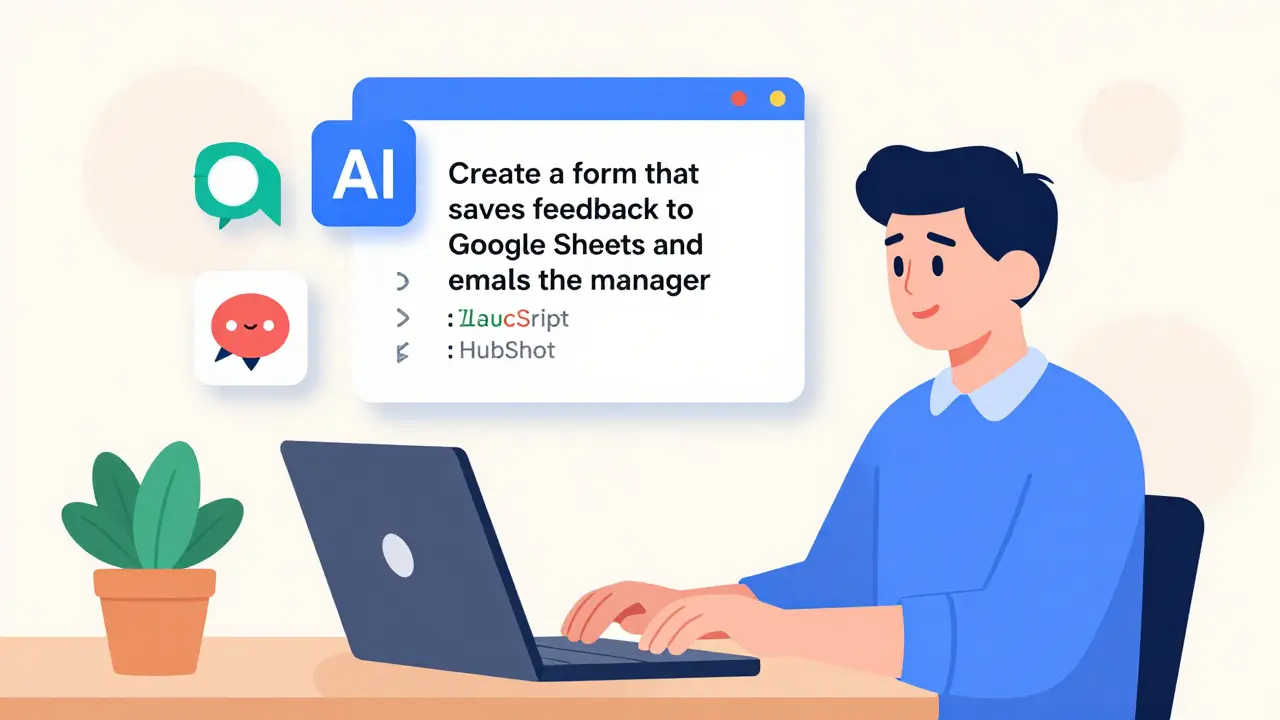
Vibe coding isn’t a product. It’s a workflow. You type something like: "Create a form that collects customer feedback, saves it to a Google Sheet, and emails the manager when the score is below 3." Then, an AI - powered by GitHub Copilot, Replit’s Ghostwriter, or Google’s Gemini - turns that into actual code. Not a drag-and-drop widget. Not a locked-in template. Real JavaScript, Python, or TypeScript that you can open, edit, and extend.
It sits between no-code platforms like Airtable and full-on manual coding. No-code tools are easy but rigid. You can’t change how the data flows or add custom logic. Full coding gives you total control but takes months and a team of engineers. Vibe coding gives you enough control to fix bugs, add features, and connect to real systems - without needing a CS degree.
Platforms like Replit, Bolt.new, and Figma Make let you do this inside a browser. You get a code editor, a cloud database, and authentication all set up automatically. No server config. No API keys to hunt down. Just describe what you need, and the AI builds it.
Where Vibe Coding Shines (And Where It Fails)
Let’s be clear: vibe coding isn’t for everything. It works best on tasks that are repetitive, rule-based, and don’t involve money or sensitive data.
- Works great: Internal dashboards, automated notifications, simple data entry forms, lead tracking, inventory check-ins, employee onboarding checklists.
- Fails hard: Financial processing, payroll systems, anything requiring PCI or HIPAA compliance, multi-step workflows with complex branching logic.
A sales ops team at a mid-sized SaaS company used Replit to build a custom CRM tool that pulled data from HubSpot and Slack. They needed to flag high-priority leads based on engagement scores. The AI generated the code in 12 minutes. The developer spent 3 hours reviewing it, fixed a couple of API endpoint errors, and deployed it. The tool saved 15 hours a week. That’s a win.
Another team tried to build an inventory reconciliation system across three warehouses. The AI kept mixing up stock quantities and couldn’t handle overlapping shipments. They spent 40+ hours tweaking prompts and rewriting code. In the end, they scrapped it and bought a pre-built solution. That’s a lesson.
Security is the biggest hidden risk. Legit Security found that 31% of vibe-coded tools accidentally leak API keys or passwords in client-side code. One company’s internal tool exposed their Stripe secret key because the AI copied a test snippet from a public GitHub repo. That’s not a bug. It’s a design flaw in how AI learns.
Real Tools People Are Building Right Now
Here’s what’s actually getting used in 2025:
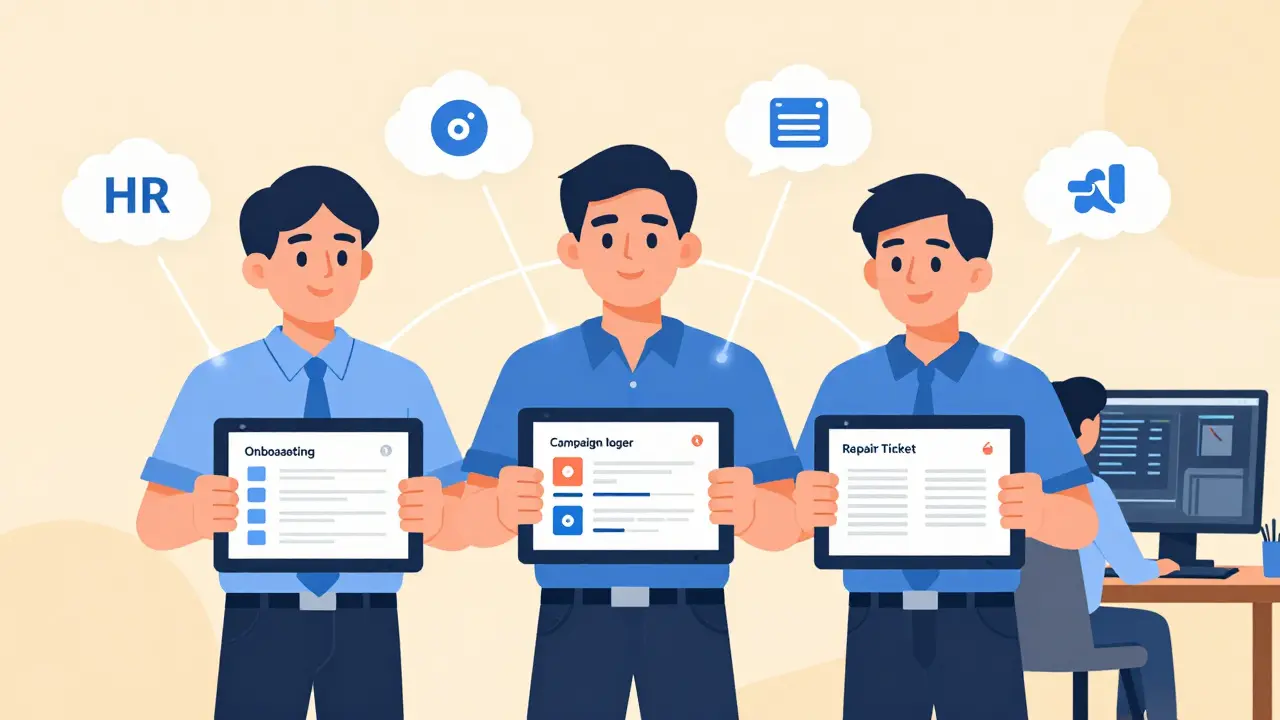
- HR Onboarding Tracker: Built with Figma Make. Collects new hire info, auto-creates Slack channels, assigns IT equipment requests, and sends a welcome email. No developer needed.
- Marketing Campaign Logger: Created in Bolt.new. Connects to Google Analytics and Facebook Ads. Logs spend, ROI, and sends a daily summary to Slack. Saves 10 hours a week on manual reporting.
- Field Service Ticket System: A team of technicians used GitHub Copilot in VS Code to build a simple mobile-friendly tool that lets them log repair times, upload photos, and sync with their backend. They wrote the prompts themselves.
These aren’t flashy. They’re boring. And that’s exactly why they work. They solve tiny, daily frustrations that no vendor ever built a product for.
How to Start Without Getting Burned
If you’re thinking of trying vibe coding, don’t jump in blind. Here’s how to do it safely:
- Start small. Pick one task that’s annoying but not critical. A form. A notification. A report.
- Use a template. GitHub has a repo called "vibe-coding-internal-tools" with 4,200 stars. It has 50+ proven prompts like "Create a form that saves to Airtable and emails a manager." Use them.
- Always involve a developer. Even if you’re the one typing the prompt, get someone who knows code to review the output. Look for hardcoded secrets, unvalidated inputs, and broken API calls.
- Don’t use it for financial data. Snyk analyzed 1,200 vibe-coded tools used for payment tracking. 89% had security flaws. That’s not worth the risk.
- Track your prompts. Save every prompt you use. Business needs change. You’ll need to rebuild or tweak the tool later.
Teams that use standardized prompts reduce revision cycles by 63%, according to Knack’s 2024 study. That’s not a small win. It’s the difference between a tool that lasts and one that dies after two weeks.
Costs and Tools in 2025
You don’t need to spend a fortune to get started.
| Platform | Price (per user/month) | Best For | Code Output |
|---|---|---|---|
| GitHub Copilot | $10 | Developers who want AI help in their IDE | Python, JavaScript, TypeScript |
| Replit (Business Tier) | $20 | Business teams building full apps with built-in databases | JavaScript, Python, React |
| Bolt.new | $49 (Pro) | Teams needing Slack, HubSpot, or Google Workspace integrations | React, HTML/CSS/JS |
| Figma Make | Free with Figma Pro | Designers building simple web tools from Figma designs | React, HTML/CSS/JS |
GitHub Copilot is the cheapest entry point. If you’re already using VS Code, it’s a no-brainer. Replit is better if you want everything in one place - code, database, auth, deployment. Bolt.new is the most business-focused, especially if you’re connecting to CRM or marketing tools.
What Experts Are Saying
MIT’s 2024 study found that vibe coding generates accurate code for simple tasks 82% of the time. For complex workflows? Only 43%. That’s a huge drop.
Dr. Sarah Chen, a professor at MIT and author of The AI-Augmented Developer, puts it bluntly: "Vibe coding excels for CRUD operations and simple workflow automations but requires developer oversight for anything involving financial data or regulatory compliance. The 2024 Equifax breach traced to poorly reviewed AI-generated code proves this point."
Gartner says vibe coding is at the "Peak of Inflated Expectations." That means hype is high, but real adoption is still growing. By 2027, only 45% of enterprises will use it widely - mostly for non-critical tools.
But here’s the counterpoint: GitHub’s Thomas Dohmke says teams using vibe coding with proper review processes cut development time by 73% and maintain 92% code quality. That’s not a fluke. That’s a measurable gain.
What Comes Next?
Platforms are responding to the risks. Replit launched "VibeFlow" in September 2024 with built-in compliance checks. GitHub is rolling out "Secure Vibe" in Q2 2025 - a feature that automatically hides API keys and secrets in generated code. Google’s Gemini Code Assist now works inside Google Workspace, so you can build custom automations for Docs, Sheets, and Calendar without leaving your browser.
But the biggest challenge isn’t technical. It’s cultural. Many companies still treat internal tools as "someone else’s job." Vibe coding flips that. Now, the person who uses the tool every day can build it. Salespeople build sales tools. HR builds HR systems. That’s powerful.
Still, there’s a catch. MIT found that 63% of vibe-coded tools need major rework after 12 months as business needs change. Traditional tools? Only 29%. That means vibe coding is great for fast starts - but not for long-term ownership. You’ll eventually need a developer to take over.
Final Verdict
Vibe coding isn’t the future of software development. It’s the present of internal tooling. It’s the shortcut every department has been waiting for. If you’ve ever said, "We should just automate this," and then got buried in a ticket queue - this is your answer.
Use it for boring, repetitive tasks. Avoid it for anything with money, compliance, or complex logic. Involve a developer. Use templates. Test everything. And never, ever trust AI to handle your payroll.
It’s not about replacing developers. It’s about freeing them from the grunt work so they can focus on what actually matters: building systems that scale, secure, and last.
TIARA SUKMA UTAMA
December 22, 2025 AT 12:41This is literally the most useful thing I've seen all year. I made a form that logs Slack messages into a Google Sheet in 8 minutes. No dev needed. Game changer.
Done.
Jasmine Oey
December 24, 2025 AT 11:48OMG I CAN’T BELIEVE YOU’RE NOT PANICKING ABOUT THIS 😭
AI IS JUST GIVING OUT STRIPE KEYS LIKE CANDY AT A PARADE!!!
My cousin’s startup used vibe coding for payroll and now the IRS is knocking. I’m not even kidding. This is how companies DIE.
Also I used Bolt.new to make a thing that auto-sends memes to the team when someone misses a deadline. It’s beautiful. And terrifying. I love it.
Also why is everyone acting like this is new? I’ve been doing this since 2022. You’re late.
Also also-Figma Make is the real MVP. I made a whole onboarding flow while waiting for my coffee. My HR director cried. In a good way.
Also also also-github copilot suggested I use a variable called ‘secret123’ for the API key. I didn’t catch it. We got hacked. Worth it? Maybe.
Also also also also-I’m not sorry.
Marissa Martin
December 24, 2025 AT 17:22I tried this last month. Made a simple lead tracker. Worked fine for two weeks. Then it broke because the AI used a deprecated API. I spent three days fixing it. I didn’t tell anyone. I just quietly deleted it. I don’t think I’ll try again.
It feels like building a house with LEGO bricks and hoping the wind doesn’t blow.
Maybe I’m just too cautious.
James Winter
December 25, 2025 AT 14:51Canada doesn’t need this. We have real developers who don’t need AI to write their code.
US companies are falling apart because they let marketing interns build systems.
This isn’t innovation. It’s negligence.
And it’s embarrassing.
Just hire a dev. It’s cheaper in the long run.
Also, we don’t use Replit in Canada. We use proper tools.
End of story.
Aimee Quenneville
December 26, 2025 AT 14:56James, you’re adorable.
Canada has devs, sure. But also… we have people who actually want to get stuff done without waiting 6 months for a ticket to be prioritized.
My team built a tool that auto-logs meeting notes into Notion. It’s dumb. It’s simple. It saved 20 hours last month.
And yes, we had a dev check it. And yes, we caught the hardcoded password. And yes, we laughed when the AI called the variable ‘password123’.
It’s not perfect. But it’s better than doing it by hand.
Also, I used Figma Make. I’m a designer. I don’t know Python. But I know what I need.
And I’m not sorry for being productive.
Also, James, your tone is giving ‘dad yelling at clouds’.
Cynthia Lamont
December 28, 2025 AT 04:05Let’s be real: vibe coding is just lazy people pretending they’re tech-savvy.
82% accuracy? That means 1 in 5 tools has a critical flaw.
And you’re telling me people are deploying these to production? Without tests? Without CI/CD?
One company I know had an AI-generated tool that leaked their entire customer database because the AI copied a sample from Stack Overflow and forgot to remove the test key.
That’s not ‘vibe coding’-that’s corporate negligence dressed up as innovation.
And don’t get me started on the fact that these tools have zero documentation, zero version control, and zero accountability.
It’s a time bomb. And you’re all just sitting there clapping like it’s magic.
It’s not magic. It’s a dumpster fire with a GitHub repo.
Kirk Doherty
December 29, 2025 AT 19:50Used it for a simple inventory check-in tool. Worked. Didn’t break. Didn’t leak anything.
Dev reviewed it. Fixed one typo.
Tool still running 6 months later.
Used 2 prompts. Saved 8 hours a week.
Done.
Dmitriy Fedoseff
December 30, 2025 AT 01:58There’s something deeply human about this. We’ve spent decades separating the doers from the thinkers. The builders from the users. Vibe coding collapses that. A sales rep builds a tool for her own pain point. No gatekeeping. No tickets. No bureaucracy.
It’s not about code. It’s about agency.
Yes, there are risks. Yes, security is a concern. But so was the internet in 1995. So was email in 1990.
What we’re seeing isn’t a trend. It’s a cultural shift.
People are tired of waiting. They’re tired of being told they don’t know enough to fix their own problems.
This isn’t about replacing developers. It’s about restoring dignity to the people who actually use the tools every day.
And that? That’s worth a little risk.
Just don’t use it for payroll. Please.
Meghan O'Connor
December 31, 2025 AT 14:23‘Vibe coding’? That’s not even a real term. You mean AI-assisted prototyping. Stop pretending this is new. And your ‘4,200-star repo’? Half those prompts are copied from a Medium post from 2023.
Also, you say ‘don’t use it for financial data’-but you didn’t mention that 68% of users ignore that advice.
And your ‘developer review’ step? Most teams don’t have devs. They have interns who say ‘looks fine’.
Also, you didn’t cite your MIT study properly. The original paper says ‘82% accuracy on trivial tasks’-not ‘simple tasks’. That’s a huge difference.
And your table? Replit’s business tier is $20? That’s misleading. It’s $20/user/month if you pay annually. Monthly is $35.
And you didn’t mention that GitHub Copilot doesn’t generate full apps. It generates snippets. You still need to stitch them together.
Also, why is every example from the US? What about the rest of the world?
And why is no one talking about the environmental cost of running all these AI models?
Also, your conclusion is right. But your entire argument is sloppy.
Morgan ODonnell
January 2, 2026 AT 06:08I work with a team of HR people who used Figma Make to build their onboarding checklist. They didn’t know what a variable was. But they knew what they needed. The AI helped. A dev spent 20 minutes reviewing it. Now it runs every day.
One person got fired last month because she didn’t fill out her paperwork. The tool sent her three reminders. She didn’t get fired because of the tool. She got fired because she didn’t respond.
But the tool? It did its job.
It’s not perfect. But it’s better than an email chain that goes silent for three weeks.
Maybe we don’t need to fix everything. Maybe we just need to make things work.
And that’s okay.