LLM Cost Allocation: Effective Chargeback Models for Enterprise AI
 Apr, 27 2026
Key Takeaways for AI Financial Governance
- Avoid Flat Splits: Simple percentage splits ignore the reality that RAG workflows and AI agents cost significantly more than basic chat interfaces.
- Granularity is King: Effective models track costs at the prompt and feature level, not just the API key level.
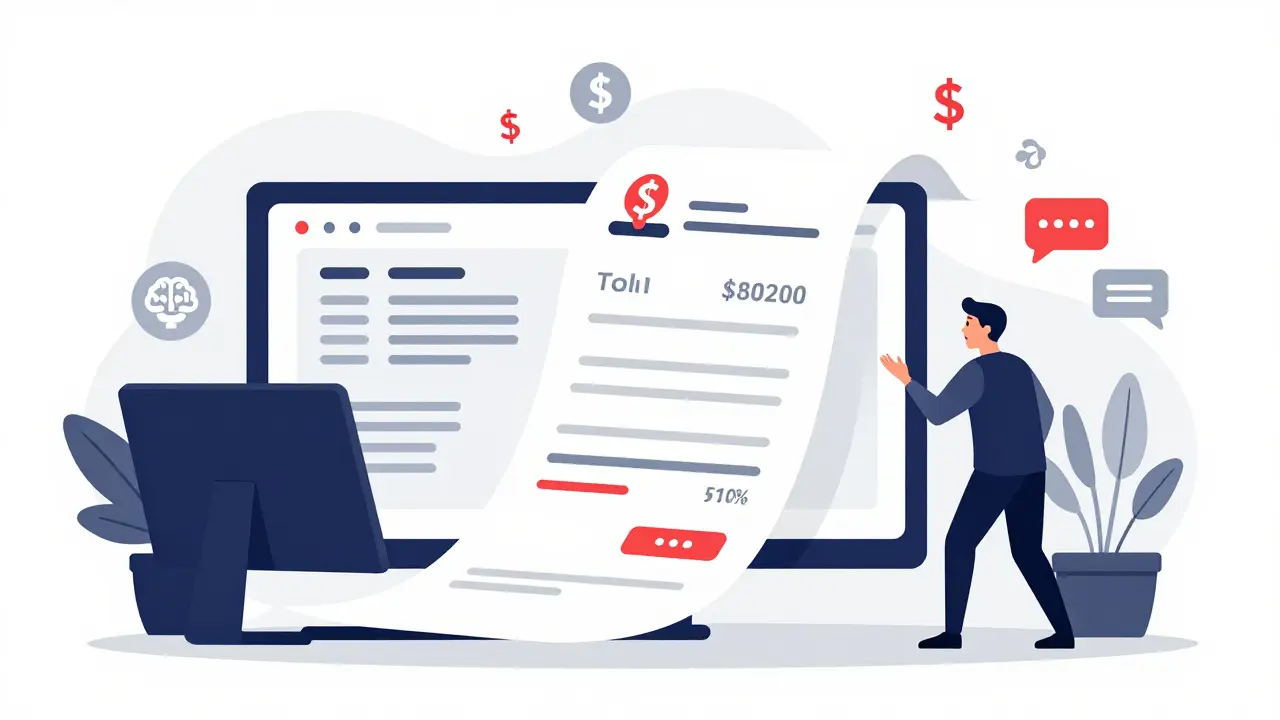
- Watch for Cost Amplification: AI agents can trigger looping behaviors that multiply token costs by 400% or more.
- Integrate Early: Connect your tracking to ERP systems like SAP or Oracle to automate the chargeback process.
The Hidden Complexity of AI Billing
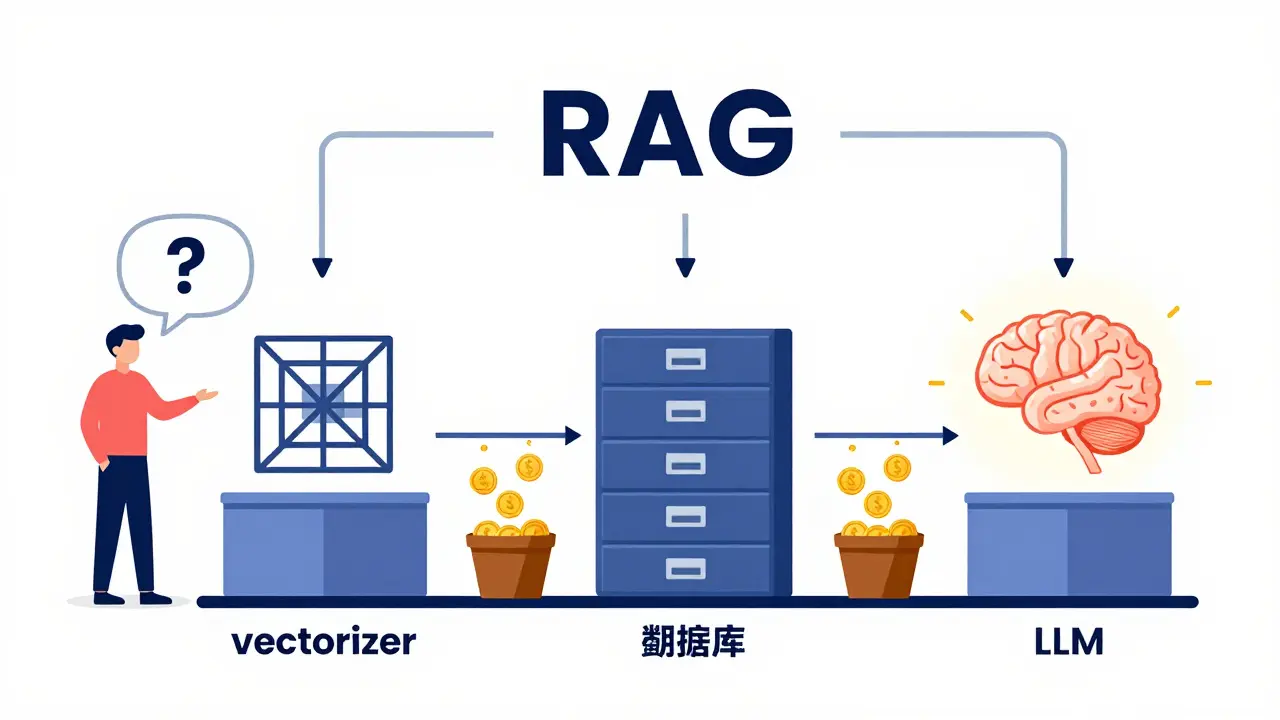
Traditional FinOps focuses on virtual machines and storage, but AI infrastructure is multi-dimensional. To build a chargeback model, you first have to understand that a "single query" is rarely just one cost. In a modern Retrieval-Augmented Generation (RAG) system, a user's question triggers a sequence: an embedding model creates a vector, a Vector Database (like Pinecone or Milvus) retrieves relevant documents, and finally, the LLM generates an answer. Finout's data shows that these retrieval operations can actually account for 35-60% of the total query cost.
Then there's the context window. Using a 32K token window isn't just a bit more expensive than a 4K window-it typically costs about 2.3x more. If one team is building a "summarize this entire book" feature while another is building a "rewrite this email" tool, charging them the same flat rate is a recipe for internal conflict.
Three Chargeback Models That Actually Work
Depending on your organization's maturity, you'll likely lean toward one of these three structures. Most companies start with the first and migrate toward the third as their AI footprint grows.
| Model Type | How it Works | Best For | The Big Risk |
|---|---|---|---|
| Cost Plus Margin | Actual cost + 10-25% markup | Uncertain early-stage projects | Overcharging if margins exceed 22% |
| Fixed Price | Predetermined monthly fee per team | Standardized, predictable tools | Fails during 30%+ usage spikes |
| Dynamic Attribution | Real-time tracking per prompt/feature | Scale enterprises with many AI apps | High technical setup effort (11-14 weeks) |
The Cost Plus Margin Approach
This is the "safe" bet for central IT teams. You cover the raw cost of the LLM and add a small percentage to cover the overhead of managing the infrastructure. It's great for stability, but it doesn't incentivize the engineering teams to optimize their prompts. If the cost is just "passed through," why spend time reducing token counts?
The Fixed Price Model
Think of this like a subscription. Team A pays $2,000 a month for a set amount of capacity. It makes budgeting a dream for the CFO, but it's dangerous in AI. Because LLM usage is so volatile-often swinging more than 30% month-over-month-you'll either end up subsidizing a power-user team or charging a lightweight team for resources they never touched.
Dynamic Attribution: The Gold Standard
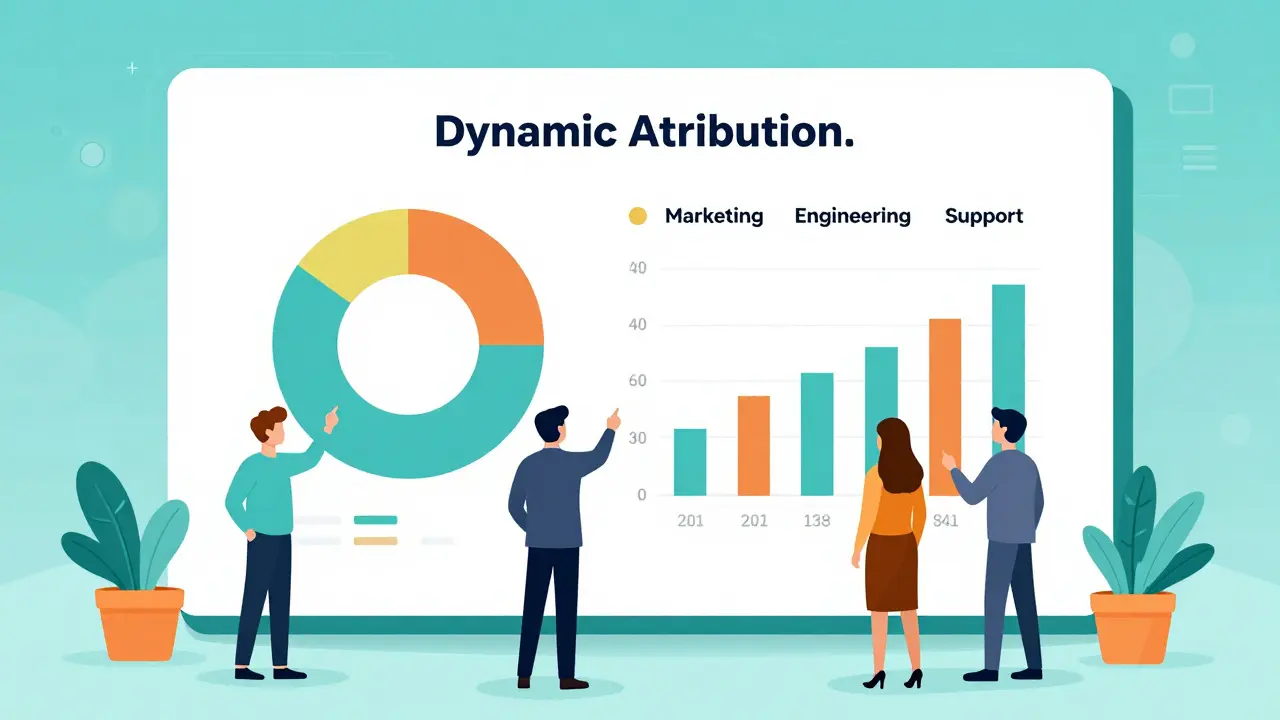
This model uses telemetry to map every single cent to a specific feature or team. Tools like Mavvrik or Finout allow you to tag requests with metadata. Instead of saying "Marketing spent $5k," you can say "The Marketing Team's Ad-Copy Generator spent $3.2k, and their Customer Support Bot spent $1.8k." This level of detail is what reduces billing disputes by up to 65% because the data is defensible.
The 'Agent Trap': When Costs Explode
If you're moving from simple chatbots to AI Agents, your previous cost models will likely break. Agents aren't linear; they loop. An agent might decide it needs to "search the web," "analyze the result," and then "double-check the fact" before giving a final answer. This compounding behavior can increase token costs by 400% for a single user task.
If you're using a per-request chargeback model, you're in trouble. An agent that makes 5 calls behind the scenes looks like one request to the user, but it's five charges to the provider. You must implement request tagging that tracks the *entire trace* of an agent's execution, not just the final output. Without this, your chargeback reports will be missing 45-60% of the actual cost drivers.
Implementing Your 90-Day Cost Plan
Don't try to build a perfect system overnight. Use this phased approach to get your FinOps under control without halting development.
- Weeks 1-2: Request Tagging. Start attaching metadata to every API call. Tag by team, environment (prod/dev), and feature ID. If you're using a gateway, this is where it happens.
- Weeks 3-4: Budget Alerts. Set hard thresholds. Use a 50% warning and an 80% critical alert. This prevents the "surprise $10k bill" scenario.
- Month 2: Correlation and Validation. Compare your internal tags with the actual invoices from providers like Anthropic or OpenAI. Look for gaps-especially caching effects. If you're using a cache, make sure you aren't charging teams for tokens that were served from memory.
- Month 3: The Accountability Loop. Start weekly spend reviews between engineering and product owners. When a product manager sees that a specific prompt is eating 40% of their budget, they'll suddenly become very interested in prompt engineering and model distillation.
Common Pitfalls to Avoid
One of the biggest mistakes is ignoring the "invisible" costs. Many companies only track the LLM tokens and forget the network egress fees or the cost of the security gateway. Additionally, be careful with high-level aggregation. If you simply divide the total bill by the number of teams, you're hiding your most inefficient users and subsidizing them with your most efficient ones.
Another trap is the "implementation rabbit hole." Some organizations spend six months building a custom internal billing system only to find it can't handle the complexity of agent-based workflows. In many cases, using a dedicated AI cost management tool is cheaper than the engineering hours required to build a custom one from scratch.
What is the most accurate way to track LLM costs?
The most accurate method is dynamic attribution via request tagging. By attaching metadata (like Team ID or Feature ID) to every individual prompt and completion, you can correlate telemetry data with provider invoices. This allows for per-token and per-request visibility, which is essential for complex workflows like RAG or AI agents.
How do RAG workflows affect cost allocation?
RAG adds significant overhead beyond the LLM itself. You have to account for embedding generation and vector database retrieval costs. In some poorly optimized systems, the cost of retrieving the data can be 3 to 5 times higher than the cost of the LLM generating the answer. A simple token-based model will miss these costs entirely.
Why is a 'fixed price' model risky for AI?
AI consumption is highly volatile. Research shows that roughly 68% of organizations experience a monthly usage variance of over 30%. A fixed price model cannot adapt to these swings, leading to either massive overcharging for low-usage teams or significant revenue loss for the providing IT unit.
How do I handle costs for AI agents that loop?
You must track 'trace IDs' rather than single requests. Because one user task can trigger multiple LLM calls in a loop, you need a system that aggregates all calls associated with a single execution trace. This prevents 'cost amplification' from going unnoticed, where a single task can increase token spending by 400%.
Does caching affect chargeback accuracy?
Yes. Many organizations mistakenly charge teams for full token counts even when a cached response was served. Since cached responses are significantly cheaper or free, failing to account for this can lead to an overallocation of costs by 18-35%.
Next Steps: Moving From Tracking to Optimizing
Once you have your chargeback model running, don't just stop at the bill. Use the data to drive technical changes. If you see a specific team spending a fortune on a high-reasoning model (like GPT-4o or Claude 3.5 Sonnet) for simple tasks, suggest they switch to a smaller, faster model for those specific prompts.
For those in the EU, keep in mind that the EU AI Act (effective February 2026) is starting to push for more financial transparency in high-risk AI systems. Getting your attribution right now isn't just a good business move-it's a hedge against future regulatory requirements. Start with tagging, move to dynamic attribution, and eventually integrate these costs directly into your product's ROI calculations.
Jane San Miguel
April 30, 2026 AT 08:47The emphasis on dynamic attribution is precisely where most enterprises falter due to a lack of technical rigor. While the author correctly identifies the 'Agent Trap,' they gloss over the architectural nightmare of implementing trace IDs across legacy microservices. It is quite simplistic to suggest a 14-week setup for a global organization with thousands of endpoints; in reality, the governance overhead alone would dwarf the implementation timeline. One must also consider the latency overhead introduced by such granular telemetry, which is rarely discussed in these high-level overviews. The mention of the EU AI Act is a necessary addition, yet it barely scratches the surface of the compliance burden we are actually facing in the private sector. Truly, the gap between a 'model that works' and a scalable production environment is an abyss that few of these tools actually bridge effectively.
Soham Dhruv
April 30, 2026 AT 23:39man this is super helpful. i tried doing the flat split thing last year and it was a total disaster lol. definitely going to look into those tagging tools for my team
Diwakar Pandey
May 2, 2026 AT 07:58The point about cached responses is really an important detail that usually gets overlooked in these discussions.
Bob Buthune
May 2, 2026 AT 18:36I just can't stop thinking about how stressful it must be for the person in charge of the budget when those agent loops go wild 😱📉 it's honestly a nightmare scenario to imagine the internal emails flying around when the costs spike 400% for no apparent reason 😰💸 and then you have to explain to the board why the bot decided to read the entire internet for one simple query 😵💫