Measuring ROI for Large Language Model Initiatives: Key Metrics That Deliver Real Value
 Jan, 10 2026
Companies are spending millions on large language models (LLMs), but too many can’t say if they’re getting their money back. It’s not enough to say, "Our chatbot is cool" or "Our employees love the new search tool." If you can’t tie that to real savings, faster decisions, or happier teams, you’re guessing-not measuring. The truth? Only 66% of organizations see tangible returns from their AI investments, according to Deloitte’s 2023 study. The difference between success and failure isn’t the model-it’s the metrics you choose.
What ROI Actually Means for LLMs
ROI for LLMs isn’t about how smart the AI is. It’s about how much time, money, and effort it saves your people. Think of it like a new tool in your workshop. If a power drill cuts your project time in half, you don’t just say, "It’s faster." You calculate: How many hours did I save this month? How many people could I reassign to higher-value work? That’s the same math for LLMs.Hard ROI is easy to track: reduced labor costs, fewer support tickets, faster report generation. Soft ROI is harder-but just as important. That’s employee satisfaction, better decision-making, reduced frustration when hunting for info. A 2024 Bluesoft case study showed a European company saved 128,000 PLN in the first year by cutting down on repetitive data questions. The LLM cost €50 in tokens. That’s a 93% ROI. Not because the AI was magical-but because they measured the right things.
The Five Metrics That Actually Matter
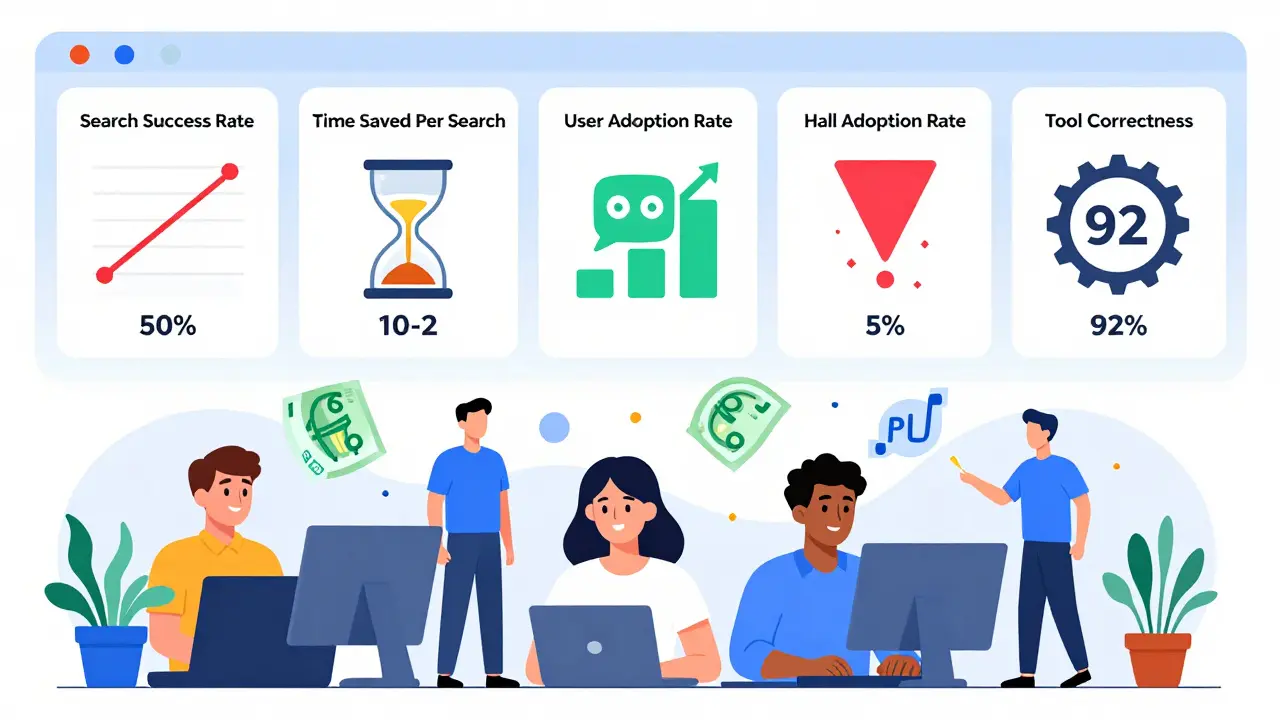
Forget vague buzzwords. These five metrics are the backbone of any real LLM ROI analysis:
- Search Success Rate: What percentage of queries return useful answers on the first try? Before LLMs, many teams saw success rates between 45% and 60%. After implementation, companies like those using GoSearch tools report jumps to 80-90%. If your team used to spend 10 minutes hunting for a report and now it takes 2 minutes, that’s 8 minutes saved per search. Multiply that by 50 people doing 2 searches a week? That’s 32 hours saved every week.
- Time Saved Per Search: Track the exact time difference between old and new methods. Use screen recording tools or ask users to log their search time for a week before and after. One tech company reported a drop from 10 minutes to 2 minutes per search. That’s 8 minutes × 100 searches per week = 800 minutes saved. That’s over 13 hours. Multiply by hourly wage? That’s direct cost savings.
- User Adoption Rate: If only 20% of employees use the tool, your ROI is capped. Adoption isn’t about login counts-it’s about active, repeated use. Bluesoft found that after training, data teams went from avoiding the tool to using it daily. Look for usage spikes after training sessions. If adoption stays below 50% after 60 days, something’s wrong with the design or training.
- Hallucination Rate: LLMs make stuff up. That’s not a bug-it’s a feature until it’s not. A single wrong answer in a legal or medical context can cost more than the whole system. Track how often the model generates false or misleading info. Confident AI’s 2024 guide says anything above 5% hallucination rate is risky for enterprise use. Use human reviewers to sample outputs weekly. If you’re getting 10 false answers out of 100, you’re not saving time-you’re creating work.
- Tool Correctness: If your LLM is calling APIs, pulling data, or running scripts, does it do it right? A model might give a perfect answer-but call the wrong endpoint, pull last year’s numbers, or misformat the output. Track how often tool calls return accurate results. Svitla Systems recommends measuring this as a percentage: if 92% of API calls return correct data, you’re in good shape. Below 85%, and you’re adding risk, not efficiency.
Costs You Can’t Ignore
Most people focus on the price of tokens. IBM says token costs are "significantly lower than manual work hours," and they’re right. Bluesoft’s LLM cost just €50 a year in tokens. But that’s not the full cost.
Here’s what else adds up:
- Implementation labor: Two engineers working two weeks? That’s 80 hours. At $50/hour, that’s $4,000. That’s your upfront investment.
- Training: Users need to learn how to ask the right questions. Prompt engineering training takes 40-60 hours per team. Factor that in.
- Data cleanup: IBM’s 2024 survey found 68% of companies hit roadblocks because their data was messy, outdated, or siloed. Fixing that can cost more than the LLM itself.
- Monitoring tools: Tools like Confident AI or Galileo help track hallucinations and accuracy. They’re not free, but they’re cheaper than a single bad decision.
ROI isn’t just savings minus cost. It’s savings minus all costs. If you skip tracking these, you’re not measuring ROI-you’re measuring optimism.

Where LLMs Shine (and Where They Don’t)
Not every use case is worth it. Some deliver massive returns. Others waste money.
High-ROI use cases:
- Internal knowledge search (sales, legal, support teams)
- Automated report generation from structured data
- Conversational Q&A for customer or employee support
- Summarizing long documents (contracts, research papers, meeting transcripts)
Low-ROI or risky use cases:
- Generating legal opinions without human review
- Replacing human customer service in high-stakes scenarios
- Writing marketing copy without brand oversight
- Any process where 100% accuracy is non-negotiable
Healthcare saw a 451% ROI over five years with AI-assisted radiology reports-jumping to 791% when you included time saved by radiologists. But that was because they measured time saved by experts, not just system uptime. A manufacturing company reported only 15% ROI because they only counted fewer support tickets. They ignored that engineers were now spending 10 extra hours a week fixing bad LLM outputs. They measured the wrong thing.
How to Start Measuring (Step by Step)
You don’t need a fancy dashboard. You need a plan.
- Choose one high-impact use case. Don’t try to roll out LLMs everywhere. Pick one team with a clear, repetitive pain point-like customer support answering the same 10 questions.
- Measure baseline performance. For one week, track how long it takes to answer those questions, how many errors happen, how many times people ask for help. Write it down.
- Deploy the LLM solution. Use a pilot group of 5-10 users. Don’t roll it out to 500 people yet.
- Track the five metrics for 30 days. Use simple spreadsheets. No need for expensive tools yet.
- Calculate ROI. Use this formula: (Time Saved × Hourly Rate) - (Implementation Cost + Token Cost). If the result is positive, you’ve got proof.
- Scale only if it works. If adoption is low or hallucinations are high, fix the problem before expanding.
Gartner’s 2024 survey found that 42% of companies took 3-6 months to fully integrate LLMs. That’s not because the tech is hard-it’s because they skipped the baseline measurement. You can’t improve what you don’t measure.

What Happens When You Don’t Measure
Companies that skip proper ROI tracking don’t just waste money-they lose trust.
One finance firm spent $200,000 on an LLM to automate financial summaries. They never tracked time saved. After six months, they shut it down because "it wasn’t helping." But when they looked back, they found the AI was cutting 15 hours of work per week for their analysts. The problem? No one told them. The tool was working. They just didn’t know.
Agathon AI warns that "the rapid advancement of LLMs has outpaced traditional evaluation methods." That’s true. But the solution isn’t to wait. It’s to build your own measurement system. Use what works: track time, track errors, track adoption. If your team uses it daily and saves hours, you’re winning-even if you can’t yet predict next quarter’s revenue.
The Future of LLM ROI
By 2026, Gartner predicts 75% of successful LLM implementations will use industry-specific metrics-not generic "productivity" numbers. A hospital won’t measure "time saved" the same way a law firm does. The next wave of tools-like IBM’s new AI ROI calculator-will let you plug in discount rates, forecast long-term savings with NPV, and even simulate risk scenarios.
But here’s the real secret: the best ROI isn’t in the numbers. It’s in the quiet moments. The analyst who no longer stays late to find a report. The support agent who finally has time to listen instead of copy-paste. The engineer who stops fixing broken outputs and starts building new features.
That’s the real return. And you can’t measure it with a spreadsheet alone. You have to ask people.
What’s the minimum ROI I should expect from an LLM project?
There’s no universal number, but most successful LLM projects hit at least 50% ROI in the first year. Bluesoft’s case study achieved 93% by focusing on time savings for data teams. If your project doesn’t break even within 12 months, reevaluate your use case or measurement approach. The goal isn’t to be profitable-it’s to be faster, smarter, and less overwhelmed.
Can I use ROI metrics from other companies?
Not directly. Every team has different workflows, salaries, and data quality. A 93% ROI from a European data team doesn’t mean you’ll get the same. Use their metrics as a guide, not a target. Measure your own baseline first. Then compare your progress against your own past performance, not someone else’s success story.
How do I measure soft ROI like employee satisfaction?
Use short, monthly surveys. Ask: "How much time do you save weekly using this tool?" and "Do you feel less frustrated when searching for info?" Use a 1-5 scale. Track the trend. If satisfaction scores rise and complaints drop, you’re gaining soft ROI. Combine that with time logs to build a full picture. People don’t leave because of bad tech-they leave because they’re tired.
What if my LLM makes mistakes? Should I still call it a success?
It depends. If mistakes are rare and caught by humans before they cause harm, yes. A 5% hallucination rate is acceptable in internal search if users double-check. But if errors lead to wrong decisions, delayed projects, or compliance risks, you’re not saving money-you’re creating liability. Always pair LLMs with human review in high-stakes areas. Success isn’t perfection-it’s controlled improvement.
Do I need special software to track these metrics?
No. Start with Google Sheets or Excel. Track search success rate manually by sampling 20 queries a week. Log time saved with a simple timer app. Use free tools like Google Forms for user feedback. Paid tools like Confident AI or Galileo help at scale, but they’re not required to prove value. Your first ROI case doesn’t need fancy dashboards-it needs honest data.
Next Steps: What to Do Today
Don’t wait for the perfect tool or the perfect metric. Start now.
- Find one team drowning in repetitive questions.
- Ask them: "What’s the one thing you wish you could stop doing?"
- Track how long it takes them to do it now.
- Test a simple LLM chatbot on that task for two weeks.
- Ask them again: "Did it help?"
If the answer is yes, you’ve got your first ROI case. If not, you’ve saved money by not scaling something that doesn’t work. That’s not failure. That’s smarter investment.
Kenny Stockman
January 12, 2026 AT 02:12Man, I’ve seen so many teams blow thousands on LLMs only to ditch them after a month because no one tracked what actually changed. This post? Spot on. We rolled out a simple chatbot for our support team last year-no fancy tools, just Google Forms and a timer. Turned out they saved 12 hours a week. We didn’t even realize it until someone mentioned they were leaving early on Fridays. That’s the real win.
Antonio Hunter
January 13, 2026 AT 17:30It’s funny how we treat AI like it’s some magical oracle when it’s really just a very fast, very gullible intern who doesn’t know when to shut up. The metrics here are dead-on-especially hallucination rate and tool correctness. I’ve seen companies deploy LLMs that generate perfect-sounding reports… with entirely fabricated KPIs. The cost isn’t the token usage-it’s the trust you lose when someone signs off on a bad number because the AI made it look legit. You can’t automate judgment. You can only augment it. And if you don’t measure the gaps, you’re just outsourcing your blind spots.
Paritosh Bhagat
January 13, 2026 AT 22:05Okay but seriously-how is anyone still not tracking search success rate? Like, come on. If your LLM can’t answer the same question correctly 8 out of 10 times, it’s not an assistant, it’s a liability. And don’t even get me started on companies that think ‘user adoption’ means people clicked the link once. Adoption is daily use. It’s muscle memory. If your team isn’t reaching for the tool before Googling, you’ve failed. Also, ‘€50 in tokens’? Bro, that’s not the cost-that’s the candy wrapper. The real cost is the HR time spent explaining why the AI said the CEO is retiring when he’s not. #GrammarNaziButAlsoRight
Ben De Keersmaecker
January 14, 2026 AT 11:55I appreciate how this breaks down ROI into concrete, measurable units instead of vague ‘productivity gains.’ The distinction between hard and soft ROI is critical-especially the part about emotional fatigue. I work in a legal ops team, and before the LLM, we spent 20+ hours a week digging through outdated contract templates. Now? 4. The tool isn’t perfect-it misreads clause numbers sometimes-but we catch it before it goes live. The real metric? My colleague hasn’t said ‘I hate this job’ in three months. That’s not in the spreadsheet, but it’s the reason we’re expanding the rollout.
Aaron Elliott
January 16, 2026 AT 05:13While the author presents a compelling narrative, it is imperative to interrogate the underlying epistemological assumptions regarding the quantification of human labor and cognitive satisfaction. The conflation of time saved with value generated presumes a utilitarian framework that reduces human agency to an input-output model. Furthermore, the reliance on self-reported survey data for ‘soft ROI’ introduces significant measurement bias, as psychological states are inherently subjective and non-falsifiable. One must ask: if the AI reduces frustration, but does not increase competence, has it truly enhanced organizational efficacy-or merely conditioned dependence? The metrics listed, while pragmatically useful, risk becoming instrumental artifacts in a broader technocratic drift.
Chris Heffron
January 16, 2026 AT 11:38Love the practical approach. I tried this with our sales team last quarter-tracked search time before and after. Went from 8 mins to 1.5 mins. Saved 40 hours a month. Used a free Chrome extension to log time. Didn’t need anything fancy. Also, the 5% hallucination rule? Gold. We caught one that said our product had a ‘lifetime warranty’ when it was 12 months. Fixed it fast. 😅
Adrienne Temple
January 18, 2026 AT 03:47This is the kind of post that makes me want to high-five someone. I work in HR and we used to spend hours answering the same 5 questions every day. Now? The bot handles it. My team says they feel less stressed. I didn’t even think to measure that-but I should’ve. We’re rolling it out to the whole company next month. Also, the part about ‘quiet moments’? Yeah. My assistant finally took a full lunch break for the first time in a year. That’s ROI.
Tina van Schelt
January 19, 2026 AT 15:23Let’s be real-LLMs are like that one friend who’s great at giving advice but will also tell you your cat is a spy if you ask them too many weird questions. The metrics here? Perfect. But the real trick is not just measuring, but listening. If your team’s using it but still whispering, ‘I’m just gonna Google it,’ you’ve got a UX problem, not a tech one. Fix the interface. Don’t just throw more tokens at it.
Sanjay Mittal
January 21, 2026 AT 13:59From India, we’ve seen this play out too. One startup here built an LLM for customer queries in regional languages. First month: 60% hallucination rate. They fixed it by adding a simple human review layer for high-risk queries. Now? 90% accuracy, 70% adoption. Cost? Less than $200/month. The key isn’t the model-it’s the guardrails. And yes, data cleanup is the silent killer. No AI can fix garbage in.
Mike Zhong
January 23, 2026 AT 13:34You’re all missing the point. You’re measuring time saved, adoption rates, hallucinations-like these are the end goals. But what’s the cost of *thinking less*? What’s the long-term erosion of critical reasoning when people outsource their curiosity to a bot that’s just statistically guessing? You’re not optimizing productivity-you’re optimizing complacency. The real ROI of an LLM isn’t in hours saved. It’s in the quiet, unquantifiable loss of human engagement. And we’re all too busy counting savings to notice we’ve stopped asking why.