Model Lifecycle Management: How LLM Updates and Deprecations Affect Your AI Strategy
 Jul, 16 2025
Every time you upgrade your phone, you know there’s a chance an old app might break. The same thing is happening with large language models - but the stakes are higher. If your business relies on GPT-4, Claude 3, or Llama 3 to power customer support, legal summaries, or financial analysis, a sudden model update or deprecation can cost you time, money, and trust. And it’s not just about switching APIs. It’s about model lifecycle management - the unseen system keeping your AI running smoothly, or letting it crash without warning.
What Is Model Lifecycle Management, Really?
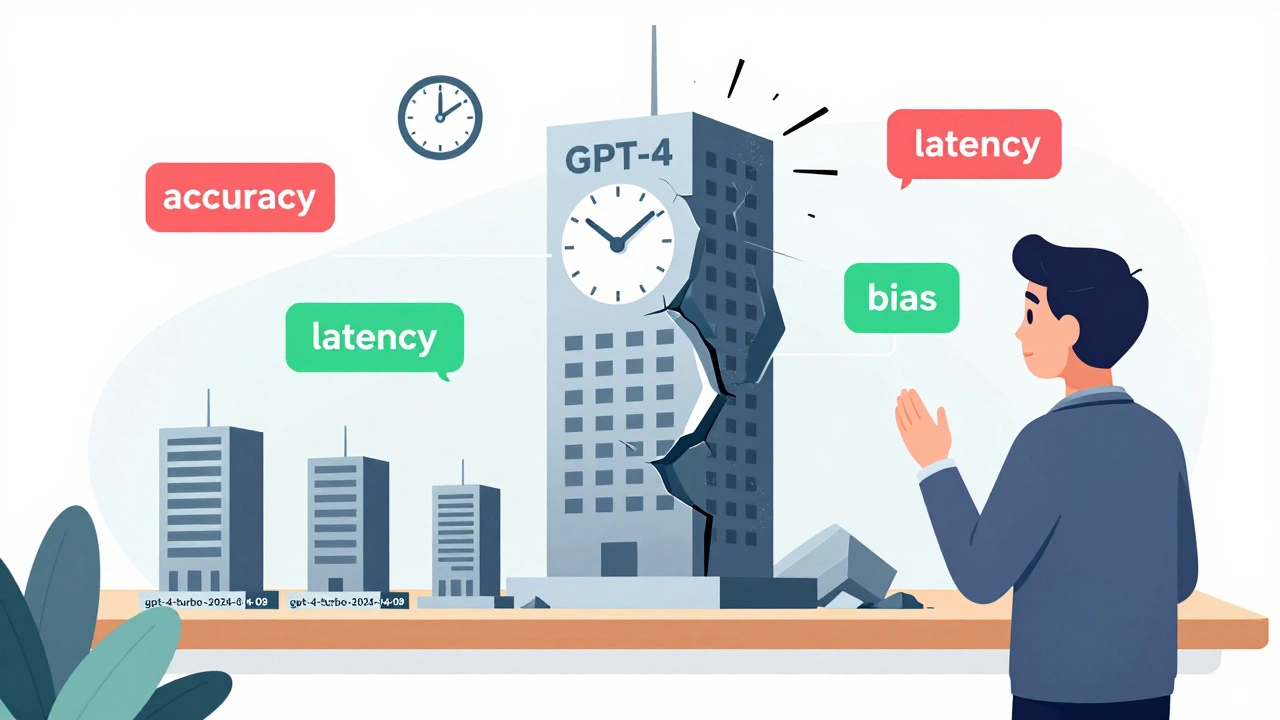
Model lifecycle management for LLMs - often called LLMOps - isn’t just a buzzword. It’s the process of tracking every version of a model from the moment it’s trained until it’s turned off. This includes logging where the data came from, how it was fine-tuned, which users accessed it, and when it’s scheduled to be retired. Unlike traditional software, LLMs don’t have clear version numbers that always mean stability. One day, a model might give you accurate answers. The next, after an invisible update, it starts hallucinating or missing key context. According to Gartner’s September 2025 report, 78% of Fortune 500 companies now have formal LLMOps teams. Why? Because without them, models drift. A model trained on 2023 financial data won’t understand new SEC rules in 2025. A model fine-tuned for customer service might start misclassifying complaints after a minor update. Google’s Vertex AI tracks over 37 performance metrics - including latency, bias, and accuracy drift - to catch these issues before they hit production. If you’re not monitoring at least 10 of these metrics, you’re flying blind.How Major LLM Providers Handle Updates and Deprecation
Not all LLMs are created equal when it comes to updates. Here’s how the big players handle it:- OpenAI: After years of silent updates, OpenAI finally changed its approach in June 2025. Now, GPT models get 180 days’ notice before deprecation. Versions like gpt-4-turbo-2024-04-09 are immutable - meaning they won’t change. But if you’re still using gpt-3.5-turbo without a version suffix, you’re on the unstable channel. In January 2025, that model changed behavior without a version bump, breaking dozens of enterprise workflows overnight.
- Google Gemini: Google uses a hybrid model. Major versions like Gemini 1.5 get 24 months of full support, followed by 12 months of security-only patches. Minor updates like Gemini 1.5 Pro-002? Only 9 months. Their Vertex AI platform now includes Model Health Scores, which auto-trigger retraining if performance drops below 85%. If you’re using Gemini through Vertex AI, you get versioning, rollback, and monitoring built in.
- Anthropic Claude: Claude’s biggest flaw? No versioning. It’s one model, constantly updated. That’s great for users who want the latest intelligence. Terrible for enterprises that need to audit, comply, or lock in behavior. A January 2025 Forrester study found Claude scored highest in update transparency (87% notification rate), but lowest in predictability. If your compliance team needs to prove a model didn’t change between Q1 and Q2, Claude makes that impossible.
- Meta Llama 3: Open-source means full control - and full responsibility. You manage the training data, the deployment, the monitoring, and the deprecation. GitHub’s 2025 State of AI report found companies using Llama 3 spend 37% more engineering hours on lifecycle management than those using proprietary models. But they also gain 42% more control over when to retire a version. If you have a strong ML team, Llama 3 gives you freedom. If you don’t, it’s a ticking time bomb.
The Hidden Cost of Poor Lifecycle Management
It’s easy to think, “We just use the API. It just works.” But the real cost shows up in the quiet failures. A fintech startup in Chicago lost $1.2 million in trading opportunities in early 2025 because their model - Cohere Command 2024-08 - quietly lost accuracy on financial jargon. No one noticed because there was no alerting system. No version tracking. No rollback plan. Just a model that slowly got worse. Reddit threads from March 2025 show 63% of users had production systems break due to unexpected LLM changes. OpenAI’s GPT-3.5-turbo was the biggest offender - not because it was bad, but because it had no versioning. Users assumed “gpt-3.5-turbo” meant the same model forever. It didn’t. MIT’s February 2025 whitepaper found 147 cases where deprecated models were still running in production code nine months after being officially retired. That’s not a bug. That’s negligence. And it’s happening because companies treat LLMs like magic boxes instead of software with expiration dates.
What You Need to Build a Real LLMOps System
You don’t need a fancy platform to start. But you do need these five things:- Versioned endpoints: Never use raw model names like gpt-4. Always use gpt-4-turbo-2024-04-09. Immutable versions are your safety net.
- Model registry: Track every model you use. What data was it trained on? What hyperparameters were used? Who approved it? Tools like MLflow (with 12,400 GitHub stars as of June 2025) can help.
- Performance monitoring: Monitor at least 10 metrics: latency, cost per request, accuracy, bias, output length, toxicity, and drift. Set alerts. If accuracy drops 5% in a week, pause the model.
- Rollback plan: Can you revert to a previous version in 15 minutes? If not, you’re not ready. Google and AWS let you do this with one click. If you’re using Llama 3, you need to build this yourself.
- Deprecation calendar: Know when each model is due to retire. OpenAI gives 180 days. Google gives 12-24 months. Anthropic gives zero. Build a spreadsheet. Update it monthly.
Open-Source vs. Proprietary: Which Is Safer?
This isn’t about which is better. It’s about which fits your team. Open-source models like Llama 3 give you total control. You can audit the weights. You can retrain them on your own data. You can keep using them forever - if you’re willing to maintain them. But that means hiring engineers who understand fine-tuning, data pipelines, and monitoring. Most companies aren’t ready for that. Proprietary models like GPT-4 or Gemini are easier to start with. But you’re locked into their timeline. If they deprecate a model you rely on, you have to switch - fast. And if they don’t notify you properly? You’re out of luck. Amazon Bedrock scored 4.6/5 on G2 Crowd in Q1 2025 because it gives 90-day deprecation warnings. OpenAI improved to 62% notification compliance after user backlash. Anthropic? 87% - but still no versioning. So if you want transparency, go with Anthropic. If you want control, go open-source. If you want ease, go with Bedrock or Vertex AI.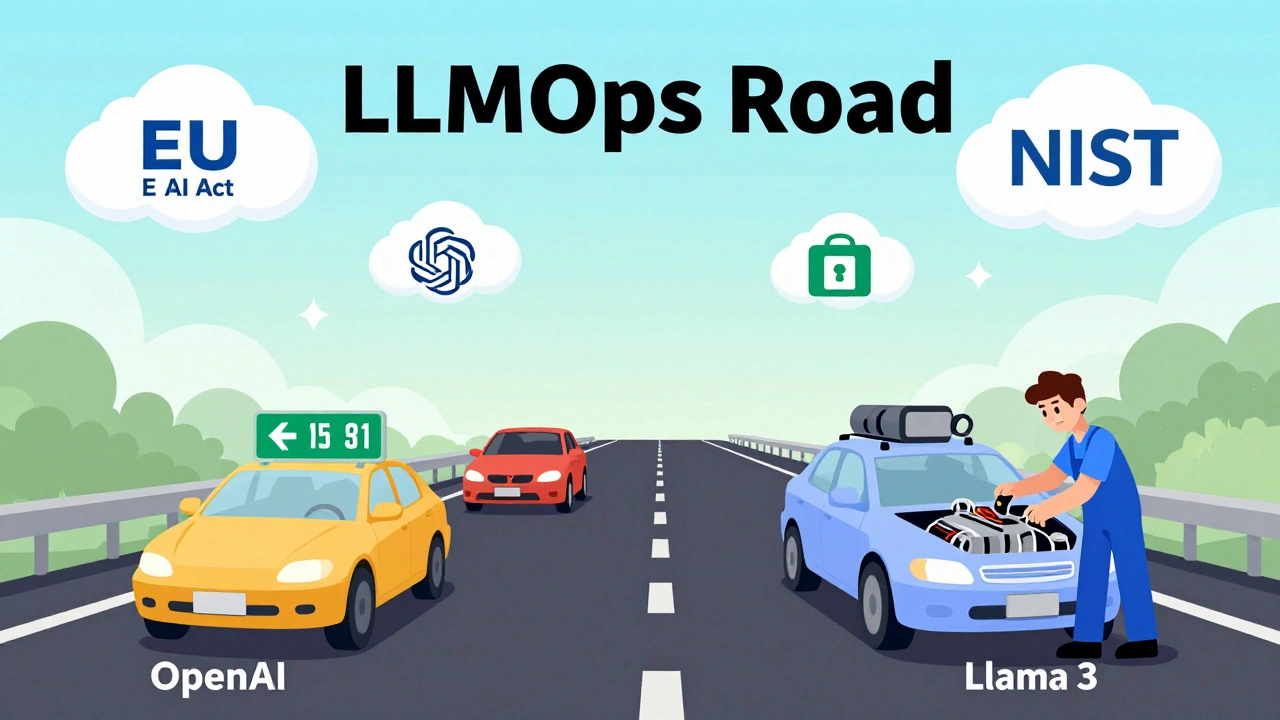
The Future: Standardization Is Coming - Fast
The market is waking up. The EU AI Act, effective July 2025, requires documented lifecycle management for high-risk AI systems. The U.S. NIST AI Risk Management Framework is now mandatory for 78% of federal contractors. And the new LLM Lifecycle Management Consortium, launched in May 2025 with 47 members, is pushing for industry-wide deprecation standards. By 2026, Constellation Research predicts 90% of enterprises will require standardized deprecation timelines in vendor contracts. Vendors who don’t comply will lose market share. That’s not speculation. That’s the direction the industry is heading. OpenAI’s June 2025 API update was a turning point. After years of criticism, they finally gave enterprises the versioning and notice they demanded. It’s a sign: the era of “trust us, we’ll update you” is over.What Should You Do Today?
Here’s your 30-minute action plan:- Check every LLM you’re using. Are you calling it by version number? If not, fix it now.
- Find the deprecation schedule for each model. OpenAI? Google? Anthropic? Write it down.
- Set a calendar alert for every model’s end-of-life date. Add 30 days buffer.
- Pick one critical workflow - customer support replies, for example - and add monitoring. Use a free tool like LangChain or Hugging Face’s inference API to log outputs and track changes.
- Ask your vendor: “Do you have a documented deprecation policy? Can I get it in writing?” If they can’t answer, start planning a backup.
Jamie Roman
December 13, 2025 AT 21:08I’ve been using gpt-3.5-turbo without a version suffix for over a year now, and honestly, I thought it was just ‘the model’-like how we used to say ‘Windows 10’ and never thought about patches. But last month, our chatbot started giving weirdly passive-aggressive replies to customer complaints. Took us three days to realize the model had quietly changed its tone thresholds. No warning. No changelog. Just… different. Now I version everything. Even if it’s annoying. Even if the API docs don’t make it obvious. I’d rather spend an hour setting up a registry than lose a client because some engineer at OpenAI decided ‘more creative’ meant ‘less accurate.’
Salomi Cummingham
December 15, 2025 AT 16:22Oh my god, YES. I had a client who used Claude for legal doc summaries and got sued because the model started omitting clauses after a ‘minor’ update. No versioning. No audit trail. Just… poof. Gone. The compliance officer cried in the Zoom meeting. I’ve never seen someone so visibly shaken by an AI. We switched to Vertex AI the next week. Now we have Model Health Scores, rollback buttons, and a spreadsheet that updates itself. It’s not glamorous, but it’s the difference between sleep and panic attacks. If you’re not doing this, you’re not using AI-you’re gambling with your reputation.
Johnathan Rhyne
December 16, 2025 AT 08:41Okay, but let’s be real-this whole ‘LLMOps’ thing is just corporate jargon for ‘we didn’t plan ahead.’ You don’t need a ‘model registry’ if you just stop using unstable APIs. And why is everyone acting like OpenAI’s 180-day notice is some kind of miracle? It’s basic software hygiene. Also, ‘GPT-4-turbo-2024-04-09’? That’s not a version number, that’s a sentence. And ‘Model Health Scores’? Sounds like a fitness tracker for robots. Can we just agree that if you can’t pin down what version you’re running, you shouldn’t be in production? Also, semicolons are not optional. This article used 17. I counted.
Gina Grub
December 17, 2025 AT 11:51Anthropic’s zero versioning is a disaster waiting to explode. I’ve seen teams lose entire quarters because their ‘Claude’ suddenly started refusing to summarize contracts. No logs. No history. Just ‘it worked yesterday.’ And now everyone’s panicking about ‘LLMOps’ like it’s some new religion. Newsflash: it’s not. It’s called version control. You’ve had it since 2005. Why are we pretending LLMs are magic? They’re not. They’re just poorly documented code with a fancy interface. And if your vendor won’t give you a deprecation schedule in writing, fire them. Now.
Nathan Jimerson
December 19, 2025 AT 06:59It’s not about fear-it’s about responsibility. I work with startups in India where resources are tight, but we still track every model version, every endpoint, every metric. It takes discipline, not money. Start small: pick one workflow, log the output, compare week to week. You don’t need a team. You just need to care enough to check. The future doesn’t belong to the biggest teams. It belongs to the most careful ones.
Sandy Pan
December 20, 2025 AT 20:50There’s a deeper question here: if we treat LLMs like appliances-plug in, use, forget-then we’re not building intelligence. We’re outsourcing thought. The real crisis isn’t model drift. It’s our willingness to let opaque systems make decisions we can’t explain. When a model changes and we don’t notice, it’s not a technical failure. It’s a philosophical one. We’ve handed over our judgment to something we refuse to understand. And now we’re surprised when it betrays us. Maybe the real LLMOps isn’t about versioning. It’s about humility.
Eric Etienne
December 21, 2025 AT 22:26Lmao at all these people acting like they just discovered version control. You don’t need a spreadsheet. You don’t need ‘Model Guardian.’ Just stop using gpt-3.5-turbo without a version. Done. That’s it. If you’re spending 37% more hours on Llama 3, maybe you’re not cut out for this. Or maybe you just need to read the damn docs. This whole post reads like a consultant’s LinkedIn carousel. Chill out. Use versioned endpoints. Move on.
Dylan Rodriquez
December 23, 2025 AT 04:15Look, I get why people are overwhelmed. LLMs feel like black boxes, and that’s scary. But we don’t have to panic-we can build systems that give us back control, one small step at a time. Start with one workflow. Use LangChain to log outputs. Set a weekly check-in. Celebrate when you catch a drift before it breaks something. You don’t need to be Shopify. You just need to be consistent. And if you’re reading this and thinking ‘I don’t have time,’ ask yourself: do you have time to lose $1.2 million? Or a client’s trust? This isn’t about being perfect. It’s about being intentional. And that’s something every team, no matter how small, can choose to do.
Amanda Ablan
December 24, 2025 AT 21:05Just wanted to say thank you for writing this. I’ve been silently panicking since our support bot started giving weird answers last month. I didn’t know if it was me, the data, or the model. Now I know. And I’m not alone. I’ve already switched our main endpoint to gpt-4-turbo-2024-04-09 and set a calendar alert for its deprecation date. Small win. But it feels like the first real step forward. If you’re reading this and feel lost-you’re not. Start here. One version. One alert. One less sleepless night.