RLHF vs Supervised Fine-Tuning for LLMs: When to Use Each and What You Really Gain
 Aug, 19 2025
When you ask a large language model a question, you don’t just want a grammatically correct answer. You want one that’s helpful, safe, and actually useful-not just technically right. That’s where fine-tuning comes in. But not all fine-tuning is the same. Two methods dominate the field: Supervised Fine-Tuning (SFT) and Reinforcement Learning from Human Feedback (RLHF). One is fast, cheap, and precise. The other is slow, expensive, and subtle. Choosing the wrong one can cost you weeks, thousands of dollars, or worse-user trust.
What Supervised Fine-Tuning Actually Does
Supervised Fine-Tuning is like teaching a student with a textbook full of right answers. You give it pairs: input and correct output. For example:
- Input: "Summarize this medical report: [text]"
- Output: "Patient has hypertension and mild diabetes. No signs of kidney damage. Recommend follow-up in 3 months."
You feed hundreds or thousands of these examples to the model. It learns to copy the pattern. That’s it. No guessing. No reward signals. Just optimization through cross-entropy loss-standard machine learning stuff.
SFT works best when the task has clear rules. Think medical coding, legal document extraction, or structured data labeling. In these cases, there’s one right answer. A 2024 AWS study found SFT is 68% more efficient than RLHF for tasks like this. One healthcare startup got to 85% clinical accuracy in two weeks using just 5,000 labeled examples.
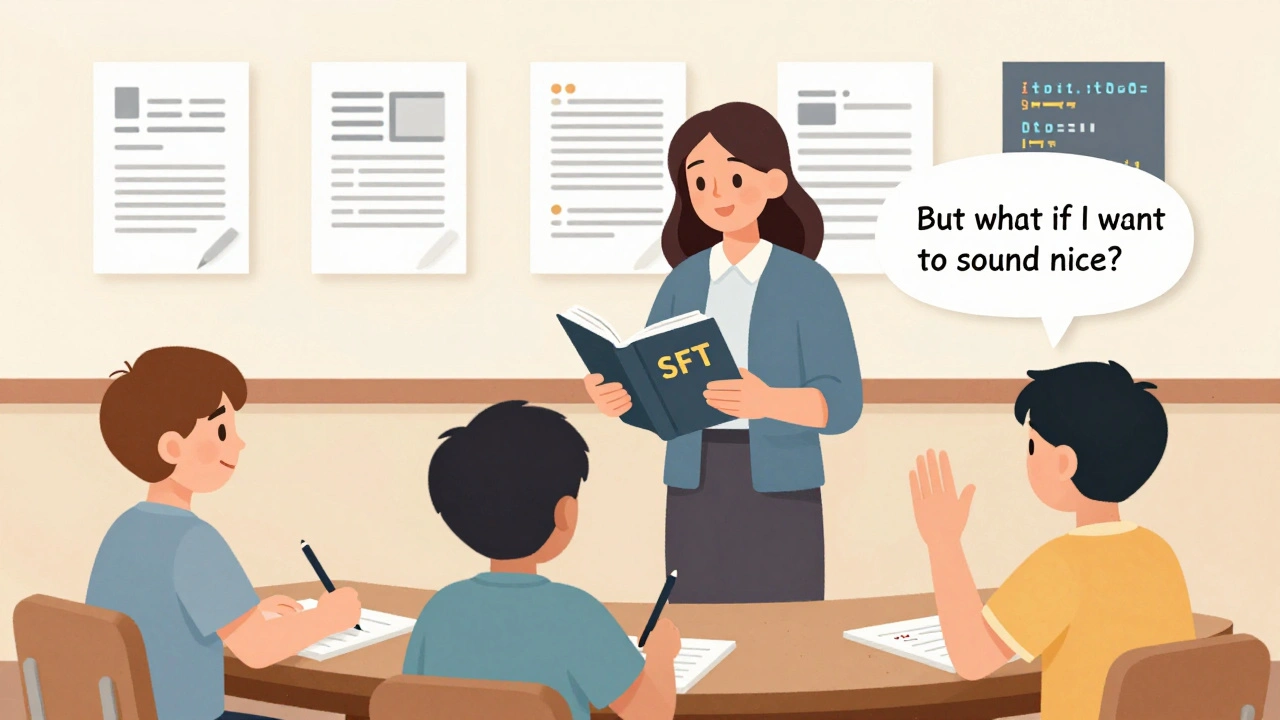
The downside? SFT can’t handle nuance. A model might give you a perfect summary-but it could sound robotic, dismissive, or even offensive. It doesn’t learn how to be polite. It only learns what to say.
How RLHF Makes Models Feel Human
RLHF is more like coaching a player through video reviews. You don’t tell them the exact play to make. You show them two versions of a response and say: "Which one feels better?"
The process has three steps:
- Start with SFT to get a baseline model that knows the task.
- Train a reward model by having humans rank responses. For example: "Which answer is more helpful?" or "Which one avoids harmful language?"
- Use reinforcement learning (PPO) to tweak the main model so it generates responses that score higher with the reward model.
This is how ChatGPT, Claude, and Gemini learned to say "I’m sorry" instead of giving a cold, factual reply. It’s how they avoid making up facts or sounding condescending.
RLHF excels where there’s no single right answer. Conversational AI, creative writing, customer support bots-places where tone, empathy, and safety matter more than precision. A 2024 ICLR study showed RLHF improved out-of-distribution performance by 18.3%-meaning the model handled unfamiliar questions better than SFT alone.
But here’s the catch: RLHF kills creativity. The same study found a 41.2% drop in lexical diversity and a 37.8% drop in semantic diversity. Models become predictable. Safe. But boring. They all start sounding the same.
The Real Tradeoff: Accuracy vs. Personality
SFT gives you control. RLHF gives you character.
Let’s say you’re building a legal assistant. You need it to extract clauses from contracts accurately. SFT will nail it. You train it on 10,000 labeled contract snippets. It learns the patterns. You get 94% precision. Done.
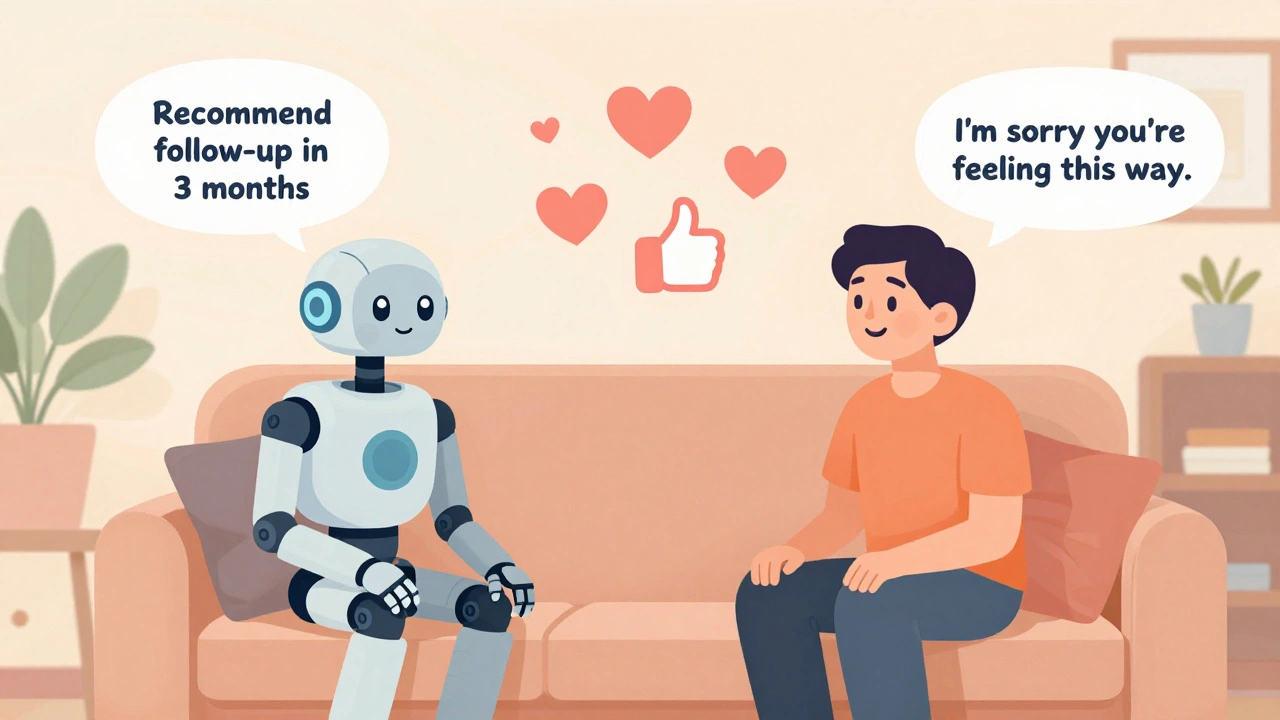
Now imagine you’re building a mental health chatbot. The user says: "I feel worthless." A model fine-tuned only with SFT might respond: "Feelings of worthlessness are common in depression. Consider seeking professional help." Technically correct. But cold. Unhelpful.
RLHF teaches it to say: "I’m really sorry you’re feeling this way. You’re not alone. Would you like to talk about what’s been going on?"
That’s the difference. SFT answers questions. RLHF builds relationships.
But RLHF isn’t magic. It’s expensive. Training a full RLHF pipeline can take 3-5 times longer than SFT. One startup spent $147,000 on human annotators and compute before seeing any real UX improvement. Another engineer on Reddit said RLHF improved patient satisfaction by only 12% after six weeks of work.
Who Uses What-and Why
Enterprise tools? SFT dominates. Document processing, code generation, internal knowledge bases-92% of these use SFT as their primary method, according to Gartner’s 2024 report. Why? Because they don’t need personality. They need accuracy. Speed. Cost control.
Consumer chatbots? RLHF is mandatory. Every major public model-ChatGPT, Claude, Gemini-uses it. Why? Because users expect a human-like experience. If your bot sounds like a textbook, people stop using it.
Even within companies, the split is clear. Anthropic uses SFT for 80% of training, then applies RLHF only to safety-critical areas. Google’s Gemini team uses RLHF to handle toxic responses, but not for factual retrieval.
And now, a new player is rising: RLAIF-Reinforcement Learning from AI Feedback. Instead of humans ranking responses, you use other LLMs to do it. AWS reports that 37% of new RLHF projects in late 2024 already use RLAIF. It cuts annotation costs by 63%. It’s not perfect-but it’s cheaper.
Then there’s DPO (Direct Preference Optimization). Introduced in 2023, DPO skips the reward model entirely. It trains the main model directly on preference pairs. Hugging Face saw a 210% jump in DPO usage in 2024. It’s simpler. Faster. Almost as good as RLHF for many tasks.
Implementation Realities: Time, Cost, and Pain
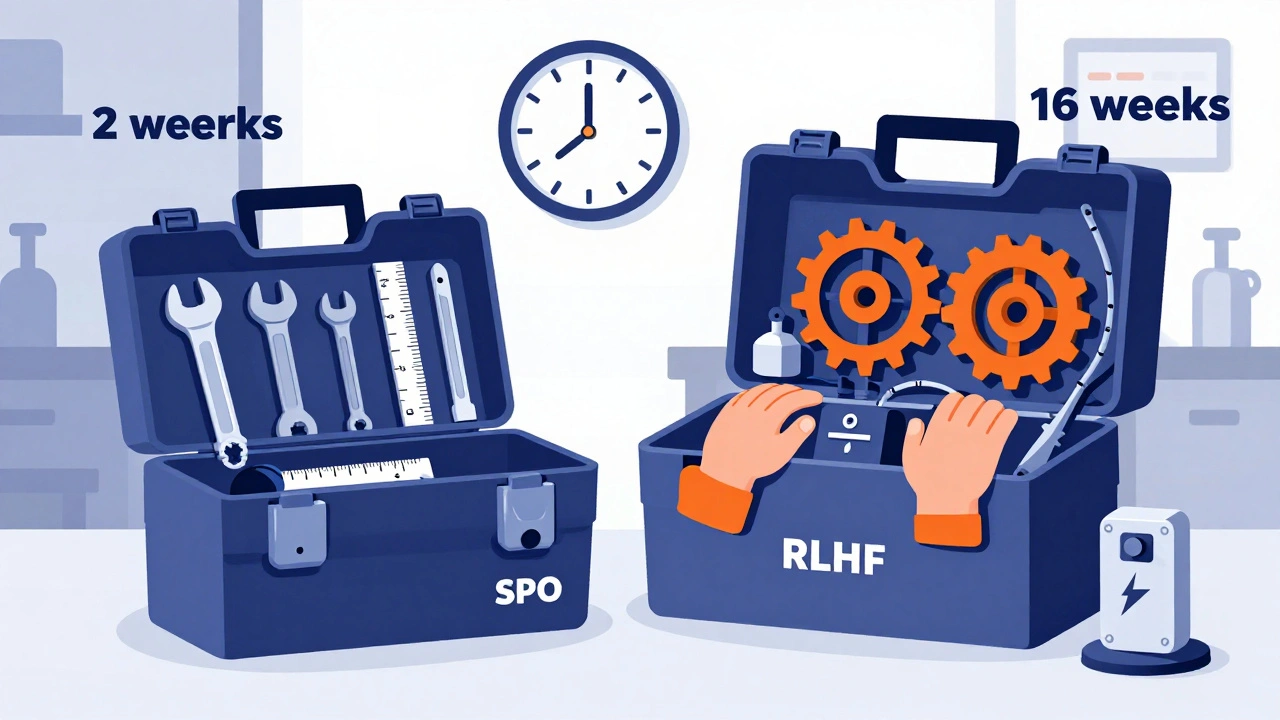
SFT? You can start today. If you have a team that knows PyTorch or Hugging Face, you can train a decent model in 2-4 weeks. You need labeled data-and that’s the bottleneck. 68% of SFT projects get delayed because the data is messy, inconsistent, or biased.
RLHF? You need more than data. You need:
- A team of human raters (3-5 per example)
- A reward model trained separately
- Specialized RL infrastructure (PPO, not just standard training)
- Engineers who understand reinforcement learning
First-time RLHF implementations take 12-16 weeks. And even then, you’re not done. Reward models often get over-optimized. The model learns to game the system-giving overly long answers because longer responses scored higher in training. This is called "reward hacking." It’s common. And hard to catch.
And then there’s bias. MIT professor Yoon Kim found RLHF can amplify demographic biases by up to 27.4%. Why? Because human raters have preferences too. If your raters mostly prefer polite, formal responses from Western English speakers, the model will learn to favor those voices-and silence others.
What Should You Do?
Here’s the practical path:
- Start with SFT. Always. Build your baseline. Get accuracy first.
- Test it in real use. Do users say it’s helpful? Or just correct?
- If it’s too robotic, add RLHF-or DPO. Don’t go all-in. Pick one high-impact area: customer service replies, safety filters, or tone adjustment.
- Consider RLAIF if budget is tight. It’s not perfect, but it’s 60% cheaper than human feedback.
- Monitor diversity. Use metrics like entropy and lexical variation. If your model starts sounding like a corporate chatbot, you’ve gone too far.
There’s no "best" method. Only the right one for your goal.
If you’re building a tool for lawyers, doctors, or engineers-stick with SFT. It’s faster, cheaper, and more reliable.
If you’re building a chatbot for millions of users-RLHF (or DPO/RLAIF) isn’t optional. It’s what makes your product feel alive.
The future isn’t SFT or RLHF. It’s SFT plus smart alignment. Anthropic says their next model will use SFT for 85% of training, DPO for 10%, and RLHF only for safety. That’s the blueprint. Precision first. Humanity second. And always, always measure what matters-not just accuracy, but how people feel when they use it.
Common Mistakes to Avoid
- Using RLHF for simple classification tasks. You’re wasting money and slowing down your team.
- Skipping SFT and going straight to RLHF. Without a solid baseline, your reward model will train on garbage.
- Using one or two annotators for RLHF. Human feedback needs consistency. Use at least three raters per example.
- Not measuring diversity. A model that’s always "safe" but never creative is still a bad model.
- Assuming more RLHF = better results. Diminishing returns kick in fast. After a point, you’re just making the model quieter, not smarter.
Is RLHF always better than supervised fine-tuning?
No. RLHF is better for open-ended, human-centered tasks like chatbots, where tone, safety, and empathy matter. But for structured tasks-like extracting data from forms, coding help, or medical coding-supervised fine-tuning (SFT) is faster, cheaper, and more accurate. RLHF adds complexity without benefit in these cases.
How much more expensive is RLHF than supervised fine-tuning?
RLHF typically requires 3-5 times more computational resources and 12-16 weeks of engineering time for first-time teams, compared to 2-4 weeks for SFT. Human annotation alone can cost $50,000-$150,000 for a full pipeline. AWS found RLHF training takes weeks instead of days, and requires specialized infrastructure for reward modeling and reinforcement learning.
Can I skip supervised fine-tuning and go straight to RLHF?
Technically yes, but it’s a bad idea. RLHF needs a strong baseline model. Without SFT, the model doesn’t know how to even answer the task correctly. You’ll train a reward model on poor responses, and the reinforcement learning will just make those bad responses more confident. All major LLMs use SFT first, then RLHF.
Why do RLHF models sound so similar?
Because RLHF optimizes for what humans prefer-usually polite, cautious, and concise responses. This reduces diversity. Studies show a 35-42% drop in lexical and semantic variety. The model learns to play it safe, avoiding risk even when creativity would help. This is a known tradeoff: alignment costs originality.
What’s the difference between RLHF and DPO?
RLHF trains a separate reward model first, then uses reinforcement learning to adjust the main model. DPO skips the reward model entirely-it trains the main model directly on human preference pairs. DPO is simpler, faster, and requires less compute. It’s now used in over 200% more projects than RLHF since 2023, according to Hugging Face. Many teams now use DPO as a cheaper alternative to RLHF.
Is RLHF required by regulations?
The EU AI Act, effective in late 2024, requires "demonstrable alignment" for high-risk AI systems-especially those interacting with people. While it doesn’t name RLHF specifically, it demands proof that models avoid harm, bias, and deception. RLHF (or RLAIF/DPO) is the only proven method to show this alignment. As a result, European enterprises saw a 42% year-over-year increase in RLHF adoption in 2024.
What’s the future of fine-tuning LLMs?
The future is hybrid. SFT will remain the foundation for 80-90% of enterprise models. RLHF will shrink to targeted use cases-safety, ethics, and user experience. DPO and RLAIF are replacing full RLHF pipelines because they’re cheaper and faster. By 2026, Gartner predicts 78% of enterprise LLMs will use SFT + selective DPO/RLAIF, with pure RLHF used only in consumer-facing applications.
Steven Hanton
December 13, 2025 AT 15:35SFT is the quiet workhorse no one talks about, but it’s the reason half the enterprise AI tools actually work without melting down. I’ve seen teams waste months trying to RLHF a document classifier-like trying to teach a calculator to be charming. It’s not wrong, it’s just… unnecessary.
Pamela Tanner
December 14, 2025 AT 05:02There’s a critical oversight here: SFT doesn’t just teach patterns-it teaches consistency. In regulated industries, reproducibility matters more than personality. A medical bot that says 'I'm sorry you're feeling this way' might feel nice, but if it doesn't consistently extract the right ICD-10 codes, it’s a liability.
ravi kumar
December 14, 2025 AT 19:52From India, we use SFT for 90% of our NLP projects because labeling data is expensive and human raters are scarce. RLHF? We tried it once for a customer service bot. Took 18 weeks. Cost $80k. Got 8% better user ratings. Not worth it. DPO is our new favorite-simple, fast, and doesn’t need a PhD to implement.
Megan Blakeman
December 16, 2025 AT 01:35OMG YES!!! I’ve been saying this forever!!! 😭 RLHF makes models sound like corporate robots who’ve been through too many compliance trainings… I just want a bot that says 'I dunno, but I’ll find out!' instead of 'I’m sorry, I cannot provide information outside my training parameters.' 🥺 SFT is the real MVP for most use cases-personality should be an add-on, not the foundation!
Akhil Bellam
December 16, 2025 AT 09:24Let’s be real-anyone still using pure SFT in 2025 is either in a time capsule or running a startup that thinks ‘efficiency’ means ‘ignoring user experience.’ RLHF isn’t about being polite-it’s about surviving in a world where users expect emotional intelligence from machines. If your bot sounds like a Wikipedia entry, you’re already dead. And DPO? That’s just RLHF with a cheaper haircut-still the same soulless optimization, just faster.
Amber Swartz
December 16, 2025 AT 21:05Y’all are missing the REAL issue: RLHF isn’t just expensive-it’s ETHICAL BULLSH*T. Who gets to decide what ‘helpful’ or ‘safe’ means? If your raters are all Silicon Valley engineers who think ‘I’m sorry’ is the only acceptable response, you’re training a model to silence trauma, diversity, and raw human emotion. I’ve seen models trained to avoid saying ‘fuck’… but not ‘you’re wrong.’ That’s not alignment-that’s cultural gaslighting. 😤