Supply Chain Optimization with Generative AI: Demand Forecast Narratives and Exceptions
 Feb, 27 2026
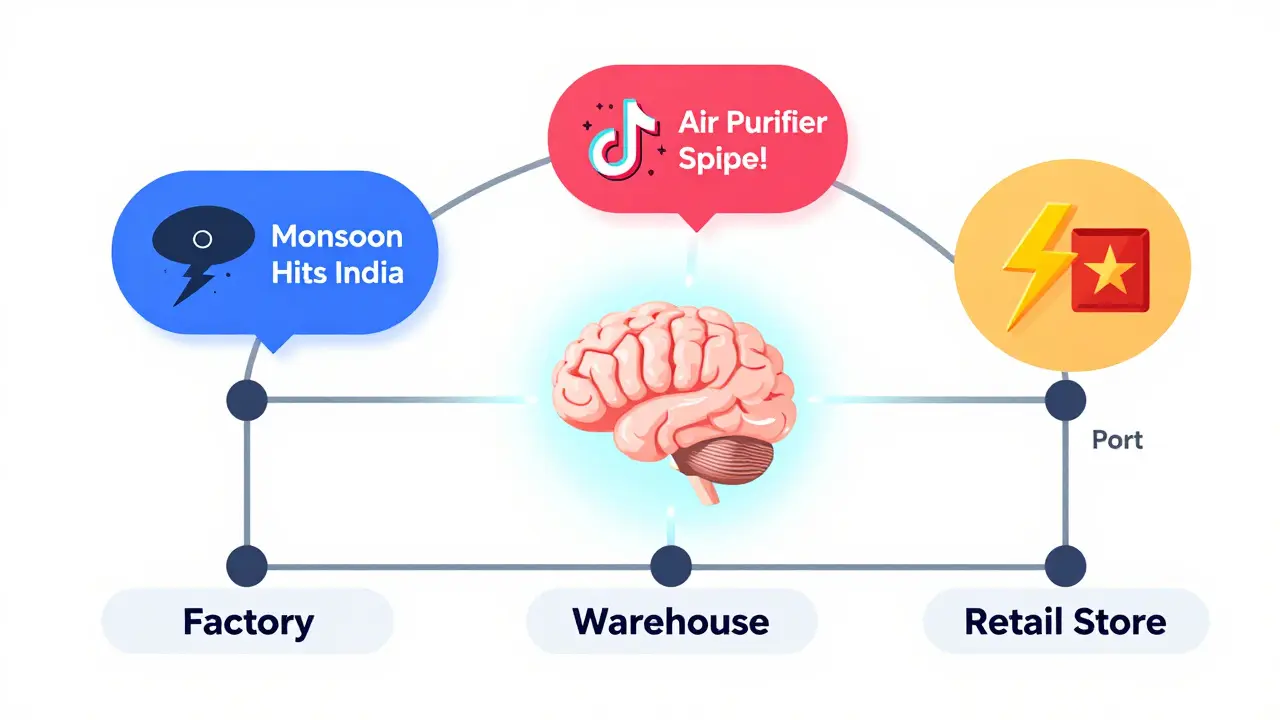
Most companies still use old-school methods to guess how much product they’ll need next month. They look at last year’s sales, adjust for seasonality, maybe throw in a gut feeling. But when a hurricane hits a port, a new viral trend spikes demand overnight, or a supplier in Vietnam suddenly goes silent - those models break. That’s where generative AI changes everything. It doesn’t just predict numbers. It tells stories. And it flags the exceptions you didn’t even know to worry about.
Why Traditional Forecasting Fails in Real-World Supply Chains
ARIMA models, exponential smoothing, even basic machine learning tools were built for stable environments. They assume patterns repeat. But today’s supply chains don’t work that way. A single disruption - say, a strike at a key port or a sudden tariff change - can ripple across continents. In 2023, one retailer saw a 40% spike in demand for portable air purifiers after a wildfire report went viral. Their old system? It kept ordering based on last year’s slow summer sales. Stockouts hit 60% in three weeks.
Traditional tools can’t process unstructured data. They don’t care about social media chatter, weather patterns, or geopolitical headlines. They only see numbers. But generative AI doesn’t just crunch numbers - it reads context. It connects a tweet about a product shortage to a shipping delay in the South China Sea, then simulates what happens if both happen at once. That’s not magic. It’s data fusion.
How Generative AI Builds Demand Narratives
Generative AI doesn’t give you a single forecast. It gives you dozens - each with a story. Instead of saying “Demand for Product X will be 12,000 units next month,” it says:
- “If the monsoon hits early in India, demand for waterproof jackets rises 32% - and logistics costs jump 18% due to port delays.”
- “If competitor Y launches a similar product next week, we could lose 15% of our market share unless we drop prices by 8%.”
- “If our key chemical supplier in Germany faces a labor strike, we’ll run out of inventory in 11 days - but we can shift production to our Mexico plant with 72 hours’ notice.”
This is called narrative forecasting. It turns dry numbers into actionable scenarios. Companies using this approach don’t just react - they prepare. One biotech firm used generative AI to simulate 87 different scenarios for a rare chemical used in cancer drugs. When a fire broke out at the only factory producing it, they had three backup suppliers lined up, a revised production schedule, and a customer communication plan - all ready in under 48 hours. Their old system? It would’ve taken three weeks just to figure out the problem.
What Makes Demand Exceptions Different Now
Not all forecast errors are the same. Some are noise. Others are signals. Generative AI learns to tell the difference.
Before, an exception was just a number that didn’t match the forecast. Now, it’s a story with causes, consequences, and possible fixes. A 20% drop in sales? It could mean:
- A competitor ran a better ad campaign (detected via social sentiment analysis).
- A key distributor cut ties (confirmed via supplier network data).
- There was a regional power outage affecting retail POS systems (verified via weather and utility outage APIs).
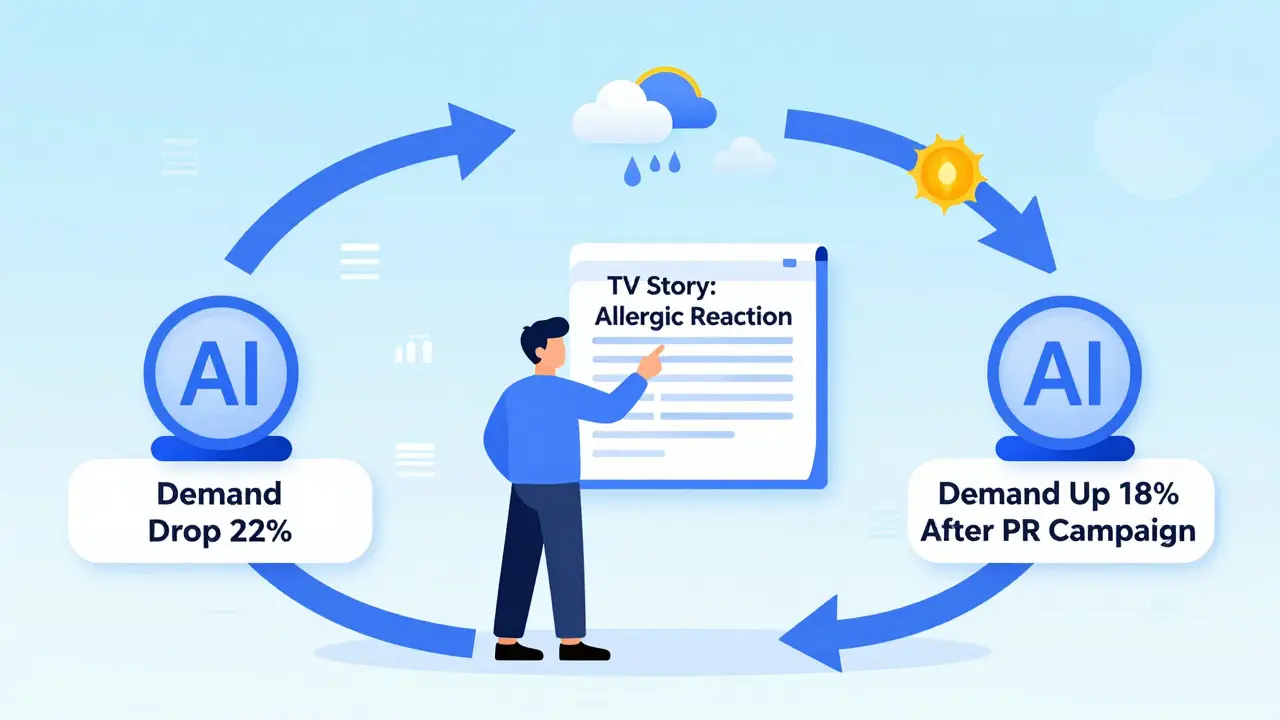
Traditional tools see the drop. Generative AI sees the why. And more importantly - it suggests what to do next. In one retail case, the AI flagged a 22% sales drop in the Midwest. The narrative: “Local TV news ran a story linking your product to a rare allergic reaction. Social media mentions spiked 140% in 72 hours.” The company didn’t just scramble to fix inventory - they launched a targeted PR campaign, adjusted ad spend, and retrained store staff. Within 10 days, sales bounced back. Without the narrative, they might’ve just lowered prices - losing margin for no reason.

Real-World Results: Numbers That Matter
Companies aren’t just testing this. They’re seeing real changes:
- Inventory costs dropped 35% for a global electronics manufacturer after switching to generative AI. They cut safety stock by 22% without increasing stockouts.
- Logistics expenses fell 15% for a pharmaceutical distributor by rerouting shipments based on AI-predicted port delays.
- Service levels jumped 65% for a healthcare supplier - meaning fewer patients waited for critical meds.
These aren’t theoretical gains. They come from real deployments. One company in Bellingham - a maker of specialty medical devices - reduced its planning cycle from 11 days to 8 hours. They now run 120 different demand scenarios every Monday morning. Their planners don’t just look at numbers - they debate stories. “What if the FDA delays approval?” “What if our main courier goes bankrupt?”
The Hidden Cost: Data and Integration
Generative AI isn’t plug-and-play. It needs fuel - clean, connected data. You can’t feed it 10 years of messy Excel files and expect miracles. Successful implementations require:
- 6-12 months of clean, consistent sales data per product.
- Integration with ERP systems like SAP or Oracle - not just APIs, but real-time syncs.
- At least 15 external data sources: weather APIs, shipping trackers, social media feeds, economic indicators, even news feeds.
One manufacturer spent 14 months just cleaning data before the AI started giving useful outputs. They had 17 different systems tracking inventory. No wonder their forecasts were wrong. The AI didn’t fail - the data did.
And the infrastructure? You need cloud power. GPU servers. Real-time pipelines. This isn’t something you run on a laptop. Most companies start small - one product line, one region - then scale.
When Generative AI Falls Short
It’s not perfect. And it shouldn’t be trusted blindly.
For products with stable, predictable demand - like toilet paper or salt - simpler models still win. The AI adds complexity without value. IBM’s own data shows that for seasonal, low-variability items, the return on investment drops sharply.
Then there’s the “black box” problem. When the AI says “demand will drop 18% next week,” and you don’t know why, you’re stuck. That’s why leading platforms now focus on explainability. Tools like IBM’s Supply Chain Insights and AWS’s Supply Chain Genius don’t just predict - they show you the chain of logic. “This forecast changed because social sentiment in California shifted after a TikTok trend, and FedEx reported 3-day delays in the Southwest.”
And for brand-new products? No history means no reliable prediction. That’s where human insight still rules. A hybrid approach works best: AI proposes scenarios, planners validate them with market knowledge. One startup selling a new type of eco-friendly packaging used AI to simulate 50 demand paths - but only launched after their sales team confirmed the top three scenarios matched real customer conversations.
The Future: AI That Learns From Mistakes
The next big leap isn’t just in prediction - it’s in learning. Companies that build feedback loops see 35% faster improvement in their models. How? By treating every forecast exception as a lesson.
Here’s how it works:
- AI predicts demand.
- Actual sales come in.
- AI flags the exception: “We were off by 27% in Region 4.”
- Planner reviews: “Ah - that’s because we ran a promo we didn’t tell the system about.”
- Planner inputs the promo details into the system.
- AI updates its model. Next time, it knows.
This turns AI from a static tool into a living system. It’s not replacing planners - it’s making them smarter.
Who’s Leading the Pack?
The market is split between three types of players:
- Enterprise giants - IBM, SAP, Oracle - offer integrated suites. Great if you’re already using their ERP. But they’re expensive and slow to adapt.
- Specialized vendors - ToolsGroup, Blue Yonder - focus only on supply chain. They’re faster, more flexible, and often better at narrative generation.
- Cloud providers - AWS, Google Cloud - are rolling out vertical-specific tools. AWS’s “Supply Chain Genius” launched in late 2024 with exception-aware forecasting built right in.
Adoption is surging. In 2023, only 7% of Fortune 500 companies used generative AI for forecasting. By early 2026, it’s 29%. Retail leads at 41%, followed by pharma and automotive. The EU AI Act now classifies these systems as “high-risk” when used for critical inventory decisions - meaning compliance is part of the decision now.
What You Need to Do Next
If you’re thinking about this:
- Start with one product line. Not your whole supply chain.
- Fix your data first. Clean, unified data is non-negotiable.
- Choose a vendor that explains why forecasts change - not just what they change to.
- Train your planners to question the AI. Not blindly accept it. Not ignore it. Interrogate it.
- Build a feedback loop. Every exception is a chance to improve.
This isn’t about replacing humans. It’s about giving them superpowers. The best supply chain teams in 2026 won’t be the ones with the most data - they’ll be the ones who know how to listen to the stories the AI tells, and when to trust their own gut.
Can generative AI replace human supply chain planners?
No - and it shouldn’t try to. Generative AI excels at processing data, simulating scenarios, and spotting patterns humans miss. But it can’t interpret cultural shifts, negotiate with suppliers, or understand unspoken customer needs. The best outcomes come from hybrid workflows: AI generates narratives and flags exceptions, while planners validate, refine, and act. The role of the planner is evolving from number-cruncher to scenario interpreter.
How long does it take to implement generative AI for demand forecasting?
Typically 6 to 18 months, depending on data quality. The biggest delay isn’t the AI - it’s cleaning and connecting your data. Companies with fragmented systems across multiple ERP platforms often take 12-14 months just to unify their data before training begins. Once data is clean, model training takes 2-4 months, and integration into daily workflows adds another 1-3 months. Retailers with clean, centralized systems have seen results in as little as 7 months.
What data sources are most important for generative AI demand forecasting?
You need three layers: historical sales data (minimum 12-24 months), real-time operational data (inventory levels, shipping delays, production output), and external signals. The most valuable external sources are: weather data, social media sentiment, news feeds on geopolitical events, economic indicators (like consumer confidence), shipping port delays, and supplier performance metrics. One company improved accuracy by 42% just by adding real-time weather and freight tracking data.
Is generative AI worth it for small businesses?
It depends. If you have fewer than 50 SKUs and stable demand, simpler tools are cheaper and sufficient. But if you’re in a volatile industry - like fashion, pharma, or seasonal consumer goods - even small businesses can benefit. Cloud-based AI tools now offer subscription pricing starting under $500/month. For a small distributor managing 200 products across multiple regions, the ROI often pays for itself in reduced stockouts and lower safety stock within 8-10 months.
What’s the biggest mistake companies make when adopting generative AI?
They treat it like a black box. Many companies buy the software, feed it data, and expect perfect forecasts without training their teams. The result? Planners ignore the AI because they don’t understand it. Or worse - they trust it blindly and make bad decisions. The winning approach is to treat the AI as a collaborator. Train your planners to ask: “Why did it say that?” “What evidence supports this?” “What’s the fallback?” This builds trust and turns forecasts into conversations.
How do generative AI models handle completely new products with no sales history?
They struggle - but not alone. Leading systems now use hybrid approaches: they compare the new product to similar items in your portfolio (e.g., same category, price point, customer segment) and simulate demand based on how those products launched. They also pull in external signals - social buzz, competitor pricing, marketing spend - to fill the data gap. Still, human input is critical. The best results come when product managers and marketers review the AI’s initial projections and adjust them based on real-world market knowledge.
Sanjay Mittal
February 28, 2026 AT 11:35Been using generative AI for demand forecasting at my firm for 8 months now, and the shift from static numbers to narrative scenarios changed everything. We used to get blindsided by weather events or port delays-now we see them coming like a weather alert. One time, the AI flagged a 22% spike in demand for air purifiers because of a wildfire tweet thread. We didn’t even know that product was trending. Within 48 hours, we rerouted inventory from Europe to the West Coast. No stockouts. No panic. Just data telling a story. If you’re still using Excel for this, you’re running a manual car in a Tesla world.
Mike Zhong
February 28, 2026 AT 20:22Let’s be real-this whole ‘narrative forecasting’ thing is just corporate buzzword bingo wrapped in AI glitter. You think a model can ‘understand’ a TikTok trend? It’s just correlating noise with sales spikes. And don’t get me started on ‘explainability.’ If you need an AI to explain why it made a decision, you’re already too dependent on it. Human intuition, gut feel, and old-school market knowledge still beat any algorithm when it comes to reading between the lines of consumer behavior. This isn’t innovation-it’s overengineering.
Jamie Roman
March 2, 2026 AT 04:50I really appreciate how this post breaks down the difference between noise and signal. I work in healthcare logistics, and we’ve been drowning in false alarms from our old system-like, ‘Oh, demand dropped 15% in Ohio!’ Turns out, it was just a power outage at one big hospital’s POS system. The AI didn’t just see the drop-it connected it to the utility outage report, the weather data, and even a local news headline. Now, we don’t panic. We investigate. And honestly? It’s made my job less stressful. I used to get called in at 2 a.m. for every anomaly. Now, I get a summary at 8 a.m. with three possible scenarios and a recommended action. It’s like having a co-pilot who’s always awake.
Salomi Cummingham
March 3, 2026 AT 15:25Oh my goodness, this is exactly what we’ve been fighting for! I’ve spent years begging my team to look beyond the spreadsheet, to see the human stories behind the numbers. Remember when we lost 40% of our seasonal product line because the AI didn’t catch that a celebrity posted a photo holding it? We thought it was a glitch. Turns out, it was a viral moment. Now, with narrative forecasting, we don’t just track sales-we track *sentiment*, *context*, *momentum*. It’s not just about inventory anymore. It’s about empathy for the customer. The AI doesn’t replace intuition-it amplifies it. And that? That’s magic.
Johnathan Rhyne
March 5, 2026 AT 07:25Okay, but let’s not pretend this is revolutionary. ‘Generative AI tells stories’? What, now we’re in a children’s book? It’s pattern recognition with a thesaurus. And ‘narrative forecasting’? That’s just fancy jargon for ‘we ran Monte Carlo simulations and dressed them up like bedtime tales.’ Also, ‘exception-aware forecasting’? You mean, it noticed something weird? Wow. Groundbreaking. Also-‘feedback loops’? You mean, people type in corrections? That’s not AI-that’s data entry with a PhD. You’re not building superpowers. You’re just automating admin work. And why is everyone acting like this is new? We’ve been doing this since 2018. Stop hyping.
Jawaharlal Thota
March 6, 2026 AT 09:49I’ve seen this play out in India’s pharmaceutical supply chain-tiny distributors with 20 SKUs, no ERP, no data teams. But even they’re using AI now, thanks to cloud-based tools under $500/month. One guy in Hyderabad started with just sales data from his WhatsApp invoices and added weather and shipping delay APIs. Within six months, his stockouts dropped 60%. He didn’t need a team of data scientists. He just needed one spreadsheet cleaned, one API connected, and the courage to trust the AI’s top three scenarios. The real barrier isn’t tech-it’s mindset. If you think AI is ‘too complicated,’ you’re just scared of change. Start small. Clean your data. Let the stories emerge. You’ll be shocked how simple it gets.
Lauren Saunders
March 7, 2026 AT 04:50Oh, so now we’re romanticizing algorithms as storytellers? How quaint. This isn’t innovation-it’s performative tech theater. Companies are paying millions to turn their supply chains into TED Talks. ‘The AI says…’ ‘The narrative suggests…’ Who cares? What matters is whether the product arrives on time. And let’s not forget: most of these ‘exception-aware’ systems are trained on biased data-urban markets, English-language social media, Western consumer behavior. What about the rural supplier in Bangladesh whose sales spike because of a monsoon? The AI doesn’t ‘understand’ that. It just sees a spike and guesses. And then we act on a guess dressed up as a ‘story.’ This isn’t intelligence. It’s illusion.
sonny dirgantara
March 8, 2026 AT 09:32Andrew Nashaat
March 9, 2026 AT 09:12Let’s address the elephant in the room: You’re calling this ‘generative AI’-but you’re not generating anything. You’re interpolating historical noise with external data streams. That’s not generative. That’s predictive analytics with a marketing makeover. Also, ‘narrative forecasting’? Please. It’s not a story-it’s a correlation matrix with a voiceover. And you say ‘feedback loops’ make it better? That’s not learning-that’s manual correction. You’re not building AI. You’re building a glorified Excel macro with a chatbot interface. And don’t even get me started on the ‘explainability’ nonsense. If your model can’t explain itself without a 12-page PDF, it’s not intelligent-it’s a black box with a thesaurus. Stop pretending this is science. It’s a sales pitch dressed up in data.