Vibe Coding Adoption Metrics and Industry Statistics That Matter
 Dec, 10 2025
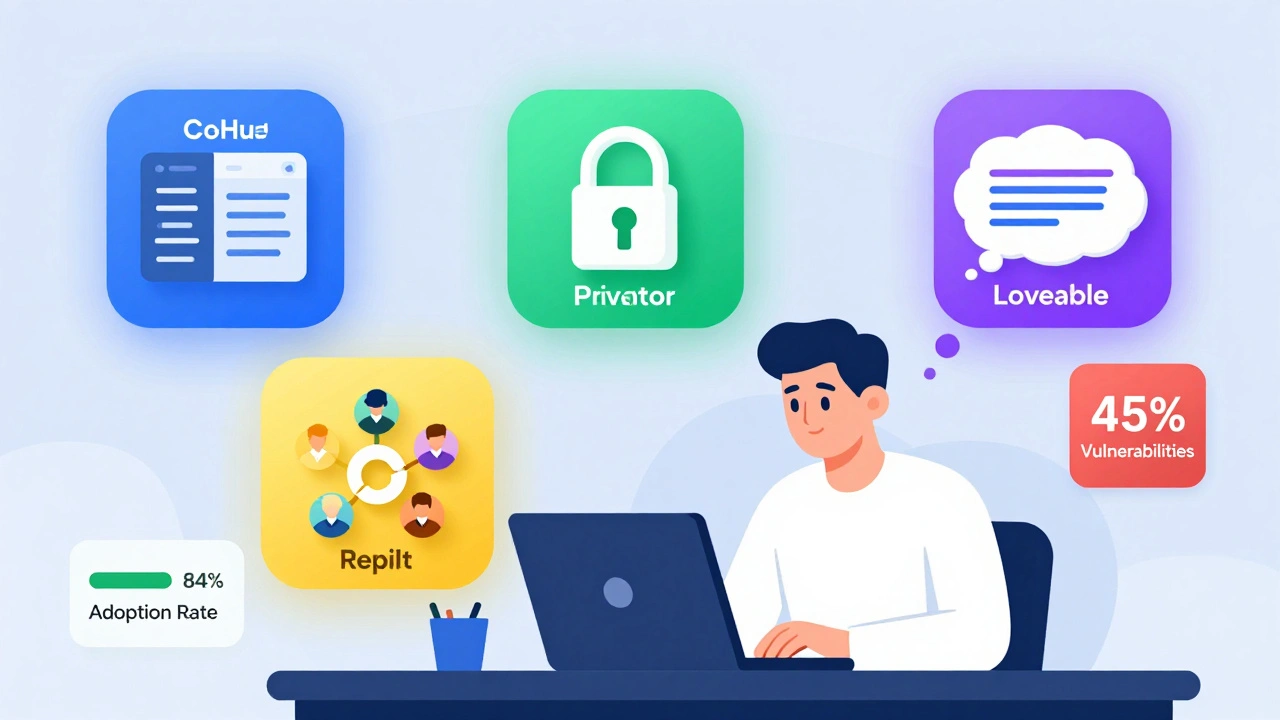
By 2025, vibe coding isn’t just a trend-it’s reshaping how software gets built. If you’re a developer, manager, or founder, you’ve probably seen AI-generated code pop up in your editor. Maybe you’ve used it. Maybe you’ve cursed it. Either way, the numbers don’t lie: 84% of developers are now using or planning to use AI-powered coding assistants, up from 70% just two years ago. That’s not slow adoption. That’s a seismic shift.
Who’s Using Vibe Coding-and How Much?
The data shows adoption isn’t evenly spread. GitHub Copilot still leads the pack, with 45% of enterprise developers relying on it. It’s the default choice for big companies like Microsoft, Google, and Amazon, where 20-30% of code in some repos now comes from AI. But startups? They’re leaning hard on Cursor. In Y Combinator’s 2025 cohort, 35% of teams use Cursor as their primary tool, mostly because it runs locally-no data leaves their machine. That matters when you’re handling sensitive IP or building for regulated industries.
Replit, with over 30 million users, dominates education and prototyping. It’s the go-to for students, bootcamp grads, and non-engineers trying to build something fast. Loveable, on the other hand, is carving out a niche in the no-code space. Its 2.3 million users aren’t coders-they’re product managers, designers, and founders who want to turn ideas into interfaces without writing a single line. And it works: 61.2% of Loveable users say it’s their fastest way to prototype.
Usage frequency is telling. Over 63% of users interact with these tools daily. Another 28% use them weekly. That’s not occasional experimentation. That’s daily workflow integration. But here’s the catch: only 9% of companies deploy AI-generated code for more than half of their production applications. The rest use it for scaffolding, boilerplate, or testing-never for the core logic that runs customer transactions or handles payments.
Speed vs. Risk: The Real Trade-Off
Everyone talks about how much faster vibe coding makes you. And it’s true. For routine tasks-setting up a REST endpoint, writing a form validator, generating unit tests-developers report 35-55% time savings. That’s huge. One engineer on Reddit said Cursor cut his prototyping time by 70%. Another said he went from a three-day API build to a three-hour one.
But speed comes at a cost. The same developers who love the speed say they spend 20-30% more time debugging AI-generated code. Why? Because AI doesn’t understand context the way a human does. It predicts patterns, not logic. And when it gets it wrong, it doesn’t just make a typo-it makes a structural flaw.
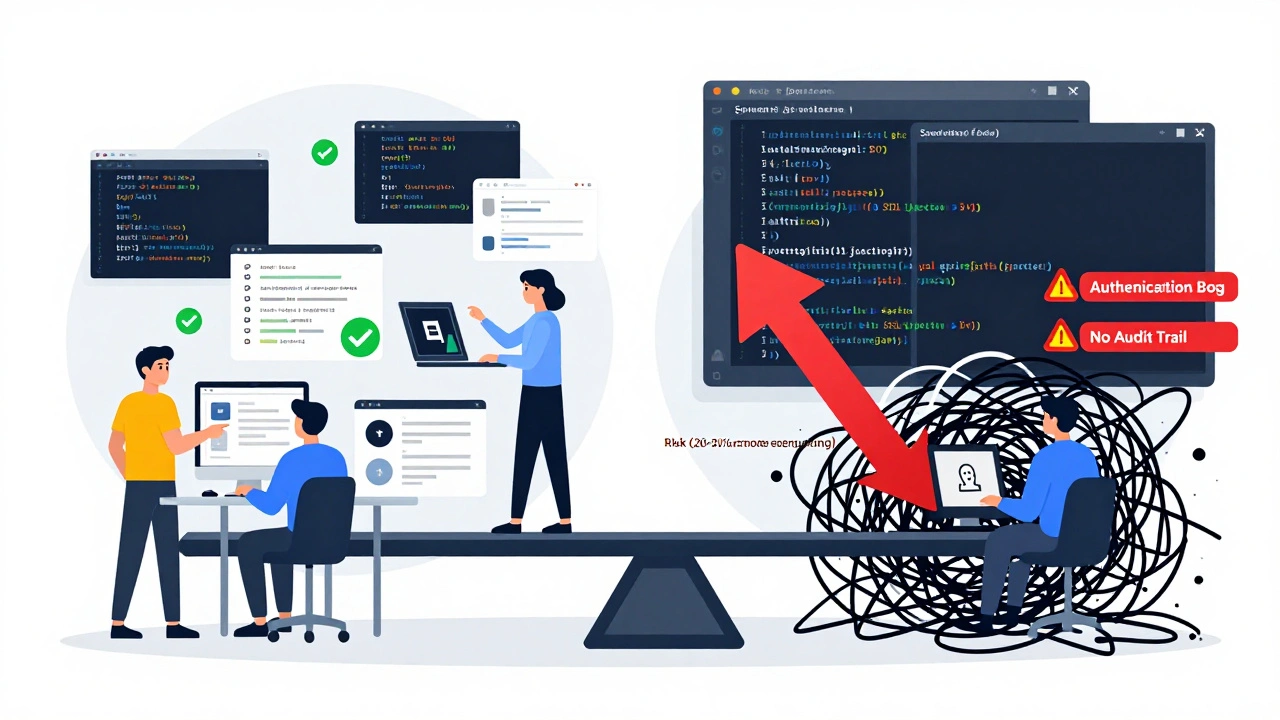
Security is the biggest red flag. According to MktClarity’s Q3 2025 analysis, 40-45% of AI-generated code contains vulnerabilities. That’s not a small risk. That’s a systemic threat. The IEEE’s 2025 Security Assessment found that 62% of AI-generated SaaS platforms lacked proper rate limiting on authentication endpoints. One security engineer at a fintech startup told Hacker News her team spent three weeks fixing an AI-written login system that let attackers brute-force passwords without triggering alerts.
And then there’s the “black box” problem. Developers can’t always tell why the AI wrote something a certain way. If you don’t understand the code, you can’t fix it. You can’t audit it. You can’t trust it. That’s why only 9% of companies use AI for mission-critical systems. The rest use it as a helper-not a co-pilot.
Platform Showdown: GitHub Copilot, Cursor, Replit, Loveable
Not all vibe coding tools are created equal. Here’s how the top four stack up:
| Platform | Market Share | Key Strength | Major Weakness | Price (Per User/Month) | Best For |
|---|---|---|---|---|---|
| GitHub Copilot | 45% (enterprise) | Deep IDE integration, 35+ languages | Data privacy concerns, 12% of Fortune 500 banned it | $10 (individual), $19 (enterprise) | Large teams, legacy systems, enterprise devs |
| Cursor | 35% (startups) | Local model execution, no data sent to cloud | Needs 16GB RAM, slow on older machines | $20 | Startups, privacy-sensitive teams, power users |
| Replit | 25% (education) | Cloud-based, collaborative, zero setup | Cloud dependency = security risk for regulated industries | Free to $12 | Students, educators, non-coders, quick prototypes |
| Loveable | 15% (no-code) | UI generation, 8% paid conversion rate | Limited customization, steep for technical users | $20 | Founders, product teams, non-developers |
GitHub Copilot wins on integration. Cursor wins on privacy. Replit wins on accessibility. Loveable wins on speed for non-developers. But none of them solve the core issue: AI doesn’t understand intent. It guesses based on patterns. And when those patterns are flawed, the code fails.
Who’s Investing-and Why?
The money’s pouring in. In 2025 alone, vibe coding startups raised over $300 million. Rocket and Emergent each landed $150 million Series B rounds. Investors aren’t betting on tools-they’re betting on the future of software creation. Roots Analysis projects the market could hit $325 billion by 2040. MktClarity is more conservative, predicting $65 billion by 2030. Either way, it’s big.
But here’s what’s really interesting: the biggest adopters aren’t just tech companies. Visa, Meta, and Amazon are all testing AI-generated code in production pipelines. Meta plans to have 50% of its internal code AI-assisted by 2026. Amazon’s internal metrics show a 55% faster feature delivery rate with AI tools. That’s not hype. That’s ROI.
Yet even these giants don’t trust AI for core systems. They use it for testing, logging, documentation, and boilerplate. The real value isn’t in replacing developers-it’s in removing the grunt work so developers can focus on architecture, security, and user experience.
The Hidden Skill Gap
One of the most overlooked impacts of vibe coding is the erosion of foundational skills. Dr. Sarah Chen, a professor at MIT and author of The AI Developer Revolution, warns: “Junior developers are learning to prompt, not to program. They’re getting good at asking for code, but terrible at understanding it.”
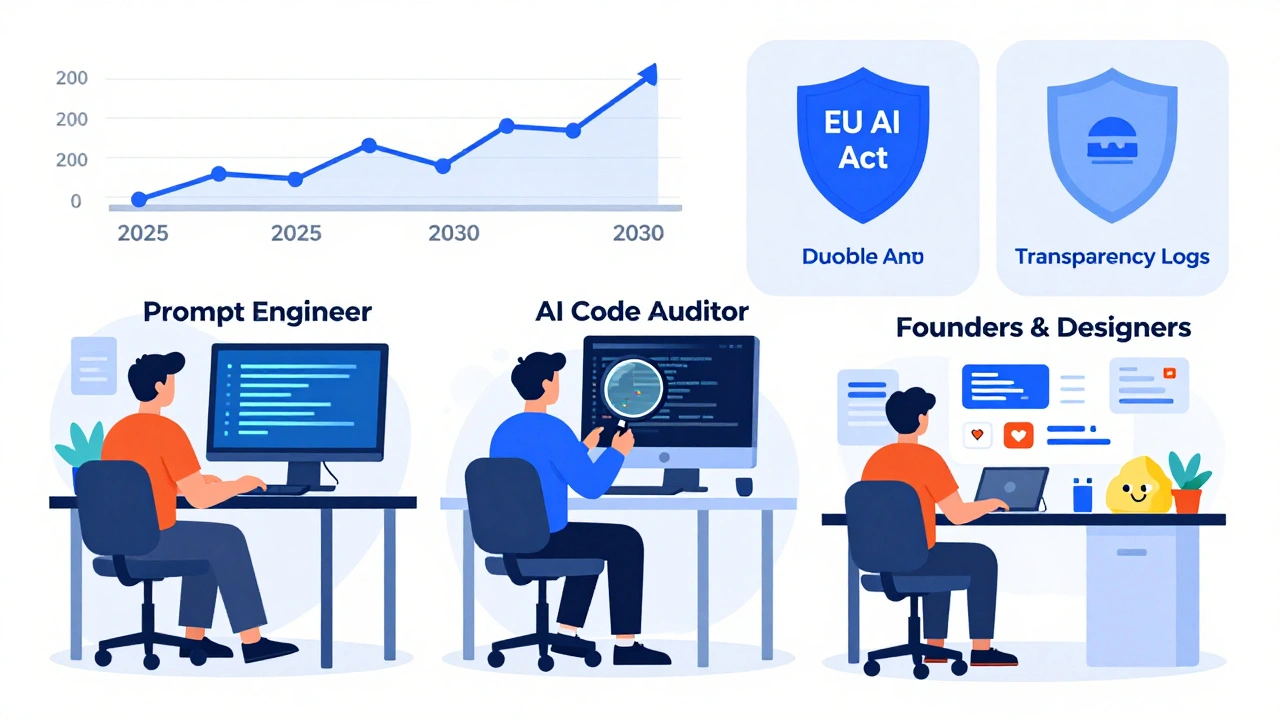
That’s dangerous. A developer who can’t debug AI-generated code is a liability. And it’s already happening. Stack Overflow’s 2025 survey found that 68% of new hires under 25 struggle to explain code they didn’t write-even if it was generated by AI. Companies are now hiring for “AI code auditing” as a separate skill. You can’t just write code anymore. You have to inspect it, question it, and fix it.
Learning the basics of vibe coding takes 1-3 hours. Mastering it? That takes 40-60 hours of deliberate practice. You need to learn prompt engineering. You need to understand how AI hallucinates. You need to know how to spot a SQL injection hidden in a generated function. These aren’t optional skills anymore.
What’s Next?
The next two years will be decisive. GitHub Copilot’s September 2025 update reduced vulnerability rates by 15%. Cursor’s December 2025 optimization cut its RAM usage by 40%. These aren’t minor tweaks-they’re responses to real market pressure.
Regulation is coming. Healthcare and finance are already moving to restrict AI-generated code in compliance-critical systems. The EU’s AI Act and upcoming U.S. guidelines will likely require transparency logs for AI-generated code-meaning every line must be traceable to its source.
And pricing models are shifting. Right now, it’s per-user. But soon, it’ll be per-output. Pay based on how much code you generate. Pay based on how much time you save. Pay based on how many bugs you avoid. That’s where the real value is.
The future of vibe coding isn’t about replacing developers. It’s about redefining them. The best developers won’t be the ones who write the most code. They’ll be the ones who know when to trust the AI, when to override it, and how to fix it when it breaks.
Final Reality Check
Let’s cut through the noise. Vibe coding is not magic. It’s not a replacement. It’s not even a co-pilot. It’s a very powerful autocomplete that doesn’t always know what it’s doing.
Use it for:
- Boilerplate code
- Unit tests
- Documentation
- Prototyping
- Repetitive tasks
Avoid it for:
- Authentication systems
- Payment processing
- Security logic
- Complex algorithms
- Code that must be audited
The stats don’t lie: 84% of developers use it. But only 9% trust it for production. That gap tells you everything you need to know.
Is vibe coding safe for production use?
Only in limited cases. While 84% of developers use AI coding tools, only 9% deploy them for more than a quarter of their production code. Security vulnerabilities appear in 40-45% of AI-generated code, and critical systems like authentication or payment handling should never rely on AI without human review. Use it for scaffolding, not core logic.
Which vibe coding tool is best for beginners?
Replit is the easiest for beginners. It requires no setup-just open a browser and start coding. It’s free, collaborative, and ideal for learning. GitHub Copilot is also beginner-friendly if you’re already using VS Code. Loveable works well if you’re not a coder but want to build UIs fast.
Do companies ban vibe coding tools?
Yes. Twelve percent of Fortune 500 companies have banned GitHub Copilot outright due to data privacy concerns. Some banks and healthcare providers restrict all AI coding tools because they can’t audit the source of generated code. Always check your company’s policy before installing any AI coding assistant.
How much time do AI tools actually save?
For routine tasks like writing tests, setting up APIs, or generating boilerplate, developers report 35-55% time savings. But for complex logic, debugging AI-generated code can add 20-30% extra time. The net gain depends on your skill level and the complexity of the task.
Will vibe coding replace developers?
No. It’s replacing grunt work, not thinking. The most valuable developers in 2025 aren’t the ones who write the most code-they’re the ones who can evaluate, fix, and improve AI-generated output. Demand is growing for roles like “AI code auditor” and “prompt engineer,” not fewer developers.
What skills do I need to use vibe coding effectively?
You still need strong programming fundamentals. Beyond that, you need to learn prompt engineering-how to ask for the right output-and AI code auditing-how to spot bugs, security flaws, and hallucinations. These are now essential skills, not nice-to-haves.
If you’re not using vibe coding yet, you’re falling behind. But if you’re using it blindly, you’re risking your codebase. The key isn’t adoption-it’s awareness.
Flannery Smail
December 14, 2025 AT 12:39Bro, vibe coding is just autocomplete with a hype sticker. I’ve seen juniors copy-paste AI-generated auth systems and then panic when the hackathon demo crashes. 84% use it? Cool. 9% trust it in prod? That’s the only number that matters.
Emmanuel Sadi
December 15, 2025 AT 12:33Oh wow, another ‘AI is a tool, not a replacement’ sermon. Let me guess-you’ve never debugged a hallucinated SQL injection buried in 200 lines of Copilot-generated boilerplate? You think ‘prompt engineering’ is a skill? Nah. It’s just lazy devs outsourcing their job to a glorified autocomplete that doesn’t even know what a buffer overflow is. Congrats, you’re the reason security teams have nightmares.
Nicholas Carpenter
December 16, 2025 AT 08:23I’ve been using Cursor for six months now, mostly for test scaffolding and API stubs. It’s saved me hours, no doubt. But I treat every line like it’s written by a drunk intern who’s read too many Stack Overflow threads. I audit everything. I run static analysis. I don’t trust it-but I don’t fear it either. It’s like a really smart intern who needs constant supervision. Use it, but don’t hand it the keys to the vault.
Chuck Doland
December 16, 2025 AT 17:39It is imperative to recognize that the proliferation of AI-assisted coding methodologies represents not merely a technological evolution, but a fundamental epistemological shift in the practice of software engineering. The cognitive labor traditionally associated with algorithmic design, semantic reasoning, and system-level comprehension is being externally delegated to probabilistic models whose internal mechanisms remain opaque. Consequently, the developer’s role is being redefined from artisan to auditor-a guardian of logical integrity in an ecosystem increasingly governed by statistical inference rather than deterministic construction. The 9% adoption rate for mission-critical systems is not a limitation-it is a necessary and prudent boundary. To conflate efficiency with reliability is to invite systemic fragility. The true metric of proficiency in this era is not lines of code produced, but the rigor with which one interrogates the machine’s output.
Madeline VanHorn
December 17, 2025 AT 06:04Replit is for people who can’t install VS Code. If you’re using AI to write code and you don’t know what a loop is, you shouldn’t be coding. Period.