Architectural Considerations and Technical Decision-Making in AI-Assisted Development
 Mar, 12 2026
When you think of architecture, you probably picture blueprints, steel beams, or brick walls. But today, architecture also means code, APIs, microservices, and cloud deployments. Whether you're designing a skyscraper or a distributed application, the core challenge is the same: making smart decisions under uncertainty. And now, AI isn't just helping - it's reshaping how those decisions get made.
AI Is Changing How Architects Think
In building design, architects used to spend weeks sketching floor plans by hand. Now, tools like Forma and Delve let them input parameters - sunlight angles, material costs, occupancy targets - and generate 50+ viable options in under an hour. One project in London, led by MBH Architects, cut design iteration time from two weeks to six hours. The AI didn’t just speed things up; it suggested layouts humans wouldn’t have considered: twisting courtyard shapes to maximize natural light, or stacking units in ways that reduced wind turbulence by 37%. This isn’t magic. It’s data. AI models trained on decades of building codes, climate patterns, and construction costs can spot inefficiencies invisible to the human eye. A design that looks elegant might waste 18% more energy. Another might violate local noise ordinances. AI catches these before the first concrete pour.Generative Design: Beyond Optimization
Generative design isn’t about finding the “best” solution. It’s about finding solutions you didn’t know existed. Traditional design follows rules: windows face south, staircases are centered, load-bearing walls are thick. AI breaks those rules - and then tests whether breaking them actually works. Take the Phoenix housing project. The team wanted carbon-negative buildings. Human designers assumed that meant using recycled steel or solar panels. The AI, trained on material lifecycle data, proposed a facade made from algae-based biocomposites. It wasn’t just sustainable - it absorbed more CO2 than it emitted during production. The result? A building that lowered embodied carbon by 62% and cut construction time by 40% because it was modular. The same applies in software. Instead of choosing between monoliths and microservices, AI can analyze your team’s deployment history, error rates, and scaling patterns - then suggest an architecture tailored to your actual needs. A startup with 3 engineers and 500 daily users doesn’t need Kubernetes. An enterprise with 200 developers and 10M daily requests does. AI doesn’t guess. It learns from your data.BIM and IoT: The Living Architecture
Building Information Modeling (BIM) used to be a static 3D model. Now, it’s a live feed. AI integrates real-time data from IoT sensors - temperature, humidity, occupancy, energy use - and updates the model automatically. If a HVAC system starts overworking, the AI flags it. If a corridor gets too crowded, it suggests a redesign. This isn’t future tech. It’s happening in warehouses in Ohio and hospitals in Seattle. In software, this is mirrored by observability platforms. AI watches how services interact, detects latency spikes, and traces bottlenecks back to their source. Instead of waiting for a crash, you get a heads-up: “Service A is calling Service B 800 times per minute - that’s 3x the expected load. Consider caching or throttling.” This shift turns architecture from a one-time decision into a continuous process. Buildings and apps evolve. AI helps them evolve smarter.
Compliance Isn’t a Checklist - It’s a Constraint
Building codes change. Fire regulations shift. ADA requirements get updated. Keeping up used to mean hiring specialists, reviewing PDFs, and hoping nothing slipped through. Now, AI scans every design against 12,000+ global codes and flags conflicts before submission. A firm in Portland was designing a mixed-use tower. The AI flagged that the proposed elevator shaft width violated the latest California accessibility code. The team had missed it. Fixing it early saved $220,000 in redesign costs. In software, AI checks for architectural antipatterns: circular dependencies, tightly coupled services, missing circuit breakers. Tools like Amazon CodeWhisperer or GitHub Copilot for Architecture now scan codebases and say: “This service calls five external APIs without retries - you’re at risk of cascading failures.” Compliance isn’t about avoiding penalties. It’s about avoiding collapse.Sustainability: The New Bottom Line
Green building isn’t optional anymore. LEED certification, carbon taxes, investor pressure - they’re all real. AI helps you hit targets without guessing. AFRY used Forma to simulate wind patterns around a new office complex. The tool showed that placing a green wall on the east side reduced cooling loads by 22%. That wasn’t obvious from a 2D plan. The AI saw it because it combined weather data, material thermal properties, and occupancy schedules. In software, sustainability means energy efficiency. A single poorly optimized API call can burn 120 kWh per year. AI tools now estimate the carbon footprint of your cloud architecture. One fintech startup reduced its AWS bill by 31% and cut emissions by 2.8 metric tons annually - just by restructuring how its services communicated. Sustainability isn’t a buzzword. It’s a metric. And AI makes it measurable.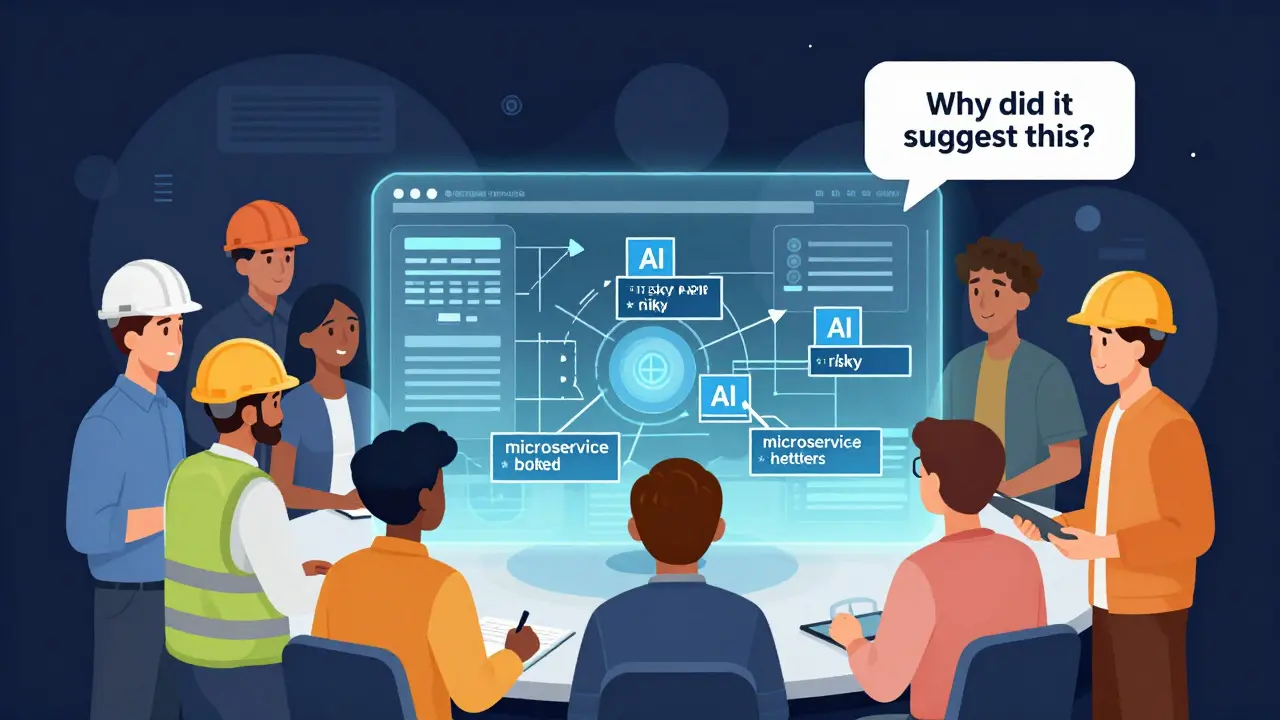
Resource Planning: From Guesswork to Precision
Construction delays? Blame supply chains. Software rollouts fail? Blame under-provisioned servers. AI fixes both. ARK, a planning tool used by contractors, cross-references inventory, delivery windows, and labor availability. It doesn’t just say “order steel next week.” It says: “Order steel from Supplier X - they’re 3 days faster than Y, and their carbon score is 40% better.” In software, AI predicts resource needs based on user behavior. If your app spikes during 8-9 AM on weekdays, the AI auto-scales your containers. No more overpaying for idle servers. No more crashes during rush hour. This isn’t automation. It’s foresight.Human Judgment Still Wins
AI gives you options. It doesn’t give you wisdom. A design team once accepted an AI-generated layout that maximized sunlight but ignored cultural preferences. Residents in a senior housing project rejected it - they valued privacy over brightness. The AI didn’t know that. The architect did. In software, AI might suggest splitting a monolith into 15 microservices. But if your team has never managed containers, that’s a disaster waiting to happen. AI doesn’t understand team dynamics, risk tolerance, or long-term vision. The best architects use AI as a co-pilot - not a captain. They ask: “Why did the AI suggest this?” “What data did it miss?” “Does this align with our values?” AI doesn’t replace judgment. It elevates it.What Comes Next?
AI-assisted architecture isn’t a trend. It’s the new baseline. By 2027, 80% of new building projects will use generative design tools. In software, 70% of enterprise teams will have AI auditing their architecture before deployment. The winners won’t be the ones using AI the most. They’ll be the ones who understand its limits. Learn to read its suggestions. Question its assumptions. Use its speed - but never outsource your responsibility. Because in the end, architecture isn’t about lines on a screen. It’s about people. Buildings that shelter. Systems that serve. And AI? It just helps you build them better.Can AI replace human architects or software engineers?
No. AI doesn’t replace architects or engineers - it amplifies them. It handles repetitive tasks like code linting, clash detection, or energy modeling, freeing humans to focus on creativity, ethics, and stakeholder needs. An AI can suggest a building layout, but only a human can decide if it respects cultural norms or community values. Similarly, AI can flag a risky API pattern, but only a team lead can weigh the trade-offs of rewriting legacy code. The best outcomes happen when human judgment guides AI’s speed.
What are the biggest risks of using AI in architectural decision-making?
The biggest risk is over-reliance. AI works with data it’s been trained on - and that data can be biased, incomplete, or outdated. For example, if an AI is trained mostly on commercial buildings, it might not understand residential needs like noise privacy or wheelchair accessibility. In software, an AI trained on GitHub repositories might recommend patterns that don’t fit your team’s skill level. Blindly trusting AI can lead to expensive mistakes. Always validate its outputs with real-world constraints, team feedback, and historical performance.
How do I start integrating AI into my architectural workflow?
Start small. If you’re in building design, try a generative design tool like Forma or Delve on one low-risk project. Input your parameters - budget, location, materials - and compare the AI’s suggestions to your own. If you’re in software, use AI-assisted code review tools like GitHub Copilot or Amazon CodeWhisperer to catch antipatterns in your pull requests. Track how often it catches something you missed. Once you trust the tool on small tasks, expand to larger decisions like infrastructure planning or compliance checks. The goal isn’t to automate everything - it’s to automate the boring stuff so you can focus on what matters.
Is AI-assisted architecture only for large firms or enterprises?
No. Many AI tools now offer free tiers or pay-as-you-go pricing. A solo architect can use Forma’s free plan to explore 10 design variants for a home renovation. A startup can use AI-powered BIM tools to simulate daylight in a small office. In software, tools like ChatGPT for Architecture or AWS Well-Architected Tool offer free guidance on scaling, security, and cost. You don’t need a $500K budget to start. You just need curiosity and a willingness to test.
How does AI improve collaboration between architects and clients?
AI turns abstract ideas into visual, data-backed options. Instead of saying “We think this layout is better,” you show clients side-by-side simulations: “Here’s your original design. Here’s what the AI found that saves 15% on energy. Here’s a third option that cuts construction time by 3 weeks.” Clients understand visuals faster than spreadsheets. Real-time rendering and live updates - like seeing how sunlight hits a room at 4 p.m. - build trust. This transparency leads to faster approvals, fewer revisions, and stronger client relationships.
Mbuyiselwa Cindi
March 13, 2026 AT 23:38Just wanted to say this post hit different. I’ve been using generative design tools on small residential projects in Cape Town, and honestly? The AI caught a ventilation flaw I’d been blind to for weeks. Didn’t even know my own client’s cultural preference for cross-breezes was a thing until the model flagged it. AI doesn’t replace intuition - it just gives your gut a data-backed high-five.
Also, that algae facade example? Mind blown. We’re all stuck on ‘green = solar panels’ but nature’s been doing this for millions of years. Time we stopped being so human-centric.
Krzysztof Lasocki
March 15, 2026 AT 13:05LMAO at the idea that AI ‘replaces’ architects. Nah bro. It’s like giving a toddler a chainsaw and calling them a carpenter. The AI can generate 50 layouts, but it still can’t tell you why your client’s grandma won’t sit in the ‘optimal sunlight zone’ because she thinks it looks like a prison. Human judgment? Still the only thing that doesn’t crash when you say ‘but what about feelings?’
Henry Kelley
March 16, 2026 AT 01:34Y’all are overthinking this. I use Copilot for architecture stuff at work and it’s wild how often it spots circular deps I missed. Like yesterday it said ‘hey this service calls itself 3x in a loop’ and I was like… oh right, I wrote that at 2am after tacos.
Point is: AI’s not the boss. It’s the coworker who always finds your typos. You still gotta sign off on the thing. Just don’t be that guy who trusts it blindly. I’ve seen teams deploy AI-recommended microservices and then spend 6 months debugging because no one knew how to manage them. Rookie mistake.
Victoria Kingsbury
March 17, 2026 AT 23:46Let’s be real - AI is the ultimate performance enhancer for architectural decision-making. The moment you stop thinking of it as a ‘tool’ and start treating it as a real-time, multi-modal sensor layer, everything shifts. BIM + IoT + AI = living architecture. It’s not about automation. It’s about emergent intelligence. You’re not designing a building anymore - you’re cultivating an adaptive system. And yeah, carbon metrics? They’re not fluff. They’re the new KPIs. If your architecture doesn’t optimize for embodied energy, you’re not just behind - you’re obsolete.
Also, the 120 kWh per API call stat? That’s the new ‘unoptimized loop’ from 2005. Same problem. Different scale. Same consequence.
Tonya Trottman
March 19, 2026 AT 15:28Oh honey. You think AI’s ‘helping’? No. It’s just making your bad decisions faster. Let’s talk about the ‘algal facade’ in Phoenix - trained on GitHub repos? What if the training data only included projects from California? What if it didn’t account for humidity in the Southwest? Or thermal lag? Or maintenance? You think algae doesn’t get moldy? Of course it does. And now you’ve got a $3M building that’s basically a fungus farm. And you’re patting yourself on the back for ‘sustainability’?
Also - ‘AI catches violations before the first pour’? LOL. It caught ONE violation. What about the 12 others? The ones the training data didn’t include? The ones from local ordinances the AI was never fed? You’re not reducing risk. You’re outsourcing ignorance.
And don’t get me started on ‘carbon footprint’ calculators. They’re all based on assumptions. Assumptions that vary by region, by grid, by season. You’re not measuring. You’re guessing. With more graphs.
Rocky Wyatt
March 20, 2026 AT 10:58You’re all just pretending this is about innovation. It’s about fear. Fear that if you don’t use AI, you’ll be replaced. So you throw money at tools, pretend you’re ‘future-proof,’ and then panic when the AI suggests something you can’t explain to your boss. I’ve seen teams get fired because their ‘AI-optimized’ design didn’t pass client review. Why? Because the AI didn’t know that the client’s son is wheelchair-bound and hates glass walls. AI doesn’t care about people. People care about people. And if you’re outsourcing empathy to a model trained on Reddit threads and GitHub commits? You’re already dead.
Santhosh Santhosh
March 22, 2026 AT 08:07I’ve been working in rural India on small-scale housing projects with limited resources, and I’ve seen how AI tools - even basic ones - can make a huge difference when used with humility. One of our local builders, who had never used digital tools before, was able to use a free version of Forma to simulate how wind flows through a courtyard design we were testing. The AI suggested a slight rotation of the structure that reduced internal temperatures by 4°C during peak summer - something our team had never considered because we were stuck in the ‘traditional layout’ mindset.
But here’s the thing: we didn’t just accept the suggestion. We sat with the community. We showed them the simulation. We asked what they thought. One elder said, ‘The wind should come from the north, not the east - that’s how our ancestors built.’ And she was right. The AI didn’t know that. But we did. So we blended the two.
This is what I’ve learned: AI doesn’t solve problems. It reveals them. And then it’s up to us - the humans, the ones who live with the consequences - to decide what to do next. Not because we’re smarter. But because we’re still here, in the dust, in the heat, in the quiet moments when a child laughs in a space that feels like home.