Attention Mechanisms in Generative AI: From Self-Attention to Flash Attention
 Jul, 29 2026
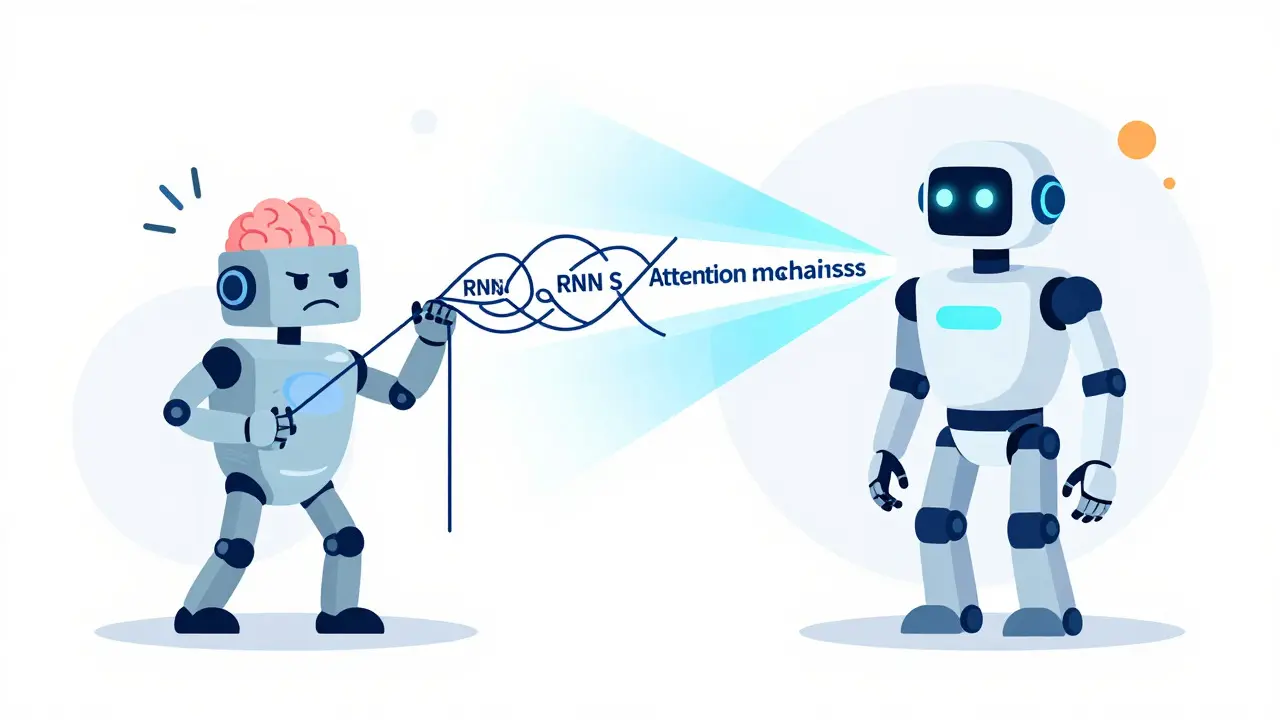
Imagine trying to read a 500-page book while only being allowed to look at one word at a time, forced to memorize the entire previous sentence before you can understand the next. That is essentially what early artificial intelligence models struggled with. They processed information sequentially, losing context as sentences grew longer. Then came a breakthrough that changed everything: attention mechanisms. This technology allows modern AI to focus on the most relevant parts of data instantly, regardless of distance. It is the engine behind every major generative AI model today, from OpenAI’s GPT-4 to Meta’s LLaMA 3. But how did we get from simple alignment scores to the high-speed Flash Attention kernels powering your chatbots right now?
The Birth of Attention: Solving the Memory Bottleneck
Before 2014, machine translation models relied on Recurrent Neural Networks (RNNs). These models compressed an entire source sentence into a single fixed vector. If the sentence was long, critical details got lost in that compression. It was like trying to summarize a novel into a single tweet and expecting someone to reconstruct the plot.
Dzmitry Bahdanau, Kyunghyun Cho, and Yoshua Bengio solved this in their 2014 paper by introducing additive attention. Instead of one static summary, the decoder could look back at the encoder’s hidden states for every single word it generated. They learned alignment weights-essentially asking, "Which part of the input sentence matters most for this specific output word?" On the WMT’14 English-French dataset, this approach boosted BLEU scores significantly compared to standard RNNs.
Minh-Thang Luong and colleagues refined this further in 2015 with multiplicative attention. By using dot products instead of complex feed-forward networks, they made the computation faster and more efficient. This period established the core idea: neural networks should dynamically weigh inputs rather than treating them all equally.
The Transformer Revolution: Self-Attention Takes Over
The real game-changer arrived in 2017 with Ashish Vaswani et al.’s paper, "Attention Is All You Need." The authors proposed the Transformer architecture, which discarded recurrence entirely. In its place, they used stacked layers of self-attention.
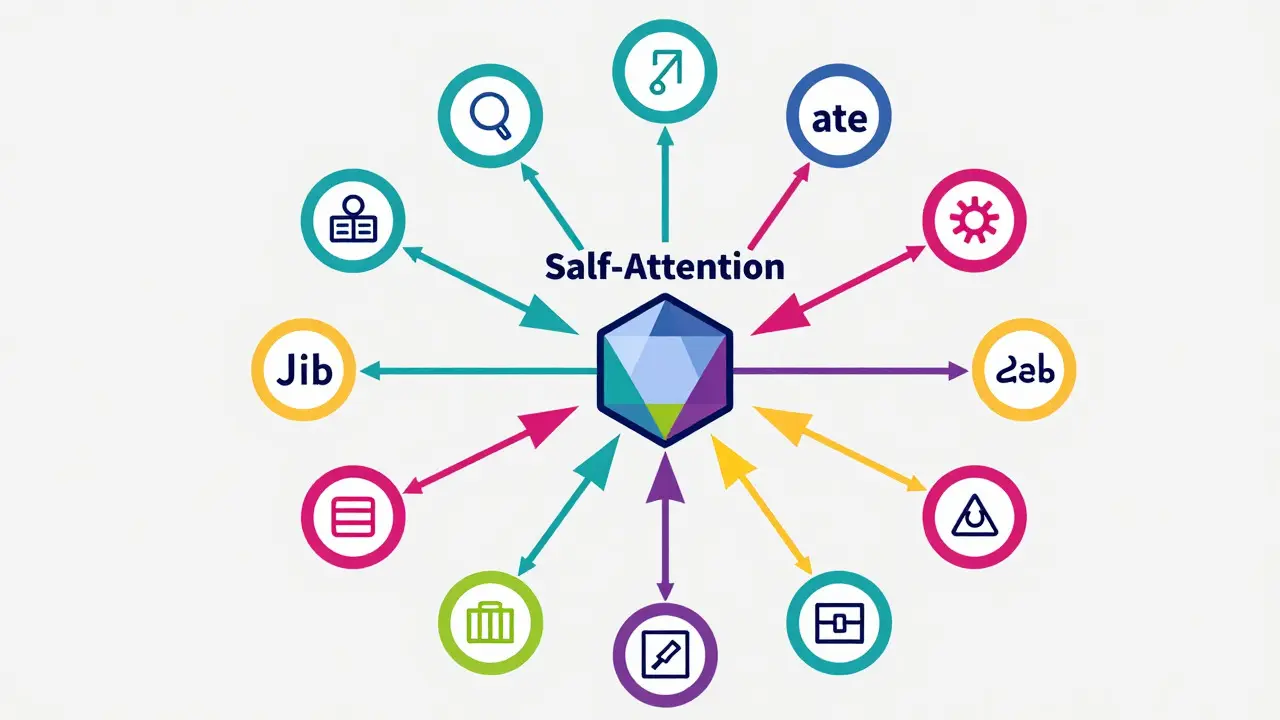
In self-attention, queries, keys, and values are derived from the same sequence. Each token in a sentence generates a query to ask questions, keys to answer them, and values to provide content. The model calculates compatibility between queries and keys, applies a softmax function to normalize these scores, and then aggregates the values. This allows the model to process all positions in parallel, solving the vanishing gradient problem that plagued RNNs.
| Model Type | Key Innovation | Performance Impact |
|---|---|---|
| RNN Encoder-Decoder | Fixed vector context | Poor for long sequences |
| Additive Attention (2014) | Dynamic alignment weights | Better translation accuracy |
| Multiplicative Attention (2015) | Dot-product efficiency | Faster training, higher BLEU |
| Transformer (2017) | Self-attention & Multi-head | Parallel processing, state-of-the-art |
The original Transformer base model achieved 28.4 BLEU on English-German translation, beating the best RNN baselines by a wide margin. More importantly, it introduced multi-head attention. By splitting the attention mechanism into multiple heads (e.g., 8 in the base model, 96 in GPT-3), the model could learn different types of relationships simultaneously-syntax, semantics, and positional locality-in parallel. This design mapped perfectly to GPU architectures, enabling the training of massive models like GPT-3 with 175 billion parameters.
The Quadratic Curse: Why Standard Attention Struggles
Despite its power, standard scaled dot-product attention has a fatal flaw: computational complexity. For a sequence of length $n$, calculating the attention matrix requires $O(n^2)$ operations and memory. As context windows grew from 2,048 tokens in GPT-3 to 32,768 in GPT-4-32k, and eventually to 200,000 in Claude 2, this quadratic scaling became a bottleneck.
Consider a 4,096-token context. The attention matrix contains over 16 million elements per head. In FP16 precision, this consumes roughly 32 MB per head. With 96 heads and multiple layers, the memory footprint explodes. GPUs with limited High-Bandwidth Memory (HBM) struggle to store these intermediate matrices, forcing practitioners to use gradient checkpointing or model parallelism, which slows down training.
To address this, researchers developed various approximations between 2019 and 2021. Reformer used locality-sensitive hashing for $O(n \log n)$ complexity. Linformer projected keys and values into low-rank representations for $O(n)$ memory. Longformer employed sparse windowed patterns. While these methods saved memory, they often sacrificed accuracy, causing drops in perplexity or BLEU scores because they were not mathematically exact.
Flash Attention: Exactness Meets Efficiency
Enter FlashAttention, proposed by Tri Dao and colleagues in 2022. Unlike approximate methods, FlashAttention is an exact implementation of standard softmax attention. The key insight was IO-awareness. Modern GPUs are compute-heavy but memory-bandwidth-limited. Standard attention repeatedly reads and writes large matrices to HBM, creating a traffic jam.
FlashAttention minimizes this traffic by tiling the Q, K, and V matrices into blocks that fit into on-chip SRAM. It computes partial attention scores for each tile, using an online softmax algorithm to maintain running maximums and sums. This allows the kernel to fuse matrix multiplication, softmax, and dropout into a single pass without ever materializing the full $n \times n$ score matrix in HBM.
The results are dramatic. On NVIDIA A100 GPUs, FlashAttention delivers 2-4× speedups and reduces memory usage by 10-20× for sequences of 4,096-8,192 tokens. Crucially, it maintains identical validation accuracy to standard attention because it is mathematically equivalent, just computationally smarter.
From v1 to Flash Attention 4: The Hardware Co-Design Era
The evolution didn’t stop at v1. FlashAttention-2, released in July 2023, optimized tiling strategies and pipelining for better utilization on A100 and H100 GPUs. It improved effective TFLOPs from roughly 150-200 to over 300 TFLOPs/s for long-context causal attention.
By March 2026, reports emerged of Flash Attention 4 achieving 1,605 TFLOPs/s on NVIDIA B200 GPUs with 71% hardware utilization. This level of performance suggests that IO-aware kernels are approaching theoretical peak limits on next-generation accelerators. Integration has become seamless; PyTorch 2.0 includes `torch.nn.functional.scaled_dot_product_attention`, which automatically dispatches to FlashAttention when available. Hugging Face’s Text Generation Inference library also supports it via flags, allowing developers to enable significant throughput gains with minimal code changes.

Practical Implications for Developers and Enterprises
For anyone deploying generative AI, understanding these mechanisms is no longer optional-it’s essential for cost management. Training a 7B-parameter model with standard attention might take weeks on expensive cloud instances. Switching to FlashAttention can cut training time by half, translating to substantial savings on AWS p4d.24xlarge instances, which cost around USD 32.77 per hour.
Inference is equally impacted. Serving models like LLaMA 2-70B requires managing KV-cache memory. Combining FlashAttention kernels with 8-bit or 4-bit KV-cache quantization allows systems to serve hundreds of concurrent users with latencies under 200 ms per token. Without these optimizations, the same hardware would struggle to handle a fraction of that load.
However, integration isn't always plug-and-play. Users report challenges with CUDA version mismatches and specific GPU architecture requirements (e.g., SM80 for A100 vs. SM90 for H100). Ensuring your environment aligns with the latest kernel versions is critical for realizing these benefits.
Interpretability: Does Attention Explain Anything?
A common misconception is that attention weights directly explain model decisions. Early tutorials suggested that high attention scores meant a token was "important." However, Jain and Wallace’s 2019 study, "Attention is not Explanation," demonstrated that attention distributions could be significantly altered without changing model predictions. While attention maps offer qualitative insights-showing, for instance, that a pronoun attends to its antecedent-they should not be treated as rigorous feature attribution metrics. Use them as diagnostic tools, not definitive explanations.
What is the difference between self-attention and cross-attention?
Self-attention allows tokens within the same sequence to attend to each other, enabling the model to capture internal dependencies. Cross-attention, used in encoder-decoder architectures, allows the decoder to attend to the encoder's outputs. In decoder-only models like GPT, masked self-attention serves both roles by attending to previous tokens in the prompt and generated text.
Why is FlashAttention considered "exact"?
FlashAttention produces numerically identical results to standard softmax attention (within floating-point rounding errors). Unlike approximate methods like Performer or Linformer, which sacrifice accuracy for speed, FlashAttention uses an online softmax algorithm to compute the exact same output without storing the full attention matrix in memory.
How does FlashAttention reduce memory usage?
It minimizes data movement between HBM and on-chip SRAM. By tiling the Q, K, and V matrices and processing them in small blocks, FlashAttention avoids writing the large $n \times n$ attention score matrix to HBM. This reduces memory bandwidth pressure and allows larger batch sizes or longer contexts to fit in GPU memory.
Can I use FlashAttention with any GPU?
FlashAttention requires NVIDIA GPUs with sufficient compute capability (typically Ampere architecture A100/H100 or newer). Older architectures may not support the necessary fused kernels efficiently. Check your GPU's SM version and ensure your CUDA toolkit matches the requirements of the FlashAttention library version you are installing.
Is FlashAttention available in PyTorch?
Yes. Since PyTorch 2.0, the `scaled_dot_product_attention` function automatically dispatches to optimized backends like FlashAttention if the appropriate CUDA kernels are installed and compatible with your hardware. You can also explicitly install the `flash-attn` package for direct access.