Benchmark Transfer After Fine-Tuning: How LLMs Generalize Across Tasks
 May, 4 2026
There is a persistent fear in the machine learning community that acts as a silent killer of productivity. You spend weeks and thousands of dollars fine-tuning a large language model (LLM) to handle your specific customer support tickets perfectly. The model performs miracles on your test set. But then you run it against a standard general knowledge benchmark, like MMLU or HellaSwag, and the scores plummet. The model has become a specialist so narrow that it has forgotten how to be an intelligent assistant for anything else. This phenomenon, known as catastrophic forgetting, is the central challenge of benchmark transfer after fine-tuning.
Benchmark transfer refers to the ability of an LLM to maintain its broad, pre-trained capabilities while acquiring new, specialized skills. It is not just about getting better at one task; it is about ensuring that improvement does not come at the cost of existing competence. As we move into 2026, the industry has shifted away from full-model fine-tuning toward more efficient methods that preserve this balance. Understanding how these models generalize across tasks is no longer optional-it is critical for building reliable AI systems.
The Core Problem: Catastrophic Forgetting
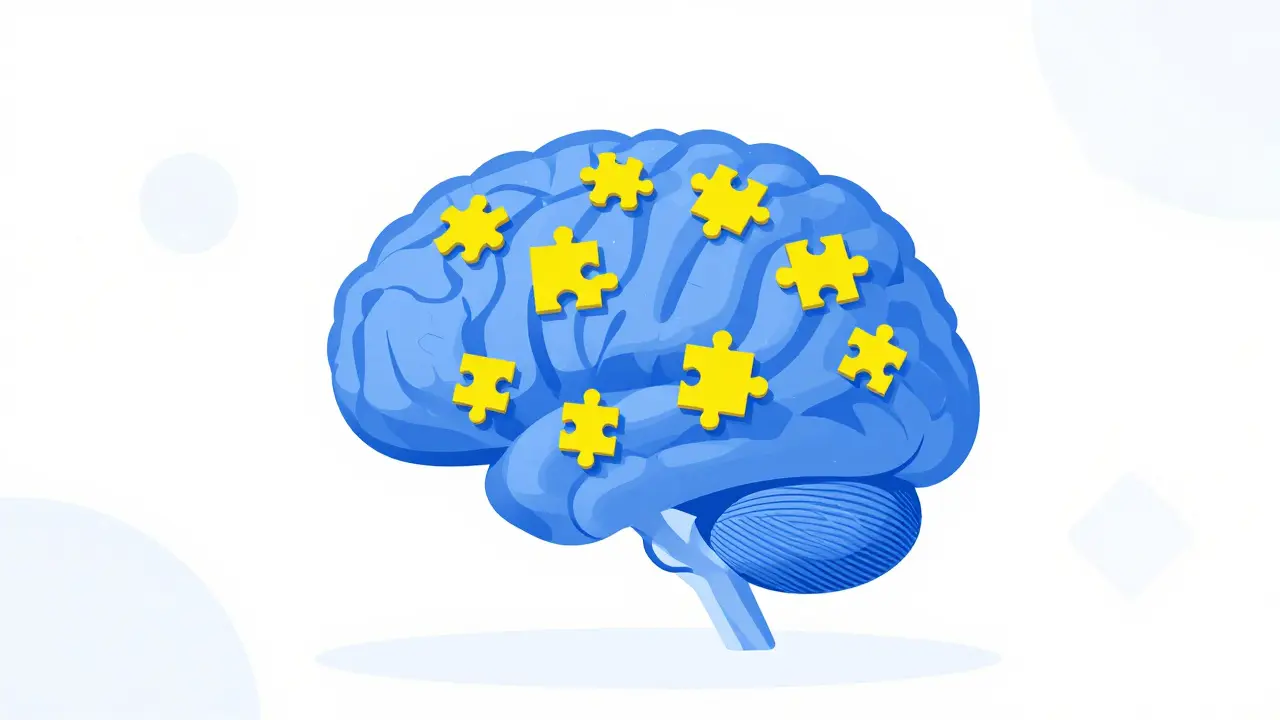
When you fine-tune a neural network, you are adjusting millions, sometimes billions, of parameters. In traditional deep learning, this process often overwrites the weights that were responsible for general knowledge. Imagine teaching a chef who knows every cuisine in the world to make only perfect sushi. If you train too aggressively, the chef might forget how to cook pasta or bake bread. In LLM terms, the model’s internal representations shift so drastically to accommodate the new data distribution that the original semantic mappings degrade.
This is why benchmark transfer is such a tricky metric. A model might achieve state-of-the-art results on a medical diagnosis dataset but fail basic logic tests it passed before training. The issue stems from the optimization landscape. During pre-training, the model finds a global minimum that balances diverse linguistic patterns. Fine-tuning pushes the weights toward a local minimum optimized for the specific task, often moving them out of the region where general capabilities reside.
- Weight Interference: Parameters used for general syntax are repurposed for domain-specific jargon.
- Distribution Shift: The statistical properties of fine-tuning data differ significantly from pre-training corpora.
- Overfitting Risk: Small datasets lead to memorization rather than true generalization.
To combat this, practitioners must monitor performance not just on the target task but also on a suite of general benchmarks throughout the training process. This dual-evaluation strategy ensures that gains in specialization do not trigger losses in generality.
Parameter-Efficient Fine-Tuning (PEFT): The Solution
The most effective way to preserve benchmark transfer is to stop updating the entire model. Enter Parameter-Efficient Fine-Tuning (PEFT). Instead of tweaking every weight in the transformer layers, PEFT methods freeze the pre-trained base model and inject a small number of trainable parameters. This approach keeps the original knowledge intact because the core weights remain unchanged.
LoRA (Low-Rank Adaptation) is the dominant PEFT technique that approximates weight updates with low-rank matrices. By decomposing the update matrix into two smaller matrices, LoRA reduces the number of trainable parameters by up to 10,000 times compared to full fine-tuning. For a model with 7 billion parameters, LoRA might add only a few million. Because the base model stays frozen, the risk of catastrophic forgetting drops significantly. The model retains its general language understanding because the foundational weights are never overwritten.
Another variant, QLoRA (Quantized LoRA) is an extension that quantizes the base model to 4-bit precision before applying LoRA adapters. This allows fine-tuning massive models on consumer-grade GPUs without sacrificing the benefits of parameter efficiency. QLoRA has become the standard for many developers because it combines memory efficiency with strong benchmark transfer preservation.
Other PEFT methods include Adapters, which insert small bottleneck layers between transformer blocks, and Prefix Tuning, which prepends trainable vectors to the input embeddings. While these methods vary in architecture, they share the same goal: minimize interference with the pre-trained knowledge base.
| Method | Trainable Parameters | Memory Usage | Benchmark Transfer Preservation | Best Use Case |
|---|---|---|---|---|
| Full Fine-Tuning | 100% | Very High | Low (High Risk of Forgetting) | Proprietary domains with massive data |
| LoRA | 0.1% - 1% | Medium | High | General purpose adaptation |
| QLoRA | 0.1% - 1% | Low | High | Resource-constrained environments |
| Adapters | 1% - 5% | Medium | Medium-High | Multi-task scenarios |
Hyperparameter Strategies for Preservation
Even with PEFT, hyperparameters play a decisive role in benchmark transfer. Aggressive training settings can still cause the adapter weights to dominate the output, effectively overriding the base model’s reasoning. Here are the key levers to pull:
- Learning Rate: Use a lower learning rate for fine-tuning than for pre-training. A range of 1e-4 to 5e-5 is common for LoRA. Higher rates increase the risk of destabilizing the latent space.
- Batch Size: Larger batch sizes provide more stable gradient estimates, reducing noise that can lead to overfitting on idiosyncrasies in the fine-tuning data.
- Epochs: Fewer epochs are often better. Training until convergence on the target task may push the model past the point of optimal generalization. Early stopping based on validation loss is crucial.
- Weight Decay: Applying weight decay to the adapter parameters helps prevent them from growing too large, which can interfere with the base model’s signals.
A practical tip is to use a warmup period for the learning rate. This allows the optimizer to find a good direction before taking large steps, preserving the integrity of the pre-trained weights during the initial phase of adaptation.
Data Mixing: The Rehearsal Technique
One of the most straightforward yet powerful techniques for improving benchmark transfer is data mixing. Instead of fine-tuning exclusively on your specialized dataset, you mix in a small percentage of general-purpose data from the pre-training corpus. This is often called "rehearsal" or "continual learning."
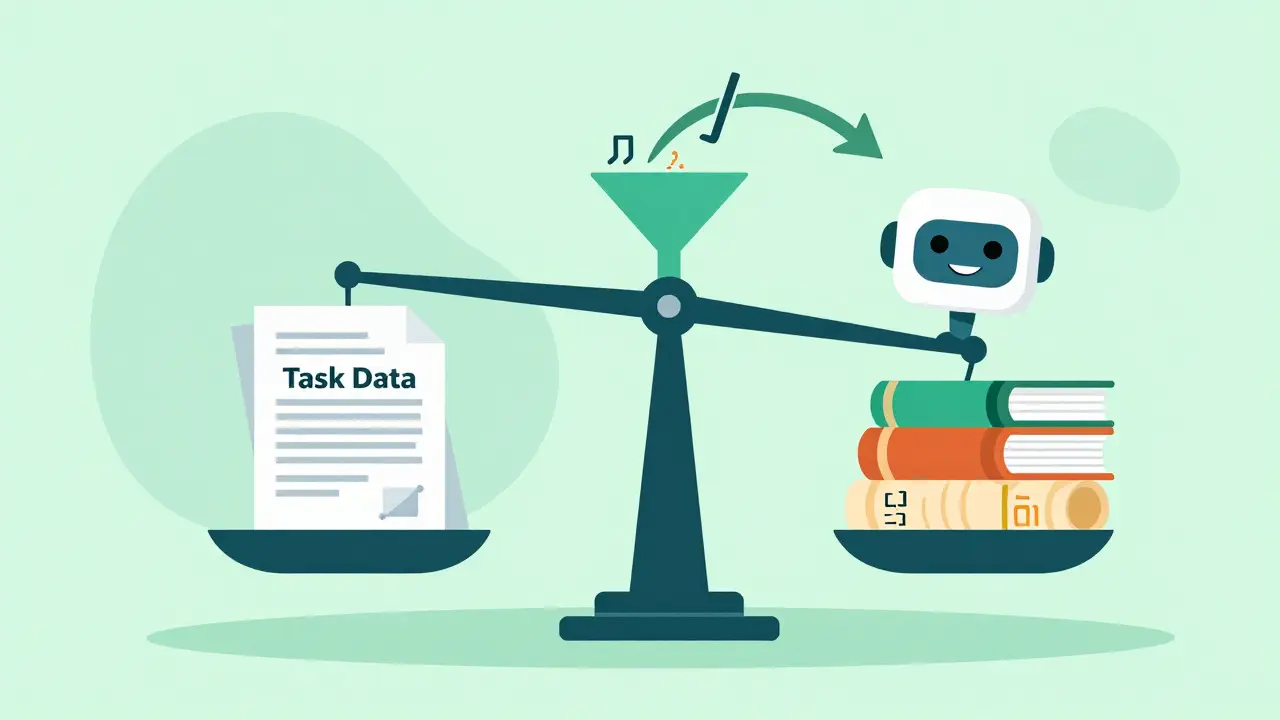
By occasionally showing the model examples of general conversation, coding, or math, you remind it of its broader capabilities. Even mixing in just 5-10% of general data can significantly stabilize performance on benchmarks like MMLU. However, this requires access to representative general data, which may not always be available due to licensing restrictions. In such cases, synthetic data generation using the base model itself can serve as a proxy for rehearsal.
Evaluating Benchmark Transfer Effectively
You cannot manage what you do not measure. Evaluating benchmark transfer requires a rigorous testing pipeline. Relying solely on accuracy for the target task is insufficient. You need a multi-dimensional evaluation strategy.
Start by selecting a suite of general benchmarks that cover different cognitive skills. Common choices include:
- MMLU (Massive Multitask Language Understanding): Tests knowledge across subjects like history, science, and law.
- HellaSwag: Evaluates commonsense reasoning and text completion.
- GSM8K: Measures mathematical problem-solving abilities.
- SCROLLS: Assesses long-context understanding and retrieval-augmented generation.
Run these benchmarks before and after fine-tuning. Calculate the delta in scores. A negative delta indicates catastrophic forgetting. Your goal is to maximize the gain on the target task while minimizing the loss on general benchmarks. Some teams use a weighted score that penalizes drops in general performance heavily, forcing the optimization process to prioritize retention.
Additionally, consider evaluating fairness and bias metrics. Fine-tuning can inadvertently amplify biases present in the specialized data. Tools like Clarifai or Hugging Face’s evaluate library can help track these aspects alongside performance.
Frameworks and Tooling in 2026
The ecosystem for fine-tuning has matured significantly. Several frameworks now offer built-in support for PEFT and benchmark monitoring.
Hugging Face Transformers is the de facto standard library for accessing and fine-tuning open-source LLMs. Its integration with PEFT library makes implementing LoRA and QLoRA straightforward. The library provides hooks for custom evaluation scripts, allowing you to run benchmarks periodically during training.
Axolotl is a configuration-based fine-tuning framework that simplifies the setup of complex training pipelines. It supports multiple backends and offers pre-configured recipes for various models, reducing the boilerplate code needed to experiment with different hyperparameters.
TorchTune is Meta’s fine-tuning framework designed for scalability and ease of use. It emphasizes modularity, allowing users to swap out components like optimizers and schedulers easily. TorchTune includes utilities for distributed training, which is essential for larger models.
For reinforcement learning from human feedback (RLHF), libraries like TRL (Transformers Reinforcement Learning) integrate seamlessly with the Hugging Face ecosystem. RLHF can further align models with human preferences, but it introduces additional complexity in maintaining benchmark transfer. Careful reward modeling is required to ensure that alignment does not erase factual knowledge.
Practical Recommendations for Developers
If you are planning a fine-tuning project, follow these steps to safeguard benchmark transfer:
- Baseline First: Evaluate the pre-trained model on your target task and general benchmarks before any training begins.
- Choose PEFT: Start with LoRA or QLoRA unless you have a compelling reason to fine-tune all parameters.
- Monitor Continuously: Set up automated evaluations that run general benchmarks every N steps during training.
- Use Data Mixing: Incorporate a small fraction of general data into your training set.
- Tune Hyperparameters Conservatively: Lower learning rates and fewer epochs often yield better generalization.
- Validate Rigorously: Do not deploy until you have confirmed that general capabilities remain within acceptable bounds.
Remember that benchmark transfer is not a binary state. It is a spectrum. Some degree of trade-off is inevitable. The key is to understand the costs and benefits for your specific application. If your model is used only for a narrow task, slight degradation in general knowledge might be acceptable. But if it serves as a general assistant with specialized plugins, preserving baseline performance is non-negotiable.
What is catastrophic forgetting in LLM fine-tuning?
Catastrophic forgetting occurs when a model loses previously learned general capabilities after being trained on a new, specific task. This happens because the weight updates for the new task overwrite the parameters responsible for general knowledge, leading to poor performance on unrelated benchmarks.
How does LoRA help preserve benchmark transfer?
LoRA (Low-Rank Adaptation) freezes the pre-trained model weights and adds small, trainable low-rank matrices. Since the original weights are not updated, the model retains its general language understanding, significantly reducing the risk of catastrophic forgetting.
Which benchmarks should I use to evaluate transfer?
Common benchmarks include MMLU for general knowledge, HellaSwag for commonsense reasoning, GSM8K for math, and SCROLLS for long-context understanding. Using a diverse suite ensures comprehensive coverage of different cognitive skills.
Is data mixing necessary for benchmark transfer?
Data mixing, or rehearsal, is highly recommended. Including a small percentage (5-10%) of general-purpose data in the fine-tuning set helps the model retain its broader capabilities by regularly reinforcing general patterns.
What are the best hyperparameters for preventing forgetting?
Use lower learning rates (1e-4 to 5e-5), larger batch sizes, fewer epochs, and weight decay. Conservative settings prevent aggressive weight shifts that can disrupt the model’s general knowledge base.