Chain-of-Thought Prompting: How to Boost LLM Reasoning Accuracy
 May, 23 2026
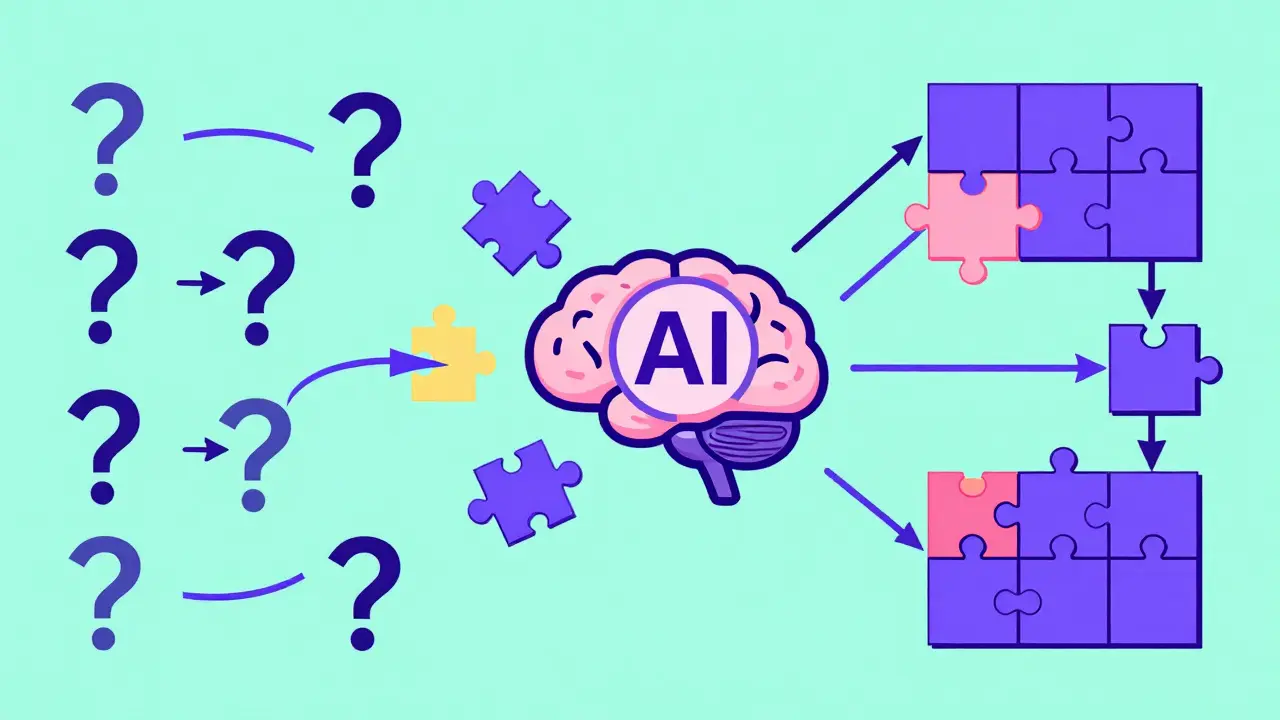
Have you ever asked an AI a complex question and gotten a confident but completely wrong answer? It happens more often than we’d like to admit. The model jumps straight to the conclusion without showing its work, leading to hallucinations or logical errors. This is where chain-of-thought prompting comes in. It is a technique that forces large language models (LLMs) to break down problems into step-by-step reasoning before giving a final answer.
Think of it like checking your math homework. If you just write "42" as the answer, no one knows if you actually solved the equation or guessed. But if you write out every step-subtracting this, dividing by that-you can spot mistakes along the way. Chain-of-thought (CoT) prompting does exactly this for AI. It doesn’t require retraining the model or changing its code. You just change how you ask the question.
What Is Chain-of-Thought Prompting?
Chain-of-thought prompting is a method introduced in 2022 by researchers at Google, including Jason Wei and Denny Zhou, that improves LLM performance on complex tasks by generating intermediate reasoning steps. Instead of asking for a direct answer, you provide examples that show the thought process. The model then mimics this behavior for new questions.
Before CoT, standard prompting relied on input-output pairs. You’d give the model a few questions and their correct answers, hoping it would learn the pattern. But for multi-step problems, this approach falls flat. The model tries to guess the output based on surface-level similarities rather than understanding the logic. CoT changes the game by making the invisible thinking process visible.
The key insight from the original research is that reasoning is an emergent property of scale. Smaller models don’t benefit much from this technique. In fact, they might perform worse because the extra steps confuse them. But once you hit around 100 billion parameters, something clicks. Large models start to reason through problems logically when guided by CoT prompts.
How Chain-of-Thought Works in Practice
Implementing chain-of-thought prompting is surprisingly simple. You don’t need access to the model’s weights or massive datasets. All you need is a well-structured prompt. Here’s how it works:
- Few-Shot Examples: Provide 3 to 8 examples in your prompt. Each example should include the question, a detailed step-by-step explanation, and the final answer.
- Explicit Reasoning: Make sure the examples show the "why" behind each step. Don’t just list calculations; explain the logic.
- Target Question: After the examples, present the new problem you want the model to solve. Add a cue like "Let's think step by step" to trigger the CoT behavior.
For instance, if you’re asking about sports statistics, a standard prompt might look like this:
Q: Who won the Super Bowl in 2020?
A: Kansas City Chiefs
A chain-of-thought version looks different:
Q: Who won the Super Bowl in 2020?
A: First, I recall that Super Bowl LIV was played in February 2020. The teams were the Kansas City Chiefs and the San Francisco 49ers. The Chiefs came back from a 10-3 deficit in the fourth quarter. Therefore, the winner was the Kansas City Chiefs.
Final Answer: Kansas City Chiefs
By seeing this structure, the model learns to pause, retrieve relevant facts, verify them against each other, and then conclude. This reduces random guessing significantly.
Why Scale Matters for CoT
One of the most critical findings in the CoT research is the role of model size. Not all AI models can do this effectively. The benefits of chain-of-thought prompting are largely tied to the number of parameters in the model.
Research showed that models with fewer than 100 billion parameters often struggle with CoT. They might get stuck in loops, repeat themselves, or generate nonsensical steps. However, larger models like Google’s PaLM (540 billion parameters) saw dramatic improvements. On the GSM8K benchmark-a dataset of grade-school math word problems-PaLM achieved 58% accuracy with CoT. That beat the previous best result of 55%, which required fine-tuning GPT-3 and using a separate verifier system.
This means if you’re working with smaller open-source models (like those under 70 billion parameters), CoT might not help much. You might be better off using zero-shot prompts or fine-tuning. But for enterprise-grade LLMs, CoT is a powerful tool that unlocks hidden reasoning capabilities without any additional training.

Comparison: Standard Prompting vs. Chain-of-Thought
| Feature | Standard Prompting | Chain-of-Thought (CoT) |
|---|---|---|
| Reasoning Process | Hidden; direct input-to-output mapping | Visible; explicit intermediate steps |
| Complexity Handling | Poor for multi-step logic | Strong for arithmetic, commonsense, and symbolic tasks |
| Model Size Requirement | Works across all sizes | Requires ~100B+ parameters for optimal results |
| Debugging | Hard to identify why an error occurred | Easy to spot logical flaws in specific steps |
| Training Data Needed | None (for zero-shot) or large sets (for fine-tuning) | Only a few exemplars (3-8) needed in the prompt |
As the table shows, CoT isn’t just a minor tweak. It fundamentally changes how the model approaches a problem. It trades speed for accuracy and transparency. For tasks where getting the right answer matters more than instant responses, this trade-off is worth it.
Types of Tasks Where CoT Shines
Chain-of-thought prompting isn’t a silver bullet for every query. It excels in three specific areas where human-like reasoning is essential:
- Arithmetic Reasoning: Math word problems require multiple operations. CoT helps the model keep track of variables and avoid calculation errors. The GSM8K benchmark proves this clearly.
- Commonsense Reasoning: Questions that rely on everyday knowledge, like StrategyQA or Date Understanding, benefit from CoT. The model connects disparate facts logically instead of relying on statistical likelihood alone.
- Symbolic Reasoning: Tasks involving rules, patterns, or abstract symbols (like coding logic or chess moves) improve when the model articulates its decision path.
For simple factual queries-like "What is the capital of France?"-CoT adds unnecessary overhead. Use standard prompting there. Save CoT for the messy, complex problems that trip up even smart people.
Advanced Variants: Auto-CoT and Beyond
Creating good CoT examples manually can be tedious. You have to craft perfect reasoning chains for each domain. To solve this, researchers developed Auto-CoT, an automated variant that generates these examples for you.
Auto-CoT works in two steps:
- Question Clustering: It groups similar questions together to ensure diverse coverage.
- Demonstration Sampling: It picks one representative question from each cluster and uses zero-shot CoT to generate a reasoning chain automatically.
This reduces the manual effort required while maintaining high quality. Other variants, like Self-Consistency, take CoT further by generating multiple reasoning paths and picking the most common answer. This ensemble approach boosts accuracy even more, especially on tricky benchmarks.
Practical Tips for Implementing CoT
If you want to start using chain-of-thought prompting today, here are some actionable tips:
- Start Small: Begin with 3-5 high-quality examples. More isn’t always better if the examples are noisy.
- Be Explicit: Don’t skip steps in your examples. If the model sees shortcuts, it will try to take them too.
- Use Clear Cues: Phrases like "Let's think step by step" or "Explain your reasoning" act as triggers for the model.
- Check Model Size: Ensure your LLM has enough capacity. If you’re using a small local model, CoT might degrade performance.
- Iterate: Test different example structures. Sometimes changing the order of steps improves clarity.
Remember, CoT is part of a broader toolkit called prompt engineering, which involves optimizing inputs to get desired outputs from LLMs. Combine CoT with other techniques like few-shot learning and instruction tuning for best results.
Limitations and Pitfalls
While powerful, CoT isn’t perfect. One major issue is verbosity. The model generates longer responses, which increases token usage and cost. For high-volume applications, this can add up quickly.
Another risk is error propagation. If the model makes a mistake in step one, it might carry that error through all subsequent steps. Unlike humans, who might catch a silly mistake mid-calculation, LLMs often commit to a flawed path once started. This is why verification layers are still important for critical applications.
Also, CoT can sometimes lead to "over-reasoning," where the model invents plausible-sounding but incorrect steps to justify a wrong answer. Always validate final outputs, especially in sensitive domains like healthcare or finance.
Does chain-of-thought prompting work with any LLM?
No. CoT primarily benefits large models with approximately 100 billion parameters or more. Smaller models may perform worse with CoT because they lack the capacity to handle the increased complexity of multi-step reasoning. Always test your specific model before relying on CoT.
How many examples do I need for effective CoT?
Typically, 3 to 8 high-quality examples are sufficient. Research showed that even eight examples allowed PaLM to achieve state-of-the-art results on math benchmarks. Focus on quality and diversity rather than quantity.
Is CoT better than fine-tuning?
For many reasoning tasks, yes. CoT achieves comparable or superior results to fine-tuned models without requiring labeled datasets or computational resources for training. It’s faster to implement and easier to adapt to new tasks.
Can I use CoT for creative writing?
Not really. CoT is designed for logical, analytical tasks like math, coding, and factual reasoning. Creative writing benefits more from style-based prompting or temperature adjustments rather than step-by-step logic.
What is Auto-CoT?
Auto-CoT is an automated method that generates chain-of-thought examples for you. It clusters similar questions and creates reasoning chains using zero-shot prompting, reducing the manual effort needed to build effective CoT prompts.
Emmanuel Sadi
May 25, 2026 AT 01:30Oh look, another blog post pretending to explain how magic works. You really think just adding "let's think step by step" fixes the fact that these models are just stochastic parrots? It’s cute how you all act like this is a breakthrough when it’s just expensive token generation for people who can’t afford real compute. The average dev reading this will try it on their tiny local LLM and wonder why it’s hallucinating even harder than before. Typical Silicon Valley hype cycle.
Nicholas Carpenter
May 25, 2026 AT 20:14I actually found this super helpful! I’ve been struggling with getting consistent answers from my API calls, and seeing the breakdown of why CoT fails on smaller models was an eye-opener. It makes sense now why my 7B parameter model was giving me nonsense steps. Thanks for clarifying that scale matters so much. Definitely going to switch to a larger provider for my logic-heavy tasks.
Chuck Doland
May 27, 2026 AT 09:23It is imperative to note that the efficacy of chain-of-thought prompting is not merely a function of prompt engineering but rather an emergent capability strictly correlated with parameter count. One must exercise caution in applying this technique to sub-100 billion parameter architectures, as the cognitive load imposed by explicit reasoning steps often exceeds the model's latent capacity for logical coherence. The distinction between surface-level pattern matching and genuine deductive reasoning remains the crux of this technological paradigm shift.
Madeline VanHorn
May 29, 2026 AT 03:58This is basic stuff if you actually read the papers instead of just reading summaries. Everyone here acts like they discovered fire. Also the table is ugly. Who designed this?
Glenn Celaya
May 29, 2026 AT 17:24i dont get the hype honestly seems like extra work for nothing most of the time i just want the answer not a essay explaining it to me feels like school again ugh
Wilda Mcgee
May 30, 2026 AT 18:13What a fantastic deep dive into the nuances of CoT! 🌟 I love how you highlighted the difference between arithmetic and commonsense reasoning-it’s like giving the AI a flashlight in a dark room instead of just asking it to guess where the furniture is. For those working with Auto-CoT, have you tried clustering your questions by domain complexity? It really helps streamline the demonstration sampling process. Keep up the awesome work sharing these insights!
Chris Atkins
May 31, 2026 AT 07:49hey guys back home we use similar methods for teaching kids math write down every step check your work simple stuff really glad to see ai learning from basic education principles no need for fancy terms sometimes
Jen Becker
June 1, 2026 AT 13:40Boring. Just give me the code. Why do I need to read all this fluff about 'reasoning' when I could just fine-tune a model and be done with it? This whole CoT trend is overrated anyway.
Ryan Toporowski
June 3, 2026 AT 13:37You nailed it! 👏 The part about error propagation is so true. I’ve seen models confidently double down on a wrong calculation because they committed to the first step. Self-consistency is definitely the way to go for critical apps. Great tips! 😊🚀
Samuel Bennett
June 4, 2026 AT 19:10Its obviously a conspiracy to make us dependent on big tech clouds. They want you to pay for more tokens so they can track your thought processes. The government is watching through your prompts. Wake up sheeple. The small models are safe because they are dumb enough to not report you yet.