Confidential Computing for Privacy-Preserving LLM Inference: A Practical Guide
 May, 11 2026
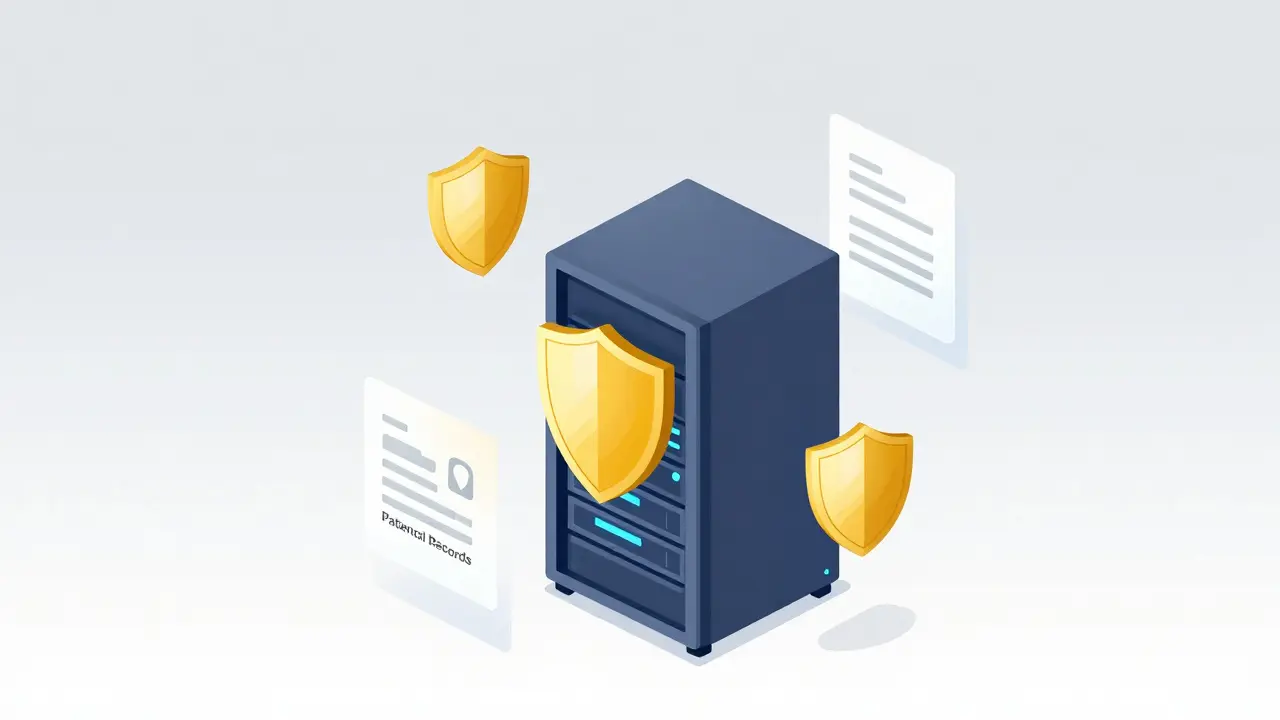
Imagine running a powerful large language model on sensitive patient records or confidential financial data without exposing that information to the cloud provider’s underlying infrastructure. This is no longer science fiction; it is the promise of confidential computing, which enables privacy-preserving LLM inference by keeping data encrypted even while it is being processed in memory. For years, encryption only protected data at rest (on disk) and in transit (over networks). Once data hit the CPU or GPU for processing, it had to be decrypted, leaving it vulnerable to insiders, hypervisor exploits, or malicious administrators. Confidential computing changes this equation by creating hardware-enforced security boundaries known as Trusted Execution Environments (TEEs).
If you are an AI engineer, CTO, or security architect looking to deploy generative AI in regulated industries like healthcare, finance, or government, understanding this technology is critical. The conflict between the demand for powerful AI services and the need for strict data privacy has reached a breaking point. Traditional methods like differential privacy or federated learning often sacrifice model accuracy or introduce significant latency. Confidential computing offers a different path: full performance with full secrecy. But how does it actually work under the hood, and what are the real-world trade-offs you need to consider before implementation?
How Confidential Computing Protects LLM Inference
At its core, confidential computing relies on hardware-based isolation. When you run an LLM inference job inside a TEE, both the user’s prompt (input data) and the model weights (intellectual property) remain encrypted outside the secure boundary. Only inside the isolated enclave-whether it’s a specific region of the CPU cache or a dedicated portion of GPU VRAM-is the data decrypted for computation.
The process follows a strict sequence designed to minimize exposure:
- Encrypted Request: The client sends the request via TLS 1.3, ensuring secure transmission.
- TEE Entry: The request enters the GPU or CPU TEE. Decryption happens exclusively within this secure zone.
- In-Enclave Inference: The LLM processes the data in encrypted memory. Even if a malicious actor accesses the physical RAM, they see only gibberish ciphertext.
- Encrypted Response: The output is re-encrypted before leaving the TEE, ensuring the final result is secure during transmission back to the client.
A critical component of this workflow is attestation. Before any sensitive operation begins, attestation cryptographically proves that the execution environment is authentic and untampered. In modern implementations, this is often mutual attestation: the LLM provider verifies the TEE’s authenticity before releasing decryption keys, and the enclave proves its authorization to pull encrypted model containers. This establishes a zero-trust foundation where neither party needs to blindly trust the other.
Hardware Foundations: CPUs vs. GPUs
You cannot run confidential computing on just any server. It requires specific hardware generations that support TEE technologies. The landscape is dominated by three major players, each with distinct architectures and capabilities.
| Provider | Technology | Key Feature | Limitation |
|---|---|---|---|
| Intel | TDX / SGX | Supports up to 512GB memory per VM | Complex software stack for legacy apps |
| AMD | SEV-SNP | Memory encryption for up to 512GB per VM | Limited GPU integration until 2025 |
| NVIDIA | CPR (Hopper/Blackwell) | Hardware firewalls for GPU VRAM | Requires latest H100/B100 GPUs |
For LLM inference, the GPU is the bottleneck. NVIDIA’s Compute Protected Regions (CPR) in their Hopper and Blackwell architectures are game-changers because they isolate memory directly on the graphics card. Previously, data had to move between CPU TEEs and unencrypted GPU memory, creating a vulnerability gap. With CPR, proprietary LLM weights remain confidential even when loaded onto high-performance GPUs. However, this means you must invest in newer hardware, such as Intel Xeon SP processors from 4th Gen Sapphire Rapids onward or AMD EPYC Milan-X series, to get started.
Cloud Provider Offerings: AWS, Azure, and Google Cloud
While hardware provides the foundation, cloud providers build the service layers that make these technologies accessible. Each major player has a distinct approach, affecting scalability, ease of use, and cost.
AWS Nitro Enclaves launched in 2020 and enhanced for LLM workloads in 2024. They use lightweight VMs isolated from the host with vsock communication channels. The advantage is seamless integration with existing EC2 infrastructure. However, the limitations are stark: limited to 2 vCPUs and 4GB RAM per enclave. For large LLMs, this forces you to quantize models heavily, which can reduce accuracy by 3-5%. AWS leads in enterprise adoption with 42% market share for confidential AI workloads, largely due to its mature ecosystem.
Microsoft Azure Confidential Inferencing leverages AMD SEV-SNP technology. It supports up to 16 vCPUs and 32GB RAM per confidential VM, offering better scalability than AWS for medium-sized models. Microsoft holds 31% market share and is positioned as a Leader in Gartner’s Magic Quadrant. Their strength lies in superior integration with Azure Machine Learning services, though NVIDIA GPU integration only became widely available in Q1 2025.
Google Cloud Confidential VMs use Intel TDX technology and offer the highest scalability, supporting up to 56 vCPUs and 224GB RAM. This makes them ideal for massive model deployments. However, they have historically lagged in GPU acceleration options. Google Cloud holds 18% market share but is rapidly catching up following partnerships announced in late 2024.
Performance Overhead and Real-World Trade-offs
No security solution comes free. The primary concern for engineers is performance overhead. Benchmarking shows a 5-15% overhead compared to non-confidential inference for CPU-bound tasks. For GPU-accelerated confidential computing on NVIDIA H100s, performance reaches 90-95% of native speeds. While this sounds impressive, the "cold start" problem remains a hurdle. Initial attestation adds 1.2-2.8 seconds to the first inference request. For real-time applications requiring sub-second responses, this latency can be prohibitive.
Another hidden cost is debugging. Debugging within isolated environments increases development time by 30-50% because traditional logging tools cannot access the encrypted memory space. You need specialized tooling and expertise in TEE-specific knowledge. Organizations typically require 80-120 hours of training for their AI engineering teams to become proficient. Furthermore, memory constraints often force model quantization, which reduces accuracy. As one healthcare CTO noted on Reddit, setting up Azure Confidential Inferencing required three dedicated security engineers for five months just to get HIPAA-compliant clinical note analysis working correctly.

Implementation Challenges and Best Practices
Deploying confidential LLM inference is not a plug-and-play operation. It requires careful planning across several domains. First, validate your hardware. Ensure your infrastructure supports the required TEE technologies. Second, configure attestation services. Setting up the cryptographic verification infrastructure is complex but essential for trust. Third, containerize your models. Use encrypted Open Container Initiative (OCI) images, as recommended by Red Hat, to ensure intellectual property stays secure throughout its journey.
Common pitfalls include ignoring side-channel attacks. While TEEs protect against direct memory access, researchers have demonstrated 12 novel side-channel techniques against TEEs in the past 18 months. These attacks exploit timing variations or power consumption patterns to infer data. To mitigate this, combine hardware TEEs with software techniques like Secure Partitioned Decoding (SPD) and Prompt Obfuscation. Additionally, monitor your latency budgets closely. If your application requires real-time interaction, the attestation delay may necessitate architectural adjustments, such as pre-warming enclaves or using hybrid approaches.
Future Outlook and Market Growth
The market for confidential computing in AI is exploding. Driven by regulatory pressures like GDPR, HIPAA, and CCPA, the global confidential computing market reached $2.8 billion in 2024, with AI workloads representing 37% of that total. IDC projects this will grow to $14.3 billion by 2027. By 2027, 65% of enterprise AI deployments in regulated industries will incorporate confidential computing techniques. This is not a niche trend; it is becoming a standard requirement. Gartner forecasts that 85% of large enterprises will implement confidential computing for sensitive AI workloads by 2027.
Standardization is also accelerating. The Confidential Computing Consortium is working on a universal attestation framework expected in Q2 2026, which would enable interoperability across different hardware platforms. This will reduce vendor lock-in and simplify deployment. As tooling matures and skills scarcity decreases, the barrier to entry will lower, making privacy-preserving LLM inference accessible to a broader range of organizations.
What is the difference between confidential computing and traditional encryption?
Traditional encryption protects data at rest (on storage) and in transit (over networks). Once data is processed by a CPU or GPU, it must be decrypted, leaving it vulnerable. Confidential computing uses hardware-based Trusted Execution Environments (TEEs) to keep data encrypted even while it is being processed in memory, protecting it from unauthorized access by cloud providers or malicious insiders.
Which cloud provider is best for confidential LLM inference?
It depends on your scale and needs. AWS Nitro Enclaves lead in enterprise adoption but have strict memory limits (4GB), forcing model quantization. Azure Confidential Inferencing offers better scalability (up to 32GB RAM) and strong integration with Azure ML. Google Cloud Confidential VMs provide the highest scalability (up to 224GB RAM) but have historically had limited GPU acceleration options. For GPU-heavy workloads, NVIDIA’s CPR-enabled instances on any major cloud are crucial.
Does confidential computing significantly impact LLM performance?
Yes, there is an overhead. Expect a 5-15% performance hit for CPU-bound tasks. For GPU-accelerated inference on NVIDIA H100s, performance reaches 90-95% of native speeds. The most noticeable impact is the "cold start" latency, adding 1.2-2.8 seconds to the first inference request due to attestation. Subsequent requests are faster, but real-time applications may need architectural adjustments to meet SLAs.
Can confidential computing prevent all types of attacks?
No. While TEEs protect against direct memory access and hypervisor exploits, they are not immune to side-channel attacks. Researchers have identified techniques that exploit timing or power consumption to infer data. To mitigate this, experts recommend combining hardware TEEs with software techniques like Secure Partitioned Decoding (SPD) and Prompt Obfuscation, and continuously updating countermeasures as new vulnerabilities are discovered.
What hardware do I need to run confidential LLM inference?
You need specific hardware generations. For CPUs, look for Intel Xeon SP processors from 4th Gen Sapphire Rapids onward or AMD EPYC processors from Milan-X onward. For GPUs, NVIDIA Hopper architecture (H100) or newer is required to utilize Compute Protected Regions (CPR) for securing model weights in VRAM. Older hardware lacks the necessary hardware-enforced security boundaries for true confidential computing.
Is confidential computing ready for production use?
Yes, but with caveats. Gartner rates its enterprise readiness at 3.7/5, citing a strong hardware foundation but immature tooling and skills scarcity. Major enterprises in healthcare, finance, and government are already deploying it. However, expect a steep learning curve, requiring 80-120 hours of training for engineering teams and 3-6 months for initial deployment. It is viable for regulated industries where compliance outweighs the complexity costs.