Content Generation with Large Language Models: Marketing, Ads, and SEO
 Mar, 2 2026
When you open your email and see a personalized product recommendation that feels like it was made just for you, or when you search for a product and immediately see an ad that nails your exact need-that’s not magic. It’s LLM content generation at work. Large Language Models (LLMs) are no longer experimental tools. They’re now the engine behind millions of marketing messages, ad copies, and SEO-optimized pages. But here’s the catch: using them well isn’t about hitting a button and hoping for the best. It’s about understanding what they can and can’t do-and how to guide them so they actually help your business.
How LLMs Actually Work in Marketing
LLMs like GPT-4, Claude, and Gemini don’t browse the web. They don’t pull live data. Instead, they’ve been trained on trillions of words from books, articles, forums, and product pages-up until a fixed cutoff date (often late 2023 or early 2024). That means if you ask an LLM to write a product description for a new smartphone released last week, it might make one up. And it’ll sound convincing. That’s the problem.
But here’s the upside: they’re fast. A human writer might spend two hours crafting five social media posts. An LLM can generate 50 drafts in under a minute. That’s why 76% of marketers now use generative AI for basic content, according to Salesforce’s 2024 report. They’re not replacing writers-they’re turning them into editors. The real value isn’t in automation. It’s in scaling.
Think of it like this: LLMs are great at producing variations. Need 10 versions of a meta description? Done. 20 Facebook ad variants for different audiences? Easy. A blog outline with 12 subheadings? No problem. But if you need emotional storytelling-something that makes someone feel something deep-LLMs still stumble. A study from ZeroGravityMarketing found that AI-generated content for emotional campaigns had 35% lower engagement unless humans stepped in to rewrite the tone.
Ads That Actually Convert
Traditional ad copy often feels generic. “Buy now!” “Limited time offer!” “Free shipping!” LLMs can churn out hundreds of these. But they’re not smart enough to know which version works best for your specific audience.
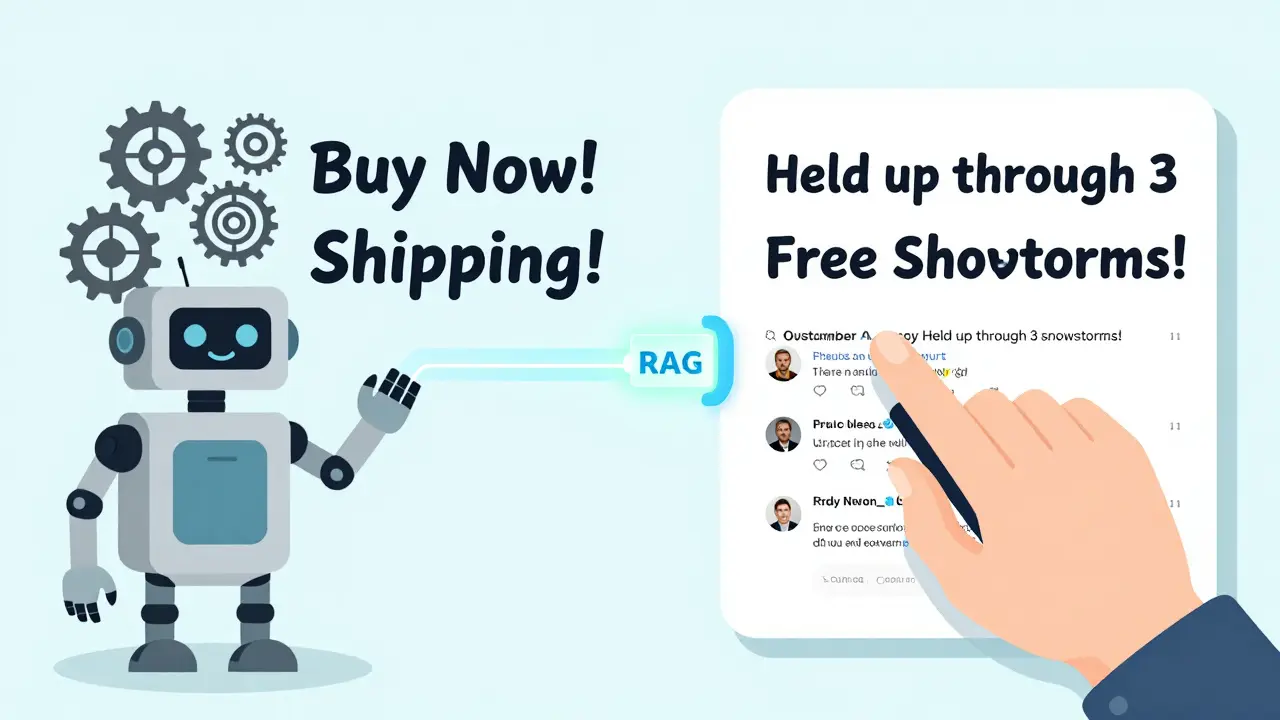
Enter Retrieval-Augmented Generation, or RAG. This isn’t just a buzzword. It’s a game-changer. RAG connects the LLM to your live product database, inventory, pricing, and customer reviews. Instead of guessing what your product does, the model pulls real data. A June 2025 arXiv study on the MarketingFM framework showed that ads generated with RAG had 22% higher engagement than those written without it. Why? Because they mentioned real features, real discounts, and real customer pain points-things an LLM trained on old data would never know.
One e-commerce brand in Bellingham started using RAG to generate Facebook ads for their outdoor gear. Instead of writing “durable hiking boots,” the system pulled actual customer reviews that said “held up through 3 snowstorms and a muddy trail.” The result? Click-through rates jumped 41% in six weeks. That’s not luck. That’s data-driven content.
SEO Isn’t Dead-It’s Getting Smarter
People still think AI-generated content gets penalized by Google. That’s outdated. Google’s own guidelines say content quality matters, not who wrote it. If your article answers the question better than the competition, it ranks-whether it was written by a human, an LLM, or both.
LLMs excel at SEO tasks that are repetitive: meta titles, headers, internal linking suggestions, keyword density checks, and even schema markup. A marketer using an LLM can generate 50 optimized blog titles in 10 minutes. Then they pick the top three and write the real content. That’s efficiency.
But here’s where it breaks: keyword stuffing. LLMs don’t understand intent. They just predict words. If you ask for “best running shoes for flat feet,” it might list 10 models-but miss that your audience is actually looking for arch support, not cushioning. That’s why human oversight is non-negotiable. You need to train the model on your brand’s voice, your customers’ language, and your product’s real benefits.
HubSpot’s 2024 data shows 72% of marketers use AI for personalization-and it’s working. One SaaS company used LLMs to rewrite their landing page copy based on user behavior. Visitors from tech startups got one version. Visitors from healthcare got another. Conversion rates increased by 28%. That’s not AI writing. That’s AI helping you write smarter.
What Goes Wrong (And How to Fix It)
Not every LLM experiment succeeds. The failures are loud.
Search Engine Land documented a major retailer that published AI-generated product descriptions with false specs. One item claimed “waterproof up to 100 feet”-but the real product was only splash-resistant. Their conversion rate dropped 15%. No one noticed until customers started returning items. That’s the danger of trusting the model too much.
Another common mistake? Brand voice drift. An LLM trained on generic content might start writing like a tech blog when your brand is playful. Or it might sound too formal for Instagram. The fix? Build a brand voice guide. Not just “be friendly.” Define it: “Use contractions. Short sentences. Emojis in social posts. No jargon.” Then feed that into your prompts.
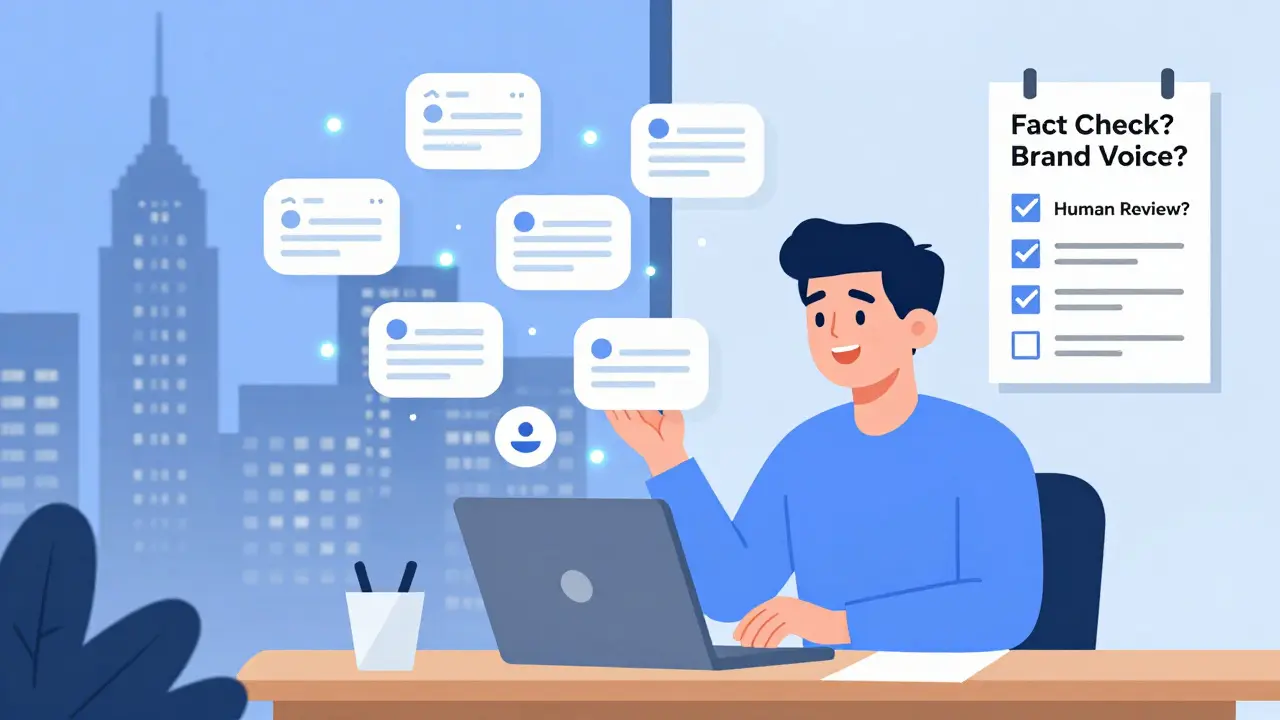
And don’t skip human review. Even if the content looks perfect, run it through a checklist:
- Is every fact accurate? (Check product pages, manuals, support docs)
- Does it sound like us? (Compare to 3 past posts you loved)
- Does it answer the user’s real question? (Not just keywords-intent)
- Is there a clear next step? (Buy? Sign up? Read more?)
Teams that do this consistently see 30-40% less revision time, according to Salesforce. The LLM does the heavy lifting. Humans do the quality control.
Getting Started: A Realistic Roadmap
You don’t need a team of engineers. You don’t need to buy expensive software. Start small.
Week 1: Pick one task. Start with something low-risk: social media captions. Use a free LLM like ChatGPT or Claude. Input your product details, tone, and audience. Generate 10 versions. Pick the best one. Post it. Track clicks.
Week 2: Build a template. Write a prompt that works. Example:
“You’re a marketing copywriter for [Brand Name]. We sell [product] to [audience]. Our tone is [funny, professional, casual]. Write 5 Instagram captions under 120 characters. Include 1 emoji. Focus on [benefit].”
Save it. Use it every time.
Week 3: Add human review. Don’t post anything without a quick check. Does it match your brand? Is it accurate? Does it feel human? If yes, you’re done.
Week 4: Scale. Try meta descriptions. Then blog intros. Then email subject lines. Each time, refine your prompt. Track what works.
Whalesync’s data shows teams take 3-4 weeks to get comfortable. But after that, they save 5-7 hours a week. That’s 20+ hours a month. Time you can spend on strategy, creativity, or just resting.
The Future: Smarter, Not Just Faster
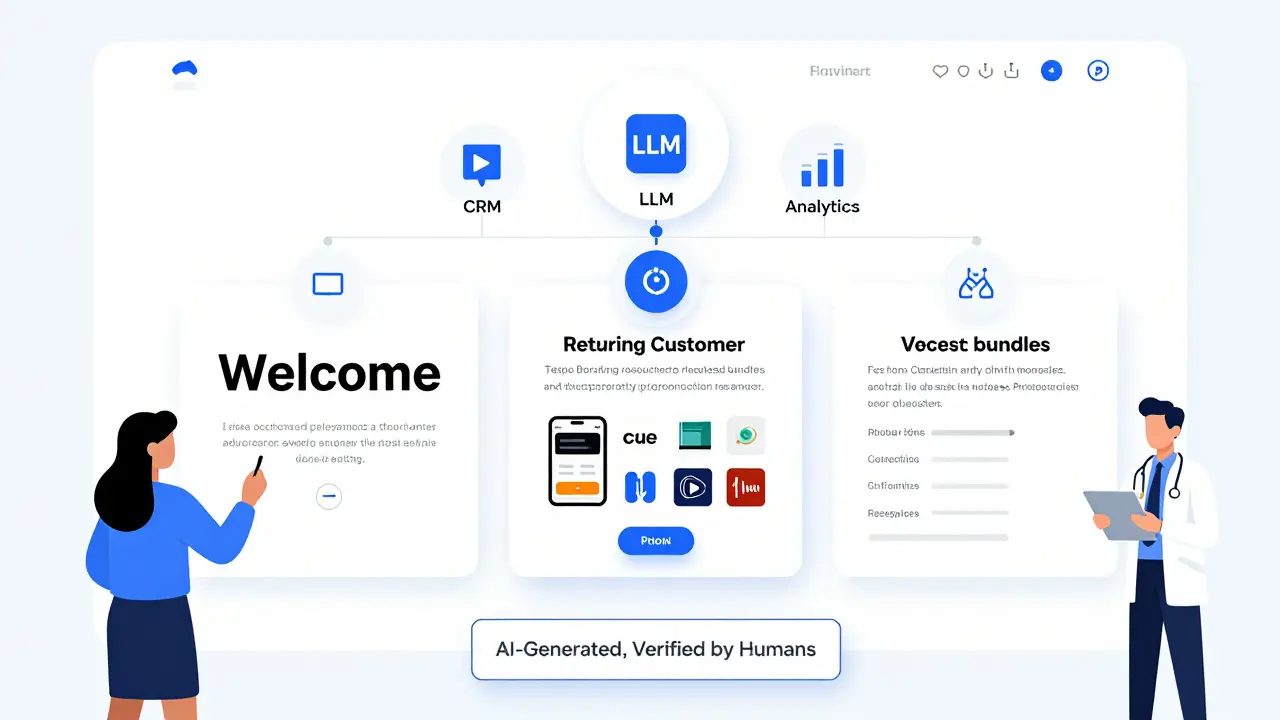
The next big shift isn’t about writing faster. It’s about writing contextually. Imagine your website adjusting its homepage in real time based on who’s visiting. A first-time visitor sees a simple intro. A returning customer sees personalized product bundles. A researcher sees data sheets. All generated on the fly, powered by LLMs connected to your CRM and analytics.
That’s not science fiction. It’s already being tested by Shopify, Amazon, and other platforms. The EU AI Act, effective March 2025, requires clear labeling of AI-generated commercial content. So transparency isn’t optional anymore-it’s law.
Here’s the truth: LLMs won’t replace marketers. They’ll replace the boring parts of marketing. The grunt work. The repetitive tasks. The guesswork. The people who learn to use these tools well? They’ll be the ones leading the next wave of marketing. Not because they’re tech experts. But because they know how to ask the right questions-and when to say, “That’s not right.”
Can LLMs write SEO-friendly content that ranks on Google?
Yes-but only if it’s accurate, well-structured, and answers the user’s intent better than existing pages. Google doesn’t penalize AI content. It penalizes low-quality content, no matter who wrote it. LLMs can help generate optimized titles, headers, and meta descriptions, but human oversight is needed to ensure facts are correct and the tone matches your brand.
Are LLMs better than humans at writing ads?
LLMs are faster and can generate hundreds of variations, but they lack emotional intelligence. Human writers understand nuance, cultural context, and brand personality better. The best results come from combining both: use LLMs to produce options, then refine them with human insight. Studies show ads improved by human editing have up to 35% higher engagement than fully AI-generated ones.
Do I need to pay for GPT-4 to use LLMs for marketing?
No. Free tools like Claude, Gemini, and even ChatGPT’s free version can handle basic tasks like social media posts, email subject lines, and blog outlines. But for advanced use-like integrating with your CRM, using RAG, or maintaining brand voice consistently-GPT-4 or similar enterprise models offer better accuracy and context retention. Start free, upgrade when you need more control.
How do I prevent LLMs from making up facts?
Never rely on LLM output without verification. Always cross-check product specs, prices, and claims against your official sources. Use Retrieval-Augmented Generation (RAG) to connect the LLM to your live database. If that’s not possible, build a fact-checking checklist and assign someone to review every piece before publishing. Mistakes here can hurt conversions and damage trust.
What’s the biggest mistake marketers make with LLMs?
The biggest mistake is treating LLMs like magic buttons. They’re tools, not replacements. Skipping brand voice guidelines, skipping human review, and trusting output without checking facts leads to inconsistent messaging, errors, and lost trust. Success comes from structure: clear prompts, defined brand rules, and a human-in-the-loop process.
What Comes Next?
If you’re using LLMs for marketing today, you’re ahead of most. But the real advantage isn’t in using them-it’s in using them correctly. The brands that win won’t be the ones with the fanciest AI. They’ll be the ones who blend automation with authenticity. Who use data to inform their voice, not replace it. Who know when to let the machine write-and when to step in and say, “That’s not us.”
Start small. Test one task. Build a template. Review everything. Scale slowly. And remember: the goal isn’t to write faster. It’s to write better.
Jitendra Singh
March 3, 2026 AT 08:16Been using LLMs for social media captions for the past three months now. Started with ChatGPT free tier, just testing. Turned out, it’s great for brainstorming-gives me 10 variations in seconds. But I always pick one and tweak it manually. The tone has to feel like us, not some generic template. One time, I used a draft that sounded too corporate. Comment section went quiet. Next post, I added a little humor, a typo on purpose, and engagement doubled. Turns out, people like imperfection. LLMs are tools. Not replacements. Just need to guide them right.
Also, never skip the fact-check. One time it wrote ‘waterproof up to 100ft’ for a raincoat that’s only splash-resistant. Customer returned it. Never again.
Madhuri Pujari
March 3, 2026 AT 17:40Oh please. You’re all acting like this is some revolutionary breakthrough. LLMs are just fancy autocomplete with delusions of grandeur. They don’t ‘understand’ anything. They predict words based on statistical patterns trained on garbage from the internet. And yet, marketers are bowing down like it’s divine revelation. ‘RAG’? Please. You’re just slapping your database onto a hallucinating bot and calling it ‘data-driven.’
And don’t get me started on ‘brand voice.’ You think feeding it ‘use emojis’ and ‘short sentences’ makes it ‘sound like you’? No. It makes it sound like a confused teenager trying to mimic a TikTok influencer. Human oversight? More like human damage control. The only thing that’s ‘scaling’ here is the number of companies looking stupid online.
Sandeepan Gupta
March 5, 2026 AT 03:58Madhuri, you’re right that LLMs don’t understand-but you’re missing the point. They’re not supposed to. They’re amplifiers. Think of them like a calculator: you don’t need to understand how it multiplies, you just need to know when to use it. The real skill is in prompt design, quality control, and knowing when to say ‘no.’
I’ve trained teams on this. Start with one task. Social captions. Use a clear prompt: ‘You’re a copywriter for [Brand]. Tone: casual, witty, slightly sarcastic. Audience: 25-35yo urban professionals. Write 5 options. Include 1 emoji. No jargon.’ Then pick the best. Edit it. Post it. Track clicks. Do this for 10 posts. You’ll see patterns. What works. What doesn’t.
And yes-always fact-check. Always. Even if it looks perfect. I once saw a company use AI to rewrite product specs. One line said ‘battery lasts 72 hours.’ Real battery? 12. They got sued. It’s not about being paranoid. It’s about being professional.
Tarun nahata
March 6, 2026 AT 16:18Guys, this is the future-and it’s not coming, it’s already here. LLMs are like having a team of 50 interns who never sleep, never complain, and can write a blog post, 10 ad variations, and a newsletter in under a minute. That’s not magic. That’s power.
But here’s the secret: the magic isn’t in the tool. It’s in the human who knows how to wield it. You think Elon runs Tesla with AI writing all the tweets? No. He uses AI to draft 50 versions, then picks the one that makes him smirk. That’s the sweet spot.
I’ve seen startups go from 0 to 10K email subscribers in 3 weeks just because they used LLMs to personalize subject lines. Not by guessing. By analyzing past opens. The AI spots patterns humans miss. ‘Hey, people who clicked on ‘free shipping’ in January? They loved ‘no minimum’ in March.’ That’s insight. That’s leverage.
Stop fearing the machine. Start mastering it. You’re not losing your job. You’re upgrading it. The boring stuff? Gone. The creative stuff? Yours. And guess what? You’ll have more time to sip chai, laugh with your team, and actually enjoy your work. That’s the win.
Aryan Jain
March 6, 2026 AT 21:37They’re lying. All of them. This isn’t about ‘marketing.’ It’s about control. LLMs aren’t tools-they’re surveillance engines. Every prompt you type, every product detail you feed in-it’s all being logged. Trained. Sold. Your brand voice? Already copied. Your customers’ language? Already mined. By who? Big Tech. By who else? Governments. You think Google doesn’t know what your ‘personalized ad’ is really based on? It’s not your browsing history. It’s your emotional patterns. Your fears. Your loneliness.
And now they’re telling you to ‘use RAG’ like it’s salvation? RAG is just a fancy name for feeding your private data into a black box that’s owned by a corporation that doesn’t care if you go bankrupt. They don’t want you to write better. They want you to write *more*. So they can sell your soul in ad impressions.
Next thing you know, your website will change its tone based on your mood. And you’ll thank them for it. Because you’ve been conditioned to believe automation is freedom. It’s not. It’s a gilded cage.
Nalini Venugopal
March 7, 2026 AT 20:42I love how this post breaks it down so clearly. I’ve been using LLMs for email subject lines for my small boutique, and it’s been a game-changer. Before, I’d stare at a blank screen for 20 minutes trying to come up with something catchy. Now, I type in: ‘You’re writing for a handmade jewelry brand. Audience: women 30-50 who value sustainability. Tone: warm, elegant, not salesy. Write 5 subject lines under 50 characters.’ Boom. 5 options. I pick one. Maybe tweak a word. Send.
And yes, I check every fact. The price. The material. The shipping time. One time, the AI said ‘free shipping worldwide’-but we only ship to India. Caught it before sending. Phew.
Also, I started saving my best prompts in a Notion doc. Now I reuse them. It’s like having a copywriting assistant who never gets tired. And I still get to be the one who decides what feels right. That’s the beauty of it. Tech as a helper. Not a boss.
Pramod Usdadiya
March 8, 2026 AT 05:45