Cross-Modal Generation in Generative AI: From Text-to-Image to Video-to-Text
 Aug, 8 2026
Imagine describing a scene in words and instantly seeing it rendered as a photorealistic image. Or watch a silent video clip and have an AI generate a detailed, accurate transcript of the action happening on screen. This isn't science fiction anymore; it is the reality of Cross-Modal Generation, which is a specialized subset of generative AI that translates data from one format (like text) into another distinct format (like images or audio). Unlike traditional AI that stays within its lane-processing only text or only images-these systems bridge the gap between different types of data.
The core promise here is semantic fidelity. The goal isn't just to make something look cool; it's to ensure that the meaning of the input matches the output perfectly across different mediums. If you type "a red apple," the generated image shouldn't show a green pear. As we move deeper into 2026, understanding how these models work, where they fail, and what hardware they need is crucial for developers and businesses alike.
How Cross-Modal Models Actually Work
To understand cross-modal generation, you first need to grasp the concept of a shared latent space. Think of this as a universal translation dictionary that lives inside the model's neural network. When you feed text into the system, the model converts those words into a numerical vector-a string of numbers representing the concept. It does the same for images, audio, or video.
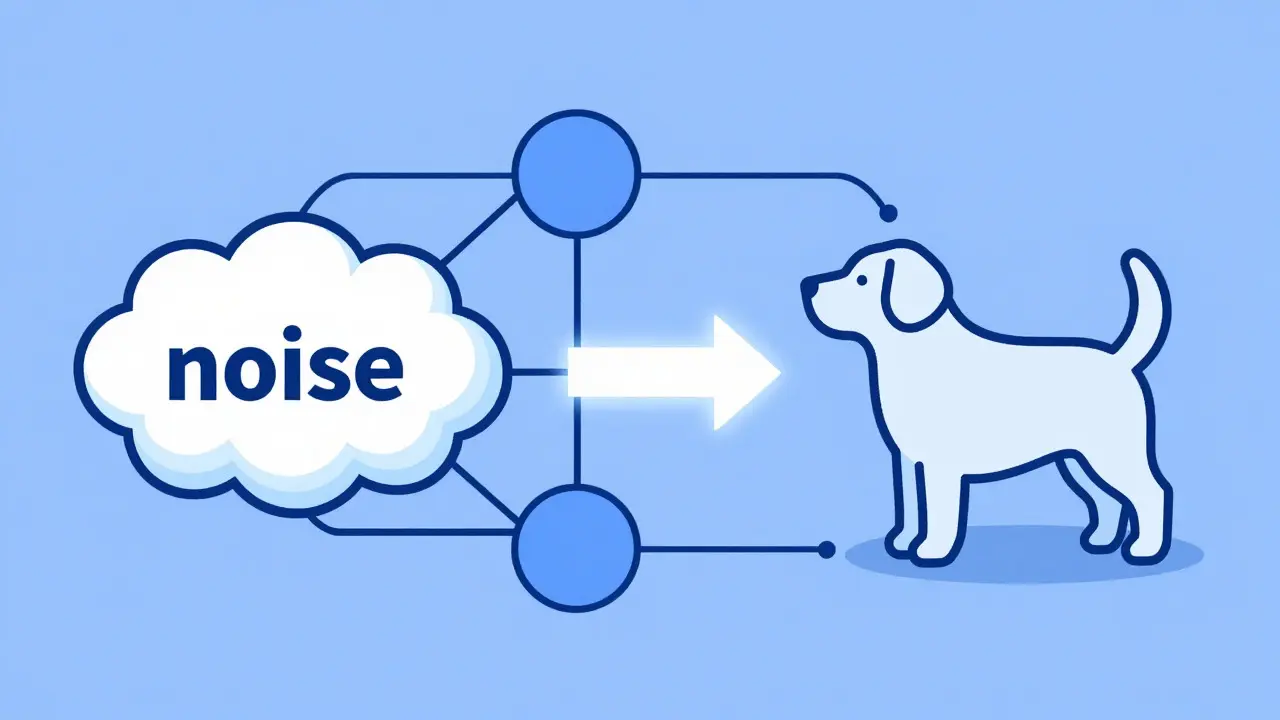
The magic happens when the model learns that the vector for the word "dog" sits very close to the vector for a picture of a dog in this abstract mathematical space. Diffusion Models are the current state-of-the-art architecture used in most high-quality cross-modal systems, working by adding noise to data and then learning to reverse the process to generate clean outputs. Specifically, modern implementations like Stable Diffusion 3 use a two-phase process:
- Forward Diffusion: The model gradually adds Gaussian noise to an image over roughly 1,000 timesteps until it becomes pure static.
- Reverse Diffusion: Using the text prompt as a guide via attention mechanisms, the model learns to remove the noise step-by-step, reconstructing an image that aligns with the text description.
This alignment relies heavily on attention mechanisms. These mechanisms map semantic relationships between modalities. For example, if your text says "left side," the attention mechanism ensures the visual generator places the object on the left. Without robust conditional mappings, the output falls apart. Research indicates that these systems require at least 70% data integrity in the input to produce acceptable quality, meaning garbled or incomplete prompts often lead to hallucinated or nonsensical results.
Key Architectures and Technologies
While diffusion models dominate the current landscape, the field has evolved through several key architectures. Understanding these helps explain why some tools are faster while others are more accurate.
| Architecture | Primary Use Case | Strengths | Weaknesses |
|---|---|---|---|
| GANs (Generative Adversarial Networks) | Early bidirectional generation (e.g., CMCGAN) | Fast inference speeds | Mode collapse, unstable training |
| VAEs (Variational Autoencoders) | Learning shared latent spaces | Stable training, good reconstruction | Blurry outputs, less sharp details |
| Multimodal Diffusion Models | High-fidelity text-to-image/video | High detail, strong semantic alignment | Computationally expensive, slow generation |
Stable Diffusion 3 was released in March 2024 by Stability AI, achieving 87.3% accuracy on cross-modal retrieval benchmarks and setting a new standard for open-source text-to-image generation. It powers many creative workflows today. On the proprietary side, GPT-4o is OpenAI's multimodal large language model released in May 2024, leading enterprise adoption with 42% market share among AI implementations. GPT-4o excels not just in generation but in understanding complex instructions across modalities, making it a favorite for enterprise applications requiring high reliability.
Hardware Requirements and Performance Metrics
You can't run these heavy models on your laptop's integrated graphics card. Cross-modal generation is computationally intense. According to technical assessments from late 2024, enterprise deployment typically requires NVIDIA A100 GPUs with a minimum of 40GB VRAM to handle the memory demands of large-scale diffusion models without crashing.
Latency matters too. If you're building a real-time application, every millisecond counts. Independent testing showed that generating a single high-resolution image takes about 2.3 seconds using Stable Diffusion 3 on optimized hardware. In contrast, DALL-E 3 averages 4.7 seconds per image due to its cloud-based processing overhead. For video-to-text tasks, the computational load spikes further because the model must process temporal coherence-understanding how objects move and change over time, not just their appearance in a single frame.
Energy consumption is also a growing concern. Current cross-modal systems require approximately 3.2 times more energy per task than unimodal equivalents. As companies scale up usage, this efficiency gap becomes a significant operational cost and environmental factor.
Common Challenges and Failure Points
Despite the hype, these models are far from perfect. The biggest issue is modality misalignment. McKinsey's AI Lab reported that 18.7% of cross-modal generation attempts suffer from misalignment, where the output doesn't match the input's intent. In text-to-image scenarios, this often manifests as semantic drift. For instance, asking for "a cat sitting on a mat" might result in a cat standing near a rug. IBM's technical assessment found that 23.8% of text-to-image generations exhibit this kind of subtle but critical error.
Data scarcity is another bottleneck. While there are billions of text-image pairs available on the internet, high-quality paired data for other combinations is rare. The K4V dataset, one of the largest public resources for video-to-text pairing, contained only 12,000 examples as of December 2024. This lack of diverse training data limits the model's ability to generalize across complex scenarios, particularly in specialized fields like medical imaging or legal document analysis.
Then there's the problem of bias propagation. Since these models learn from human-generated data, they inherit our biases. The AI Now Institute rated cross-modal systems at only 5.2 out of 10 for reliability, citing concerns that stereotypes in text inputs could be amplified in visual outputs, creating misleading or harmful content.
Real-World Applications and Industry Adoption
Where is this technology actually being used? Media and entertainment lead the pack. Adobe Firefly, integrated into Creative Cloud, received a 4.5/5 rating from users in late 2024, largely because it streamlined content creation workflows. Architects use text-to-image models to generate building concepts from rough descriptions, saving 15-20 hours per project according to developer feedback. However, even in these creative fields, manual correction is still needed about 40% of the time to fix perspective issues or style inconsistencies.
In healthcare, the potential is huge but risky. Medical image captioning-converting X-rays or MRIs into textual reports-shows a 43.7% error rate in current implementations, according to Johns Hopkins researchers. This highlights why precise technical translation remains a challenge. You can't afford ambiguity when diagnosing patients.
Enterprise adoption stands at 37% across tech, media, and healthcare sectors. But implementation isn't plug-and-play. Developers report that integrating cross-modal capabilities increases development time by 35-50%. Data alignment alone consumes 62% of implementation time, as teams struggle to clean and pair datasets effectively.

Future Trends and Regulatory Landscape
Looking ahead, the trend is toward multi-stage alignment and hybrid architectures. Meta AI's research suggests that combining diffusion models with neural radiance fields could improve 3D-aware generation, addressing current limitations in spatial consistency. OpenAI's upcoming GPT-4.5 promises 32% improved temporal coherence for video-to-text tasks, which would significantly reduce errors in summarizing long-form video content.
Regulation is catching up. The EU AI Act, updated in November 2024, now requires specific transparency disclosures for cross-modal systems used in public-facing applications. This means companies must clearly label AI-generated content and provide information about the underlying models. Compliance costs are expected to rise by 12-15%, pushing smaller players to rely on established platforms rather than building custom solutions.
By 2027, Forrester predicts that 75% of enterprise AI applications will incorporate cross-modal generation. However, experts caution that true semantic understanding-the ability to reason across modalities rather than just statistically correlate them-remains unsolved. Until then, human oversight will remain essential.
Best Practices for Implementation
If you're planning to integrate cross-modal generation into your workflow, start small. Don't try to build a full-scale video-to-text engine on day one. Begin with text-to-image prototypes to test alignment quality. Use established APIs like GPT-4o or Stable Diffusion 3 initially to validate your use case before investing in custom infrastructure.
Prioritize data quality. Spend at least half your project budget on curating and cleaning paired datasets. Garbage in, garbage out applies doubly here because the model has to learn two representations simultaneously. Implement rigorous validation metrics early. Standard accuracy scores aren't enough; you need custom checks for semantic fidelity, such as human-in-the-loop evaluations for critical outputs.
Finally, plan for latency. If your user experience depends on real-time generation, consider caching common outputs or using distilled smaller models for quick drafts, reserving the heavy lifting for final renders. And always include a clear fallback mechanism when the model fails to align properly.
What is the difference between cross-modal generation and multimodal fusion?
Cross-modal generation creates new content in one modality based on input from another (e.g., text to image). Multimodal fusion combines multiple inputs to make a single decision or classification (e.g., analyzing both text and image to detect spam). One generates; the other analyzes.
Which model is better for enterprise use: Stable Diffusion 3 or GPT-4o?
It depends on your needs. Stable Diffusion 3 offers greater control and customization for creative tasks and is open-source, making it ideal for developers who want to fine-tune models. GPT-4o provides higher reliability, easier integration via API, and stronger semantic understanding, making it better for general enterprise applications where ease of use and accuracy are priorities.
Why do cross-modal models struggle with video-to-text tasks?
Video involves temporal dynamics-objects move, change, and interact over time. Most training data consists of static images or short clips, lacking the depth needed to teach models about long-term context and causality. Additionally, there is a severe scarcity of high-quality paired video-text datasets compared to text-image pairs.
What hardware do I need to run cross-modal generation locally?
For production-grade performance, you need NVIDIA A100 GPUs with at least 40GB VRAM. For lighter experimentation, consumer-grade cards like the RTX 4090 can handle smaller diffusion models, but expect slower generation times and limited batch sizes.
Are there legal risks associated with using cross-modal AI?
Yes. Copyright issues arise if generated images resemble protected works. The EU AI Act requires transparency labels for AI-generated content. Additionally, bias in outputs can lead to reputational damage or discrimination claims. Always audit your outputs and maintain clear disclosure policies.
Quintin Franzese
August 8, 2026 AT 22:10So basically we spent the last decade arguing about whether AI can write a decent sonnet, and now it’s just hallucinating cats on rugs because the math got slightly too complicated.
I mean, congrats? We finally automated the ability to misunderstand simple instructions with photorealistic precision. The part about 'semantic drift' is my favorite new buzzword for 'it looks nothing like what I asked for but hey, at least the lighting is nice.'
Tamara Miller
August 9, 2026 AT 14:56This entire post is a masterclass in corporate techno-optimism masking a fundamental lack of ethical oversight!!
The fact that they mention bias propagation as a mere 'problem' rather than a systemic failure of the training data itself is insulting!!! Who approved this narrative?? It seems that the only thing being generated here is more excuses for lazy engineering practices!!! One must ask: where are the safeguards??? Where is the accountability???
Susan Cole
August 11, 2026 AT 13:03I appreciate the detailed breakdown of the hardware requirements, though it does make me feel quite small knowing my laptop couldn't handle a single inference without melting down.
It’s interesting how the article notes that manual correction is still needed 40% of the time. That suggests we aren’t actually replacing human creativity yet, just adding a tedious layer of editing on top of it. I suppose that’s a fair trade-off if it saves those 15-20 hours per project mentioned earlier.
Chandan Singh
August 13, 2026 AT 03:30Actually, the comparison between GANs and Diffusion models is slightly outdated since the introduction of Latent Consistency Models (LCMs) which drastically reduce the timestep requirement from ~1000 to under 10 while maintaining quality.
The post mentions Stable Diffusion 3 using a two-phase process, but it ignores the architectural shift towards MMDiT (Multi-modal Diffusion Transformer) which handles cross-attention much more efficiently than the older UNet structures. Also, claiming 70% data integrity is a hard threshold is anecdotal; most modern pipelines use robust loss functions that handle noisy inputs better than that statistic suggests.
Anthony Miller
August 14, 2026 AT 20:08You people are missing the forest for the trees. The energy consumption stat is the real killer here. 3.2 times more energy per task? That is unsustainable garbage. Why are we pushing these bloated models when unimodal ones work fine? It is arrogant to assume we need video-to-text generation for every trivial task. The EU AI Act is barely scratching the surface of the regulatory nightmare coming. Stop celebrating mediocrity.
Brannen Hall
August 15, 2026 AT 02:58Everyone is hyping up GPT-4o like it’s the second coming, but let’s be real-proprietary APIs are just walled gardens designed to lock you into their ecosystem. Open source is always better because you can actually see what’s happening under the hood. Plus, the idea that enterprise adoption is high is laughable when half these integrations break every time there’s an update. It’s all smoke and mirrors.
Savara Gunn
August 15, 2026 AT 23:31I found the section on best practices really helpful, especially the advice to start small with text-to-image prototypes.
It’s easy to get overwhelmed by the complexity of video-to-text tasks, so taking it one step at a time makes sense. Spending budget on data curation is such a smart tip because clean data really does make or break the model’s performance. Thanks for sharing this perspective!
tiffany King
August 16, 2026 AT 17:43This is such an exciting time to be working in tech! The potential for creative workflows is endless, and I love seeing how tools like Adobe Firefly are making these powerful features accessible to everyday users.
Even with the challenges, the progress feels incredible. I’m optimistic that as the technology matures, the latency and accuracy issues will smooth out, opening up even more amazing possibilities for everyone involved!
Brenna Gonedrman
August 17, 2026 AT 20:57OMG did you guys read the part about the medical image captioning error rate?? Like 43.7%?? That is literally insane!! How are they even allowed to test this on patients?? It’s scary thinking that a machine could misread an X-ray and someone gets hurt because the AI was 'hallucinating' again!! We need to slow down before we break something big!!
Onyinyechi Nwosu
August 19, 2026 AT 14:36it is quiet impressive how fast things are moving. i mostly watch from the sidelines. the part about bias is worrying though. we have seen enough bad actors online already without giving them better tools to spread stereotypes. hope the regulations stick.