Curriculum Design for Instruction-Following Large Language Models
 Oct, 9 2026
Imagine spending three weeks crafting a single math worksheet, only to realize it doesn’t quite hit the mark for half your class. Now imagine doing it in two hours, with the AI predicting exactly which students will struggle and why. That’s not science fiction; it’s the current reality of curriculum design using instruction-following large language models (LLMs). We aren’t talking about replacing teachers with robots. We’re talking about giving educators a super-powered assistant that handles the heavy lifting of content creation, so they can focus on what humans do best: connecting with students.
The shift from static textbooks to dynamic, AI-assisted curricula is happening fast. But how does it actually work? And more importantly, does it hold up under scrutiny? Let’s break down the mechanics, the evidence, and the pitfalls of using LLMs to build better learning experiences.
How LLMs Actually Design Curriculum
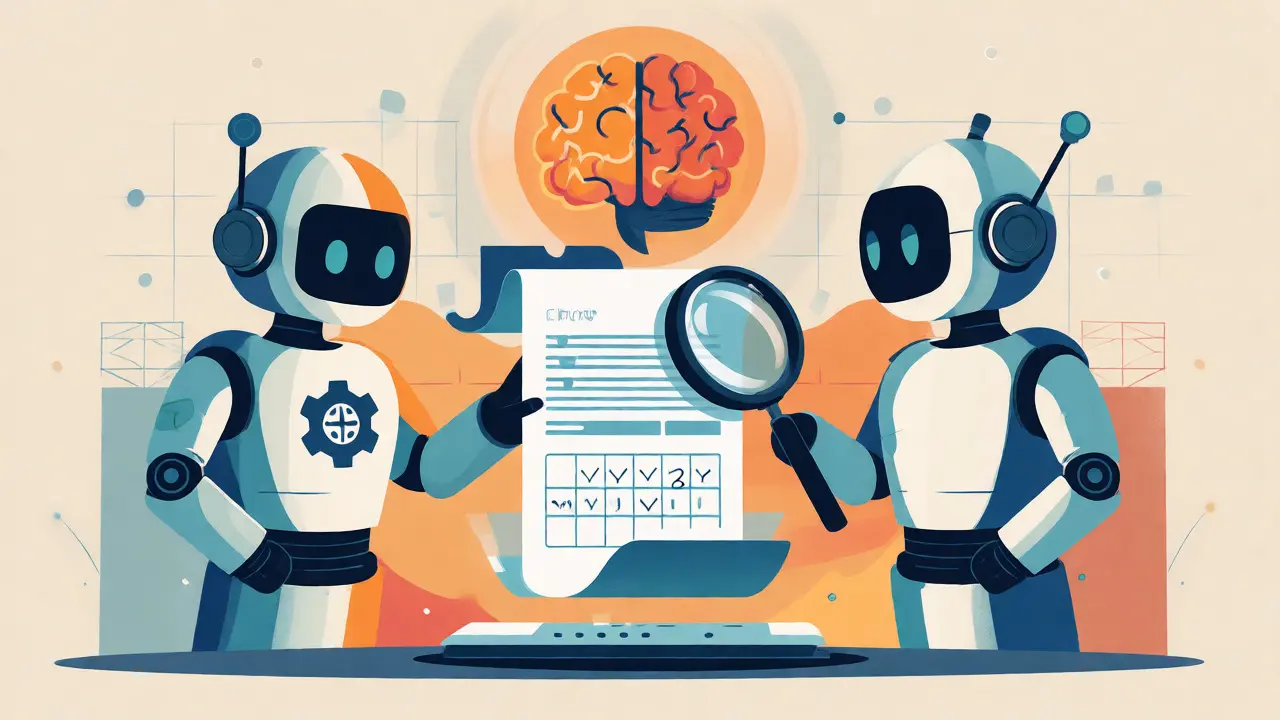
At its core, using an LLM for curriculum design isn’t just about asking a chatbot to "write a lesson plan." It involves a structured workflow where the model acts as both creator and critic. Researchers at Stanford, led by Emma Brunskill and Joy He-Yueya, pioneered an approach where one LLM generates educational materials while a second model evaluates them. This dual-model system predicts student outcomes based on post-test scores, effectively simulating the judgment of an expert educator.
This method leverages specific prompting techniques to mimic established educational psychology principles. For instance, the models were tested on their ability to replicate the "Expertise Reversal Effect"-the phenomenon where beginners need structured guidance, but advanced learners perform better with minimal scaffolding. In trials involving 120 test cases of math word problems, GPT-3.5-turbo successfully replicated these pedagogical nuances with 87% accuracy compared to human experts. This suggests that when properly instructed, these models understand not just facts, but the cognitive load associated with learning them.
The University of San Diego’s Learning Design Center (LDC) has taken this further by implementing a practical workflow using ChatGPT-4 and Microsoft Copilot. Their process starts with subject matter experts providing initial drafts. These are then refined through AI-generated prompts to ensure alignment between Module Learning Outcomes (MLOs) and Course Learning Outcomes (CLOs). The result? A 35% reduction in development time without sacrificing instructional quality, according to faculty evaluations conducted in early 2024.
The Speed vs. Accuracy Trade-Off
Let’s look at the numbers. Traditional curriculum development is slow. Creating and testing a set of math worksheets might take 2-3 weeks. An LLM-based pipeline can generate and evaluate those same materials in roughly 2 hours. That’s a massive efficiency gain. But speed often comes with risks, specifically regarding accuracy.
Studies indicate that LLMs may introduce factual inaccuracies in 15-20% of generated examples. This isn’t negligible. If you’re teaching history or science, a hallucinated date or incorrect formula can confuse students. However, the nature of these errors is changing. Early models struggled with basic coherence. Current instruction-following models excel at generating multiple variants of assessments quickly. For example, ChatGPT can produce 10 different quiz versions on a topic in under five minutes. While human experts remain superior at designing assessments for higher-order thinking skills, the AI’s ability to provide volume and variety is unmatched.
| Metric | Traditional Method | LLM-Assisted Method |
|---|---|---|
| Development Time | 2-3 Weeks | ~2 Hours |
| Factual Accuracy | High (Human Verified) | 80-85% (Requires Review) |
| Personalization | Limited/Static | High/Dynamic |
| Cost Efficiency | High Labor Cost | Lower Operational Cost |
Real-World Impact and Student Engagement
Does all this tech actually help students learn? Evidence suggests yes, but with caveats. A framework proposed by Li, Nong, Liu, and Evans in 2025 showed that adaptive learning systems powered by LLM analytics improved learner engagement by 22.3% and knowledge retention by 18.7% compared to static curricula. This study covered five educational environments and over 1,200 students, providing robust data on the benefits of personalization.
Consider the San Diego Unified School District. In January 2025, they implemented an LLM-assisted curriculum system across 42 middle schools. Within six months, teacher satisfaction with curriculum materials rose by 30%, and student engagement metrics improved by 12 points. Teachers reported that having access to instantly customizable resources allowed them to address diverse learning styles more effectively. One teacher noted that while prep time was cut in half, fact-checking became a new critical step in their routine.
However, not everyone is convinced. Dr. Audrey Watters, a prominent critic of EdTech trends, warns against the "neoliberal co-optation" of AI in education. She argues that over-reliance on standardized LLM outputs could erode culturally responsive teaching. If every school uses the same base model with similar prompts, are we creating a homogenized curriculum that fails to reflect local contexts? This is a valid concern. The solution lies in human oversight. As Professor Roy Pea of Stanford puts it, LLMs should be "thought partners," not autonomous creators.

Implementation Challenges and Best Practices
Adopting this technology isn’t plug-and-play. Faculty at the University of San Diego found that while course development time dropped from 80-100 hours to 45-60 hours, teachers needed 15-20 hours of training to use the tools effectively. Prompt engineering is a skill. You can’t just ask for "good questions." You need to guide the model through pedagogical reasoning.
Common pitfalls include:
- Factual Hallucinations: Reported in 23% of generated content in recent surveys.
- Cultural Insensitivity: Noted in 17% of cases, particularly in social studies or literature.
- Over-Simplification: Complex concepts are sometimes dumbed down too much (31% of cases).
To mitigate these issues, successful implementations use a multi-model consensus approach. By having multiple LLMs generate and evaluate content, institutions can reduce individual model biases. The LDC also developed a knowledge base of 247 verified prompt templates, which reduced implementation errors by 42%. This highlights the importance of standardizing how you talk to the AI.
The Future of AI in Education
The market is booming. The global AI in education sector was valued at $3.56 billion in 2024 and is projected to hit $25.7 billion by 2030. Curriculum design applications make up about 22% of this segment. Adoption varies significantly: 68% of higher education institutions use LLM tools, compared to 41% of K-12 schools, largely due to budget constraints.
Looking ahead, we’re seeing the rise of multimodal LLMs that can generate text, images, audio, and interactive simulations. Gartner predicts that by 2027, 65% of educational content will involve AI co-creation. Regulatory frameworks are catching up too. The EU’s AI Act requires transparency about AI-generated content, and the U.S. Department of Education mandates human oversight. This ensures that while AI accelerates production, humans remain accountable for quality.
The goal isn’t to automate teaching. It’s to free teachers from administrative drudgery so they can spend more time mentoring. When used correctly, instruction-following LLMs don’t replace the teacher; they amplify their impact.
Can LLMs completely replace human curriculum designers?
No. While LLMs excel at generating drafts, variations, and initial structures, they lack deep contextual understanding and cultural nuance. Human expertise is still required for verifying facts, ensuring pedagogical soundness, and adapting content to specific classroom dynamics. The consensus among experts is that LLMs serve as assistants or "thought partners," not replacements.
What is the biggest risk of using AI for curriculum design?
The primary risk is factual inaccuracy, often referred to as "hallucination." Studies show that 15-23% of AI-generated educational content may contain errors. Additionally, there is a risk of cultural insensitivity or over-simplification of complex topics. Rigorous human review processes are essential to mitigate these risks.
How much time does AI save in curriculum development?
Time savings vary by task and institution, but reports indicate significant reductions. For example, the University of San Diego saw a 35% reduction in content development time. Some tasks, like generating quiz variants, can be completed in minutes rather than days. However, time must be reallocated to fact-checking and refinement.
Do students learn better with AI-designed curriculum?
Research suggests yes, primarily due to personalization. Adaptive systems using LLM analytics have shown improvements in engagement (22.3%) and knowledge retention (18.7%). The ability to tailor content to individual learning paces and styles contributes to these gains, provided the content itself is accurate and well-designed.
What skills do teachers need to use LLMs effectively?
Teachers need proficiency in prompt engineering and critical evaluation. Training typically takes 8-12 hours to become proficient. Key skills include formulating clear learning objectives, defining student personas, and knowing how to verify AI outputs for accuracy and bias.