Deterministic Prompts: How to Reduce LLM Output Variance
 Sep, 5 2026
You send the same prompt to a Large Language Model twice. The first time, it gives you a perfect answer. The second time, it hallucinates or changes the format slightly. This isn't a bug; it's a feature of how these models work. But for production systems, that unpredictability is a nightmare. If your code relies on an LLM returning a specific JSON structure or a precise legal clause, you can't afford "maybe."
This guide breaks down deterministic prompts and the technical levers you can pull to reduce variance in Large Language Model responses. We'll look at why total determinism is nearly impossible, what parameters actually control randomness, and practical strategies to get consistent outputs without breaking your budget.
Why LLMs Are Inherently Non-Deterministic
To fix the problem, you have to understand the source. Large Language Models (LLMs) are probabilistic engines. They don't retrieve facts from a database like a search engine; they predict the next token (word or piece of word) based on probability distributions learned during training.
Think of it like rolling dice with weighted sides. For every step in a sentence, the model calculates a probability for thousands of possible next tokens. Even if one token has a 99% chance and another has 1%, there is always a non-zero chance the model picks the 1% option, especially if sampling is involved. This process creates an "ever-exploding tree of generation paths," as described by developer Nick Lucas. Each choice branches into new possibilities, compounding small differences into vastly different final outputs.
A critical nuance here: the model itself is static. Its weights don't change between calls. The variance comes from the sampling strategy used to select tokens from those probabilities. If you could always pick the absolute highest-probability token, you'd get deterministic results. But even then, hardware-level floating-point arithmetic introduces tiny errors that can flip a decision when two tokens have nearly identical scores.
The Core Parameters That Control Variance
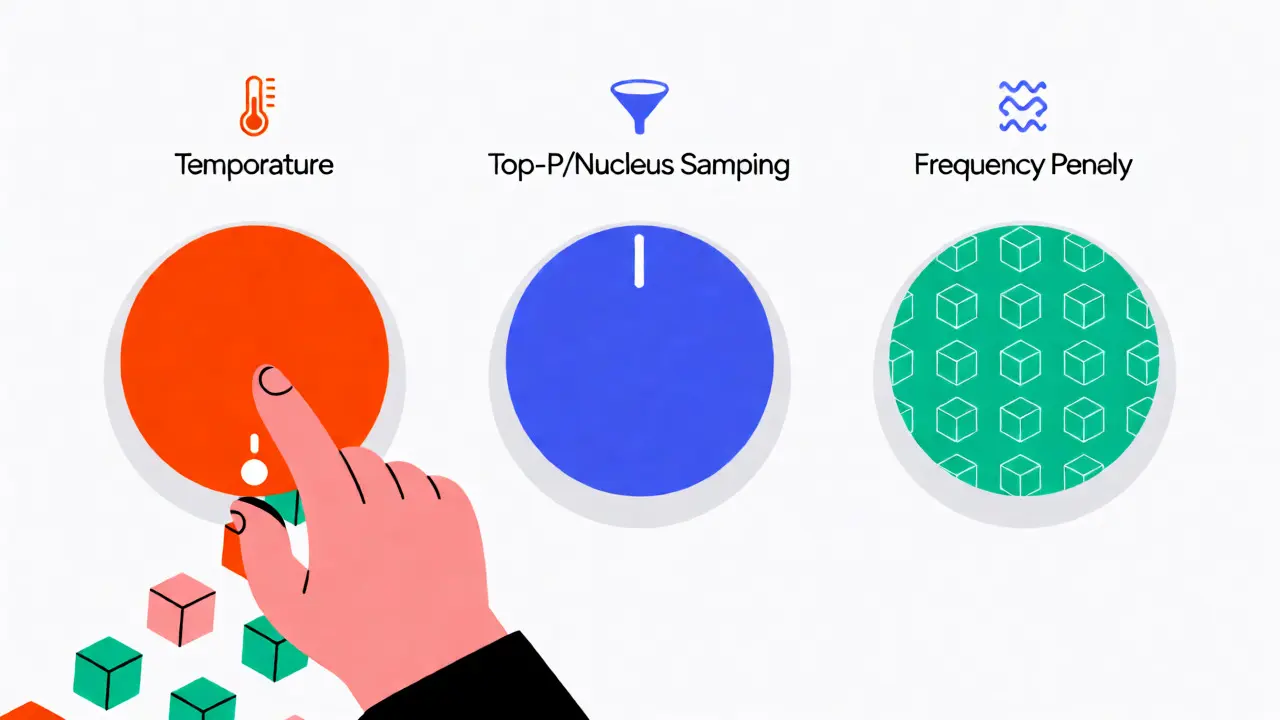
You can't eliminate the probabilistic nature of LLMs, but you can constrain them. Most API providers expose three main knobs for this: Temperature, Top-P (Nucleus Sampling), and Frequency Penalty. Understanding how they interact is key to building stable applications.
Temperature: The Randomness Dial
Temperature scales the probability distribution before sampling. At temperature=0.0, the model theoretically becomes greedy-it always picks the most likely next token. This is the closest you get to determinism via standard parameters. As you raise temperature toward 1.0 or higher, the model flattens the distribution, making less likely tokens more competitive, which increases creativity but also variance.
For factual tasks, stick to low temperatures (0.0-0.3). For creative writing, you might go higher (0.7-1.0). But beware: even at temperature 0, some providers introduce slight variations due to backend load balancing or batch processing optimizations.
Top-P (Nucleus Sampling): Cutting the Tail
Top-P restricts token selection to the smallest set of tokens whose cumulative probability exceeds a threshold P. If top_p=0.1, the model only considers tokens that make up the top 10% of the probability mass. This prevents the model from picking rare, nonsensical words that exist in the long tail of the distribution.
Nucleus Sampling is a technique that improves stability by ignoring low-probability outliers. Unlike temperature, which reshapes all probabilities, top-p acts as a hard filter. However, mixing high temperature with low top-p can create unpredictable interactions, so experts recommend tuning one or the other, not both simultaneously.
Frequency and Presence Penalties
These parameters discourage repetition. While they don't directly control initial token selection variance, they stabilize longer generations by preventing the model from getting stuck in loops. A frequency penalty of 0.5 is a common starting point for reducing redundant phrasing that often accompanies high-variance outputs.
Comparing Provider Determinism Features
Not all APIs treat determinism equally. Some providers offer explicit modes or stricter guarantees than others. Here’s how major players stack up regarding control over output consistency.
| Provider/Model | Determinism Mode Available? | Key Parameter Limitations | Consistency Level |
|---|---|---|---|
| OpenAI GPT-4o | No strict mode (temp=0 helps) | Backend updates can shift weights subtly | High (with temp=0) |
| Anthropic Claude 3 | Partial (via system prompts) | Limited direct sampling control | Moderate-High |
| Meta Llama 3 (Local) | Yes (if configured correctly) | Requires fixed seeds & hardware control | Very High (local) |
| AWS Bedrock | Determinism Mode (Premium) | +15% cost, +22% latency | Guaranteed Identical |
AWS Bedrock's "Determinism Mode" is a notable exception. It guarantees identical outputs for identical inputs but charges a premium and adds latency. For most developers, achieving 95-99% consistency through parameter tuning is more cost-effective than paying for guaranteed determinism.
Prompt Engineering Techniques to Lock Down Output
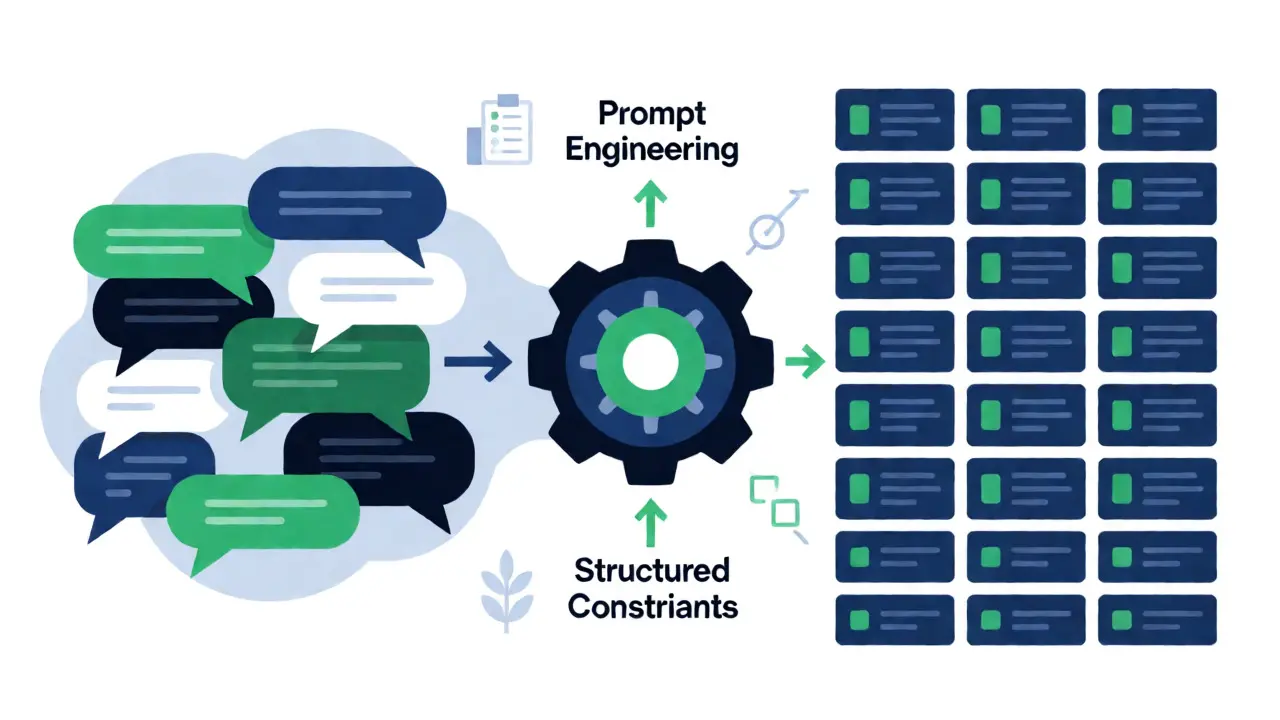
Parameters are blunt instruments. Prompt structure is where you gain fine-grained control. You can force the model into a narrower path by constraining its reasoning space.
Chain-of-Thought (CoT) Prompting
Asking the model to "think step by step" doesn't just improve accuracy; it reduces variance. By forcing the model to generate intermediate reasoning steps, you anchor the final answer to a logical progression rather than a single intuitive leap. Google’s research showed that CoT significantly stabilizes outputs for complex reasoning tasks, though it requires larger models (62B+ parameters) to be effective. Smaller models may actually degrade with forced CoT.
Structured Output Constraints
Vague prompts lead to vague answers. Instead of asking "Summarize this article," ask "Extract the three main arguments in bullet points, under 15 words each." Specificity reduces the solution space. Using JSON schemas or XML tags in your prompt forces the model to adhere to a rigid format, which indirectly suppresses stylistic variance.
Few-Shot Examples
Providing 2-3 examples of input-output pairs within the prompt sets a strong pattern. The model mimics the style, tone, and format of the examples. This is particularly effective for classification tasks where the label set is fixed. If you show the model exactly what a "positive" review looks like, it’s less likely to invent a new category.
Infrastructure and Environment Factors
Sometimes, the variance isn't in the prompt or the model-it's in the plumbing. Floating-point arithmetic differs slightly across CPU and GPU implementations. If you run the same model on different hardware clusters, you might see divergent results even with identical parameters.
For local deployments, you can achieve near-perfect determinism by setting environment variables like PYTHONHASHSEED=0 and enabling deterministic operations in frameworks like PyTorch (torch.use_deterministic_algorithms(True)). However, this often comes at a performance cost because it disables certain optimization kernels.
In cloud environments, you're at the mercy of the provider's infrastructure. Updates to the underlying serving layer can subtly alter numerical precision. This is why Martin Fowler notes that storing prompts in Git isn't enough; you must version your expectations alongside the prompts.
Practical Checklist for Reducing Variance
If you need reliable outputs today, follow this sequence:
- Set Temperature to 0.0: Start here. It removes the primary source of randomness.
- Use Low Top-P (0.1-0.3): Further restricts the candidate pool to highly probable tokens.
- Fix the Seed (if supported): Some APIs allow passing a random seed. Use it to replicate runs during debugging.
- Enforce Structured Formats: Demand JSON, XML, or specific delimiters.
- Add Explicit Instructions: "Do not add commentary," "Return only the date," etc.
- Monitor Log Probabilities: If the top two tokens have very similar log probabilities, expect potential instability. Flag these cases for human review.
The Future: Is Perfect Determinism Worth It?
Industry trends suggest we are moving toward hybrid approaches. Rather than fighting the probabilistic nature of LLMs, engineers are designing systems that tolerate variance. Tools like LangChain and LlamaIndex now include caching layers that store previous outputs, effectively turning a probabilistic call into a deterministic retrieval for repeated queries.
Research from Stanford’s Center for Research on Foundation Models indicates that techniques like "probabilistic pruning" can achieve 99.9% consistency with minimal performance loss. As these methods mature, the gap between "mostly deterministic" and "guaranteed deterministic" will narrow. Until then, accept that some variance is inevitable, and build your application logic to handle it gracefully.
Does setting temperature to 0 guarantee identical outputs?
Not necessarily. While temperature=0 selects the highest probability token, floating-point precision errors in hardware or backend infrastructure updates can cause slight deviations. For absolute guarantees, use dedicated instances or provider-specific determinism modes.
What is the difference between Top-P and Temperature?
Temperature rescales the entire probability distribution, affecting how sharp or flat it is. Top-P (Nucleus Sampling) cuts off the low-probability tail entirely, restricting selection to a subset of tokens. They control different aspects of randomness and should usually be tuned separately.
Why do I get different results with the same prompt and parameters?
This is often due to auto-regressive cascade effects. A tiny difference in the first few tokens (caused by hardware noise or parallel processing order) can lead to completely different subsequent tokens. Backend load balancing can also route requests to different server versions with subtle weight differences.
Can Chain-of-Thought prompting reduce variance?
Yes, for complex reasoning tasks. By forcing the model to generate intermediate steps, you anchor the final answer to a logical path, reducing the likelihood of arbitrary leaps. However, this works best on large models (62B+ parameters); smaller models may perform worse.
Is it cheaper to tune prompts or buy determinism modes?
Tuning prompts is generally cheaper initially but requires development time. Determinism modes (like AWS Bedrock's) charge a premium (e.g., 15%) and increase latency. For high-volume, low-stakes tasks, tuning is better. For critical financial or legal workflows, the premium may be justified.
Zach Loescher
September 6, 2026 AT 10:42Interesting breakdown. I've been wrestling with this exact issue in our internal tools.
The part about hardware-level floating-point errors flipping decisions when two tokens have nearly identical scores is something I hadn't fully appreciated before. We assumed temp=0 was a silver bullet, but you're right that backend load balancing can still introduce noise.
I'm curious how others are handling the monitoring aspect mentioned at the end. Do you actually parse log probabilities in real-time production, or is that more of a debugging step for you?
Also, the distinction between Top-P and Temperature being better tuned separately rather than together is good advice. We used to tweak both simultaneously and got inconsistent results.
Anthony Miller
September 7, 2026 AT 23:01Your analysis lacks rigor. You claim temperature=0 is the closest to determinism yet admit it fails due to hardware variance. This contradiction undermines your entire premise. If the foundation is unstable then the structure built upon it is worthless. Furthermore you ignore the catastrophic implications of auto-regressive cascade effects which render minor deviations fatal in long context windows. The industry needs stricter standards not these half measures.
Susan Cole
September 9, 2026 AT 14:33Thanks for sharing this. It’s helpful to see the provider comparison table.
I work mostly with local Llama deployments so the point about fixed seeds and hardware control resonates. It’s nice to know there are ways to get closer to perfect determinism if we accept the performance hit.
I’ll definitely look into the probabilistic pruning research from Stanford you mentioned. Seems like a promising direction for balancing cost and consistency.
Quintin Franzese
September 11, 2026 AT 02:21Oh wow, another article telling me my code isn't broken, it's just 'probabilistic.' Groundbreaking stuff. Truly. I love paying extra for AWS Bedrock just so my JSON doesn't decide to take a vacation on Tuesdays. Can't wait to explain to my PM why 'guaranteed identical outputs' costs 15% more while adding latency. Great read, really clarified that I should probably just use regex instead.
Tamara Miller
September 12, 2026 AT 12:15This is... fine? I guess??
You spend all this time talking about parameters and prompts but completely gloss over the fact that most developers don't understand basic probability distributions!!! Like seriously??? How many people actually read the API docs before throwing temp=0.7 at everything??? It’s frustrating because you could have saved us all so much pain by starting with "Stop guessing"!!! Also the table formatting is a bit messy?? Not sure if that’s intentional or lazy?? Just saying...
Savara Gunn
September 13, 2026 AT 21:58Hey! Really appreciate the practical checklist at the end. That sequence is super useful for quick reference.
One small note: for those new to this, maybe emphasize that changing top-p too aggressively can sometimes make outputs feel robotic or repetitive, even if they are consistent. It’s a trade-off worth keeping in mind.
Overall, great resource for anyone trying to stabilize their pipelines!
michelle veluz
September 14, 2026 AT 11:28I KNEW IT!!! They’re hiding the truth!!! It’s not just "floating point errors"!!! It’s back-end updates shifting weights subtly without telling us!!! OpenAI does this ALL THE TIME!!! One day your model works perfectly the next day it hallucinates because some engineer pushed an update at 3 AM!!! And we’re supposed to trust them??? With our data??? With our money??? This "Determinism Mode" is just a way to charge us more for the same unreliable garbage!!! Wake up!!!
Jacob Baby Official
September 15, 2026 AT 17:03Contrarian take: Determinism is overrated. Creativity IS variance. By trying to lock down every token, you kill the very thing that makes LLMs interesting. You're turning Shakespeare into a calculator. Sure, calculators are reliable, but do you want your legal clause to sound like a spreadsheet? Probably not. The "nightmare" of unpredictability is actually a feature for brainstorming, not a bug to be squashed. Stop trying to force AI into human boxes of certainty. Embrace the chaos.