Distributed Training at Scale: Orchestrating Thousands of GPUs for LLMs
 Mar, 29 2026
You might think that throwing more GPUs at a model automatically makes it train faster. In practice, this assumption is dangerous. If you have tried to scale past a hundred devices, you know the reality: your utilization drops, your costs spike, and the job stalls due to network deadlocks. By late 2025, the industry hit a wall where adding hardware stopped yielding linear performance gains. This shift forced engineers to focus less on raw compute power and more on orchestration strategies.
We are currently operating in an environment where Large Language Models is a type of neural network requiring massive parallelization. These systems now routinely exceed 100 billion parameters, a size that single graphics processing units cannot hold in memory. To handle this, teams rely on distributed training clusters involving thousands of accelerators. However, the bottleneck isn't calculation speed anymore; it is communication bandwidth. When you connect machines, the time spent moving gradients between nodes often consumes more resources than doing the actual math.
The Physics of Communication Overhead
Imagine trying to coordinate a conversation among ten thousand people simultaneously. Every participant has to update everyone else with their latest thought. As you add more people, the chatter grows exponentially until nobody gets work done. This is the exact scenario in massive clusters. In Q4 2024, Gartner predicted that 75% of enterprises training over 70 billion parameter models would face specialized orchestration hurdles.
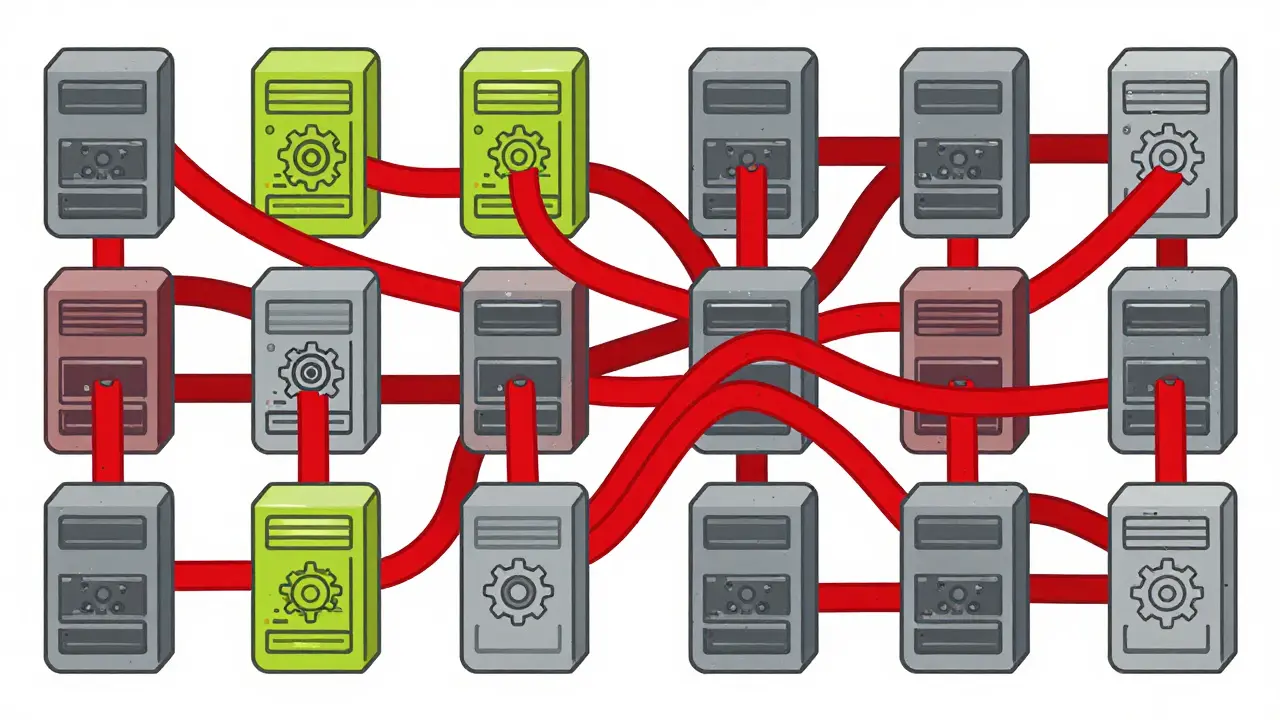
Recent studies confirm a hard limit. Once you cross 8,192 GPUs, scaling efficiency can drop below 50%. This means half your expensive hardware is waiting for the network instead of computing weights. This phenomenon, often called the "communication wall," dictates that raw speed does not equal throughput. You must prioritize how data moves across the cluster topology before worrying about how many cores you have available.
Understanding Parallelism Strategies
To break through these limits, developers combine different techniques to slice the workload. There isn't one magic switch; instead, you layer approaches based on your model architecture and hardware constraints.
- Data Parallelism: Each GPU holds a copy of the full model but processes different batches of data. It is simple and works well when the model fits in memory, but it requires frequent synchronization.
- Model Parallelism: You split the model layers themselves across devices. If Layer 1 lives on GPU A and Layer 2 on GPU B, they pass activations back and forth. This is necessary for massive transformer blocks that won't fit on a single card.
- Pipeline Parallelism: Think of an assembly line. Different stages of the forward pass happen sequentially across devices. While one device calculates loss, another starts on the next batch. This hides latency but complicates scheduling logic significantly.
In 2026, hybrid approaches are the standard. For example, Megatron-LM is a popular framework developed by Microsoft that combines tensor parallelism with pipeline parallelism. It allows teams to shard matrices directly, keeping computation local to reduce traffic. However, recent benchmarks suggest that combining ZeRO optimization with pipeline parallelism yields better results for extreme scales.

Hardware Selection: H200 and Interconnects
Choosing the right accelerator is step two. By early 2026, the landscape had shifted toward high-bandwidth memory solutions. The NVIDIA H200 provides 141GB of HBM3e memory and 3.4TB/s bandwidth compared to its predecessor. While raw teraflops matter less now, memory bandwidth determines how quickly you can shuffle data within a node.
But nodes are useless without strong connections. NVLink delivers 900GB/s per GPU, whereas Ethernet-based solutions struggle to compete on latency. For clusters larger than 512 nodes, InfiniBand networks remain essential. Without low-latency links, the "all-reduce" operations required to synchronize gradients become the primary source of wasted time. Companies like Gradient.ai achieved 92% hardware utilization by prioritizing NVLink connectivity over cheaper, slower networking options.
| Specification | NVIDIA H200 | NVIDIA A100 | Google A3VM |
|---|---|---|---|
| Memory Capacity | 141 GB | 80 GB | 80 GB (per unit) |
| Memory Bandwidth | 3.4 TB/s | 1.6 TB/s | 3.35 TB/s (interleaved) |
| Interconnect | NVLink Switch | NVLink x8/x16 | Jupiter Network |
| Best Use Case | Mega-model Training | Inference / Fine-tuning | Hyperscale Clusters |
Notice that the Google A3 series emphasizes inter-node speed, specifically optimizing for cloud-native environments. If you are running on AWS SageMaker, you often face limitations where fitting even a single record requires complex tuning. Runpod alternatives offer lower costs but sometimes lack the consistent multi-hop stability needed for stable weeks-long runs.
Orchestration Tools and Software
Once hardware is provisioned, you need software to manage the chaos. Manual configuration is impossible at scale. Teams use container management systems to spin up and tear down worker nodes dynamically. Kubernetes acts as the glue here, handling node failures and job rescheduling. When a GPU crashes mid-training, which happens frequently in clusters of thousands, K8s ensures the job restarts from the last checkpoint rather than failing entirely.
On top of containers, specific libraries handle the math distribution. PyTorch is now widely preferred for flexibility, especially with Full Sharded Data Parallel (FSDP) built-in. However, for the absolute largest jobs, DeepSpeed remains a powerhouse. Its ZeRO optimizer shards model states across CPUs, drastically reducing memory overhead on the GPU itself.
Debugging these setups introduces unique challenges. Google Cloud engineers reported in early 2025 that 60-70% of distributed failures stem from communication deadlocks, not bad code. A mismatch in network topology-say, mapping a logical grid to physical racks incorrectly-can stall everything. Topology-aware placement algorithms solve this by pinning virtual processes to physical switches that actually talk to each other fastest.
Cost Management and ROI
Running a cluster of 2,000 GPUs burns hundreds of thousands of dollars a week. Efficiency is financial survival. You must account for idle time. If your batch scheduler doesn't fill the cluster perfectly, you pay for unused cycles. Carbon-aware scheduling is emerging as a solution, where you run heavy loads during periods of cheap energy, cutting bills by up to 22%.
Beyond the cloud provider bills, the hidden cost is engineering talent. GreenNode estimates it takes four specialized engineers three months just to configure a robust distributed stack for 1 billion+ parameters. This barrier to entry is why managed services are growing. Startups favor cost-effective clouds like Runpod, while enterprise users stick to AWS or Google for reliability guarantees.
Future Limits and Alternatives
There is a looming concern about diminishing returns. The consensus is that beyond a certain threshold, physics wins. The energy required to move data eventually outweighs the benefit of extra compute. Research from February 2025 suggests modular training-training parts of the model separately and stitching them together-might bypass traditional scaling laws. Until then, communication compression is becoming standard, reducing the data volume sent across links by encoding gradients more efficiently.
If you are planning a project today, remember that 2026's hardware will soon look dated. Plan for portability. Your code should be abstracted enough to move from on-premise clusters to hyperscalers if your workload spikes. The goal is not just to build a bigger model, but to do so in a way that actually finishes training.
Frequently Asked Questions
Why does scaling stop working after 8,000 GPUs?
Communication overhead overtakes computation time. As the cluster grows, the surface area for sending gradients expands faster than the compute capacity. Beyond this threshold, adding more cards adds less than 0.1% to throughput because they spend most time waiting on network syncs.
Is Kubernetes strictly required for distributed training?
While SLURM works for smaller clusters, Kubernetes is critical for production-scale orchestration. It handles fault tolerance, auto-scaling, and resource isolation effectively, preventing a single failing node from taking down a multi-week training run.
What causes the most common training failures?
Deadlocks and network timeouts cause the majority of issues (approx. 65%). Often, this stems from incorrect network topology mappings where logical process ranks don't align with physical rack switches, forcing traffic over slow external paths.
How does H200 differ from H100 for this task?
The H200 features upgraded HBM3e memory with higher bandwidth. For distributed training, this allows slightly larger batch sizes or faster gradient exchange, though the difference diminishes once network saturation hits.
Can I use cloud providers instead of building my own cluster?
Yes. Providers like AWS and Google Cloud offer optimized machine types (like A3) designed for all-to-all communication. Third-party options like Runpod offer significant cost savings, making them viable for startups, though support levels vary.
Franklin Hooper
March 30, 2026 AT 09:51It is fascinating how the industry continues to misinterpret basic scaling laws despite repeated evidence. Your distinction between communication overhead and raw compute throughput is technically accurate yet lacks necessary nuance regarding latency variance. Most engineers fail to appreciate that network topology mismatches cause significantly more downtime than actual hardware faults. The mention of Kubernetes handling fault tolerance assumes a level of maturity rarely seen in production environments without rigorous testing. DeepSpeed integration often introduces hidden serialization costs that simple benchmarking overlooks entirely. Furthermore, the reliance on NVLink assumes a homogeneous cluster which is financially impossible for most enterprises attempting this scale. You imply that H200 memory bandwidth solves the bottleneck whereas inter-node traffic remains the primary choke point regardless of local specs. Carbon-aware scheduling sounds like marketing fluff designed to sell unnecessary infrastructure upgrades under the guise of efficiency. Engineers typically ignore the software stack complexity required to manage checkpointing across such distributed systems effectively. The prediction regarding eighty thousand GPUs losing efficiency aligns with theoretical bounds established years ago by collective operations analysis. It is disappointing that fewer resources are allocated to optimizing gradient compression algorithms before investing in new hardware generations. Without solving the fundamental physics of data movement we simply burn money waiting for packets to arrive at distant nodes. Your table comparing H200 and A100 omits critical factors like error rates over extended training periods which affect convergence speed significantly. Managed services are often touted as the solution but they introduce vendor lockin risks that compromise long term portability strategies. We need better standardization in how parallelism strategies are named because the current terminology confuses junior developers unnecessarily.
Mbuyiselwa Cindi
April 1, 2026 AT 05:35The advice on focusing on orchestration strategies rather than raw hardware makes sense for anyone managing large clusters. Pipeline parallelism hides latency but complicates scheduling logic significantly so careful planning is always required before deployment. Running heavy loads during periods of cheap energy cuts bills by significant amounts which many teams overlook initially. Debugging communication deadlocks takes up most of the engineering time so topology awareness is crucial for stability. Using managed services helps reduce configuration time but you still need experts to verify the networking setup works correctly. It is great to see detailed breakdowns on how specific accelerators impact overall system throughput compared to memory bandwidth limits. We need more resources discussing how to migrate legacy pipelines to newer architectures without losing weeks of progress.
Jess Ciro
April 2, 2026 AT 02:40Big tech is deliberately throttling performance to force everyone into their expensive proprietary cloud solutions.
Mike Marciniak
April 3, 2026 AT 21:18That theory tracks perfectly with how they quietly disabled open source alternatives last year to protect their revenue streams from hyperscale competitors. You see the pattern when you look at who controls the chip patents versus who actually builds the models nobody audits. It feels like a coordinated effort to keep the real computing power away from independent researchers and startups who might disrupt the status quo. They want us focused on buying hardware instead of understanding the underlying architecture that governs our data flow. Trust issues are justified when every major update seems to break compatibility with previous open frameworks intentionally. Security concerns become irrelevant when the people controlling the network switches decide what gets processed locally versus remotely. This centralized control creates massive single points of failure that threaten global stability during critical infrastructure moments. We need decentralized alternatives before the dependency becomes too deep to reverse safely without total system collapse.
saravana kumar
April 5, 2026 AT 17:27Your critique regarding Kubernetes maturity ignores the fact that most failures stem from human misconfiguration rather than platform limitations fundamentally. The industry has moved past the era where manual setup was viable for anything larger than a few dozen nodes effectively. Claiming that carbon scheduling is marketing fluff shows a lack of understanding regarding real utility pricing models currently existing in cloud markets. Hardware specifications alone cannot guarantee success without software layers properly abstracting the underlying physical topology constraints. We need to stop pretending that throwing money at GPUs fixes architectural flaws in gradient synchronization protocols consistently. The reality is that network topology matters more than individual card specs which you seem to gloss over slightly. Optimizing gradient compression algorithms does help but it requires custom coding that standard libraries do not provide out of the box easily.
VIRENDER KAUL
April 5, 2026 AT 22:26Collaboration on open standards helps absolutely no one since proprietary solutions offer far superior reliability guarantees for enterprise clients needing uptime suggesting that managed services are the way forward is naive given how quickly vendor support levels can degrade without slA protection your optimism about migration strategies ignores the technical debt accumulated during the transition phase which often leads to project failure completely relying on carbon aware scheduling is a distraction from the core issue of ensuring stable connectivity across geographically dispersed data centers nobody cares about cutting bills by twenty two percent when the training job fails due to network instability repeatedly you focus too much on minor optimizations while ignoring the elephant in the room regarding hardware availability shortages globally true scalability comes from ruthless prioritization of performance over any hypothetical sustainability metrics discussed here