End-to-End LLM Training Pipeline: Data to Deployment Guide
 Nov, 20 2026
You built a model. It scores well on the validation set. But when you push it to production, it hallucinates facts, ignores context, or crashes under load. Why? Because you treated Large Language Model (LLM) training as a one-off experiment instead of a continuous engineering pipeline. The difference between a research prototype and a scalable product isn't just parameter count-it's the end-to-end workflow that connects raw data to live inference.
Why Pipelines Beat Ad-Hoc Experiments
Think back to the early days of deep learning. You’d write a script, run it on a GPU cluster, check the loss curve, and maybe deploy if things looked good. That worked for small models. It fails for LLMs. With billions of parameters and trillions of tokens, manual management is impossible. You need reproducibility, versioning, and automation.
An End-to-End LLM Pipeline is an automated workflow covering data ingestion, preprocessing, training, evaluation, deployment, and monitoring. It turns chaos into code. Instead of "I ran this script last Tuesday," you have a tracked artifact with a specific commit hash, dataset version, and hyperparameter config. This matters because LLMs are sensitive to data shifts. A tiny change in tokenization can degrade performance by double digits. Without a pipeline, you won’t even know what changed.
Data Ingestion and Preprocessing at Scale
Data is the bottleneck. For GPT-3, OpenAI processed roughly 300 billion tokens. Most of that came from Common Crawl, a massive web scrape. But raw web text is messy. It’s full of boilerplate, ads, and broken HTML. If you feed garbage in, you get garbage out.
Your pipeline needs robust Data Ingestion mechanisms to pull from warehouses, streams, and APIs into a unified layer. Then comes cleaning. This isn’t just removing stop words. It’s deduplication using algorithms like MinHashLSH on Apache Spark. It’s filtering low-quality documents using classifiers trained to distinguish curated sources like Wikipedia from random blog posts.
Tokenization is the final step before training. You can’t just split by spaces. You need subword units like Byte-Pair Encoding (BPE) to handle rare words and multilingual content. If your tokenizer changes, your model’s vocabulary changes, and you effectively break compatibility with previous checkpoints. Version your tokenizer alongside your data.
Distributed Training Infrastructure
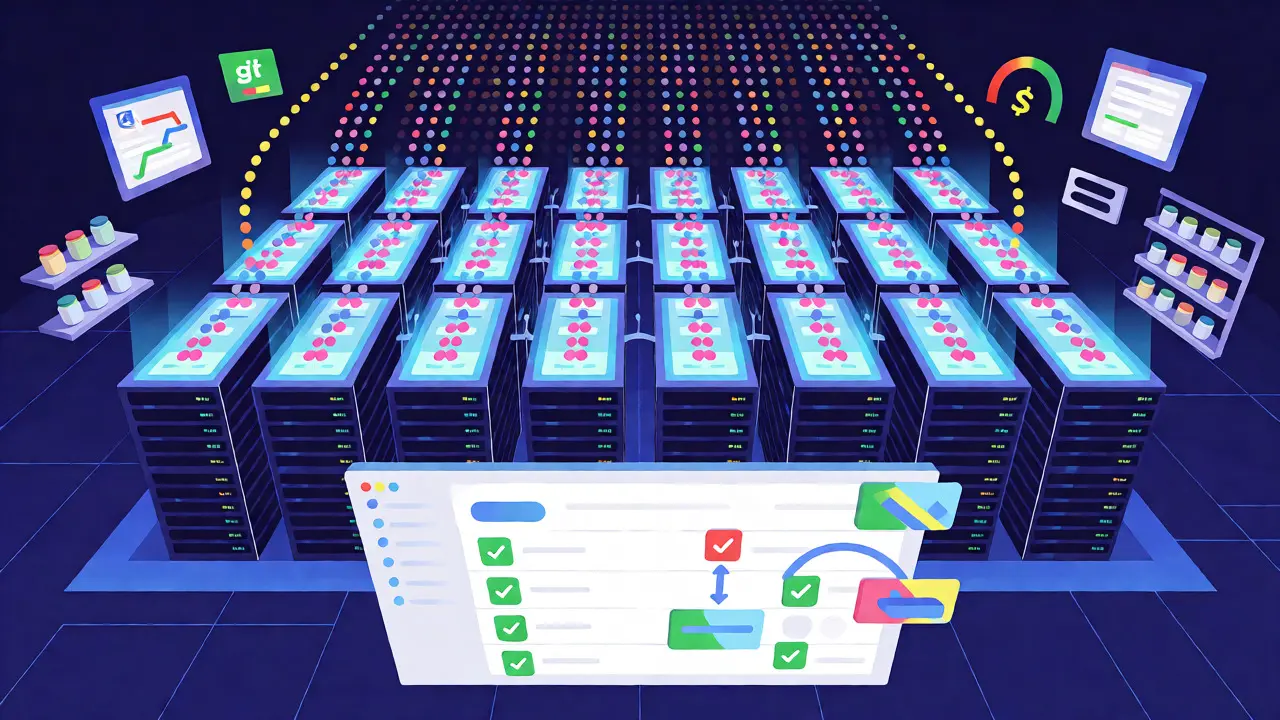
Training an LLM isn’t a single-node job. You’re looking at clusters of GPUs or TPUs. Managing these resources manually is a nightmare. You need orchestration tools that schedule jobs, handle failures, and checkpoint progress automatically.
Most modern pipelines use frameworks like PyTorch FSDP or DeepSpeed. These libraries shard model parameters across multiple devices, allowing you to train models larger than the memory of any single GPU. But hardware is only half the battle. You need a Model Registry to store validated artifacts and link them to their training configurations. When a training run finishes, the best checkpoint gets pushed to the registry with metadata: accuracy metrics, training time, and resource usage.
Consider cost. Estimates for training GPT-3 ranged from $4.6 million to $12 million. Even fine-tuning smaller models costs thousands of dollars per run. Your pipeline should include budget alerts. If a training job runs twice as long as expected, kill it. Don’t let a misconfigured batch size burn through your cloud credits overnight.
Evaluation Gates and Validation
Accuracy isn’t enough. You need business-level metrics. Does the model answer customer queries correctly? Does it summarize legal contracts without missing key clauses? Define these KPIs before you start training.
Use a strict 60/20/20 split for training, validation, and test sets. Stratify them to ensure balanced representation. More importantly, automate evaluation gates. In a CI/CD setup, the pipeline shouldn’t deploy a model unless it beats the current baseline on a predefined metric. If perplexity increases or toxicity scores spike, the pipeline blocks the promotion. This prevents bad models from reaching users.
Human-in-the-loop evaluation still matters. Automated metrics miss nuance. Integrate sampling steps where subject matter experts review outputs from the latest checkpoint. Feed this feedback back into the dataset for future retraining cycles.
Deployment and Serving Architecture
Training ends. Deployment begins. This is where many teams stumble. An LLM isn’t a simple REST endpoint. It requires GPU allocation, autoscaling rules, and security hardening.
Containerize your model. Use Docker images to package the model weights, inference library, and dependencies. Deploy these containers to Kubernetes or similar orchestrators. Configure autoscaling based on request volume and GPU utilization. If traffic spikes, spin up more replicas. If it drops, scale down to save money.
API design is critical. LLMs are slow compared to traditional ML models. A request might take seconds, not milliseconds. Design your API for streaming responses. Let users see tokens as they generate. This improves perceived latency significantly.
| Component | Classical ML Pipeline | LLM Pipeline |
|---|---|---|
| Data Type | Structured tabular data | Unstructured text/multimodal |
| Compute Resource | CPU / Small GPU | Multi-GPU / TPU Clusters |
| Inference Latency | Milliseconds | Seconds (Streaming required) |
| Cost Metric | Requests per second | Tokens processed |
| Monitoring Focus | Error rates, Drift | Token traces, Hallucination rate |
Monitoring, Drift, and Retraining
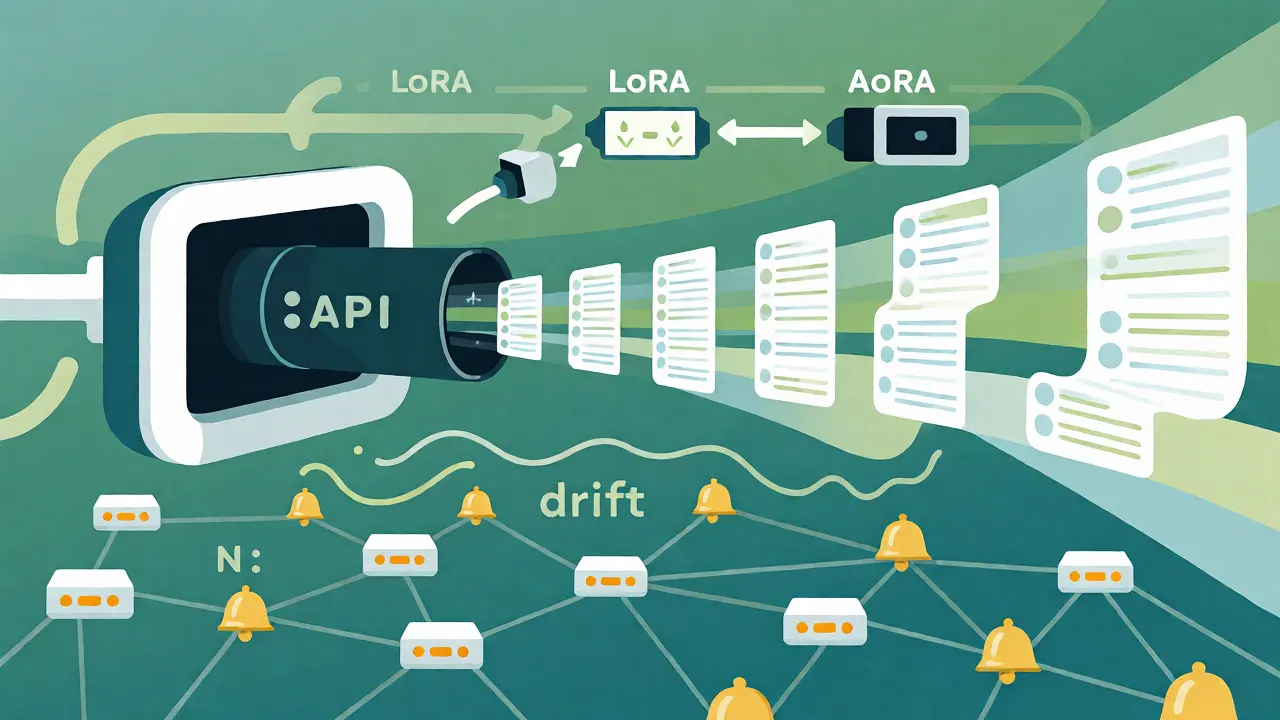
Deployment isn’t the finish line. It’s the start of operation. Models degrade over time. User behavior changes. New slang emerges. This is data drift.
Implement observability layers that capture token-level traces. Log inputs, outputs, and confidence scores. Set up alerts for anomalies. If the average response length suddenly doubles, something is wrong. Maybe the prompt template changed. Maybe the model is stuck in a loop.
Trigger retraining automatically. When drift exceeds a threshold, or when new labeled data accumulates, kick off a fine-tuning job. Use LoRA (Low-Rank Adaptation) to update only a fraction of the weights. This is faster and cheaper than full pre-training. Push the updated model to the registry, evaluate it, and roll it out gradually.
Common Pitfalls to Avoid
- Ignoring Tokenizer Versions: Changing tokenizers mid-pipeline breaks everything. Pin your versions.
- Skip Evaluation Gates: Never auto-deploy without automated checks. Humans make mistakes; pipelines don’t.
- Underestimating Storage: Checkpoints for large models are huge. Plan your storage tiering carefully.
- Lack of Security: LLMs can leak PII if not filtered. Add guardrails to input/output processing.
What is the difference between MLOps and LLMOps?
MLOps focuses on general machine learning workflows, often dealing with structured data and smaller models. LLMOps is a specialized subset tailored for Large Language Models. It handles unique challenges like massive unstructured data, transformer architectures, high compute costs, and complex inference patterns like streaming generation.
Do I need to pre-train my own LLM from scratch?
Rarely. Pre-training from scratch costs millions of dollars and takes weeks. Most organizations start with a base model (like Llama 3 or Mistral) and use fine-tuning or RAG (Retrieval-Augmented Generation) to adapt it to their specific domain. This saves significant compute resources and time.
How do I handle data privacy in the pipeline?
Implement PII detection and masking during the preprocessing stage. Ensure your data storage complies with regulations like GDPR or HIPAA. During inference, log inputs and outputs securely, and consider anonymizing user queries before sending them to external APIs if necessary.
What tools are commonly used for LLM orchestration?
Popular tools include Kubeflow for Kubernetes-native workflows, ZenML for portable ML pipelines, Hopsworks for feature stores, and Ray for distributed computing. Many teams also use Airflow or Prefect for scheduling tasks within the broader data ecosystem.
How often should I retrain my LLM?
It depends on your use case. For fast-moving domains like news or social media, weekly or monthly retraining might be needed. For stable domains like legal or medical texts, quarterly updates may suffice. Always monitor for drift indicators rather than sticking to a rigid calendar.
Kevin Ching
November 20, 2026 AT 20:03This is exactly the mindset shift most teams need to make right now 🚀
It's so easy to get lost in the hype of just training a model and forget that deployment is where the real engineering happens. I've seen too many projects stall because they didn't version their data or tokenizers properly from day one.
The point about cost alerts is gold 💰. We almost burned through our entire quarterly budget on a single misconfigured batch size run last year. Automating those checks isn't just nice-to-have, it's survival.
Mitch Marcus
November 21, 2026 AT 13:08You are completely missing the forest for the trees here.
Everyone wants to talk about pipelines and orchestration but nobody talks about the absolute disaster that is current open-source licensing for LLMs. You build this beautiful end-to-end pipeline only to find out your base model license prohibits commercial use in your specific region.
Then you have to rebuild everything from scratch. This article pretends that technical infrastructure solves legal and ethical liabilities. It doesn't. You can have the cleanest code in the world and still get sued into oblivion because you ignored the fine print in the dataset licenses.
We spent six months migrating our stack to Kubernetes and FSDP only to realize we couldn't legally deploy the output. That is not a pipeline failure. That is a business strategy failure that tech blogs like this always ignore in favor of shiny tooling diagrams.