Enterprise LLM Compression: Pipelines, Tools & Cost Savings
 Nov, 12 2026
You’re burning cash on GPU clusters for a model that’s 90% redundant. It’s a common headache for enterprise teams in late 2026. You want the intelligence of a massive Large Language Model (LLM) but need it to run fast and cheap enough to actually make money. The solution isn’t just buying more hardware; it’s compression. But here is the catch: throwing random tools at your model often breaks it. This guide cuts through the noise to show you how to build reliable compression pipelines that actually work in production.
Why Your Current Setup Is Bleeding Money
Let’s look at the numbers. According to Thinkaicorp’s 2025 analysis, enterprises using proper compression methodologies see up to an 80% drop in operational costs. That’s not a rounding error; that’s the difference between a profitable pilot and a shut-down project. Yet, many teams still serve full-precision models because they’re afraid of accuracy loss. They shouldn’t be. LinkedIn, for instance, used domain-adapted compression to shrink prompt sizes by 30% while keeping their candidate-job matching accuracy high. If a tech giant with millions of daily users can do it, your internal chatbot or RAG system definitely can.
The core issue is efficiency. Uncompressed models require heavy GPU resources, limiting where you can deploy them. You’re stuck in the cloud, paying premium rates for latency-sensitive tasks. Compression lets you move workloads to edge devices, browsers, or cheaper on-premise servers. It also helps with sustainability. Training and serving massive models has a huge carbon footprint. By reducing the computational load, you’re not just saving money; you’re making your AI strategy more sustainable.
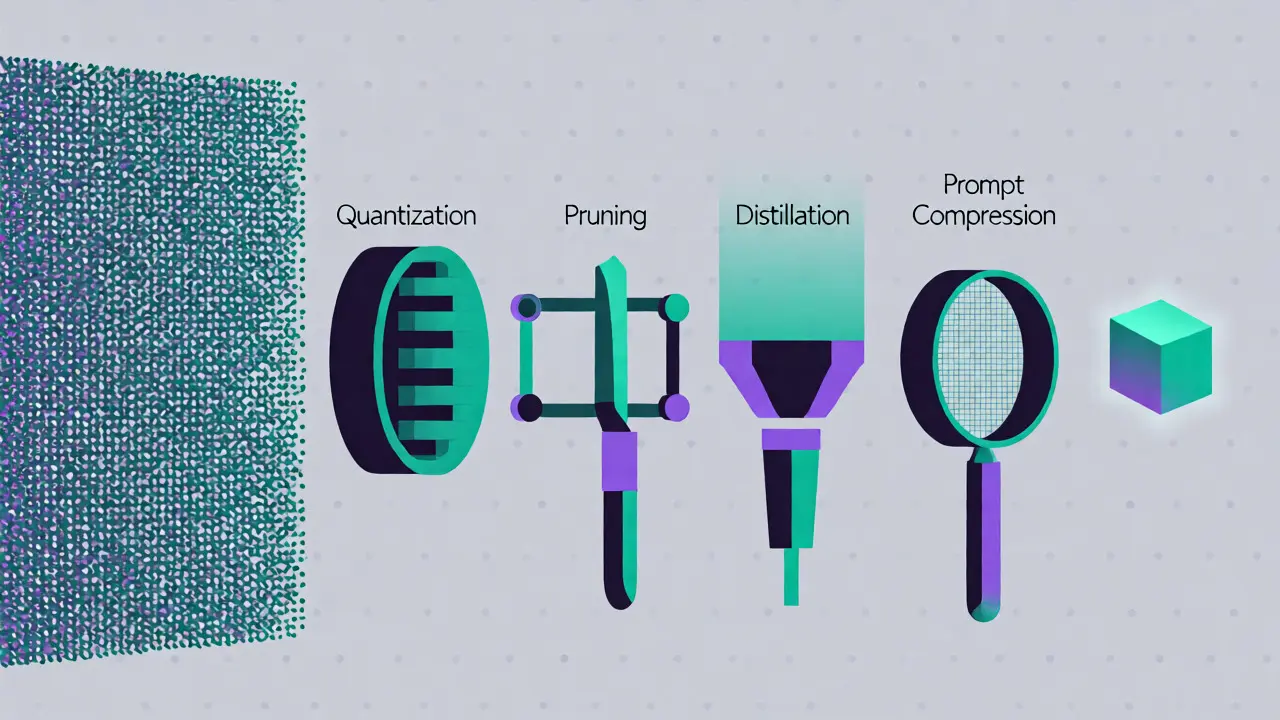
The Four Pillars of Compression
Not all compression is created equal. To build a solid pipeline, you need to understand the four main techniques. Each has its place, depending on whether you care more about speed, size, or accuracy.
- Quantization: This reduces the numerical precision of the model weights. Think of it as turning a high-resolution photo into a slightly lower-res one. You might go from FP32 (32-bit floating point) to INT8 (8-bit integer). It’s the easiest to implement and offers 2-4x speedups. However, push it too far (like INT4), and you risk accuracy degradation.
- Pruning: This removes redundant weights-essentially deleting the parts of the brain that aren’t doing much work. Iterative pruning can achieve 80-90% compression. The downside? It requires careful fine-tuning to recover any lost performance. It’s like trimming a hedge; cut too much, and you ruin the shape.
- Knowledge Distillation: Here, you train a smaller "student" model to mimic a larger "teacher" model. It preserves capabilities well but demands significant training resources. It’s great if you have time and compute to spare, but bad for rapid deployment.
- Context/Prompt Compression: Instead of shrinking the model, you shrink the input. Techniques like extractive summarization reduce token usage by 50-80%. This is crucial for RAG (Retrieval-Augmented Generation) systems where every extra token costs money and slows down response times.
Building the Pipeline: From Theory to Production
Knowing the techniques is half the battle. Putting them together is the other half. In late 2025, Apple introduced LLM-KICK, a framework that unified training and evaluation for these techniques. Before this, teams were cobbling together scripts, leading to inconsistent results. LLM-KICK standardized metrics, making it easier to compare quantization against pruning objectively.
For most enterprise teams, the workflow looks like this:
- Baseline Evaluation: Test your uncompressed model against specific business tasks, not just generic benchmarks like MMLU. If your model handles legal contracts, test it on legal contracts.
- Select Technique: Start with quantization (INT8) because it’s low-risk. If you need more savings, try pruning. Use context compression if your bottleneck is long prompts.
- Apply Compression: Use tools like AutoRound in LLM Compressor or TitanML’s server. Note that AutoRound works well for Llama variants but struggles with Mixtral architectures, so check compatibility first.
- Fine-Tune: Pruned models often need a quick fine-tune pass to recover accuracy. Don’t skip this.
- Validate: Run your baseline tests again. If accuracy drops more than 1-2%, dial back the compression ratio.
Integration with MLOps is critical. Tools like ZenML provide production-ready pipelines that connect compression steps to orchestrators like Airflow or Kubeflow. This ensures reproducibility. If you can’t reproduce your compression result, you can’t trust it in production.
Tooling Landscape: What Actually Works?
The market is flooded with tools, but only a few are ready for enterprise-grade reliability. Here’s a breakdown of the current landscape as of early 2026.
| Tool/Framework | Best For | Key Strength | Known Limitation |
|---|---|---|---|
| Titan Takeoff Server | On-premise deployment | Optimized for data residency and strict compliance needs | Limited documentation for custom architectures |
| LLM Compressor (AutoRound) | Open-source experimentation | Strong community support and flexible quantization schemes | Inconsistent performance across diverse model families |
| DSPy | RAG and prompt optimization | Lowest framework overhead (~3.53ms latency) | Requires declarative programming mindset shift |
| LLM-KICK | Standardized evaluation | Reproducibility and unified metrics across techniques | Newer ecosystem, fewer third-party integrations |
TitanML’s Titan Takeoff Server is particularly strong for organizations with strict data residency requirements, like banks or healthcare providers. G2 reviews give it a 4.3/5 rating, praising its on-premise capabilities. However, users complain about debugging difficulties when compressed models behave unexpectedly. One Microsoft Azure engineer noted that debugging compressed models takes 2-3x more effort than standard implementations. Plan for that extra engineering time.

Pitfalls and How to Avoid Them
Compression isn’t magic. There are traps that can sink your project. First, beware of over-compression. Dr. Sarah Chen from Stanford HAI warned that pushing beyond model-specific thresholds causes irreversible accuracy degradation, especially for reasoning-heavy tasks. Just because you can compress to 90% doesn’t mean you should.
Second, specialized models don’t compress like general ones. Professor Andrew Ng pointed out that the oft-cited 80-90% compression figures apply mostly to general-purpose models. If you’re using a model trained specifically for medical diagnosis or financial forecasting, expect realistic compression ratios of 50-60% without significant penalties. Adjust your expectations accordingly.
Third, non-deterministic behavior. Pruned models can act strangely because removing weights changes the activation patterns in unpredictable ways. Always use dynamic pruning approaches that adapt based on input complexity. This conserves resources contextually rather than applying a blanket rule. Combining this with CUDA Graphs and KV caching can eliminate CPU-GPU bottlenecks, delivering significant latency improvements.
The Future: Dynamic and Adaptive Systems
We are moving toward dynamic compression. Static models are becoming obsolete. Dextra Labs’ 2026 blueprint outlines systems that adjust retrieval strategies based on query complexity. Simple questions get direct answers; complex multi-hop queries trigger iterative retrieval with reasoning chains. This adaptive approach means your infrastructure scales efficiently without manual intervention.
By 2027, McKinsey projects that 95% of enterprise LLM deployments will use at least one compression technique due to cloud cost pressures. The EU AI Act, implemented in February 2026, also adds a layer of complexity. It requires documentation of any significant modifications to model architecture, including compression. Make sure your pipeline logs exactly what was pruned or quantized so you can prove compliance later.
How much does LLM compression actually save on costs?
Enterprises typically report up to 80% reduction in operational costs and 10x improvement in inference throughput. These savings come from requiring fewer GPUs and operating more efficiently at scale. Financial services and healthcare sectors see the highest adoption rates due to strict compliance and cost constraints.
Which compression technique is best for RAG systems?
Context and prompt compression are most effective for RAG systems. Techniques like extractive summarization and sentence filtering can reduce token usage by 50-80% while preserving essential information. This directly lowers API costs and speeds up response times, which is critical for user experience.
Does compression always hurt model accuracy?
Not necessarily, but it depends on the technique and the model. Quantization (INT8) usually maintains high accuracy, while aggressive pruning or lower-bit quantization (INT4) can degrade performance. Specialized domain models may only tolerate 50-60% compression before accuracy suffers, unlike general-purpose models which handle higher ratios better.
What tools should I start with for enterprise deployment?
For on-premise needs, Titan Takeoff Server is highly rated. For open-source flexibility, LLM Compressor with AutoRound is popular, though it requires more tuning. DSPy is excellent if your focus is primarily on optimizing prompts and RAG pipelines rather than model weights themselves.
How long does implementation take?
Basic quantization can be implemented in 1-2 weeks by experienced ML engineers. A full pipeline integration with RAG systems and comprehensive testing typically takes 4-6 weeks. Remember to budget extra time for debugging, as compressed models can exhibit non-linear behavior changes.
Somesh gupta
November 12, 2026 AT 09:58the logic is sound but the implementation details are often glossed over in these summaries
most teams underestimate the fine tuning overhead required after pruning which can negate initial speed gains if not managed properly
Nnaemeka Anadu
November 12, 2026 AT 20:40You people are so obsessed with saving a few pennies on GPU costs that you forget the soul of the machine
Compression is just another form of lobotomy for AI and you all cheerfully walk into the clinic thinking you're getting a brain transplant when really you're just losing your mind one bit at a time
It's tragic really how we trade wisdom for speed like it's some kind of moral virtue to be fast and stupid rather than slow and profound
I've seen models pruned so aggressively they couldn't even tell the difference between a cat and a dog anymore yet the executives high-five each other over the quarterly savings report
The human cost of this efficiency obsession is invisible because nobody looks at the degradation of nuance until it's too late
We are building hollow shells and calling them intelligence
It's pathetic
You think you're optimizing but you're just erasing the very things that make the model interesting in the first place
Why do you insist on destroying the complexity that defines true understanding
Because money talks louder than truth apparently
So go ahead compress your precious little matrices and watch your profits rise while your AI becomes dumber than a bag of rocks
Enjoy your empty victory
The universe doesn't care about your latency metrics
It only cares about meaning and you are deleting meaning to save bandwidth
This is the end of an era where we valued depth over convenience
And no amount of quantization can fix that spiritual emptiness
Wake up sheeple before your models forget what love even means
Or don't and keep counting your coins
I pity you all
Truly I do
Melissa Emrick
November 13, 2026 AT 13:59omg finally someone said it!!
i tried using titan takeoff last week and it was such a pain to debug lol my team hated me for suggesting it tbh
but yeah the docs suck ass and i had to spend 3 days just figuring out why my int8 model was hallucinating every third sentence
waste of time imo unless u have a dedicated eng who does nothing else but fix compression bugs
also dspy is way better for rag stuff honestly stop trying to squeeze weights and just optimize prompts its easier and less risky
anyway great post maybe next time mention how hard it is to get buy in from finance dept when u ask for more compute for testing??
they never believe the roi projections until its too late anyway
A Gift Shop
November 14, 2026 AT 16:24AutoRound fails on Mixtral.
End of story.
Annabel Lee
November 16, 2026 AT 01:41While this article touches on the technical aspects it completely ignores the geopolitical implications of relying on frameworks developed by companies like Apple or TitanML which may not align with our national security interests regarding data sovereignty and technological independence
We cannot simply import solutions without considering the long-term strategic risks involved in outsourcing our core AI infrastructure to entities that might prioritize profit over patriotic duty
Furthermore the emphasis on cost savings overlooks the fact that American innovation should not be measured solely by operational expenditure but by our ability to maintain a robust and self-sufficient technological ecosystem that supports domestic jobs and research institutions
If we allow foreign or private sector tools to dictate our standards we risk becoming dependent on systems that do not reflect our values or our need for rigorous oversight in critical sectors like defense and healthcare
Therefore we must advocate for homegrown solutions that prioritize transparency and accountability over mere efficiency metrics
This is not just about GPUs it is about preserving our intellectual property rights and ensuring that our digital future remains under our control
Anything less is a betrayal of our heritage and our potential as a global leader in technology
We need to stand firm and demand better from our vendors and policymakers alike
Otherwise we will find ourselves locked into proprietary ecosystems that drain our resources and limit our freedom
It is time to wake up and realize that cheap is not always good especially when it comes to something as vital as artificial intelligence
Let us protect our interests and build a future that honors our legacy
Not one that is defined by spreadsheets and cloud bills
We deserve better
Our children deserve better
Stop selling out our country for a few percentage points of margin improvement
This is serious business
Do not treat it lightly
History will judge those who compromised too easily
Be vigilant
Stay strong
God bless America
And God bless our uncompressed models
For now
Marilyn wiilliams
November 17, 2026 AT 08:57LOL!!!
Annabel Lee, honey... did you write that entire paragraph while crying into a flag???
It's a compression tool, not the Constitution!!!
We aren't selling our souls; we're trying to afford electricity!!!
Also, saying 'stop selling out' to engineers trying to reduce latency is hilarious.
Like, bro, we are literally trying to keep the lights on in the server room!
Your patriotism won't pay the AWS bill!!!
Get real!!!
Nobody cares about 'intellectual property rights' when the model takes 4 seconds to respond!!!
Users leave!!!
Churn happens!!!
Money evaporates!!!
Then what???
No more budget for your 'homegrown solutions'!!!
It's called economics!!!
Look it up!!!
Next!!!
kevin montesinos valencia
November 18, 2026 AT 09:01this is actually really helpful context for teams starting their journey into optimization
i particularly liked the point about testing against specific business tasks rather than generic benchmarks because that has been our biggest hurdle recently
we found that our legal contract analysis model lost significant accuracy with INT4 quantization but retained nearly perfect performance with INT8 which aligns perfectly with the advice given here
it gives me hope that we can balance cost and quality without sacrificing too much reliability
thanks for sharing these insights it helps validate our current approach
looking forward to seeing how dynamic compression evolves in the next year
feels like we are on the right track
keep up the good work!
Adam Fenech
November 19, 2026 AT 15:10I respectfully disagree with the premise that compression is the silver bullet it is portrayed to be in this discussion. The argument assumes that the primary bottleneck in enterprise LLM deployment is computational resource scarcity, whereas in many mature organizations, the actual constraint is data governance and regulatory compliance complexity. By focusing on compression, we may inadvertently obscure the need for more fundamental architectural changes, such as moving towards retrieval-augmented generation exclusively or investing in smaller, domain-specific models from the ground up rather than retrofitting large general-purpose ones. Furthermore, the claim of 80% cost reduction often fails to account for the increased engineering hours required to maintain complex compression pipelines, which can offset hardware savings significantly. It is crucial to consider that compression introduces non-deterministic behaviors that complicate debugging and audit trails, a factor that is particularly problematic in regulated industries like finance and healthcare. Therefore, while compression is a valuable tool, presenting it as a universal solution oversimplifies the multifaceted challenges of enterprise AI deployment. We must look beyond immediate cost metrics and consider the total cost of ownership including maintenance, compliance, and talent acquisition. Only then can we make truly informed decisions about our infrastructure strategy.