Error Messages and Feedback Prompts That Help LLMs Self-Correct
 Nov, 9 2026
You ask a Large Language Model to generate JSON data. It returns something close, but the keys are wrong, or a value is missing. You try again. It fails differently. This loop of "generate, fail, retry" wastes tokens and time. But what if the model could catch its own mistakes before you even saw them? That’s the promise of LLM self-correction. It’s not magic; it’s a specific set of prompting strategies that guide a model to review its own work. Done right, it can cut structured output errors by up to 45% without retraining your model.
But here’s the catch: most developers implement this poorly. They just add "Check your answer" to the end of a prompt and hope for the best. That rarely works because models struggle to identify their own errors without clear signals. In this guide, we’ll break down exactly how to structure error messages and feedback prompts so your AI actually fixes its mistakes instead of hallucinating new ones.
The Three Ways Models Can Fix Themselves
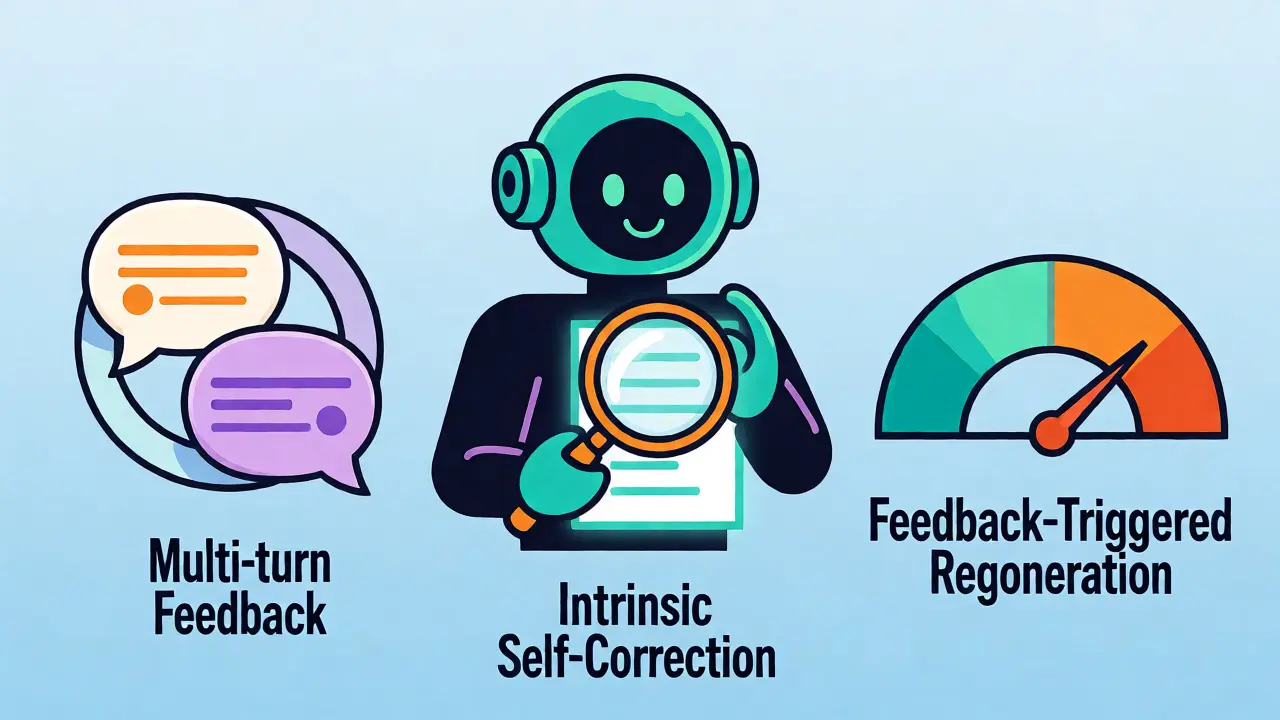
Not all self-correction is created equal. Research from 2023 through 2025 has categorized these techniques into three distinct buckets. Understanding which one fits your use case saves you from building overly complex pipelines for simple problems.
Intrinsic self-correction happens within a single interaction. You instruct the model to generate an output, then immediately validate it against a rule, and finally correct it if needed. For example, "Produce a JSON response, then check if it matches this schema and correct any mismatches." This method adds minimal latency-about 15-25% more processing time-and requires zero extra training. It works best for tasks with clear rules, like formatting code or filling out forms.
Multi-turn feedback correction treats errors as conversation pauses. If a response gets cut off or looks incomplete, you send a specific interruption signal: "Feedback: Incomplete at [point]. Continue and correct." This approach recovers 76-89% of interrupted streams in real-time apps. It’s ideal for chatbots where context matters, but it consumes more tokens because each turn adds history to the context window.
Feedback-triggered regeneration (FTR) is the heavyweight champion. Introduced in late 2025, FTR combines user feedback signals with advanced decoding methods. It doesn’t just guess if there’s an error; it waits for a confidence score below 0.65 or explicit user dissatisfaction before triggering a rewrite. This reduces unnecessary corrections by 41% compared to standard methods. However, it requires integrating your LLM with a feedback system, making it less suitable for fully automated background jobs.
| Method | Best Use Case | Latency Impact | Effectiveness |
|---|---|---|---|
| Intrinsic Correction | Structured outputs (JSON, XML), Code generation | +15-25% | High for rigid formats |
| Multi-Turn Feedback | Chatbots, Long-form content, Interrupted streams | Variable (depends on turns) | Recovers ~80% of interruptions |
| Feedback-Triggered Regeneration | High-stakes reasoning, Math problems, User-facing apps | +30-40% (if triggered) | Reduces false positives by 41% |
Why Generic "Check Your Work" Prompts Fail
You might think telling an AI to "double-check" is enough. It isn’t. Professor Yoav Goldberg from Bar-Ilan University points out that the bottleneck isn’t the correction itself-it’s the feedback generation stage. Models struggle to reliably identify their own errors without external signals. When you just say "check your work," the model often falls into "prompt-induced solution drift." This means the act of correcting inadvertently distorts the reasoning trajectory, causing systematic deviations from optimal solutions in 37-52% of cases.
Think of it like asking someone to proofread their own essay while they’re still writing it. Their brain fills in gaps they didn’t write. To fix this, you need to separate the roles. Don’t ask the model to be both author and editor simultaneously in a vague way. Instead, give it a specific checklist or a validator role.
For instance, instead of "Fix any errors," try: "You are a strict JSON validator. Review the following output against Schema X. List every key that is missing or has the wrong type. Do not rewrite the whole thing yet; just list the errors." This forces the model to slow down and look at specific attributes rather than glancing over the whole text.
Structuring Effective Error Messages
The quality of your feedback determines the quality of the correction. Vague feedback leads to vague fixes. Concrete feedback leads to precise repairs. Here’s how to build error messages that actually help the model learn from its mistakes.
- Be Specific About the Failure: Don’t say "This is wrong." Say "The 'date' field is missing the timezone offset required by ISO 8601 format." The model needs to know exactly which rule was broken.
- Provide the Correct Format: Show an example of what success looks like. If you want a list, show a bullet point. If you want JSON, show a valid snippet. This anchors the model’s next attempt.
- Limit the Scope of Correction: Tell the model what not to change. "Correct only the date format. Keep the rest of the text identical." This prevents the model from rewriting the entire paragraph and introducing new stylistic inconsistencies.
- Use Confidence Thresholds: As noted in recent arXiv studies, only trigger regeneration when internal confidence scores fall below 0.65. If the model is 90% sure it’s right, don’t force a correction. Over-correcting valid responses is a common pitfall, reported in 29% of developer cases.
Consider a real-world scenario from a GitHub discussion. A developer named Alex Chen reduced JSON validation errors from 22% to 7% by adding a two-step prompt. First, the model generates the JSON. Second, a separate prompt asks the model to validate it against the schema. Crucially, the second prompt included the exact error message from a code-based validator, not just the model’s opinion. This hybrid approach-using deterministic code checks to inform the probabilistic model-is far more reliable than pure self-reflection.

When Self-Correction Backfires
Self-correction isn’t a silver bullet. Percy Liang from Stanford University warns that it must be integrated carefully. There are specific scenarios where adding a correction step makes things worse.
First, avoid self-correction for open-ended creative tasks. If you ask for a poem, there’s no objective "correct" answer. The model might try to "fix" a perfectly good metaphor because it thinks it’s too obscure. The TACL analysis (2024) notes that self-correction fails in 83-92% of general knowledge tasks when relying solely on prompted feedback. Why? Because the model doesn’t have access to ground truth. It’s guessing whether its fact is right based on probability, not verification.
Second, watch out for infinite loops. If your correction criteria are ambiguous, the model might keep changing the output back and forth between two plausible states. Samira Patel, a senior engineer, noted that 18% of corrections initially made outputs worse until validation criteria were refined. To prevent this, cap your iterations. Most experts recommend a maximum of 2-3 correction rounds. After that, switch to a fallback strategy, like using a different model or flagging the item for human review.
Implementation Checklist for Developers
Ready to implement this? Here’s a practical roadmap to get started without breaking your production pipeline.
- Define Clear Validation Rules: Before you prompt, know exactly what constitutes an error. Is it syntax? Logic? Factuality? Write these rules down. If you can’t write them, you can’t prompt them.
- Start with Intrinsic Correction: Try the single-prompt approach first. Add instructions to "generate, validate, correct" within the same context. Measure the latency increase. If it’s under 25%, you’re in a good spot.
- Add External Validators for High-Stakes Tasks: For math or code, don’t rely on the LLM’s self-assessment. Run the code or solve the math problem with a traditional script. Feed the actual error message back to the LLM. This leverages the model’s language skills to fix issues identified by deterministic tools.
- Monitor for Correction Drift: Track metrics specifically for corrections. Are corrected outputs better than the originals? If you see a trend where corrections degrade quality, tighten your feedback prompts. Make them more restrictive.
- Implement Fallbacks: What happens after three failed corrections? Have a plan. Switch to a cheaper, faster model for a quick fix, or route the request to a human queue. Hybrid systems reduce overall pipeline failures by 63% in documented case studies.
Remember, the goal isn’t perfection on the first try. It’s reliability over time. By structuring your feedback loops correctly, you turn a flaky generator into a robust tool.
Does self-correction always improve accuracy?
No. While it significantly helps with structured outputs like JSON or code, it can degrade performance in open-ended creative tasks or general knowledge questions where the model lacks external validation signals. Studies show failure rates of 83-92% for general knowledge tasks without external checks.
How much latency does self-correction add?
Intrinsic self-correction typically adds 15-25% to processing time per request. More complex methods like Feedback-Triggered Regeneration (FTR) can add 30-40% if triggered frequently. Multi-turn approaches vary depending on the number of correction rounds required.
What is "prompt-induced solution drift"?
This occurs when correction prompts inadvertently distort the model's original reasoning trajectory. Instead of fixing a small error, the model deviates from the optimal path, leading to systematic inaccuracies in 37-52% of cases. It happens when feedback is too vague or broad.
Can I use self-correction for factual QA?
It is risky. Without external search or database lookup, the model cannot verify facts. It may confidently "correct" a true statement into a false one because it misremembers the source. Use self-correction for facts only if paired with retrieval-augmented generation (RAG) or external validators.
How many correction iterations should I allow?
Experts recommend a maximum of 2-3 iterations. Beyond this, the risk of error amplification increases, and the cost-benefit ratio drops sharply. If the model hasn't fixed the issue in three tries, it likely needs a different approach or human intervention.