From Markov Chains to Transformers: The Technical History of Generative AI
 May, 22 2026
It’s easy to look at a chatbot writing code or an image generator creating photorealistic art and think this technology appeared out of nowhere. You might assume the current boom in generative AI is a sudden miracle of modern engineering. But if you peel back the layers, you’ll find a century-long struggle involving mathematicians, frustrated researchers, and massive shifts in computing power. This isn’t just a story about better algorithms; it’s a history of how we taught machines to understand context, sequence, and creativity.
We are standing in May 2026, looking back at a path that started with simple probability chains and evolved into the complex transformer architectures that power today’s most advanced systems. Understanding this lineage helps you grasp why these models behave the way they do-and where they are likely going next.
The Probabilistic Roots: Markov and Early Logic
Before computers could write poetry, they had to learn to predict what came next. That journey began around 1913 with Russian mathematician Andrey Markov. He developed Markov chains, which are probabilistic models for sequence generation by predicting the next element based on previous states. The concept was simple: if you know the current state, you can calculate the probability of the next one. It didn’t care about the entire history, only the immediate past.
This approach laid the groundwork for early natural language processing. In the 1950s, Hidden Markov Models (HMMs) became standard for speech recognition because they could model sequential data like audio waves. However, HMMs had a major flaw-they couldn’t handle long-range dependencies. If a sentence was ten words long, the model struggled to connect the first word to the last. They were great for short sequences but terrible for understanding complex context.
Parallel to this, the formal discipline of artificial intelligence was born at the 1956 Dartmouth Summer Research Project. John McCarthy coined the term "Artificial Intelligence" here, and the Logic Theorist program debuted as the first system capable of solving mathematical proofs. Alan Turing’s 1950 paper also shifted the goalpost from internal consciousness to observable behavior via the Turing Test. This behavioral focus remains central to how we evaluate large language models today-if it acts intelligent, does it matter if it doesn’t "think"?
The First Conversations and the AI Winters
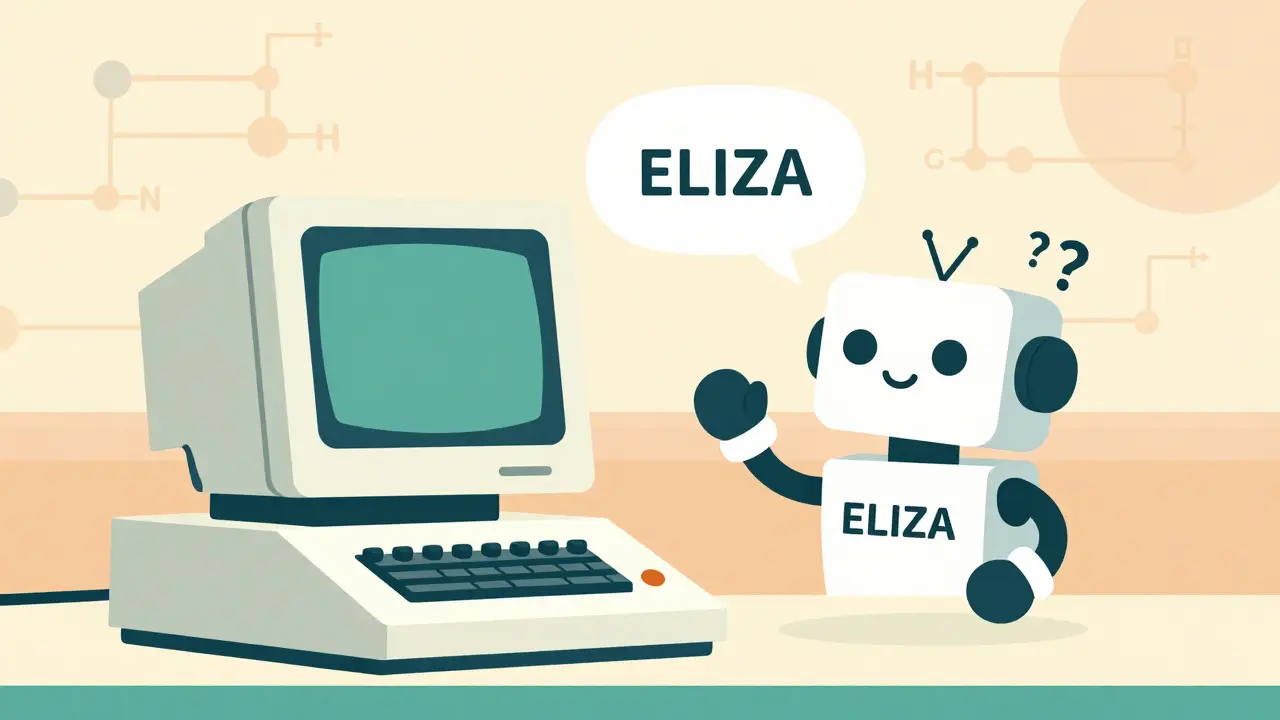
By 1964, Joseph Weizenbaum created ELIZA, which was the first concrete instance of generative AI, a chatbot that used pattern matching and substitution methodology to simulate conversation. Running at MIT, ELIZA didn’t truly understand language. It mirrored your words back to you using simple rules. Yet, people anthropomorphized it instantly-a phenomenon known as the "ELIZA Effect." This proved that humans are eager to find meaning in machine outputs, even when those outputs are mechanically generated.
Despite these early sparks, the field hit a wall. From the mid-1960s through the 1980s, AI went through several "winters." Funding dried up because expectations weren’t met. Computers lacked the memory and processing speed to run anything beyond basic rule-based systems. Researchers realized that symbolic logic alone wasn’t enough to capture the nuance of human communication. The dream of generative AI was put on hold until hardware caught up with theory.
Neural Networks Take Shape: Perceptrons to RNNs
In 1958, Frank Rosenblatt proposed the perceptron at Cornell University. This was the first operational neural network, inspired by biological neurons. It could learn from diverse data by adjusting weights between inputs and outputs. While primitive, it planted the seed for connectionist approaches-systems that learn patterns rather than following explicit rules.
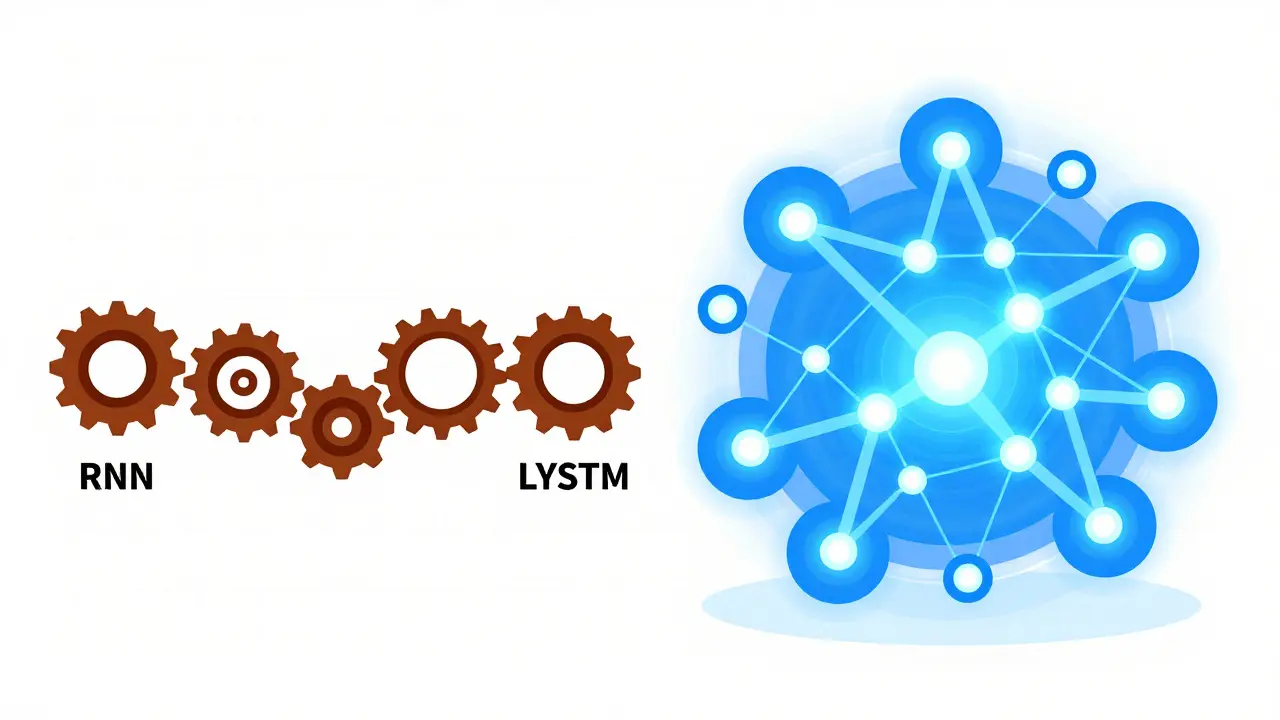
The real breakthrough for sequential data came in 1982 with Recurrent Neural Networks (RNNs). Unlike earlier models, RNNs maintained an internal state. They remembered prior inputs, allowing them to process sequences like sentences or time-series data. But RNNs had a critical weakness: vanishing gradients. As sequences got longer, the network forgot earlier information. Trying to make an RNN remember the beginning of a novel while reading the end was nearly impossible.
Jürgen Schmidhuber’s team solved this in 1997 by developing Long Short-Term Memory (LSTM) networks, which feature specialized memory cells that retain information across extended sequences. LSTMs introduced gates that controlled what information to keep and what to discard. By 2001, Schmidhuber demonstrated that LSTMs could learn formal languages that traditional HMMs couldn’t touch. This bridged the gap between neural "subsymbolic" models and symbolic reasoning tasks.
The practical impact was huge. In 2007, Schmidhuber’s team implemented Connectionist Temporal Classification (CTC) with LSTMs, creating the first superior end-to-end neural speech recognition system. This technology eventually powered Google Translate by 2016. For over a decade, LSTMs were the king of sequence modeling.
The Adversarial Era: GANs and VAEs
While LSTMs dominated text and speech, image generation needed a different approach. In 2013, Diederik Kingma and Max Welling introduced Variational Autoencoders (VAEs), offering a probabilistic way to generate new data points by learning the underlying distribution of training data. Around the same time, Ian Goodfellow unveiled Generative Adversarial Networks (GANs) in 2014.
Generative Adversarial Networks (GANs) employed two competing neural networks-a generator and a discriminator-to produce increasingly realistic outputs. Think of it as a counterfeiter trying to fool an art expert. The generator creates fake images, and the discriminator tries to spot them. Over millions of iterations, both get better, resulting in stunningly realistic images. GANs sparked a revolution in visual arts, enabling tools that could create faces of people who didn’t exist.
However, GANs were notoriously unstable to train. They often collapsed into producing low-quality variations of a single output. Meanwhile, diffusion models, introduced in 2015, offered a more stable alternative by reversing a noise-adding process. Initially ignored, diffusion would later become the backbone of high-fidelity image generators like Stable Diffusion.
The Transformer Revolution: Attention Is All You Need
The pivotal moment arrived in 2017. A team of researchers at Google, including Ashish Vaswani and Noam Shazeer, published "Attention is All You Need." They introduced the transformer architecture, which eliminated recurrence in favor of self-attention mechanisms, enabling parallel processing and unprecedented scalability.
Here’s why this mattered. LSTMs processed sequences step-by-step. To read a sentence, the computer had to wait for word one, then word two, then word three. This sequential nature made training slow and limited how much context the model could absorb. Transformers used self-attention, allowing the model to look at every word in a sentence simultaneously. It calculated relationships between all tokens in parallel.
This shift changed everything. While LSTMs had O(n) computational complexity per step, transformers achieved O(1) parallelization potential. Yes, they required more memory for the attention matrix (O(n²)), but GPUs were getting faster and cheaper. NVIDIA’s advancements accelerated transformer training by 10-100x compared to CPU-based LSTM implementations.

Scaling Up: From GPT-1 to Multimodal Giants
The transformer architecture directly enabled OpenAI’s Generative Pre-trained Transformer (GPT-1) in 2018. But the real magic happened when companies started scaling up parameters. GPT-2 (2019) had 1.5 billion parameters. GPT-3 (2020) exploded to 175 billion parameters.
With scale came emergent capabilities. GPT-3 demonstrated few-shot learning-the ability to perform tasks it hadn’t been explicitly trained for, just by seeing examples in the prompt. This was a qualitative leap from smaller models. The largest practical LSTM implementations rarely exceeded 100 million parameters due to training instability. Transformers broke that ceiling.
By 2021, DALL-E showed that transformers could handle multimodal tasks, generating images from text descriptions. In 2022, Stable Diffusion combined diffusion models with transformer components, democratizing high-quality image generation. Then came GPT-4 in March 2023, handling inputs up to 25,000 words with significantly improved reasoning. These systems weren’t just predicting the next word; they were synthesizing complex arguments, writing code, and diagnosing medical conditions.
| Architecture | Key Innovation | Primary Use Case | Limitation |
|---|---|---|---|
| Hidden Markov Models | Probabilistic sequence prediction | Early speech recognition | Poor long-range dependency |
| LSTMs | Gated memory cells | Machine translation, speech | Sequential processing bottleneck |
| GANs | Adversarial training loop | Image synthesis | Training instability |
| Transformers | Self-attention mechanism | NLP, multimodal generation | High memory/compute cost |
Current Challenges and Future Directions
As of 2026, transformers dominate the landscape, but they aren’t perfect. Training GPT-3 required approximately 1,300 megawatt-hours of electricity. The quadratic memory complexity means that as context windows grow, so does the computational burden. Additionally, experts like Geoffrey Hinton have raised concerns that transformers lack explicit world models, potentially hindering progress toward true artificial general intelligence (AGI).
The industry is responding with efficiency-focused innovations. Microsoft’s Phi-2 (January 2024) achieved GPT-3.5-level performance with only 2.7 billion parameters through advanced training techniques. Retrieval-Augmented Generation (RAG) has become standard, with 67% of enterprise implementations adopting it by late 2023 to reduce hallucinations. Meanwhile, DeepMind’s Mamba architecture offers a state-space alternative to transformers, claiming to overcome the O(n²) complexity limit.
For developers, the barrier to entry has lowered but not disappeared. Fine-tuning transformer models still requires significant expertise. An O’Reilly survey found that practitioners need 6-12 months to become proficient. However, open-source ecosystems like Hugging Face have provided crucial support, with tens of thousands of contributors sharing solutions for issues like catastrophic forgetting.
Why This History Matters for You
Understanding the evolution from Markov chains to transformers helps you make better technical decisions. If you’re building a system that needs to understand long documents, you know why a transformer is necessary. If you’re concerned about compute costs, you understand the trade-offs between GANs, diffusion, and autoregressive models. This history isn’t just academic-it’s a toolkit for navigating the rapid changes in AI technology.
We are still in the early stages of this revolution. The next decade will likely see hybrid architectures that combine the best of neural networks, symbolic reasoning, and efficient state-space models. But the foundation was laid by decades of trial, error, and breakthroughs that turned simple probability calculations into creative engines.
What is the main difference between Markov models and Transformers?
Markov models predict the next item in a sequence based solely on the current state, ignoring long-term context. Transformers use self-attention to analyze all parts of a sequence simultaneously, capturing complex long-range dependencies and context.
Why did LSTMs become obsolete for many tasks?
LSTMs process data sequentially, which makes training slow and limits their ability to scale to very large datasets. Transformers allow for parallel processing, making them significantly faster to train and more effective at handling large contexts.
What role did GANs play in the history of generative AI?
GANs pioneered the creation of highly realistic synthetic images by pitting a generator against a discriminator. While largely superseded by diffusion models for image generation, they established the proof-of-concept for adversarial training in deep learning.
Are Transformers the final solution for AI?
Not necessarily. Experts note limitations such as high energy consumption and lack of explicit world modeling. New architectures like Mamba and hybrid models are being explored to address these inefficiencies and move closer to AGI.
How has the cost of running generative AI changed over time?
While early models were cheap but limited, modern transformer models require massive computational resources. Training large models consumes megawatt-hours of electricity. However, inference costs are decreasing due to specialized hardware and more efficient model designs like Phi-2.