Generative AI Careers: Roles, Skills, and Top Certifications for 2026
 Nov, 4 2026
You might think that knowing how to chat with a bot is enough to land a job in tech. But by late 2026, the landscape has shifted dramatically. Employers aren't just looking for people who can type prompts; they want proof you can build, evaluate, and deploy systems that create text, images, code, and video. If you're trying to break into Generative AI or pivot your current career, understanding the specific roles, curricula, and certifications required is no longer optional-it's survival.
The market has moved from degree-centric screening to skill-based hiring. A 2025 study on AI and green jobs confirmed this shift, showing that recruiters prioritize demonstrable, task-level skills over traditional credentials. This means your resume needs to show more than just a university name. It needs to highlight specific capabilities in prompt engineering, agentic systems, and production deployment. Let's look at what actually works right now.
Key Takeaways
- Skill-Based Hiring is Real: Degrees matter less than portfolio projects and recognized certifications like AWS GenAI Developer or Johns Hopkins certificates.
- Role-Specific Paths Exist: Don't take a generic course. AI Engineers need cloud infrastructure skills, while Product Managers need technical literacy combined with business impact case studies.
- Foundations are Standardized: Entry-level roles increasingly require baseline literacy proofs, such as the Certiport Generative AI Foundations certification, which covers ethics and basic prompting.
- Projects Beat Theory: Expert guides consistently recommend building at least three serious projects with real data and evaluation metrics to prove competence.
- Cloud Ecosystems Dominate: Choosing one major cloud provider (AWS, Azure, or Google Cloud) and mastering its AI stack is more valuable than spreading effort across all of them.
The Core Roles in Generative AI
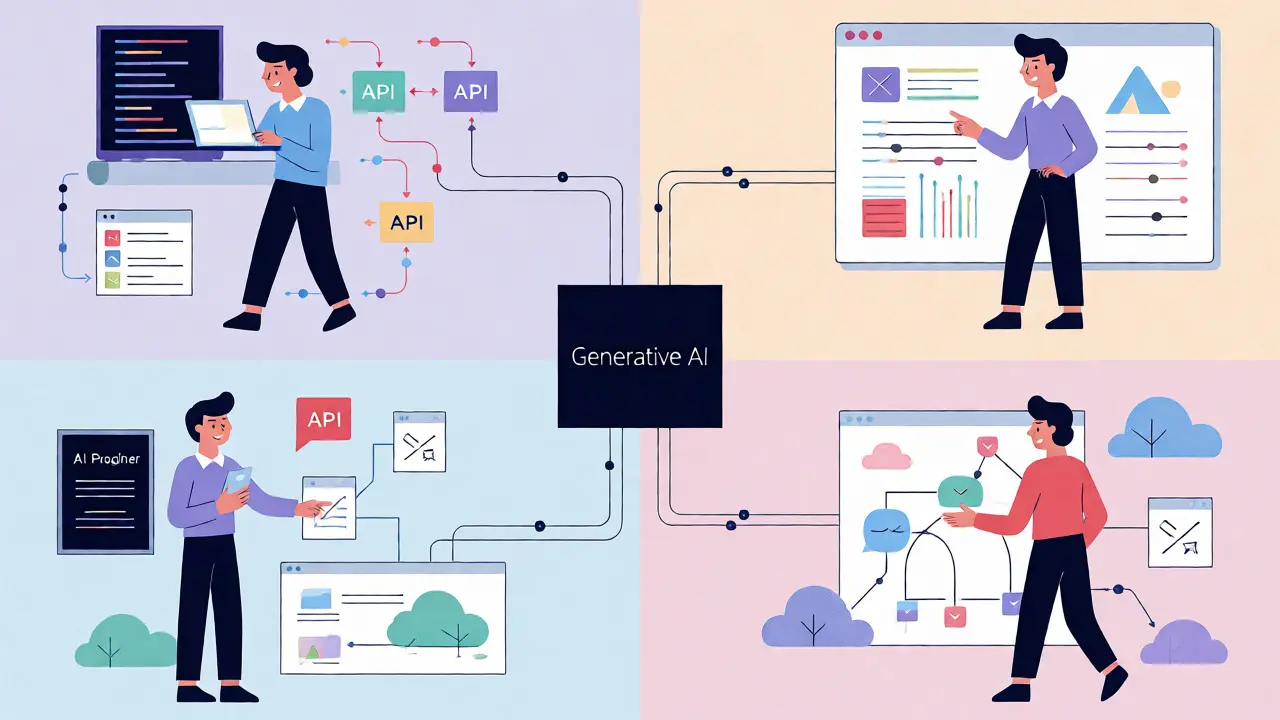
Not everyone in this field does the same thing. The talent landscape clusters around four main responsibilities: engineering, data, product, and infrastructure. Knowing which bucket you fit into saves you from wasting time on irrelevant courses.
AI Engineer is perhaps the most sought-after title. These professionals don't just use models; they integrate them into applications. They need strong coding skills, usually in Python, and a deep understanding of how to optimize costs and latency. You'll see job descriptions asking for experience with Amazon Bedrock, LangChain, or vector databases. If you're coming from software engineering, this is often the natural next step.
Then there's the Machine Learning Engineer. While similar to an AI Engineer, this role leans heavier on the lifecycle of the model itself-training, fine-tuning, and maintaining accuracy over time. They work closely with data scientists but focus on making models reliable in production. Tools like Weights & Biases for experiment tracking and NVIDIA Deep Learning Institute resources for GPU optimization are part of their daily toolkit.
For those who prefer strategy over code, the AI Product Manager (AIPM) role is growing fast. You don't need to write code, but you must understand what models can and cannot do. You need to define success metrics, manage user expectations about hallucinations, and coordinate between engineers and stakeholders. Technical literacy here is non-negotiable; if you can't explain why a RAG system failed, you'll lose credibility.
Finally, Solution Architects design the overall system. They decide whether to use a proprietary API or open-source models, how to handle security, and how to scale. This role requires broad knowledge of cloud platforms and enterprise integration patterns.
Essential Curricula and Learning Paths
Where do you start? The consensus among experts in 2026 is clear: start with foundations, then specialize. Jumping straight into advanced cloud certifications without understanding neural networks or transformer architecture sets you up for failure.
For early-career professionals, the "gold standard" remains the DeepLearning.AI specializations led by Andrew Ng. Specifically, the Machine Learning Specialization and the Generative AI with LLMs course provide the mathematical and practical grounding needed. These courses cover core concepts like optimization and modern LLM workflows. They are highly rated on Coursera, with completion rates significantly higher for courses above 4.0 stars, indicating their effectiveness.
Once you grasp the basics, move to tool-specific training. The Hugging Face Transformers curriculum is crucial for understanding how to fine-tune models efficiently. For agentic systems-where AI performs multi-step tasks autonomously-LangChain Academy and LangGraph certifications have become essential. Agentic workflows are central to modern AI engineering, moving beyond simple question-answering to complex problem-solving.
Universities are also catching up. Johns Hopkins University launched an Applied Generative AI and Agentic AI Certificate Program. This isn't just theory; it requires hands-on projects that mirror real-world use cases. Completing this program gives you a credential from a reputable institution plus a portfolio of artifacts you can show employers.
Certifications That Actually Matter
Certifications signal to recruiters that you have verified skills. But not all certs are created equal. Here’s what’s gaining traction in 2026.
| Certification Name | Provider | Target Audience | Key Focus Areas | Prerequisites |
|---|---|---|---|---|
| Generative AI Foundations | Certiport | Students, Entry-Level, Non-Tech | Prompt Engineering, Societal Impact, Basic Models | None |
| AWS Certified Generative AI Developer - Professional | AWS | Mid-Level Developers | Amazon Bedrock, Production Deployment, Cloud Security | 2+ Years Cloud Experience |
| Professional Machine Learning Engineer | Google Cloud | ML Engineers, Data Scientists | Model Lifecycle, MLOps, GCP Infrastructure | 3+ Years ML Experience |
| Azure AI Engineer Associate (AI-102) | Microsoft | Software Engineers, AI Developers | Azure AI Services, Cognitive Search, Bot Framework | 1+ Year Coding Experience |
| Applied Generative AI Certificate | Johns Hopkins University | Career Changers, Professionals | Agentic Systems, Evaluation, Project Portfolio | Bachelor's Degree Recommended |
The AWS Certified Generative AI Developer - Professional exam is rigorous. It lasts 180 minutes, contains 75 questions, and costs $300. AWS explicitly recommends this for developers with at least two years of cloud experience. It proves you can move beyond proofs-of-concept to large-scale deployments using services like Amazon Bedrock.
On the entry level, the Certiport Generative AI Foundations Certification is gaining recognition. Launched in late 2024 and endorsed by Mindstone, it covers societal impact and prompt refinement. It’s accessible via Pearson VUE and is becoming a baseline expectation for high school and college graduates entering the workforce.
Databricks also reports certifying over 90,000 professionals through its data and AI programs. Their certifications validate skills in orchestrating training pipelines and managing feature stores on the Databricks Lakehouse platform, which is critical for enterprises handling massive datasets.
Building a Portfolio: Projects Over Paper
Here’s the hard truth: a certificate alone won’t get you hired. Experts repeatedly stress that you need to "build at least three serious projects." These shouldn't be toy apps. They need real data, evaluation metrics, and clear tradeoffs.
Consider building a retrieval-augmented generation (RAG) system for a niche domain, like legal contracts or medical guidelines. Document your process: How did you chunk the data? Which embedding model did you choose and why? How did you evaluate accuracy? Did you use LangChain or LlamaIndex? What were the cost implications?
For AI Product Managers, the equivalent is a case study. Pick a deployed AI product, analyze its strengths and weaknesses, and propose improvements. Show that you understand the balance between technical feasibility and user value. Recruiters scan resumes for these indicators of applied capability. If you can point to a GitHub repo with clean code and a README explaining your decisions, you’re ahead of candidates who only list courses taken.

Strategic Advice for Different Career Stages
If you’re transitioning from software engineering, start with foundational courses like DeepLearning.AI, then layer on cloud context. Pick one ecosystem-AWS, Azure, or Google Cloud-and stick with it. Spreading yourself thin across all three dilutes your expertise. Once you have the foundation, pursue the professional-level developer certification for that platform.
For mid-level engineers targeting senior roles, focus on specialization. Do you want to be the go-to person for vector databases? Get certified with Pinecone or Weights & Biases. Interested in GPU optimization? Look at NVIDIA Deep Learning Institute resources. Depth beats breadth in senior hiring.
If you’re an AI Product Manager or Solution Architect, take a hybrid approach. Combine one technical cloud certification with a product-focused credential. Back both up with case studies of products you’ve influenced. This demonstrates both technical literacy and business impact, which is exactly what leadership teams look for.
Before enrolling in any program, check five things: instructor background (do they have industry experience?), presence of hands-on projects, recognition of the provider, fit with your schedule, and reviews from past learners. Courses with ratings above 4.0 stars on platforms like Coursera tend to have higher completion rates, suggesting better engagement and quality.
The Future of AI Talent
The generative AI talent market is maturing. Vendor-specific credentials are becoming de facto signals of depth within particular ecosystems. Tool-centric credentials from Hugging Face, LangChain, and NVIDIA mark specialization in transformers, agents, and MLOps. Foundational programs serve as on-ramps for students and career changers.
Corporate initiatives like Microsoft’s AI Skills framework position AI literacy as a baseline expectation, comparable to communication or digital productivity skills. This means generative AI skills are no longer niche. They are embedded across education and professional development pipelines. To stay competitive, keep updating your skill set. The tools change every six months, but the underlying principles of good engineering and ethical awareness remain constant.
Do I need a computer science degree for generative AI jobs?
No, not necessarily. The industry is shifting toward skill-based hiring. Demonstrable skills through projects, portfolios, and recognized certifications often outweigh formal degrees. However, a strong understanding of programming fundamentals and mathematics is still required for engineering roles.
Which cloud certification is best for generative AI in 2026?
It depends on your target employer. AWS Certified Generative AI Developer - Professional is highly valued for developers using Amazon Bedrock. Google Cloud Professional Machine Learning Engineer is excellent for those focusing on model lifecycle management. Azure AI Engineer Associate is ideal for enterprises already in the Microsoft ecosystem. Choose one and master it rather than trying to learn all three simultaneously.
Is prompt engineering still a viable career path?
Pure prompt engineering is evolving into broader AI application development. While crafting prompts is a fundamental skill, standalone "prompt engineer" roles are becoming rarer. Instead, prompt engineering is integrated into roles like AI Engineer, AI Product Manager, and Content Strategist. You need to pair prompting skills with technical implementation or strategic oversight to remain competitive.
How many projects should I have in my portfolio?
Experts recommend having at least three serious projects. These should involve real data, clear evaluation metrics, and documented tradeoffs. Quality matters more than quantity. A well-documented RAG system or an agentic workflow project is more impressive than ten simple chatbot demos.
What is the difference between an AI Engineer and a Machine Learning Engineer?
An AI Engineer typically focuses on integrating existing models into applications, handling APIs, prompt engineering, and user interface logic. A Machine Learning Engineer focuses more on the model lifecycle itself, including training, fine-tuning, data pipeline management, and optimizing model performance and reliability in production environments. There is overlap, but the emphasis differs.