Generative AI in Agriculture: Crop Reports, Equipment Manuals, and Market Outlooks
 May, 8 2026
Imagine asking your tractor manual why it’s overheating, getting a plain-English answer instantly, or receiving a crop report that predicts yield losses before they happen. This isn’t science fiction anymore. In 2026, Generative AI is a type of artificial intelligence that creates new content like text, images, or data based on patterns learned from existing information is moving from experimental labs into actual fields. Farmers aren’t just looking at dashboards; they are talking to systems that understand agronomy, machinery, and market trends.
The shift is happening fast. We are no longer in the phase where AI is hidden "under the hood" generating alerts you can’t interpret. Now, generative AI acts as a conversational partner. It explains why a recommendation was made, compares different scenarios for pest control, and helps you make decisions right when you need them. For many, this means less guesswork and more confidence in daily operations.
From Static Reports to Dynamic Crop Insights
Traditionally, crop reports were static documents. You got a PDF at the end of the season, or maybe a weekly summary that told you what already happened. Generative AI changes this by turning historical data, satellite imagery, and weather forecasts into actionable, dynamic insights.
Consider how Large Language Models (LLMs) are being integrated into agricultural extension services. Organizations like the International Food Policy Research Institute (IFPRI) are leading the charge with projects like GAIA is Generative AI for Agriculture, a multi-institutional initiative designed to enhance the efficacy and reliability of AI-generated agricultural advisories. This project specifically targets small-scale producers in developing regions, showing that this technology isn’t just for massive industrial farms.
In Phase I of the GAIA project (2023-2024), researchers tested chatbots using a retrieval-augmented generation (RAG) framework. They combined open-access research from CGIAR with proprietary materials from CABI. The result? More accurate, context-specific advice for farmers in Kenya and India. Now, in Phase II (2025-2027), the focus is expanding. They are integrating real-time data sources and predictive analytics. This means an AI assistant can look at current soil moisture levels, predict rain patterns, and suggest irrigation adjustments all in one conversation.
- Real-time integration: AI connects live weather data with crop growth stages.
- Contextual relevance: Recommendations adapt to local soil types and regional pests.
- Dynamic updates: Reports update automatically as new data arrives, rather than waiting for monthly summaries.
This shift allows farmers to move from reactive problem-solving to proactive management. Instead of discovering a disease outbreak after it spreads, the AI analyzes image inputs and historical patterns to warn you early.
Simplifying Equipment Manuals with AI
One of the most frustrating parts of modern farming is dealing with complex machinery. Tractors, combines, and sprayers come with hundreds of pages of technical manuals. When something breaks in the middle of harvest, nobody wants to scroll through a PDF looking for error code E-402.
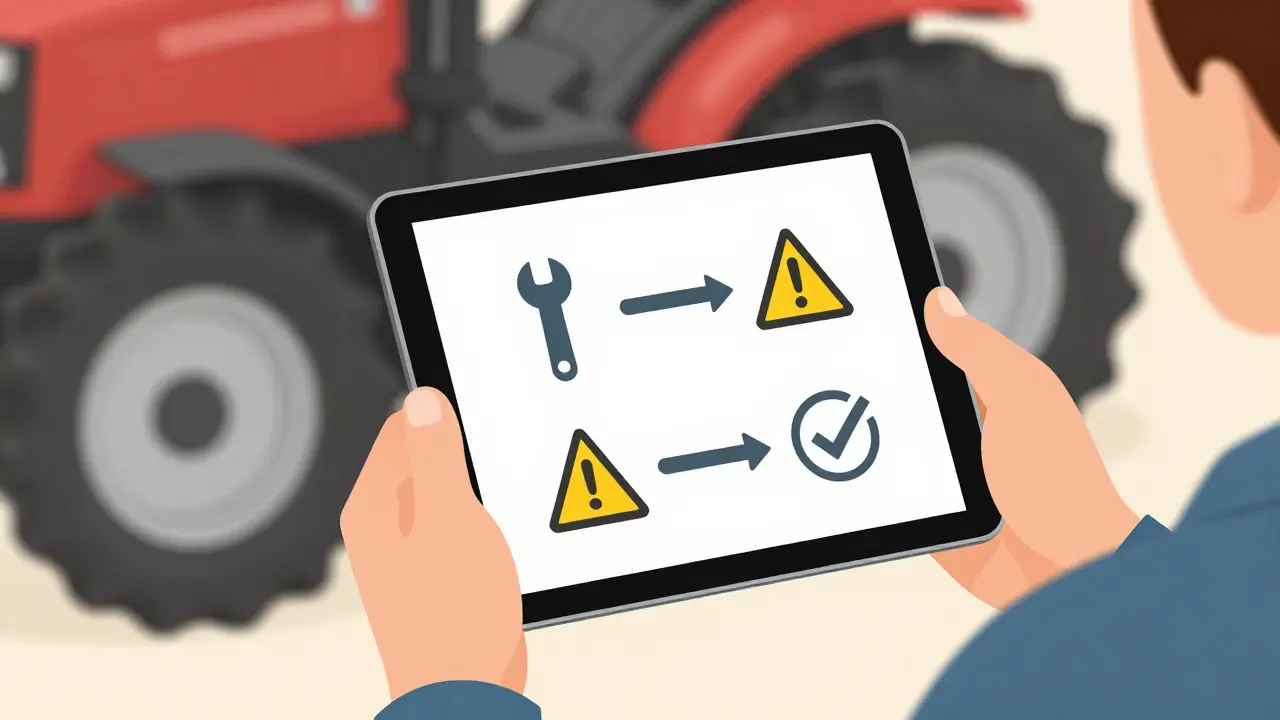
Generative AI solves this by acting as an intelligent interface for equipment documentation. Imagine pointing your phone camera at a malfunctioning part or typing in an error code. The AI reads the manufacturer’s manual, cross-references common fixes, and gives you step-by-step instructions in plain language. It doesn’t just tell you what the error code means; it tells you how to fix it based on your specific model and current field conditions.
This application relies on multimodal AI capabilities. These systems can process text, images, and sensor data simultaneously. While fully autonomous repair bots are still emerging, AI-enhanced manuals are here now. They reduce downtime significantly because operators get immediate answers instead of waiting for a technician to arrive.
For service providers and retailers, this is a game-changer. It transforms them from simple input suppliers into trusted technology partners. If a farmer can troubleshoot minor issues themselves using AI guidance, they spend less time idle and more time working. This efficiency directly impacts the bottom line.
Market Outlooks and Decision Support
Farming isn’t just about growing crops; it’s about selling them. Market volatility has always been a risk, but generative AI provides tools to navigate it better. By analyzing global supply chains, commodity prices, and consumer trends, AI can generate detailed market outlooks tailored to your specific region and crop mix.
In 2026, we see a trend toward "field-ready decision partners." These AI agents don’t just give you a price prediction; they help you decide when to sell. They might analyze storage costs, current futures contracts, and predicted demand spikes to recommend the optimal timing for your harvest sale. This kind of prescriptive analytics combines agronomy, operations, and finance into a single view.
The United States Department of Agriculture (USDA) has recognized this potential. Their fiscal year 2025-2026 strategy explicitly includes expanding predictive analytics and machine learning to improve food safety, increase sustainability, and predict crop yields. This institutional backing signals that AI is becoming a core part of federal agricultural policy, not just a private sector experiment.
However, adoption varies. Larger commercial operations and service-led businesses are adopting these tools quickly because they have the resources to integrate them into existing workflows. Smaller farms are more cautious. They prioritize simplicity and proven value. For them, the tool must be easy to use and show a clear return on investment (ROI) without adding operational complexity.
The Rise of Physical AI and Automation
While software gets a lot of attention, "Physical AI" is changing the hardware side of agriculture. Physical AI refers to intelligence systems embedded directly into steel, rubber, and hydraulic field equipment. It’s not just code in the cloud; it’s autonomy on the ground.
Experts like Tim Bucher, CEO of Agtonomy, argue that 2026 is the tipping point for physical AI. The goal is to scale autonomy from demonstrations to actual food infrastructure. This doesn’t mean replacing farmers entirely. Instead, it’s about "human-in-the-loop" automation. Machines handle repetitive, labor-intensive tasks-like weeding or spraying-while humans retain control over critical decisions.
This approach addresses two major issues: labor shortages and cost. By automating the drudgery, farms can attract younger talent who want to work with technology rather than perform back-breaking manual labor. It also makes precision agriculture more accessible through modular robotic systems and service models that reduce upfront capital costs.
For generative AI to work well here, it needs to communicate effectively with these physical systems. An AI assistant should be able to explain why an autonomous tractor changed its path or adjust its speed based on terrain data. This interoperability between software intelligence and physical action is key to the next era of digital agriculture.

Challenges: Ethics, Bias, and Data Governance
With great power comes great responsibility. Generative AI is only as good as the data it’s trained on. In agriculture, bad advice can lead to crop failure or environmental damage. That’s why data governance and ethics are critical topics in 2026.
The GAIA project is addressing this by developing a GenAI ethics toolkit. They are focusing on accuracy, timeliness, gender-sensitivity, and contextualization. For example, an AI advisory system must recognize that male and female farmers may have different access to resources or decision-making authority in certain regions. Ignoring these nuances leads to biased recommendations that don’t work in practice.
Another challenge is connectivity. Rural areas often lack reliable internet access. While offline-capable technology is improving, it remains a barrier for some. Interoperability is also a hurdle. Farmers use multiple platforms for different tasks. If AI tools don’t share data seamlessly via open APIs, they create silos rather than solutions. Industry leaders emphasize that connected intelligence requires connected infrastructure.
| Feature | Traditional Systems | Generative AI Solutions |
|---|---|---|
| Interaction Style | Static reports, dashboards, alerts | Conversational, interactive Q&A |
| Data Integration | Siloed, manual entry required | Real-time, multimodal (text, image, sensor) |
| Decision Support | Descriptive (what happened) | Prescriptive (what to do next) |
| Accessibility | Requires technical expertise | Natural language, user-friendly |
| Adoption Speed | Slow, high training cost | Faster, integrates into existing workflows |
What to Expect in the Coming Years
The trajectory is clear. Generative AI is moving from proof-of-concept to practical deployment. In 2026, the focus is on proving ROI. Farmers will adopt tools that save money, reduce manual work, and simplify planning. As these tools mature, they will become standard parts of farm management software.
We will likely see more partnerships between original equipment manufacturers (OEMs) and AI developers. This ensures that AI solutions are robust, financeable, and serviceable. We’ll also see greater emphasis on transparency. Farmers need to trust their AI advisors. Knowing how a recommendation was derived builds that trust.
For those entering this space, the opportunity is huge. But success depends on solving real problems, not just showcasing cool tech. The best applications will be those that disappear into the background, making farming easier and more profitable without adding complexity.
How does generative AI differ from traditional AI in agriculture?
Traditional AI often works behind the scenes, processing data to provide alerts or predictions (like yield estimates). Generative AI goes further by creating new content, such as written reports, conversational advice, or customized plans. It acts as a direct interface, allowing farmers to ask questions in natural language and receive detailed, context-aware answers.
Can generative AI replace human agronomists?
No, it augments them. Generative AI handles data analysis, pattern recognition, and initial troubleshooting, freeing up agronomists to focus on complex strategic decisions and personalized farmer relationships. It serves as a powerful decision support tool, not a replacement for human expertise.
What is the GAIA project?
GAIA (Generative AI for Agriculture) is a multi-institutional initiative led by IFPRI. It aims to improve the reliability and relevance of AI-generated agricultural advisories, particularly for small-scale producers in developing regions. The project focuses on ethical AI, data governance, and practical implementation through platforms like Farmer.Chat.
Is generative AI suitable for small farms?
Yes, especially if the tools are simple and cost-effective. Projects like GAIA specifically target smallholders. However, adoption depends on connectivity and ease of use. Small farms tend to adopt technologies that offer clear, immediate value without requiring significant technical skills or infrastructure investment.
How does AI help with equipment maintenance?
AI-powered systems can interpret error codes, analyze sensor data, and reference equipment manuals to provide instant troubleshooting steps. This reduces downtime by allowing operators to fix minor issues immediately or prepare detailed diagnostic information for technicians before they arrive.