Generative AI in Construction: Revolutionizing Bids, Schedules, and Safety
 Apr, 13 2026
For decades, the construction industry has relied on the same rigid tools. If you've ever spent hours manually updating a Gantt chart in Oracle P6 or Microsoft Project, you know the pain: one delayed shipment of steel or a sudden rainstorm can throw a six-month timeline into chaos. But the game is changing. Generative AI in construction is a suite of artificial intelligence models capable of creating new data, simulating thousands of project scenarios, and automating complex documentation. Unlike traditional software that simply records a plan, these systems actually design the plan based on historical data and real-world constraints. It's moving the industry from "guessing and checking" to "simulating and optimizing."
The Death of the Static Schedule
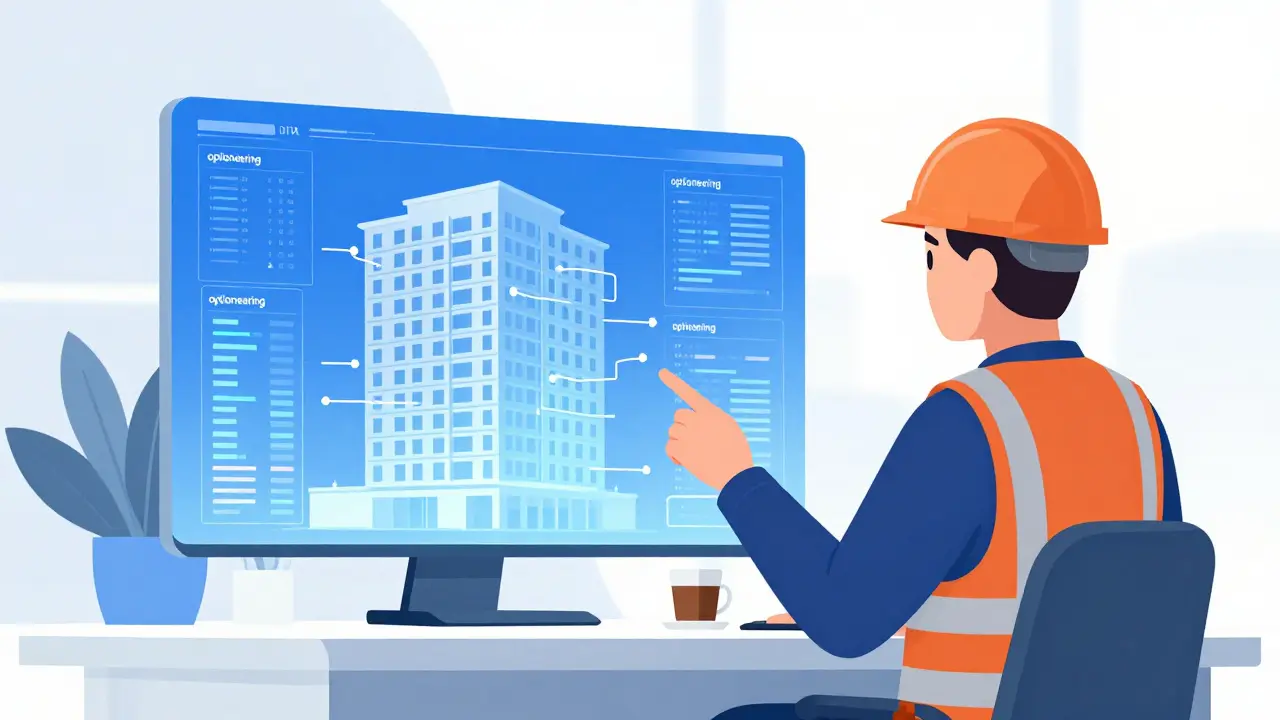
Traditional scheduling is a linear process. You map out Task A, then Task B, and hope for the best. Generative AI replaces this with what's known as "optioneering." Instead of one master schedule, the AI generates thousands of variations in minutes. It tests different combinations of materials, crew sizes, and sequencing to find the one with the highest probability of success.
Take ALICE Technologies is a generative construction platform that uses AI to simulate millions of scheduling scenarios to find the most efficient project path . If you're deciding between quick-drying concrete and traditional pours, you don't have to guess the impact on your timeline. The AI simulates both scenarios across the entire project lifecycle, showing you exactly how that one choice affects your finish date and total cost. This allows project managers to move from reactive firefighting to proactive strategic planning.
Another powerhouse in this space is nPlan is an AI planning tool trained on hundreds of thousands of historical schedules to predict activity uncertainty and schedule integrity . By analyzing a dataset of 750,000 historical schedules-representing over $2 trillion in spend-nPlan identifies "invisible" risks. It can flag a specific task as likely to be delayed because similar tasks in previous projects were consistently underestimated, effectively removing human optimism bias from the equation.
Automating the Bidding Process
Bidding is often the most stressful part of a project's start. It requires a precise balance between winning the contract and ensuring the project remains profitable. Generative AI is beginning to tackle this by automating the heavy lifting of bid generation and evaluation.
Instead of manually combing through thousands of pages of scope documentation, AI can extract key requirements and cross-reference them with a company's historical pricing and labor performance. This means a contractor can generate a highly accurate preliminary bid in a fraction of the time. By using generative AI in construction to analyze past project margins, firms can identify exactly where they are overbidding (and losing work) or underbidding (and losing money).
The real value here is the ability to perform "what-if" analysis on the bid itself. If a client asks for a 10% reduction in cost, the AI can suggest where to swap materials or adjust the sequence of work to meet that price point without sacrificing the profit margin.
| Feature | Traditional (P6/MS Project) | Generative AI Approach |
|---|---|---|
| Schedule Creation | Manual entry based on experience | Automated generation from scope docs |
| Scenario Testing | One or two manual "what-if" versions | Thousands of simulations in minutes |
| Risk Detection | Human intuition and gut feel | Data-driven uncertainty forecasting |
| Resource Allocation | Static assignments | Dynamic optimization based on skill/availability |
AI-Driven Safety Plans and Risk Mitigation
Safety plans are often treated as "check-the-box" documents-thick binders that sit in a trailer and are rarely read. Generative AI is turning these static documents into living, breathing risk mitigation strategies. By feeding the AI a project's specific site data, blueprints, and historical accident reports, it can generate a site-specific safety plan that highlights the most dangerous zones of a project.
For example, the AI can analyze the intersection of crane movements and pedestrian walkways. If it detects a high-risk overlap in the schedule for Tuesday morning, it can automatically alert the safety officer and suggest a revised sequence to separate the activities. This moves safety from a general set of rules to a precise, predictive operation.
Furthermore, generative tools can translate complex safety regulations into easy-to-understand, multilingual daily briefings for the crews on the ground. Instead of a generic "be careful with ladders" warning, the AI generates a briefing based on the exact tasks being performed that day on that specific floor of the building.
Optimizing the Workforce and Supply Chain
A project is only as good as the people and materials on site. Generative AI optimizes the "who, what, and when" of resource management. By analyzing worker skill sets and real-time availability, AI tools can assign the right personnel to the right tasks, drastically reducing downtime.
On the supply side, the AI connects the schedule to the supply chain. If a shipment of HVAC units is delayed by two weeks, the AI doesn't just flag the delay; it automatically reshuffles the entire project sequence to keep other crews working. It might suggest pulling forward the painting of the lower levels or accelerating the landscaping, ensuring that labor isn't standing around waiting for materials to arrive.
Tools like Opteam is AI construction progress tracking software that automates report generation and Primavera schedule management help bridge the gap between the field and the office. By automating progress tracking, these tools provide the real-time data that the generative AI needs to recalibrate the schedule on the fly.
The Reality Check: Where AI Still Struggles
It is tempting to think AI can replace the project manager entirely, but that's not the case. While tools like ChatGPT can draft a coherent preliminary schedule for a simple residential project, they often struggle with the extreme complexity of a skyscraper or a bridge. The "hallucination" problem-where AI confidently provides incorrect information-can be dangerous in a field where a mistake in a structural calculation can lead to a collapse.
The most successful firms aren't replacing humans; they are using AI as a "co-pilot." The AI does the drudgery-simulating 5,000 versions of a schedule or scanning 200 pages of contracts-and the experienced project manager makes the final call based on a level of nuance that AI doesn't yet possess. We are seeing a shift where the value of a scheduler is no longer their ability to use a software tool, but their ability to interrogate the AI's options and choose the most viable one.
Will Generative AI replace construction project managers?
No. AI is designed to automate the routine parts of the job-like data entry, scenario simulation, and document drafting. The high-level decision-making, stakeholder negotiation, and complex problem-solving on a physical job site still require human judgment and experience.
How does AI actually improve a construction bid?
AI analyzes historical data from past projects to find patterns in where costs were underestimated. It can automate the extraction of requirements from project manuals and suggest pricing based on a company's actual performance rather than just a general estimate, leading to more competitive and profitable bids.
Is AI scheduling better than Oracle P6 or Microsoft Project?
It's not necessarily "better" in terms of recording data, but it is fundamentally different. Traditional tools are static record-keepers. Generative AI tools like ALICE or nPlan are simulation engines that can suggest the best path forward, rather than just documenting the path you've already chosen.
Can AI really make a job site safer?
Yes, by moving from generic safety plans to predictive ones. AI can identify high-risk activity overlaps (like hoisting materials over workers) and suggest schedule changes to eliminate those risks before they happen. It can also tailor safety briefings to the specific tasks of the day.
What are the biggest risks of using AI in construction?
The biggest risk is over-reliance on the AI without human verification. "Hallucinations" or errors in AI-generated schedules can lead to costly delays or safety hazards if not vetted by a qualified professional. Data privacy is another concern when uploading proprietary project data to cloud-based AI models.
Next Steps for Implementation
If you're looking to move your firm toward an AI-integrated workflow, don't start by replacing your entire system. Start with a "shadow project." Run your existing traditional schedule alongside a generative AI tool like nPlan or ALICE. Compare the AI's risk predictions with your actual outcomes over three months.
For those focused on safety, start by using generative AI to convert your dense safety manuals into daily, task-specific checklists for your field leads. Once you see the impact on crew compliance and site incidents, you can scale up to more complex predictive risk mapping. The goal isn't to implement "AI" as a vague concept, but to solve specific bottlenecks-like the three days it takes to update a schedule-one tool at a time.
Lissa Veldhuis
April 14, 2026 AT 20:20Absolute fairy tale lol. Like some corporate suit thinks a bot can handle a site where the subs can't even read a basic blueprint without a meltdown. This stuff is pure vaporware until it can actually deal with the chaotic circus of a real job site and the sheer incompetence of human labor
David Smith
April 15, 2026 AT 04:43It's honestly insulting to think this is 'revolutionizing' anything while we still have basic safety failures every single day. I'm just exhausted by the tech-bro obsession with replacing a human brain with a glorified calculator. Just great. Truly wonderful.
Michael Jones
April 16, 2026 AT 16:37Imagine the energy we can unlock when we stop fighting the tools and start mastering the flow of data. This is the evolution of the craft and we gotta ride this wave to the top
Jen Kay
April 17, 2026 AT 23:39Oh, absolutely. Because nothing says 'safe' like letting a piece of software decide where the crane goes while the operator is probably on his third coffee break. I'm sure the 'living, breathing' safety plan will be a real hit with the guys who've been doing this for thirty years and hate everything that isn't a hammer.
Gabby Love
April 19, 2026 AT 02:17The point about hallucination is the most critical part here. In structural engineering, a 'close enough' answer is a disaster. It's a useful tool for drafting, but the verification process still needs to be rigorous and human-led.
allison berroteran
April 20, 2026 AT 22:04It is quite fascinating to consider how the integration of these simulations might fundamentally alter the psychological burden on project managers who have traditionally carried the weight of uncertainty on their shoulders for decades, and while I do wonder if we might lose some of the intuitive 'gut feeling' that comes from years of physical experience on a site, the possibility of reducing human error and enhancing the overall safety of the workforce is a prospect that feels genuinely hopeful for the future of the entire industry as a whole.