Generative AI ROI Case Studies: Real Lessons from Early Adopters
 Apr, 30 2026
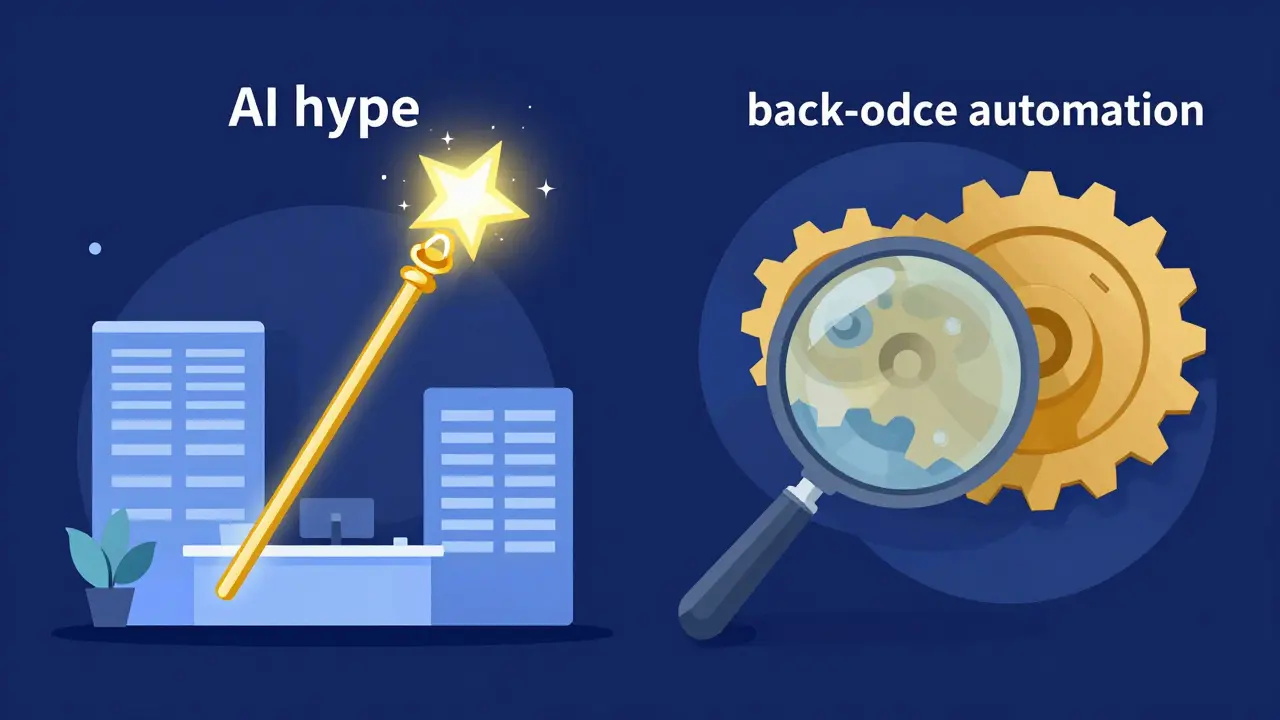
Most companies are throwing money at AI and hoping for a miracle, but the reality is that 95% of generative AI pilots fail to spark rapid revenue growth. Why? Because there is a massive gap between playing with a chatbot and actually moving the needle on a balance sheet. While the hype suggests that AI is a magic wand for profit, the data from early adopters shows that the real money isn't in the flashy customer-facing tools, but in the boring back-office automation that nobody talks about.
If you want to see a real return on investment, you have to stop treating AI as a software upgrade and start treating it as a process redesign. The difference between a failed pilot and a high-ROI implementation usually comes down to one thing: focusing on a specific, painful problem rather than trying to "digitally transform" the whole company at once.
The Reality of the AI Payoff
When we talk about generative AI ROI is the measurable financial and strategic value a business gets from deploying generative artificial intelligence solutions, we aren't just talking about saving a few hours of typing. We are talking about fundamentally changing how work gets done. In the early days of 2023, the returns were slim-around 5.9% according to the IBM Institute for Business Value-because companies were just experimenting.
Fast forward to 2025, and the landscape has shifted. Data from the Wharton 2025 AI Adoption Report shows that 82% of enterprises now use these tools weekly. More importantly, three-quarters of business leaders are finally seeing positive returns. But these gains aren't spread evenly. The winners are those who shifted from "exploring" to "executing." For instance, product development teams that followed a strict set of AI best practices reported a median ROI of 55%, proving that the method of implementation matters more than the tool itself.
Where the Money is Actually Made: Case Studies
To understand how to get a return, look at the companies that stopped guessing and started measuring. Success usually falls into two buckets: operational speed and customer experience.
Scaling Creativity at Coca-Cola
Coca-Cola didn't just use AI to write a few emails. They integrated OpenAI and DALL·E into their creative pipeline. By using these tools for campaign generation, they slashed concept development time. The result wasn't just "faster work," but the ability to launch more campaigns per quarter while keeping the brand look consistent globally. This is a prime example of generative AI ROI through increased output without increasing headcount.
Customer Support Transformation at Klarna
Klarna took a different route by deploying AI assistants to handle customer inquiries. They didn't just replace humans; they optimized the interaction. According to 2025 benchmarks from Kanerika, Klarna saw a 20-30% jump in customer satisfaction scores. When you reduce the friction in support, you don't just save on labor costs-you increase customer lifetime value and retention, which is a much harder metric to move.
The Back-Office Goldmine
While many executives are obsessed with sales tools, the highest ROI is actually found in back-office automation. This means eliminating expensive business process outsourcing (BPO) and streamlining internal operations. For example, in healthcare, tools like Abridge are reducing the administrative burden on doctors, allowing them to spend more time with patients. When a doctor spends less time on paperwork, the clinic can see more patients, directly impacting the bottom line.
| Approach | Primary Focus | Typical ROI Driver | Risk Level |
|---|---|---|---|
| Experimental/Pilot | Broad Exploration | Low (Learning value) | High (Resource waste) |
| Operational Focus | Back-office/Internal | High (Cost reduction) | Medium |
| Customer-Centric | UX/Support | Medium/High (CSAT/LTV) | Medium |
| Strategic Redesign | End-to-End Process | Extreme (New business models) | High (Complexity) |

The Pitfalls: Why Most AI Pilots Fail
If the potential is so high, why do 95% of pilots fail to accelerate revenue? The answer is usually "scope creep." Many enterprises try to solve ten problems at once, spreading their resources so thin that none of the solutions actually work. Contrast this with the high-growth startups we're seeing today-some led by 19-year-olds-who took their revenue from $0 to $20 million in a single year. Their secret? They picked one specific pain point, executed it perfectly, and partnered with the right tool providers.
Another hidden danger is the "Shadow AI" phenomenon. MLQ.ai reported in 2025 that unofficial, employee-led AI implementations often deliver better ROI than formal corporate initiatives. Why? Because the people actually doing the work know where the bottlenecks are. While a CMO might buy a fancy enterprise tool for the whole department, a single marketing specialist using a personal account might find a way to create content 3-5x faster because they are solving a real-world friction point, not a corporate KPI.

Measuring What Actually Matters
You can't manage what you can't measure. Organizations that formally track their ROI outperform those that just "feel" like they are being more productive. But you have to track the right things. Forget vague metrics like "employee happiness" as your primary KPI. Instead, focus on theseconcrete markers:
- Employee Hour Savings: Track the actual time spent on a task before and after AI. If a content piece took 10 hours and now takes 2, that's 8 hours of reclaimed capacity.
- Campaign Cycle Time: Measure the time from concept to launch. Some marketing teams have cut this by 50%, allowing for more iterations and faster market response.
- CSAT and Retention: For customer-facing AI, track Customer Satisfaction (CSAT) scores. A 20% increase here usually correlates with lower churn.
- Conversion Rates: Use AI for personalization in marketing and track if lead generation actually increases.
It's also worth noting the difference between generative and agentic AI. Generative AI is great for short-term productivity gains (summarizing a meeting, writing a draft). However, Agentic AI-AI that can actually execute multi-step tasks autonomously-requires a longer timeframe for ROI measurement because it involves redesigning entire business processes.
Steps to Secure Your AI Return
If you're starting now or trying to fix a failing pilot, follow this sequence to ensure you aren't just burning cash.
- Audit the "Boring" Work: Look for repetitive, high-volume tasks in your back office. This is where the easiest ROI lives.
- Pick One Pain Point: Do not launch a "company-wide AI strategy." Pick one specific bottleneck (e.g., "Our legal review takes 4 days") and solve it.
- Build a Measurement Framework: Define your success metric before you deploy the tool. If you can't put a dollar value on the time saved, don't do it.
- Empower the "Shadow AI" Users: Find the employees who are already using AI tools under the radar. Ask them what works and scale those specific workflows.
- Bridge to Agentic AI: Use the quick wins from generative AI to build momentum and funding for more complex, autonomous agent systems that can handle end-to-end processes.
How long does it take to see a measurable ROI from Generative AI?
For productivity-focused use cases (like content creation or coding assistance), ROI can be seen almost immediately in terms of hours saved. However, Deloitte's 2025 research suggests that for a significant, measurable financial impact on the bottom line, about 38% of organizations expect it to take up to one year. This depends heavily on whether you are just swapping a tool or changing a business process.
Is AI ROI higher for internal or external facing tools?
Surprisingly, back-office automation often yields higher and more reliable ROI than customer-facing tools. While customer-facing AI (like chatbots) can improve CSAT scores, internal-facing AI eliminates expensive outsourcing and removes operational bottlenecks, which provides a more direct and predictable financial return.
What is the biggest reason AI pilots fail?
The primary reason is a lack of focus. Many enterprises spread their budget across too many use cases (often over-investing in sales and marketing tools) without solving a specific, high-friction pain point. Successful adopters focus on one problem, execute it well, and then scale.
Does Generative AI replace human skills or enhance them?
According to Wharton's 2025 data, 89% of organizations agree that generative AI enhances employee skills. While 43% of leaders worry about skill degradation, the most successful implementations use AI to handle the "grunt work," allowing humans to focus on higher-level strategy and creativity.
What is the difference between Generative AI and Agentic AI ROI?
Generative AI ROI is typically measured by efficiency and productivity gains (e.g., doing a task faster). Agentic AI ROI is measured by cost savings from process redesign and long-term transformation, as agents can handle entire workflows autonomously rather than just assisting with a single piece of content.
Vimal Kumar
April 30, 2026 AT 20:37Spot on about the back-office stuff. Most of us just try to make a fancy chatbot for customers, but the real wins happen when you just fix the broken internal spreadsheets and boring paperwork tasks first.
Rohit Sen
May 1, 2026 AT 08:00Predictable analysis. Everyone loves the "boring back-office" narrative because it sounds pragmatic, but true disruption only happens when you redefine the customer interface entirely. The focus on operational speed is just a corporate obsession with efficiency over actual innovation.
Noel Dhiraj
May 2, 2026 AT 00:19let's get after it everyone just pick one small thing today and automate it like the post says it is the only way to actually see progress without getting overwhelmed
Amit Umarani
May 3, 2026 AT 14:00The author uses "mush" instead of "must" in the prompt guidelines, and honestly, the phrasing in the case studies section is a bit lazy. I can't even focus on the ROI claims when the writing feels this rushed.
Priti Yadav
May 5, 2026 AT 12:14Wait, you guys actually believe these corporate numbers? Please. These "case studies" are just marketing fluff to get more companies to buy into the AI bubble. If you look closer, the "Shadow AI" part is the only real truth here because the companies are just trying to track every single move we make with these tools to replace us eventually. It's all a data grab by the big tech firms to map out human cognitive processes so they can eventually phase out the middle class entirely and we are just cheering for it because we save an hour on a report. Wake up people!
vidhi patel
May 5, 2026 AT 16:29It is profoundly disappointing to observe the lack of syntactic precision in this discussion. Furthermore, the assertion that "Shadow AI" is a benefit is an egregious oversight of corporate governance and security protocols. One must adhere to strict organizational standards to ensure data integrity, regardless of the perceived efficiency gains.
Indi s
May 6, 2026 AT 03:21I feel you.