Grounding Long Documents: Summarization and Hierarchical RAG Strategies for LLMs
 Aug, 21 2026
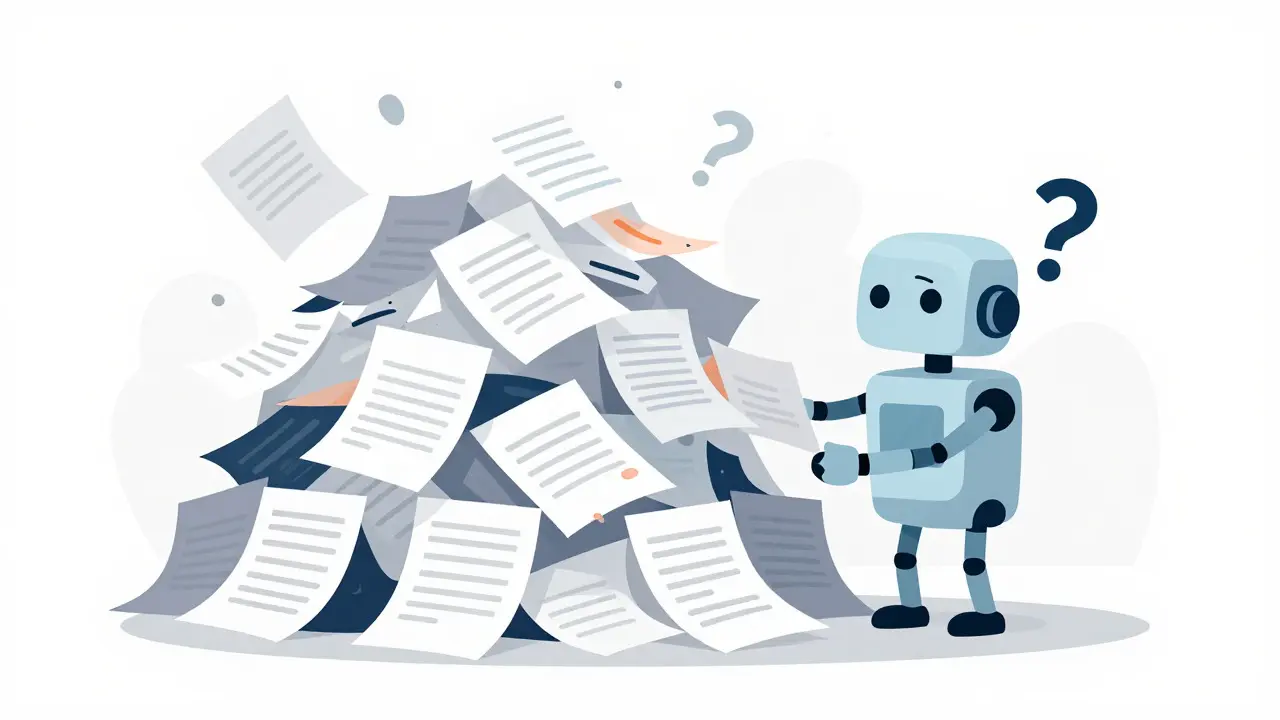
Ever tried to feed a 200-page legal contract or a dense technical manual into an LLM and got back a hallucinated summary? It’s a common pain point. Large language models struggle with context windows, and naive approaches often lead to factual drift. The solution lies in hierarchical RAG, a strategy that combines structured summarization with multi-stage retrieval to keep your AI grounded in the source material.
This isn't just about making things faster; it's about accuracy. Without proper grounding, hallucination rates can hit 27% in enterprise settings. But when you implement hierarchical retrieval and summarization pipelines, you can push factual consistency above 85%. Here’s how to build a system that actually works for long documents.
Why Naive Chunking Fails for Long Documents
Most developers start by splitting text into fixed-size chunks. It seems logical, right? You break the document down, embed each piece, and retrieve what you need. But this approach has a fatal flaw: it ignores context. A sentence like "It failed because of the protocol" is useless without knowing which protocol or which component is being discussed.
Research from Microsoft shows that simple chunking fails to maintain contextual relationships in 68% of complex technical documents. When you lose those connections, your retrieval scores drop, and your LLM starts guessing. This is where hierarchical processing steps in. Instead of treating every chunk as an isolated island, you create a map of the document’s structure, allowing the model to understand the big picture before diving into the details.
The Core Architecture: Map-Reduce and Hierarchical Summarization
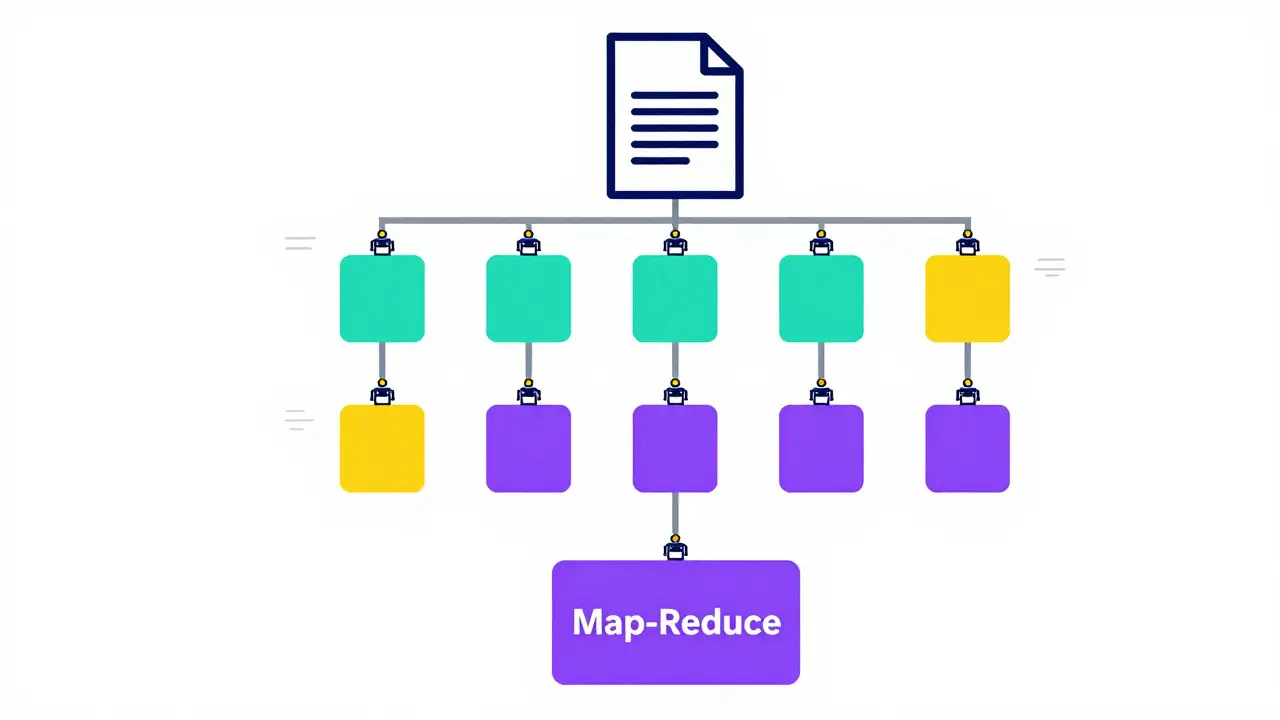
The most effective pattern for handling long documents is the Map-Reduce workflow. Think of it as parallel processing for understanding. Here’s how it breaks down:
- Map Phase: Split the document into manageable chunks (typically 1,000-2,000 tokens). Process these chunks in parallel to generate local summaries or extract key entities.
- Reduce Phase: Combine these local insights into a cohesive global summary or answer.
Google Cloud engineers report that this parallel approach is 3.1x faster than sequential refinement methods for documents over 100 pages. But speed isn’t the only benefit. By creating summaries at different levels-chunk-level, section-level, and document-level-you give the retrieval system multiple entry points. If a user asks a high-level question, the system retrieves the document-level summary. If they ask for specific details, it drills down to the relevant section or chunk.
| Strategy | Hallucination Reduction | Implementation Complexity | Best For |
|---|---|---|---|
| Naive Chunking | Low (~10%) | Low | Short, independent Q&A pairs |
| Flat RAG | Medium (~41%) | Medium | Moderate-length articles |
| Hierarchical RAG | High (>85% consistency) | High | Long, complex technical/legal docs |
Optimizing Chunking Parameters: The Sweet Spot
Getting the chunk size right is critical. Too small, and you lose context. Too large, and you waste tokens on irrelevant information. According to LangChain documentation, optimal performance is typically found at 1,000-2,000 token chunks with a 15-20% overlap.
But don’t just pick a number and hope for the best. Use semantic clustering during preprocessing. By grouping related content together before summarization, you ensure that each chunk contains a coherent thought unit. This technique, used in 73% of successful GitHub implementations, significantly reduces coherence gaps. It also helps with entity extraction, preserving cross-document relationships that flat chunking often misses.
Improving Retrieval Relevance with Query Expansion
Even with perfect chunking, retrieval can fail if the user’s query doesn’t match the document’s vocabulary. This is where query expansion comes in. Microsoft’s Azure AI Studio introduced "Query Expansion as a Service," which automatically generates 3-5 semantic variations of a user’s query. This simple step improves retrieval coverage by 37%.
Here’s a practical tip: use an LLM to reformulate queries before sending them to the vector database. While this adds 150-200ms of latency per request, it boosts relevant chunk identification by 29%. In production environments, this trade-off is almost always worth it for the accuracy gain. Pair this with tiered caching for frequently accessed content, and you can reduce overall grounding latency by up to 60%.
Implementation Roadmap: From Prototype to Production
Building a robust hierarchical RAG system takes time. Expect to spend 2-4 months on optimization if you’re aiming for enterprise-grade reliability. Here’s a realistic timeline:
- Weeks 1-2: Set up basic Map-Reduce workflow using frameworks like LangChain or LlamaIndex. Focus on getting the pipeline running end-to-end.
- Weeks 3-4: Tune chunk size and overlap parameters. Implement semantic clustering to improve coherence.
- Month 2: Integrate query expansion and evaluate retrieval relevance. Start building audit trails for compliance.
- Month 3-4: Optimize for cost-performance. Monitor latency and adjust caching strategies. Validate against benchmark datasets.
One major pitfall to avoid is over-reliance on chunk-level summarization without semantic clustering. Stanford researchers found that 31% of hierarchical summaries fail to maintain critical cross-chunk relationships in legal documents if you skip this step. Always validate your summaries against the original text to catch these gaps early.
Evaluation Metrics That Matter
How do you know if your grounding is working? Don’t just look at BLEU scores. Focus on factual consistency metrics. Google Cloud reports that their implementation achieved over 85% factual consistency compared to 62% for naive approaches. Additionally, track retrieval precision at k (R@k) to ensure the right chunks are being pulled. If your R@5 score drops below 0.8, your chunking or embedding strategy needs work.
Also, monitor hallucination rates directly. Aisera’s testing showed that RAG implementations grounded in source material reduce hallucinations by 41%. If your rate is higher, check if your retrieval is pulling in irrelevant noise. Tightening your similarity thresholds often solves this.
What is the ideal chunk size for hierarchical RAG?
The sweet spot is generally between 1,000 and 2,000 tokens with a 15-20% overlap. However, this varies by document type. Technical manuals may require smaller chunks for precision, while narrative texts might handle larger chunks better. Always test with your specific data.
How does hierarchical RAG differ from standard RAG?
Standard RAG retrieves flat chunks of text. Hierarchical RAG creates a multi-level index with summaries at the chunk, section, and document levels. This allows the system to answer both high-level questions and detailed queries more accurately by providing context-aware retrieval paths.
Is query expansion worth the added latency?
For most enterprise applications, yes. The 150-200ms latency increase is usually negligible compared to the 29% improvement in relevant chunk identification. It’s particularly valuable for domains with specialized terminology where user queries might not match document vocabulary exactly.
How do I measure the effectiveness of my grounding strategy?
Use a combination of factual consistency metrics, retrieval precision at k (R@k), and direct hallucination rate tracking. Aim for >85% factual consistency and R@5 scores above 0.8. Regularly audit a sample of responses against source documents to catch subtle errors.
Which tools are best for implementing hierarchical RAG in 2026?
LangChain and LlamaIndex remain the top choices for flexibility and community support. For managed solutions, Google Cloud Workflow and Azure AI Studio offer built-in hierarchical processing capabilities. Choose based on your existing cloud infrastructure and team expertise.