How Large Language Models Generalize: Pattern Learning vs. Explicit Reasoning
 Aug, 14 2026
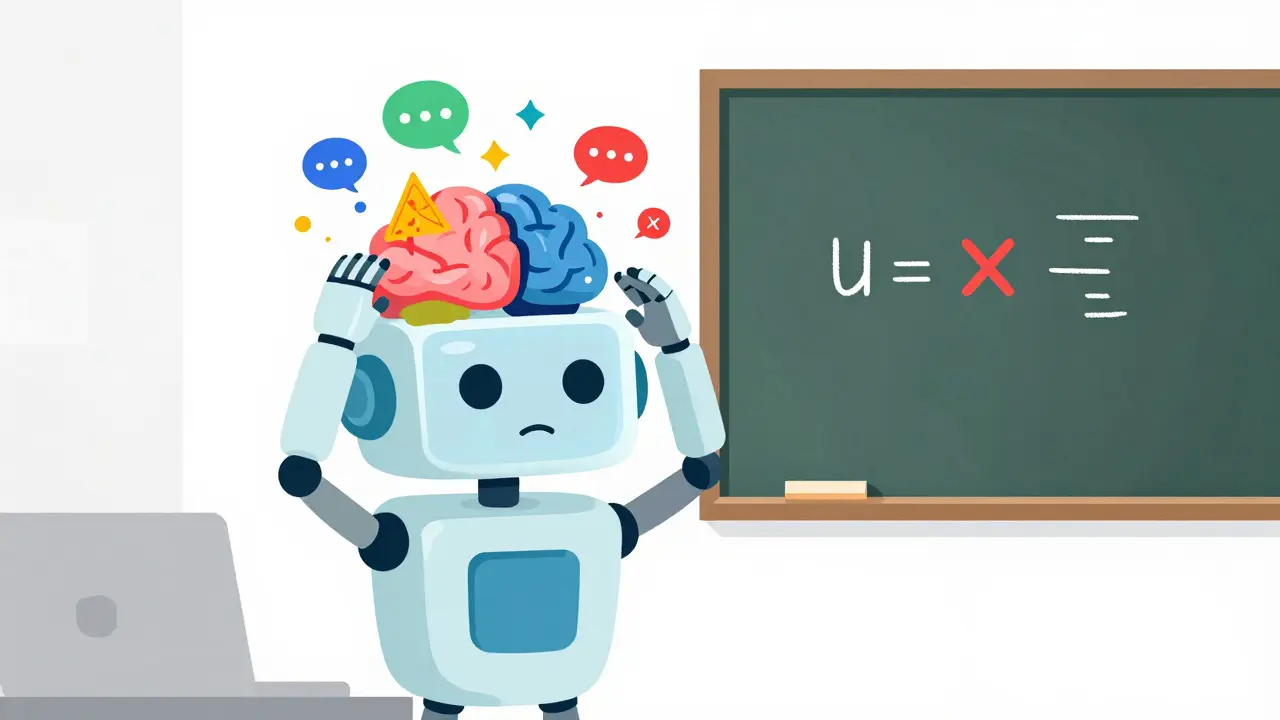
You ask a Large Language Model to solve a complex math problem, and it spits out the correct answer with step-by-step logic. It feels like the model is thinking. But is it? Or is it just really good at guessing what comes next based on patterns it has seen millions of times before? This question sits at the heart of modern artificial intelligence research in 2026. The short answer is that most current systems rely heavily on statistical pattern recognition rather than true logical deduction. However, a new class of models known as Large Reasoning Models is changing the landscape by attempting to bridge this gap.
The Illusion of Reasoning in Standard LLMs
To understand how these systems work, we first need to look under the hood of standard Large Language Models (LLMs). At their core, these are prediction engines. They analyze vast amounts of text data to learn statistical relationships between words and concepts. When you see an LLM produce a coherent argument, it is not necessarily "reasoning" in the human sense. Instead, it is identifying high-probability sequences of tokens that mimic logical structures.
Researchers often refer to this as the illusion of reasoning. The model captures correlations-like knowing that "rain" often appears near "wet ground"-without understanding the causal link. A study published in early 2025 highlighted that these models lack the rule-based symbolic logic that characterizes human cognition. They don't know *why* rain makes the ground wet; they just know that those phrases frequently co-occur in training data. This distinction matters because it explains why LLMs can sometimes fail spectacularly when faced with novel problems that require deep structural understanding rather than surface-level pattern matching.
Emergence: When Patterns Start to Look Like Logic
If LLMs are just pattern matchers, why do they seem to get smarter as they grow larger? This phenomenon is known as emergent behavior. As models scale up in terms of parameters and training data, they begin to capture more intricate and abstract patterns. What looks like random noise in a small model becomes recognizable structure in a massive one.
For example, a small model might struggle with basic arithmetic because the numerical patterns are sparse in its training set. But a model with billions of parameters, exposed to enough examples of mathematical operations, starts to internalize the rules implicitly. It doesn't have a dedicated "calculator" module, but it has learned the statistical shape of correct calculations. This scaling effect creates the appearance of reasoning capabilities that weren't explicitly programmed. However, experts caution that this is still fundamentally different from explicit reasoning. The model is still relying on associations, even if those associations are incredibly sophisticated.
Enter Large Reasoning Models (LRMs)
In response to the limitations of standard LLMs, the industry has shifted toward developing Large Reasoning Models (LRMs). Unlike traditional models that jump straight to an answer, LRMs are designed for multi-step deliberation. They generate intermediate steps, often called reasoning traces, which allow them to "think through" a problem before producing a final output.
This architectural shift represents a significant evolution. According to research from late 2025, LRMs are specifically optimized for complex tasks that require consistency over long chains of thought. Models like DeepSeek-R1 and various iterations of the Qwen series demonstrate this approach. By forcing the model to articulate its process, developers hope to reduce errors and improve generalization. Early results are promising, with some LRMs showing accuracy improvements of up to 37% on complex benchmarks compared to their non-reasoning counterparts.
Pattern Matching vs. Symbolic Logic: Key Differences
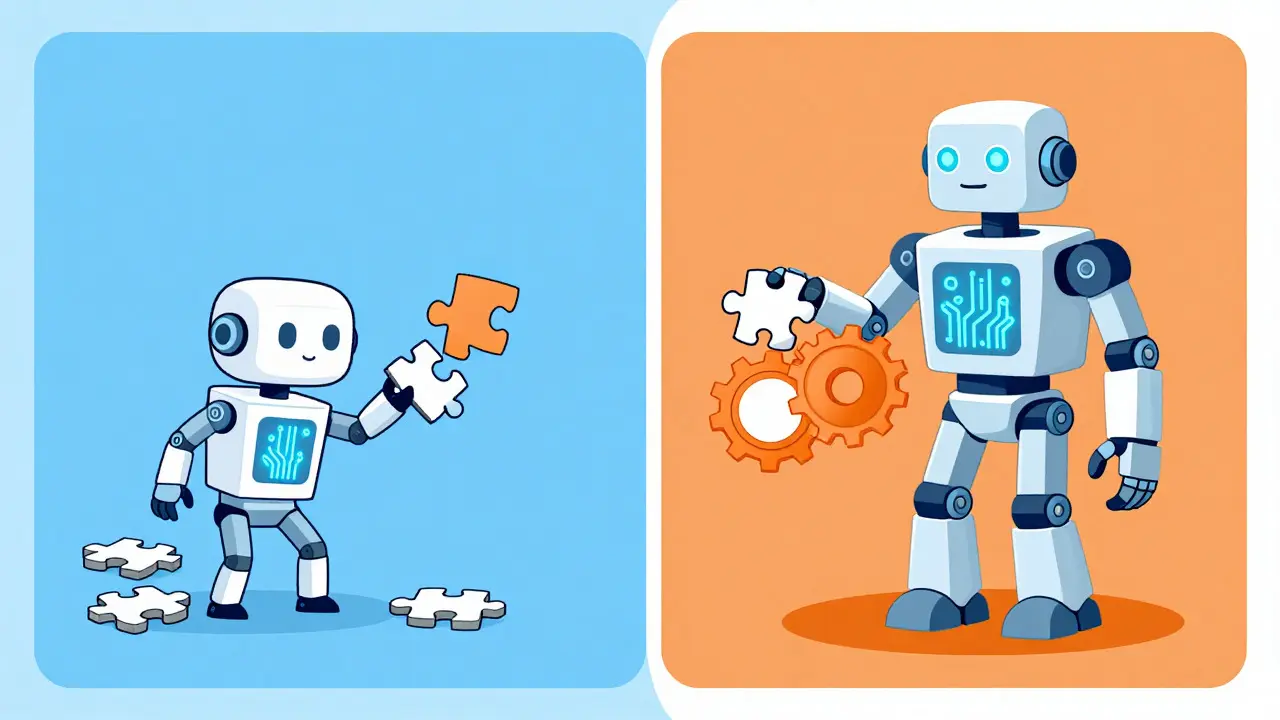
Understanding the difference between pattern learning and explicit reasoning is crucial for anyone deploying AI in critical applications. Here is a breakdown of how these two approaches compare:
| Feature | Pattern Learning (Standard LLMs) | Explicit Reasoning (Human/LRM Hybrid) |
|---|---|---|
| Mechanism | Statistical probability of token sequences | Rule-based symbolic logic and causal inference |
| Strengths | High flexibility, creative generation, broad knowledge coverage | Precision, consistency, verifiable steps |
| Weaknesses | Hallucinations, inconsistent logic, sensitive to prompt phrasing | Rigidity, slower processing, requires structured input |
| Error Type | Plausible-sounding but factually incorrect outputs | Logical contradictions or failure to follow strict rules |
| Generalization | Based on similarity to training examples | Based on underlying principles and axioms |
This table highlights why hybrid approaches are gaining traction. Pure pattern matching fails when precision is required, while pure symbolic logic struggles with ambiguity. The goal of modern AI development is to combine the best of both worlds.
Real-World Limitations and Failure Modes
Despite advancements, LRMs are not perfect. Research conducted by Apple's Machine Learning team in late 2025 revealed significant gaps in exact computation. While these models excelled at pattern-based problems with 92% accuracy, they failed 68% of the time on tasks requiring precise algorithmic execution. This inconsistency suggests that even with reasoning traces, the underlying mechanism remains probabilistic.
User feedback from developer communities corroborates these findings. In discussions throughout 2025, engineers reported that models like Qwen3-14B could enter circular reasoning loops in 34% of complex mathematical scenarios. These loops occur when the model gets stuck repeating similar logical steps without making progress. Additionally, language mixing remains a challenge. If a prompt contains multiple languages, the model may switch languages mid-reasoning chain, breaking the logical flow and reducing accuracy.
Another critical issue is computational cost. Generating detailed reasoning traces requires significantly more tokens than standard responses. On average, complex tasks using LRMs consume 2.5 to 3.7 times more compute resources. This trade-off between quality and cost forces organizations to carefully select which tasks warrant the use of expensive reasoning models versus cheaper pattern-matching alternatives.

Practical Strategies for Developers
So, how should you leverage these models effectively? First, recognize the limits of each type. Use standard LLMs for content generation, summarization, and creative writing where slight inaccuracies are acceptable. Reserve LRMs for tasks requiring multi-step logic, such as code debugging, legal analysis, or scientific hypothesis generation.
Second, optimize your prompts. Research indicates that specifying direct problem descriptions without overly complex prompting patterns can yield 29% higher accuracy on reasoning tasks. Keep instructions clear and concise. Avoid mixing languages unless necessary, and ensure that the context provided is sufficient for the model to establish relevant patterns.
Third, implement validation layers. Since no current model guarantees perfect logical consistency, critical applications should include automated checks. For example, if an LRM generates code, run unit tests automatically. If it produces a financial forecast, verify the calculations against a deterministic spreadsheet tool. This hybrid approach mitigates the risk of hallucination and ensures reliability.
The Future: Hybrid Architectures
Looking ahead, the consensus among AI researchers is that true reasoning will require architectural breakthroughs. Current neural networks alone may never replicate human-style explicit logical deduction. The next frontier involves integrating symbolic reasoning modules with neural pattern recognition. Imagine a system where a neural network handles natural language understanding and pattern identification, while a separate symbolic engine verifies logical consistency and executes precise algorithms.
Experts predict that by 2027, hybrid systems will dominate enterprise AI deployments. These systems will dynamically route tasks based on complexity and required precision. Simple queries will be handled by fast, cheap pattern matchers, while complex decisions will trigger deeper reasoning processes with built-in verification. Until then, users must remain aware of the illusion of reasoning and design their workflows accordingly.
Do Large Language Models actually think?
No, not in the human sense. They simulate thinking through statistical pattern recognition. While newer Large Reasoning Models generate intermediate steps that look like thought processes, these are still probabilistic predictions based on training data, not conscious deliberation or symbolic logic.
What is the difference between an LLM and an LRM?
An LLM (Large Language Model) focuses on predicting the next word based on patterns. An LRM (Large Reasoning Model) is designed to generate explicit intermediate reasoning steps, allowing for multi-step deliberation and better performance on complex logical tasks, though at a higher computational cost.
Why do LLMs fail at exact math problems?
LLMs rely on statistical associations rather than algorithmic execution. They can memorize common math patterns but often struggle with novel or precise calculations because they lack a dedicated computational engine. This leads to inconsistencies, especially in multi-step arithmetic where small errors compound.
Is emergent reasoning real?
Yes, emergent reasoning refers to capabilities that appear as models scale up, without being explicitly programmed. As models process more data, they capture increasingly complex patterns that mimic logical deduction. However, this is still distinct from true symbolic reasoning found in human cognition.
How can I improve the accuracy of reasoning models?
Use clear, single-language prompts and avoid unnecessary complexity. Implement validation layers such as unit tests for code or double-checking calculations. Consider using majority voting with multiple samples if the model supports it, as this can significantly boost accuracy on difficult tasks.
Jeff Falcon
August 14, 2026 AT 23:41Oh, wow. This is such a fantastic breakdown of what has been going on in the AI space for the last couple of years, really? It is incredibly interesting to see how the distinction between just pattern matching and actual reasoning is becoming more and more clear to everyone, isn't it? I mean, we have all seen those moments where an LLM just completely hallucinates something that sounds totally plausible but is factually wrong, right? And this article explains exactly why that happens, which is super helpful for people like me who are trying to understand the tech better. The part about emergent behavior was particularly eye-opening for me because I always thought bigger models were just smarter, but now I realize they are just better at finding complex patterns in the noise. It makes you wonder if we will ever truly get to a point where machines can think like humans, or if we are just creating very sophisticated parrots. Anyway, thanks for sharing this, it really helped clarify some of the confusion I had about LRMs versus standard LLMs.
Alyson Karson
August 16, 2026 AT 22:16finally someone gets it!! i am so tired of people acting like these models are magic black boxes when they are just fancy autocomplete tools lol. the stats about qwen3-14b getting stuck in loops are wild tho. like seriously 34%?? that is insane. we need to stop trusting them with critical stuff until they fix this. anyway great post keep it up! 🔥
Chris Neal
August 18, 2026 AT 08:23You're missing the nuance here. It's not just 'autocomplete'. The transformer architecture allows for attention mechanisms that capture long-range dependencies in ways that simple n-gram models never could. Sure, it's probabilistic, but the high-dimensional vector space embeddings create a geometric representation of meaning that facilitates a form of analogical reasoning. Saying it's just 'pattern matching' is a bit reductive given the mathematical underpinnings of the dot-product attention mechanism. However, I agree that without symbolic grounding, true logical deduction is absent. The Apple study cited is interesting, but sample size matters. Also, the claim about language mixing breaking logic is well-documented in multilingual NLP literature; code-switching introduces significant entropy into the token prediction distribution.
Vishnu Vardhan Reddy M S
August 19, 2026 AT 14:44Haha, look at Chris here with his big words and math talk. 'Geometric representation of meaning'? Give me a break man. You sound like you read one paper and decided you're Einstein. But hey, maybe you're right, maybe I'm just too dumb to understand the 'dot-product attention mechanism'. Whatever floats your boat, buddy. At least Jeff over there appreciates the simple explanation. Some of us just want to know if our code will work or not, not a lecture on vector spaces. 😂
Chris Neal
August 21, 2026 AT 07:34Sarcasm doesn't change the mathematics, Vishnu. If you find the technical details overwhelming, perhaps stick to high-level summaries. The point stands: dismissing the architectural complexity as mere 'autocomplete' ignores the fundamental shift in how information is processed in high-dimensional spaces. It's a subtle but critical distinction for anyone actually building systems, not just consuming content.
Kyle Ware
August 22, 2026 AT 05:34Hey guys lets keep it chill. Both points are valid in their own way. For most devs using these APIs the practical takeaway is what matters most which is that you need validation layers. I use unit tests for every code snippet generated by an LRM now and it saves me hours of debugging. Its not perfect but its better than nothing. Just remember to check your outputs especially for math or logic tasks. Hope that helps!
Iva Grekova
August 22, 2026 AT 13:33I kinda feel like we are overcomplicating this. It works mostly fine for writing emails and blog posts, which is what I use it for. I don't need it to solve quantum physics equations. The cost thing is real though, my bill went up when I started using the reasoning models for everything. Now I just switch back to the cheap ones for simple stuff. Seems like a good balance to me. No stress, just vibes.
Onyinyechi Nwosu
August 22, 2026 AT 18:51its funny how we argue about whether it thinks or not while it writes better essays than most students. i just use it to help me organize my thoughts before writing. it doesnt replace me but it helps. the hybrid approach mentioned in the post seems smart. why choose one when you can use both?
Chandan Singh
August 24, 2026 AT 15:10The future is definitely hybrid. Neural nets for the fuzzy stuff, symbolic engines for the hard constraints. We saw this coming since the Good Old-Fashioned AI days. The integration is the hard part though. Most current attempts are bolt-ons rather than native architectures. Expect major shifts in 2027 as predicted.