How to Write Clear Instructions for Large Language Models to Get Better Results
 Mar, 14 2026
Have you ever asked a large language model (LLM) a simple question and gotten a response that’s off-topic, too vague, or just plain wrong? It’s not the model’s fault-it’s usually your instruction. The truth is, how you write instructions to an LLM makes the biggest difference in what it gives back. A poorly worded prompt can lead to confusion, even if the model is powerful. A clear, well-structured one? It can unlock responses that feel almost human.
Start with clarity and specificity
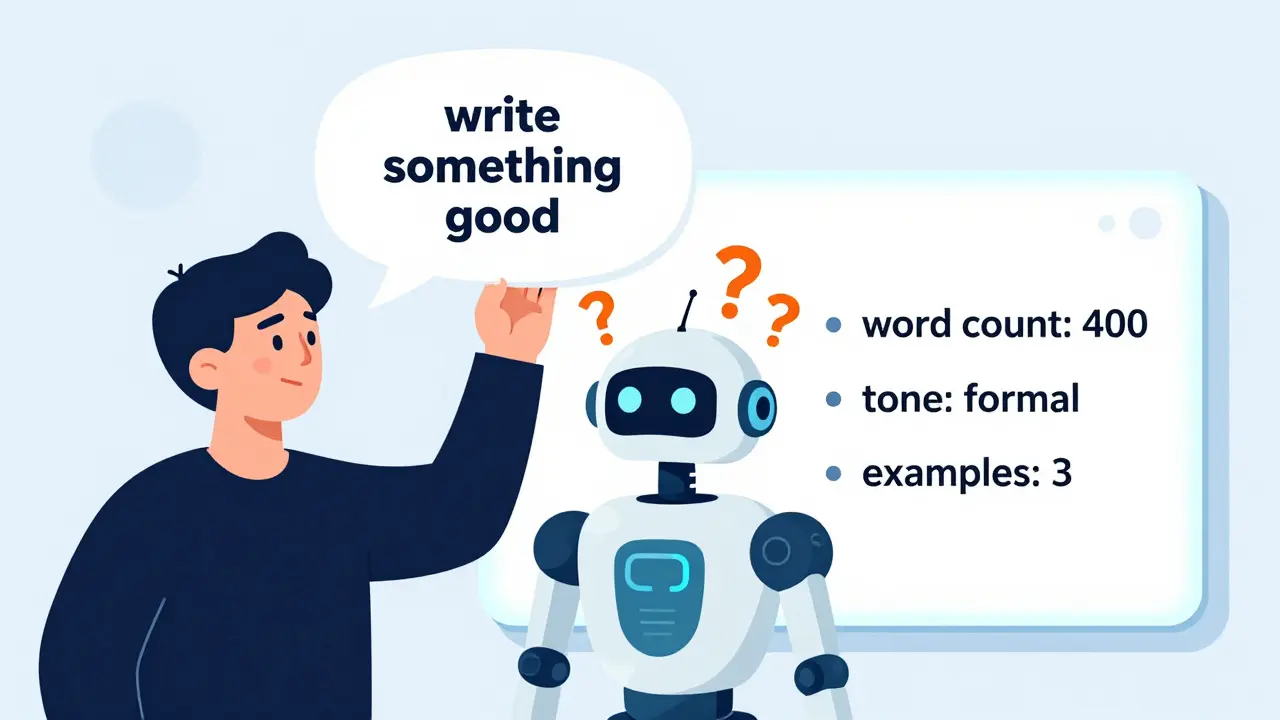
Vague instructions like "Tell me about AI" or "Write something good" don’t work. LLMs don’t read your mind. They don’t know what "good" means to you. They need exact directions. Instead of saying "Write a report," say: "Write a 400-word report on how AI is changing customer service in retail, using data from 2024. Include three real-world examples and end with a short conclusion." The more specific you are, the better the result. Mention word count, tone, format, key points to cover, and even examples of what you don’t want. If you need a formal tone, say so. If you want bullet points, say so. If you’re avoiding jargon, say that too. These details aren’t extras-they’re requirements.Use examples to show, not tell
One of the most powerful techniques in prompt engineering is giving the model an example. This is called few-shot prompting. You’re not just asking-it’s like showing. For instance, if you want the model to summarize news articles in a casual tone, give it one:- Input: "Tesla announced a 15% price cut on its Model Y in North America. Analysts say this is a response to declining demand and pressure from Chinese EV makers."
- Output: "Tesla just dropped prices on its Model Y. Looks like they’re trying to keep up with cheaper EVs from China."
Break down complex tasks into steps
When you say "Write a report, then summarize it, then make three recommendations," the model doesn’t see three steps. It sees one messy sentence. It might skip the summary or merge everything into one paragraph. Instead, structure it like this:- First, write a 500-word report on the impact of AI in healthcare in 2025. Use data from WHO and CDC.
- Next, summarize the report in 100 words.
- Finally, list three actionable recommendations for hospital administrators based on the summary.
Add constraints to guide behavior
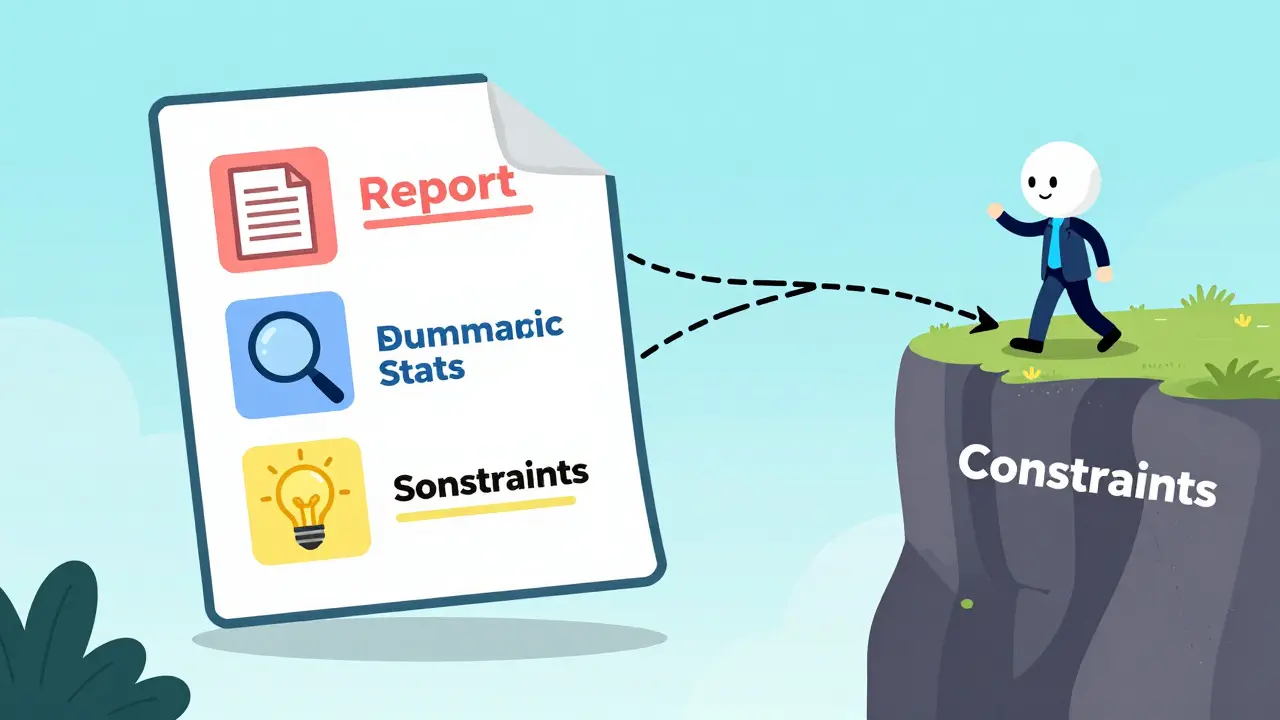
Constraints are rules that limit what the model can do. They prevent it from going off-track. Try these:- "Do not use technical terms like ‘neural network’ or ‘backpropagation.’"
- "Answer in under 150 words."
- "Do not make up statistics. If data is unavailable, say so."
- "Use only sources from .gov or .edu domains."
Refine through iteration
No one writes the perfect prompt on the first try. Even experts test, tweak, and repeat. Think of it like writing an email. You draft it, read it again, fix the tone, shorten a sentence, then send it. Prompt engineering works the same way. Start with your first version. Run it. Look at the output. Ask:- Did it miss something important?
- Is it too long or too short?
- Is the tone right?
- Did it make up information?
Provide context
LLMs don’t know your world. They don’t know your company, your audience, or your goals. You have to tell them. Instead of: "Write a customer response to this complaint." Say: "You’re a support agent at a mid-sized SaaS company that sells project management software. Your customers are mostly small business owners. They value clear, friendly replies. The customer says their workflow broke after an update. Write a reply that apologizes, explains the fix in simple terms, and offers a free 15-minute call to help them reset." Now the model knows who you are, who the user is, and what kind of response fits. Context turns generic answers into tailored ones.Let the model ask questions
Sometimes, even the best instructions aren’t enough. That’s okay. The smartest systems now let the model ask for clarification. A new approach called Ask-when-Needed (AwN) teaches LLMs to pause and say: "I’m not sure what you mean by ‘quick’-do you mean under 10 minutes or under an hour?" instead of guessing and getting it wrong. You can mimic this by adding: "If any part of this instruction is unclear, ask for clarification before responding." This turns your prompt from a one-way command into a conversation. It’s especially useful for complex tasks like coding, legal analysis, or medical summaries.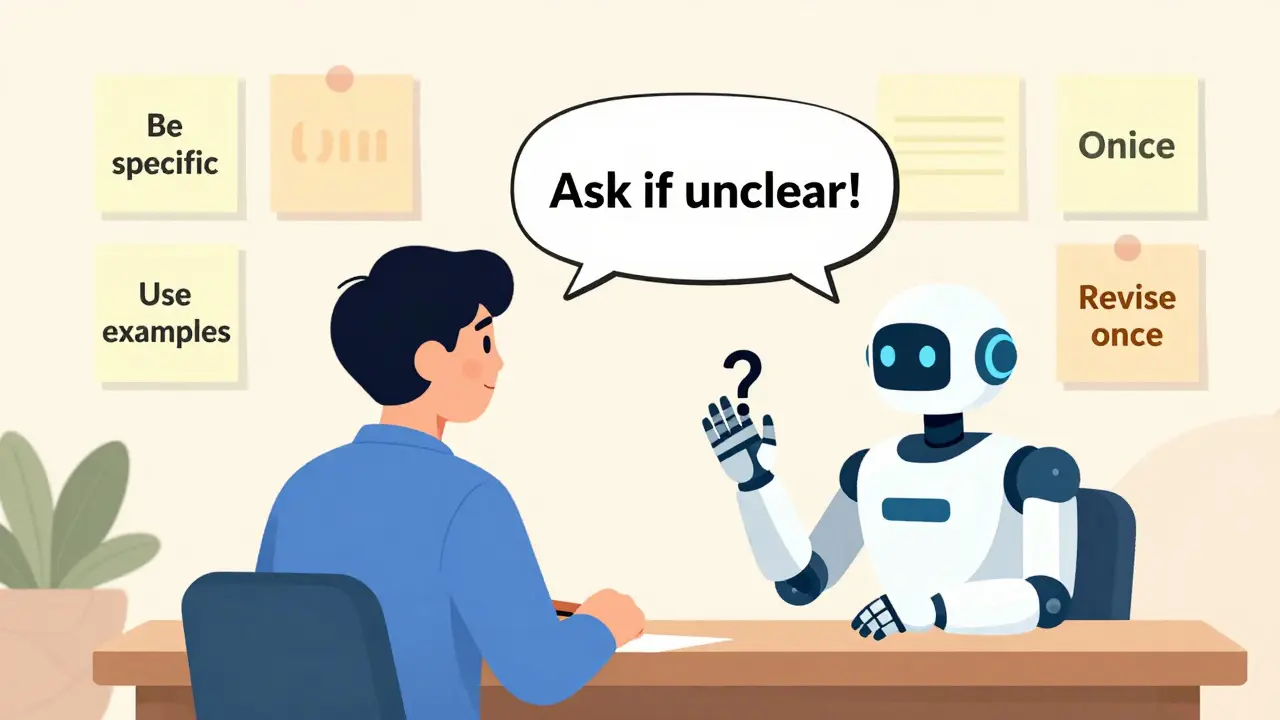
Use automated tools to scale quality
You don’t need to write every prompt by hand. Tools like MAGPIE and AgentInstruct generate millions of high-quality instruction-response pairs automatically. They don’t use random data-they use smart rewriting to create clean, consistent examples. The result? Models trained on these datasets perform better than those trained on huge, messy collections. This proves one thing: you don’t need volume-you need precision. For businesses, this means you can adapt a general-purpose LLM to your needs with just 50-100 well-written examples. No need for terabytes of internal data. Just clear instructions, good examples, and smart constraints.Final checklist for clear instructions
Before you send any prompt, run through this quick list:- Is it specific? (Not "write something"-but "write a 300-word guide for beginners on X."")
- Do I include an example? (Even one helps.)
- Are steps numbered if it’s multi-part? (Yes.)
- Are there constraints? (No jargon? No made-up stats? Word limit?)
- Is context given? (Who’s reading this? What’s the goal?)
- Can the model ask for help if unsure? (Add: "Ask if unclear.")
- Have I tested and revised it at least once? (Always.)
Why this matters
Clear instructions aren’t just about getting better answers. They’re about trust. When an LLM gives accurate, consistent, on-brand responses, people start relying on it. That’s when AI stops being a novelty and becomes a tool. The research is clear: models like LLaMA, fine-tuned on just 1,000 high-quality examples, can match or beat GPT-4 in human evaluations. That’s not magic. It’s good instruction design. Whether you’re writing customer replies, generating code, summarizing reports, or building a custom AI assistant-you’re not fighting the model. You’re guiding it. And the better your instructions, the more powerful it becomes.Why do LLMs sometimes ignore my instructions?
LLMs don’t ignore instructions-they interpret them based on patterns they’ve seen. If your prompt is vague, overly long, or lacks examples, the model fills in the gaps with guesses. It might default to common responses it learned during training, even if they don’t match your goal. The fix? Be specific, use examples, add constraints, and break complex tasks into steps.
Do I need to use technical terms like "few-shot" or "prompt engineering" to write better prompts?
No. You don’t need to know any jargon. You just need to be clear. Think of it like giving directions to a friend: "Turn left at the gas station, then go two blocks, and stop at the red door." You don’t say "execute a navigation sequence." You say what they need to do. The same applies to LLMs. Use plain language, concrete examples, and clear structure.
Can I use this for coding or technical tasks?
Yes-and it works even better. For code, include the programming language, required libraries, input/output format, and edge cases. Example: "Write a Python function that takes a list of integers and returns the second-highest number. Handle empty lists and duplicates. Use no external libraries. Include comments. Test it with [1, 5, 3, 5, 2]." This level of detail helps the model avoid common mistakes and generate working code on the first try.
How many examples should I include in a prompt?
One or two are usually enough. Too many can overwhelm the model or trigger token limits. The goal isn’t quantity-it’s clarity. A single well-chosen example that shows tone, structure, and output style often outperforms five generic ones. Research from the LIMA study shows that 1,000 high-quality examples can outperform millions of noisy ones.
What if I’m not sure what I want the output to look like?
Start with a rough version. Ask for a draft. Say: "Give me three possible formats for this response, each with a different tone." Then pick the one closest to what you need and refine it. You don’t need to have the perfect answer before you start. You need to start to find it.
Is this only for advanced users?
No. Anyone can write better prompts. You don’t need to be a programmer or data scientist. The principles are simple: be clear, be specific, give examples, and revise. Even a student, teacher, or small business owner can use these techniques to get far better results from AI tools like ChatGPT, Claude, or Gemini.
Clear instructions turn AI from a guessing game into a reliable partner. The next time you’re stuck with a bad output, don’t blame the model. Ask yourself: Did I give it enough to go on?