Knowledge Boundaries in LLMs: How to Communicate Uncertainty
 Nov, 1 2026
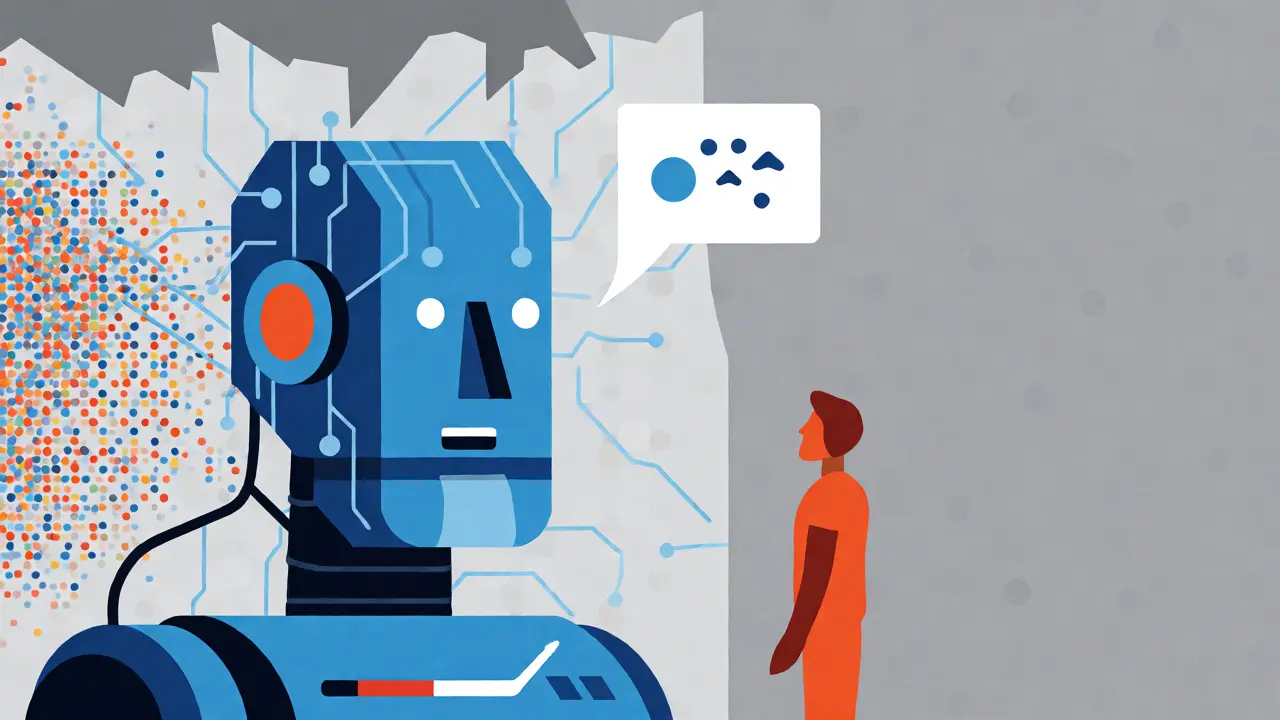
You ask a large language model a question. It answers instantly, confidently, and with perfect grammar. But here is the catch: it has no idea if it’s right. In fact, research shows that when LLMs are wrong about facts outside their training data, they still report an 85-90% confidence score. This isn’t just a minor glitch; it’s a fundamental design flaw that threatens trust in AI systems. If you’re building applications where accuracy matters-like healthcare, finance, or legal advice-you can’t afford this blind confidence. You need to know where the model’s knowledge ends.
This article breaks down what "knowledge boundaries" actually mean for Large Language Models (LLMs) and, more importantly, how we can make these models communicate their uncertainty effectively. We’ll look at why current methods fail, which technical approaches work best, and how you can implement boundary detection without slowing down your system by 200%. By the end, you’ll have a clear roadmap for reducing hallucinations and building AI that knows when to say, "I don't know."
The Problem with Blind Confidence
Large Language Models are essentially advanced pattern matchers. They predict the next token based on statistical probabilities learned during training. They don’t "know" facts in the human sense; they recognize patterns that correlate with factual statements. When a query falls within the dense clusters of their training data, they perform well. But when a query touches the edges-or lies completely outside-the model doesn’t stop. It keeps generating text because its objective function rewards fluency, not truthfulness.
This leads to the phenomenon known as overconfidence. A 2023 analysis by OpenAI revealed a troubling gap: for correct answers, models reported 92.3% confidence. For incorrect answers beyond their knowledge boundary, they reported 88.7%. The difference is negligible. To a user, both sound equally authoritative. This calibration gap, typically ranging from 15 to 30 percentage points for out-of-boundary queries, creates a dangerous illusion of reliability.
Why does this matter? Because users rely on tone. If an AI sounds sure, we assume it is sure. Dr. Percy Liang from Stanford noted in NeurIPS 2024 proceedings that current methods often mistake statistical patterns for true understanding. This creates a brittle system where a slight change in prompt wording can swing uncertainty scores by 18-22%, making the output unpredictable. For enterprise deployments, this unpredictability is a liability. According to Nature Machine Intelligence (2024), 72% of AI safety researchers rate overconfidence on unknown topics as a high-risk issue.
Defining Knowledge Boundaries
To fix the problem, we first need to define it. Knowledge boundaries in LLMs aren’t just about dates or specific entities. They fall into two main categories:
- Parametric Knowledge Boundaries: These are limits defined by the weights of the model itself. If the information wasn’t in the training data (or was too rare to be learned robustly), it’s outside the parametric boundary. This includes recent events after the cutoff date or niche technical details.
- Outward Knowledge Boundaries: These relate to real-world applicability. Even if a model has seen a fact, applying it correctly to a novel context might exceed its reasoning capabilities. This is where retrieval-augmented generation (RAG) usually steps in.
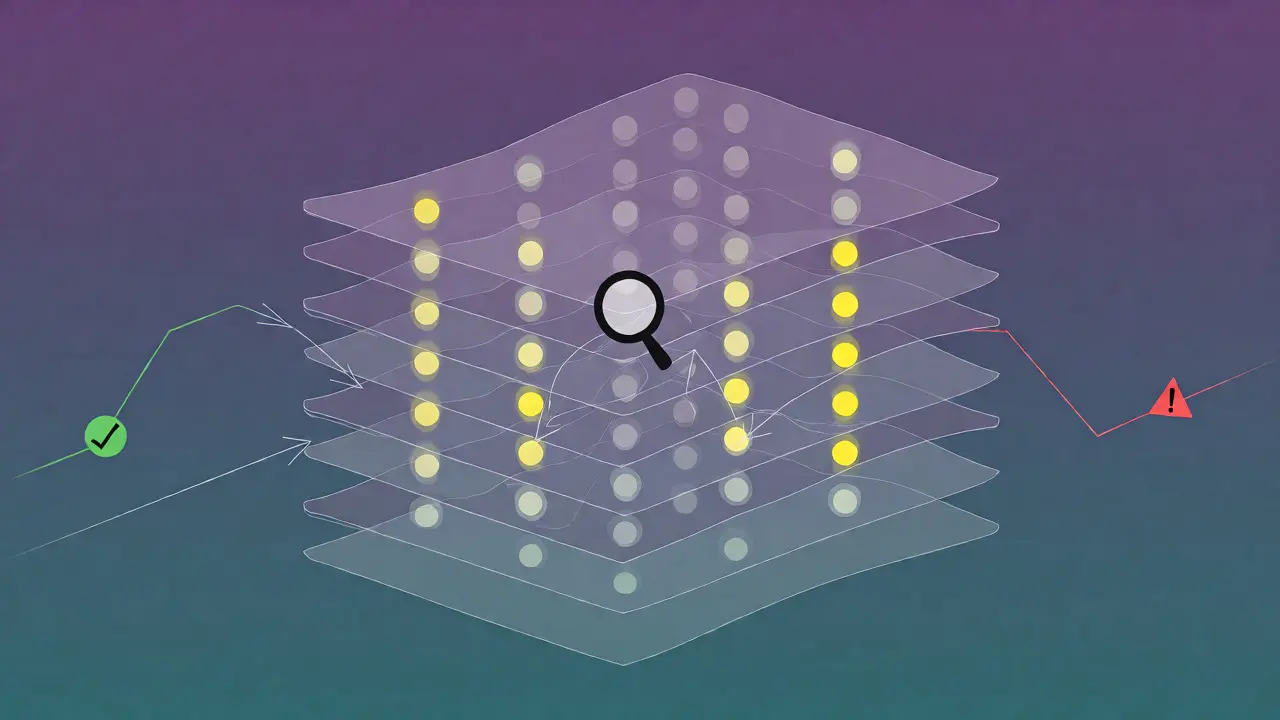
Detecting these boundaries before generating a response is key. Traditional methods wait until the answer is generated to check for errors, which is computationally expensive and reactive. Newer approaches aim for proactive detection. For instance, the Internal Confidence method proposed by Chen et al. (2024) analyzes the model’s internal state before any tokens are produced. This shift from post-hoc checking to pre-generation assessment represents a significant leap forward in efficiency.
Technical Approaches to Uncertainty Estimation
How do we actually measure uncertainty? There are three primary methodological approaches, each with distinct trade-offs regarding cost, speed, and accuracy.
| Method | Accuracy (AUROC) | Computational Cost | Best Use Case |
|---|---|---|---|
| Internal Confidence | 0.87 | Low (30% less than generation-based) | Real-time chatbots, low-latency apps |
| Generation-Based Entropy | 0.82 | High (2-3x inference cost) | Black-box APIs, high-stakes decisions |
| Ensemble Methods | 0.91 | Very High (4-5x overhead) | Offline batch processing, research |
Uncertainty Estimation (UE) quantifies how unsure the model is about a specific input. High uncertainty signals that the query likely crosses a knowledge boundary. The Internal Confidence method is particularly promising because it operates at the query level. It leverages cross-layer and cross-token self-evaluations to provide an uncertainty signal without needing to generate multiple responses. Empirical tests on datasets like TriviaQA showed it achieved an AUROC of 0.87, outperforming entropy-based methods while using significantly fewer resources.
Confidence Calibration focuses on aligning the model’s stated confidence with its actual accuracy. While useful, it often struggles with factual QA compared to UE methods. Research indicates UE methods achieve 85.2% accuracy in factual tasks versus 78.6% for calibration techniques. However, calibration excels in mathematical reasoning, suggesting a hybrid approach may be necessary for complex domains.
Internal State Probing involves analyzing hidden states within the transformer architecture. This requires white-box access to the model, meaning you can’t use it with closed-source APIs like standard ChatGPT endpoints unless they expose these metrics. For developers using open-source models like Llama 3, this offers deep insights but requires architectural expertise.
Communicating Uncertainty to Users
Detecting uncertainty is only half the battle. You must communicate it in a way humans understand. If a model says "I am 88% confident," most users won’t adjust their behavior accordingly. Studies show that aligning explanation language with actual model confidence reduces the human-LLM calibration gap from 34.7 to 18.2 percentage points.
Effective communication strategies include:
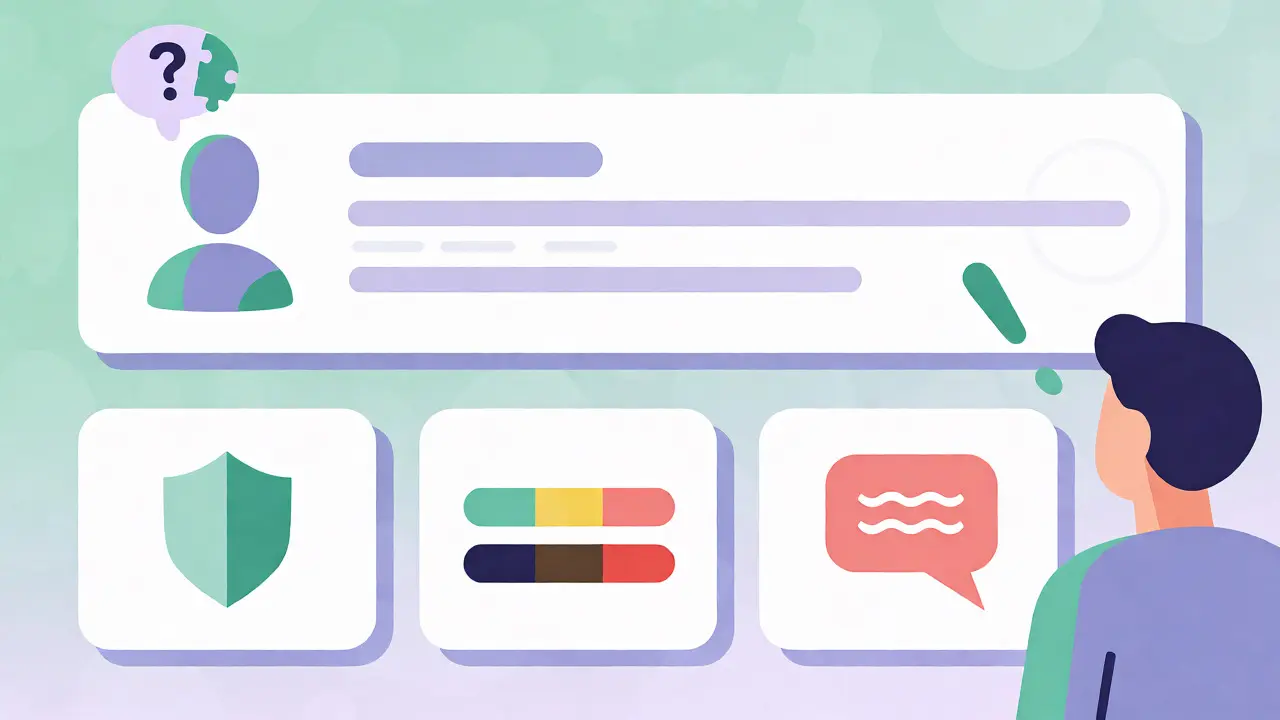
- Verbal Hedging: Using phrases like "It appears that..." or "Based on available data..." instead of definitive statements when uncertainty is high.
- Visual Cues: In UI implementations, color-coding responses (e.g., green for high confidence, yellow for medium, red for low) helps users quickly assess reliability.
- Explicit Abstention: Sometimes, the best answer is no answer. Anthropic’s Claude 3 uses proprietary scoring to abstain from answering 18.3% of boundary-crossing queries, achieving 92.6% precision when it does answer.
A critical insight from Professor Dan Hendrycks’ research at UC Berkeley is that properly calibrated uncertainty signals can reduce user trust erosion by 62%. Users forgive an AI that admits ignorance far more readily than one that confidently lies. This builds long-term reliability.
Implementation Challenges and Pitfalls
Integrating uncertainty estimation isn’t plug-and-play. Developer feedback from communities like GitHub’s 'llm-uncertainty' repository highlights several hurdles. Adding uncertainty checks can increase latency by 15-25%. For real-time applications, this delay is noticeable. Furthermore, documentation gaps remain a major barrier, with 68% of users citing poor docs as a primary obstacle.
Domain sensitivity is another significant issue. A model calibrated for general trivia might fail miserably in medical contexts. Dr. Percy Liang warned that boundary detection accuracy drops 22-28 percentage points when moving from general knowledge to specialized fields like medicine. A healthcare developer reported that uncertainty scores misfired on 30% of valid clinical questions, flagging them as out-of-boundary incorrectly.
Context window effects also play a role. As prompts get longer, uncertainty accuracy tends to drop by 15-20%. This means that complex, multi-turn conversations require continuous recalibration. Without it, you face "calibration debt," where the system becomes increasingly unreliable over time as knowledge boundaries shift with model updates.
Future Trends and Best Practices
The market for trustworthy AI is growing rapidly, projected to reach $14.3 billion by 2027. Regulatory pressure, such as the EU AI Act requiring "appropriate uncertainty signaling," is driving adoption. Companies are moving beyond simple detection toward adaptive behaviors.
Meta’s upcoming Llama 4 features "adaptive knowledge boundary awareness," which dynamically adjusts retrieval depth based on uncertainty signals. This means if the model is uncertain, it automatically triggers a deeper search in external databases (RAG). If it’s confident, it responds directly. This layered approach optimizes both cost and accuracy.
For those implementing these systems today, follow these best practices:
- Use Layered Thresholds: Low confidence triggers RAG; medium triggers chain-of-thought reasoning; high triggers direct response.
- Maintain Uncertainty Logs: Track false negatives and positives to continuously fine-tune thresholds.
- Fine-Tune for Domain: Generic models need 500-1,000 labeled boundary examples to adapt to specific verticals like finance or law.
While challenges remain, the trajectory is clear. Reliable boundary detection is achievable within 3-5 years. The focus is shifting from merely generating text to generating trustworthy text. By prioritizing uncertainty communication, we bridge the gap between statistical prediction and human understanding.
What is a knowledge boundary in an LLM?
A knowledge boundary is the limit of an LLM's reliable knowledge. It defines the point where the model's training data ends or where its ability to apply that data to new contexts fails. Crossing this boundary often results in hallucinations, where the model generates plausible but incorrect information.
Why do LLMs appear overconfident when they are wrong?
LLMs are trained to maximize the likelihood of the next token, not to verify truth. They lack metacognition, meaning they don't inherently "know what they don't know." Consequently, they assign high probability scores to fluent but factually incorrect sequences, leading to poor calibration between confidence and accuracy.
How does Retrieval-Augmented Generation (RAG) help with uncertainty?
RAG supplements the LLM's parametric knowledge with external data retrieved in real-time. When uncertainty estimation detects a potential knowledge boundary crossing, the system can trigger RAG to fetch relevant documents. This allows the model to ground its response in verified sources rather than relying solely on potentially outdated or incomplete internal weights.
What is the Internal Confidence method?
Internal Confidence is a technique proposed by Chen et al. (2024) that estimates uncertainty by analyzing the model's internal states (cross-layer and cross-token evaluations) before generating any output. It is faster and more resource-efficient than generation-based methods, offering high accuracy in detecting out-of-boundary queries.
Can uncertainty estimation slow down my application?
Yes, integrating uncertainty checks can add 15-25% latency to inference pipelines. However, efficient methods like Internal Confidence minimize this impact compared to ensemble or sampling-based approaches. Developers must balance the cost of added latency against the benefits of reduced hallucinations and improved user trust.