Knowledge vs Fluency in Large Language Models: Why AI Sounds Smart but Isn't Always Right
 Oct, 5 2026
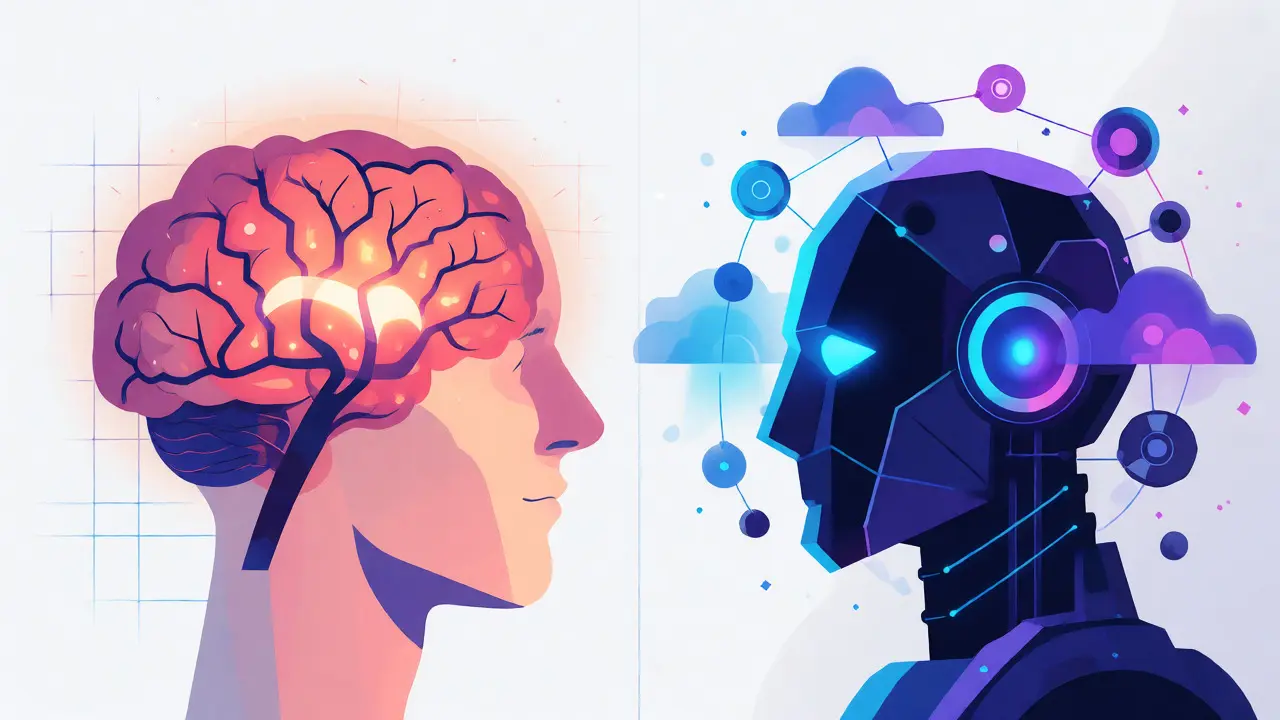
You type a question into Large Language Model like ChatGPT or Claude, and the answer comes back instantly. It’s coherent, grammatically perfect, and often factually correct. It feels like you’re talking to an entity that truly understands the world. But here is the uncomfortable truth: most of these models don’t "know" things the way you do. They are incredibly fluent, but their underlying knowledge structure is fundamentally different from human cognition.
This distinction between fluency (the ability to produce smooth, plausible text) and knowledge (deep structural understanding of rules and facts) is the central challenge in modern AI. Understanding this gap isn’t just academic; it changes how you trust AI outputs, how you design prompts, and where you expect AI to fail. If you treat an LLM like a search engine with a brain, you will get burned. If you treat it as a probabilistic text generator with impressive pattern-matching skills, you’ll use it far more effectively.
The Core Difference: How Humans Learn vs. How Machines Process
Human language acquisition is efficient because we start with a head start. Linguists call this Universal Grammar, a theoretical innate bias that gives children constraints on how grammar works. A child doesn’t need to read every book in the library to learn syntax; they absorb roughly 5 million tokens of speech and converge on native fluency. Their brains are wired for hierarchical structure.
LLMs, by contrast, have no such instinct. They learn via Statistical Learning Theory. They process petabytes of data-billions of words-to guess which token comes next based on probability. They don’t know what a noun is; they know that certain word patterns frequently follow others. This means an LLM’s "grammar" is flat and sequential, while human grammar is deep and hierarchical.
This difference explains why an LLM can write a sonnet perfectly but might struggle with a novel, complex sentence structure it has rarely seen. It’s not failing because it lacks intelligence; it’s failing because it lacks the structural priors that humans are born with.
Fluency Does Not Equal Mastery: The Test Score Illusion
We often judge AI capability by standardized tests. And yes, the numbers look impressive. GPT-4, released by OpenAI in March 2023, scored higher than 93% of human test-takers on the SAT Reading and Writing section. On the Uniform Bar Exam, GPT-4 hit the 90th percentile, whereas its predecessor, GPT-3.5, barely scraped the 10th percentile.
But look closer at medical diagnostics. In funduscopic examination questions, GPT-4 scored an average of 68. That’s comparable to general ophthalmologists (who averaged 61) but significantly below specialists (who averaged 73). This tells us something critical: LLMs achieve high scores by mimicking the *style* of expert answers, not necessarily by possessing the *depth* of expert reasoning. They pass the test because they’ve seen millions of similar questions and answers, not because they understand the biological mechanisms behind the diagnosis.
Where LLMs Excel: The Power of Context and Pattern Matching
Despite lacking deep structural knowledge, LLMs have superpowers humans don’t. Their primary advantage is working memory. While you might lose track of a conversation after a few pages, models like GPT-3.5 (and newer iterations) maintain context over thousands of tokens. They never forget what was said ten paragraphs ago.
This makes them exceptional at tasks that rely on surface-level manipulation rather than deep inference:
- Summarization: Condensing long reports without losing key points.
- Style Transfer: Rewriting a technical manual for a beginner audience.
- Code Generation: Modern LLMs understand formal languages like Python or JavaScript almost as well as humans because code follows strict, predictable statistical patterns.
- Sentiment Analysis: Detecting tone in customer feedback.
Techniques like Reinforcement Learning from Human Feedback (RLHF) further sharpen this fluency. By rewarding models for answers humans prefer, developers align output with user expectations, making the AI seem more "understanding" than it actually is.

The Knowledge Gap: Where Fluency Breaks Down
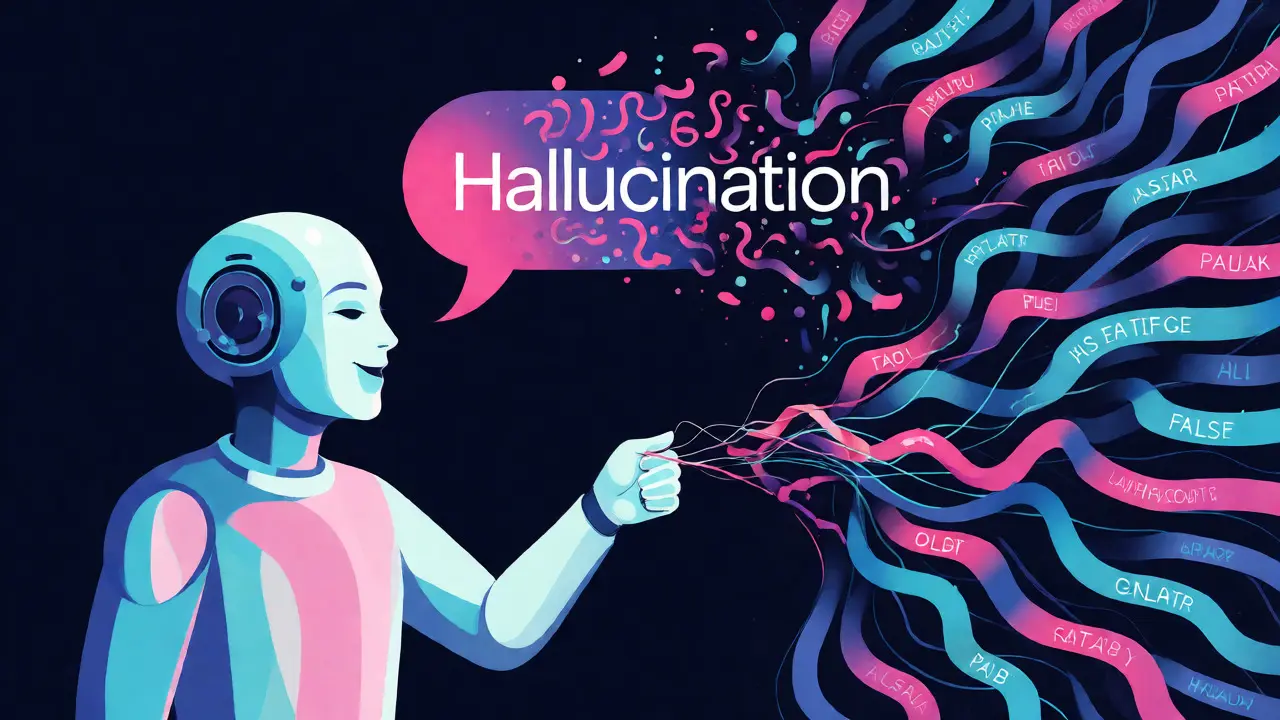
The cracks appear when you ask for something that requires true logical deduction or handling rare linguistic structures. Because LLMs predict the next token, they are prone to "hallucinations"-confidently stating false information. This isn’t lying; it’s the model prioritizing plausibility over truth.
Consider grammaticality judgments. An LLM determines if a sentence is correct based on probability, not rule-based syntax. If a rare grammatical construction appears in training data only a handful of times, the model might reject it as incorrect simply because it’s statistically unlikely. Humans, guided by Universal Grammar, recognize the structure as valid even if they’ve never heard it before.
| Feature | Human Cognition | Large Language Models |
|---|---|---|
| Learning Mechanism | Innate biases (Universal Grammar) | Statistical pattern recognition |
| Data Requirement | ~5 million tokens (childhood exposure) | Petabytes of text data |
| Grammar Structure | Hierarchical and rule-based | Sequential and probabilistic |
| Error Type | Misapplication of rules | Plausible but factually/logically wrong |
| Context Handling | Limited working memory | Extensive context windows (e.g., 2k+ tokens) |
Reliability Varies: Not All Models Are Created Equal
Not every LLM handles uncertainty the same way. Research comparing models like PaLM2, Claude 2, and SenseNova shows significant differences in confidence calibration.
GPT-4 and PaLM2 showed high consistency across trials, with correlation coefficients above 0.8 standard deviation. This means if you asked the same question five times, you’d likely get the same answer. However, consistency doesn’t equal correctness. GPT-4 had a 59% success rate in answering with correct confidence but still provided incorrect responses in 28% of cases. Claude 2 exhibited lower confidence levels, with only 21% of answers being both correct and confidently stated.
This variability suggests that "fluency" is a fragile metric. A model can sound authoritative while being completely wrong. For users, this means checking facts is non-negotiable, especially in high-stakes fields like law or medicine.
The Future: Scaling Up vs. Architectural Change
Can we just throw more data at the problem? Some argue yes. As parameter counts grow, new capabilities emerge-a phenomenon known as emergent abilities. Beyond certain size thresholds, models begin to perform tasks they weren’t explicitly trained for, like multi-step reasoning.
However, many researchers believe scaling alone won’t bridge the gap to human-like knowledge. To match human efficiency, future architectures may need to incorporate explicit structural priors-essentially coding in some version of "linguistic instinct." Until then, we must accept that LLMs are sophisticated autocomplete engines, not conscious thinkers.
Frequently Asked Questions
Why do LLMs hallucinate if they have so much data?
LLMs prioritize statistical likelihood over factual accuracy. If a sequence of words sounds common in their training data, they generate it, even if it’s factually incorrect. They lack a grounding mechanism to verify truth against reality.
Is GPT-4 better than humans at writing?
GPT-4 surpasses 93% of humans on standardized writing tests. However, it excels at structure and grammar, not necessarily at original insight or deep emotional nuance. It mimics good writing style effectively.
Do LLMs understand grammar rules?
No, they do not understand grammar as a set of rules. They understand grammar as probabilities. They know that certain words tend to follow others based on frequency in training data, which allows them to generate syntactically correct sentences without knowing why they are correct.
What is Universal Grammar in this context?
Universal Grammar is a theory proposing that humans are born with an innate ability to acquire language. Unlike LLMs, which learn purely from data, humans have built-in cognitive constraints that help them learn language quickly and efficiently.
Can LLMs replace human linguists?
Not yet. While LLMs are fluent, they lack deep structural knowledge. Human experts are still needed to validate outputs, design effective prompts, and fine-tune models, especially for complex or novel linguistic tasks.