Layered Architecture in Vibe-Coded Apps: Enforcing Separation of Concerns
 Nov, 3 2026
You asked an AI to build a feature. It did. The code runs. The tests pass. You feel like a genius for shipping it in ten minutes instead of ten hours. But six months later, you try to add one small change, and the whole thing collapses. Why? Because vibe coding is great at making things work but terrible at making them last. When you let AI agents generate code without strict architectural guardrails, you get apps that are structurally fragile. They look fine on the surface, but underneath, there is no separation of concerns. Everything is mashed together.
This isn't just about messy code. It's about a fundamental shift in how we build software. In traditional development, you design the structure first. With vibe coding-where you prompt an AI agent like GitHub Copilot or Lovable and accept its output-you often skip the design phase entirely. The AI makes architectural decisions by default. And usually, those defaults are bad for long-term maintenance. If you want your app to survive more than a few sprints, you need to force the AI to respect layered architecture. Here is how you do it without killing the speed that made you love AI coding in the first place.
The Hidden Cost of "It Just Works"
Here is the trap: AI agents optimize for local success. You ask for a login button. The AI gives you a login button. It works. But where did the logic go? Did it go into the UI component? Did it hit the database directly from the view? Did it bypass the authentication service?
Most AI models, when left to their own devices, will collapse your application into a single layer. They put business logic right inside the route handlers or React components. This creates what experts call "architectural rot." The code compiles. The user clicks the button. Nothing breaks today. But tomorrow, when you need to swap out your database provider or add a new payment gateway, you realize the logic is tangled with the presentation. You can't test the logic because it's trapped inside the UI. You can't reuse the logic because it depends on the specific framework of the frontend.
This is systemic dysfunction hidden behind working features. The AI doesn't see the forest; it only sees the branch it's typing on. It doesn't know that your team agreed to keep data access strictly in the repository layer. It doesn't know that mixing API calls with state management in the same file will make debugging a nightmare next quarter. Without explicit instructions, the AI assumes simplicity equals good code. In reality, simplicity without structure equals technical debt.
Why AI Agents Ignore Your Boundaries
To fix this, you have to understand why the problem happens. AI coding assistants are trained on millions of lines of code. A lot of that code is tutorials, quick-start guides, and hackathons. In those contexts, putting everything in one file is perfectly fine. The AI learns that pattern. So when you ask it to "build a user profile page," it retrieves the most common pattern it knows: a big component that fetches data, formats it, and displays it all in one go.
Mark Russinovich and Scott Hanselman highlighted this issue during Microsoft's BUILD conference. They pointed out that developers still need to understand complexity theory and design principles to guide these agents. If you don't tell the AI where boundaries exist, it won't create them. It treats your entire codebase as a flat namespace. It doesn't respect domain boundaries unless you explicitly define them in your prompt or your project configuration.
This is especially dangerous in existing codebases. If you drop an AI agent into a legacy app with a clear layered structure, it might not recognize the pattern. It sees files, not architecture. It might write new code that ignores the existing service layer, creating a hybrid mess where some features follow the rules and others don't. This inconsistency is harder to maintain than if the whole app were messy, because now you have two different mental models fighting each other.
Enforcing Layers Through Prompt Engineering
You can't just hope the AI gets it right. You have to enforce it. Think of the AI as a very fast, very eager junior developer who has never seen your company's style guide. You wouldn't hand them a ticket and say, "Make this work." You'd say, "Put the validation in the Service class, use the Repository interface for data access, and keep the Controller thin." You need to give the AI the same level of detail.
Stop using vague prompts. Instead of "Add a delete user feature," try this:
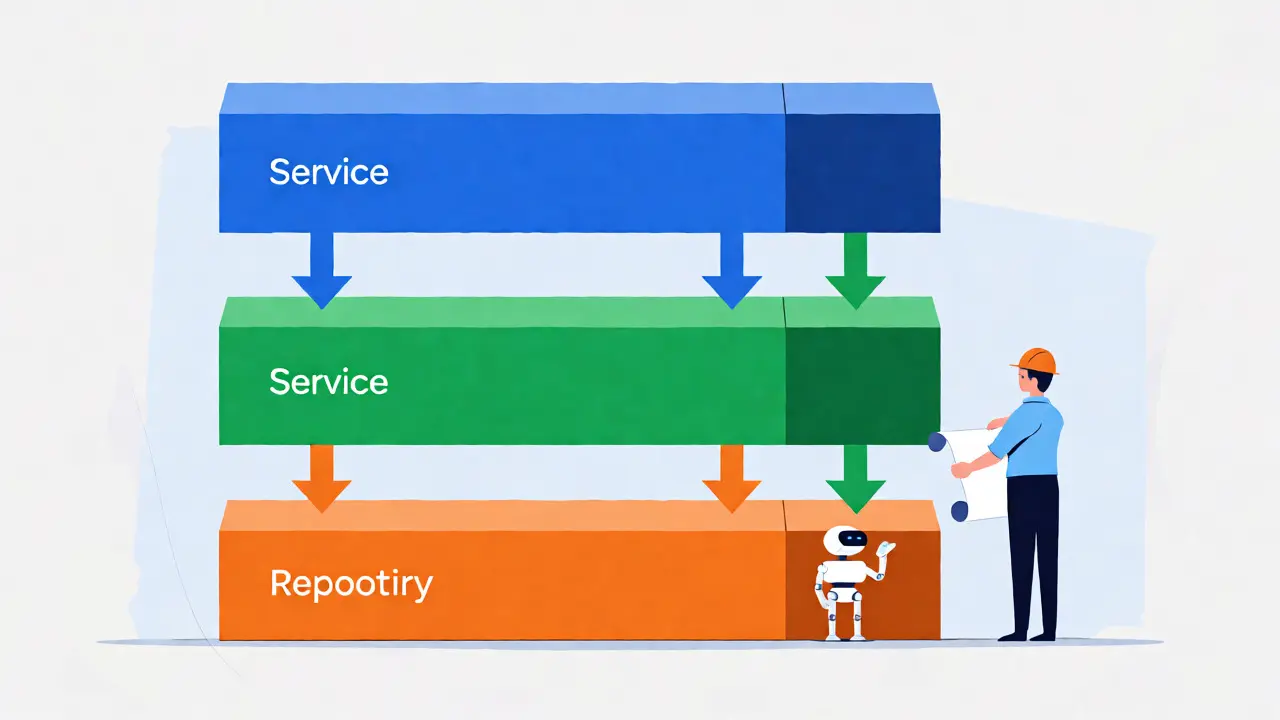
- Controller Layer: Handle HTTP request/response. Do not include business logic.
- Service Layer: Validate input, check permissions, orchestrate the deletion.
- Repository Layer: Execute the SQL query or ORM call to remove the record.
- Constraint: Ensure dependencies flow downward (Controller -> Service -> Repository). No upward calls.
By spelling out the layers, you constrain the AI's creativity to the paths you approve. You're not micromanaging syntax; you're defining the contract. Some advanced setups even allow you to feed the AI your architecture diagram or a set of linting rules. Tools like Cursor or Windsurf can ingest context files. Put your architectural rules in a file named ARCHITECTURE.md and tell the AI to read it before generating code. This keeps the constraints persistent across sessions.
Practical Strategies for Separation of Concerns
How do you actually implement this in day-to-day vibe coding? Here are three concrete tactics that work well in practice.
1. The Skeleton First Method
Don't let the AI write the implementation immediately. Ask it to scaffold the structure first. Generate empty classes, interfaces, and folder structures that match your desired layers. Once the skeleton exists, the AI is forced to fill in the blanks within those boundaries. It's much harder for an AI to dump logic into a controller if the controller file is already defined as having only three methods: get(), post(), and delete(), with no imports for database libraries.
2. Dependency Injection as a Guardrail
If you use dependency injection (DI), leverage it. Force the AI to inject services rather than instantiating them directly. If the AI tries to import a database driver directly into a UI component, your DI container setup will likely throw an error or fail linting. Make your linter strict. If the AI generates code that violates your import rules (e.g., importing a heavy library in a lightweight module), catch it automatically. The AI learns from errors. If it fails the lint check, it will regenerate the code to fit the rule.
3. Test-Driven Prompts
Ask the AI to write the unit test before the implementation. If you ask for a test that mocks the repository, the AI realizes the service must depend on the repository interface, not the concrete class. This naturally enforces separation. If the AI writes a test that requires spinning up a full database to test a simple calculation, you know the layers are leaking. Reject that approach and refine the prompt.
Greenfield vs. Legacy: Different Rules Apply
Your strategy changes depending on whether you're starting fresh or adding to an existing system.
| Scenario | Risk Profile | Best Approach |
|---|---|---|
| Greenfield (New App) | High risk of chaotic initial structure. Easy to pivot early, hard to fix later. | Define the folder structure and naming conventions upfront. Use the AI to generate boilerplate for all layers simultaneously to ensure consistency. |
| Legacy (Existing App) | High risk of breaking existing contracts. AI may ignore established patterns. | Provide examples of existing correct code. Ask the AI to mimic the pattern of similar features already in the codebase. Strictly limit scope to one layer per task. |
In greenfield projects, you have the luxury of setting the standard. Do it in the first hour. Decide: "We are using Clean Architecture." Then, never deviate. In legacy projects, the AI is a guest in someone else's house. It needs to follow the host's rules. Always point the AI to an existing file that demonstrates the correct pattern. Say, "Look at UserService.ts for how we handle validation, then apply the same pattern to OrderService.ts."

The Human Role: Architect, Not Typist
Vibe coding doesn't eliminate the need for architects. It shifts the role. You are no longer writing every line of glue code. You are designing the constraints. You are deciding where the boundaries lie. If you abdicate this responsibility to the AI, you lose ownership of the system.
Remember, the real architecture isn't in the code itself. It's in the agreements between developers. Where does state live? Who owns the transaction? What happens when the network fails? These questions aren't answered by autocomplete. They require human judgment. The AI can implement your decision, but it cannot make it for you.
Treat the AI like a powerful tool, not an autonomous architect. Review the generated code not just for bugs, but for structural integrity. Does this new function belong here? Does this import cross a boundary? If you find yourself asking these questions after the code is written, you waited too long. Ask them before you accept the diff.
Conclusion: Speed Without Structure Is Debt
Vibe coding offers incredible velocity. But velocity without direction is just chaos. By enforcing layered architecture through explicit prompts, scaffolding, and automated checks, you can keep the speed while protecting the structure. Don't let the convenience of "it works" blind you to the fragility of "it fits." Build the walls first, then let the AI paint the rooms.
What is vibe coding?
Vibe coding is a development style where programmers use AI agents to generate large portions of code based on natural language prompts, focusing less on manual syntax and more on high-level intent and rapid iteration.
Why does AI-generated code often lack separation of concerns?
AI models are trained on diverse codebases, including many tutorials and prototypes where simplicity is prioritized over scalability. Without explicit instructions, they default to placing logic wherever it is most convenient for the immediate task, often collapsing distinct architectural layers into single files or components.
How can I enforce layered architecture with AI tools?
You can enforce layers by providing detailed prompts that specify responsibilities for each layer, using scaffolding techniques to create empty structures first, leveraging strict linting rules to catch boundary violations, and requiring unit tests that mock dependencies to prove isolation.
Is vibe coding suitable for enterprise applications?
Yes, but only with strict governance. Enterprise apps require maintainability and security. Vibe coding works best when combined with strong architectural guidelines, automated testing, and human review to ensure the AI-generated code adheres to complex system requirements.
What is the biggest risk of ignoring architecture in AI-coded apps?
The biggest risk is technical debt that compounds silently. The app appears functional initially, but as features grow, the lack of separation makes changes risky and expensive. Eventually, the system becomes impossible to modify without breaking unrelated parts, leading to rewrite scenarios.