LLM Output Calibration Across Languages: Improving Non-English Accuracy
 Jul, 28 2026
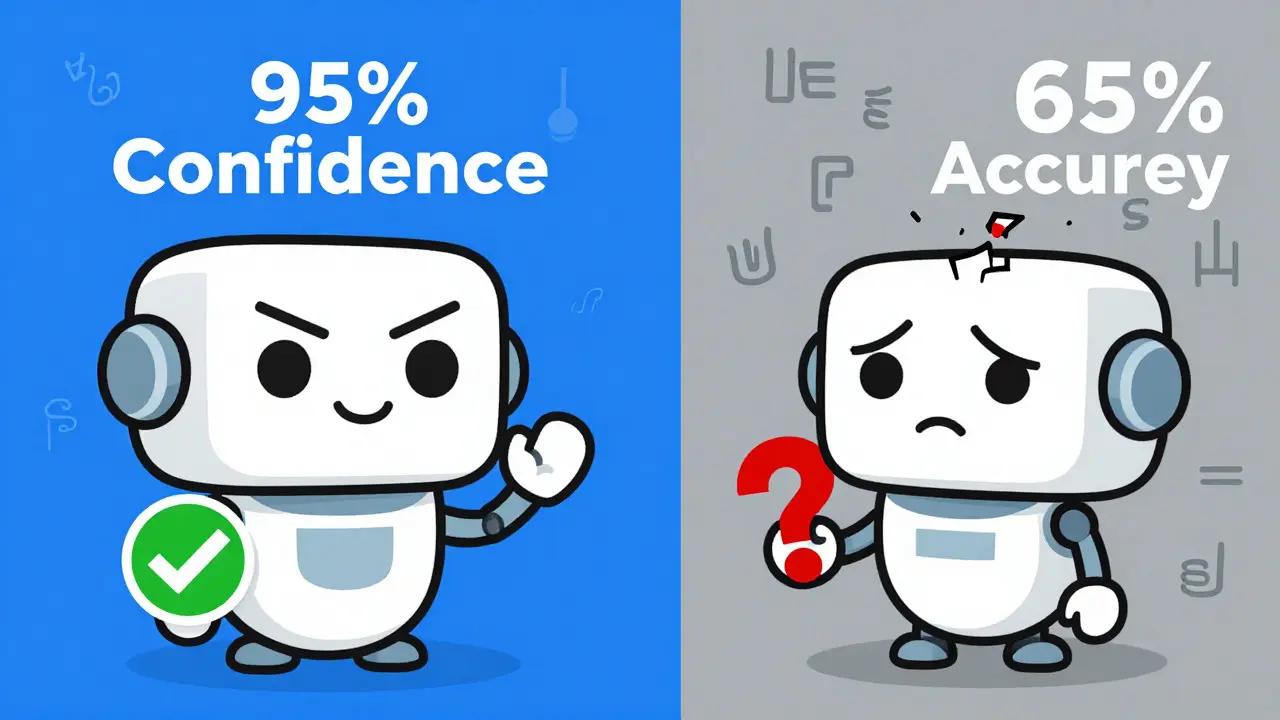
You ask a large language model a question in Spanish, and it answers with 95% confidence. But when you check the facts, the answer is wrong. This isn't just a glitch; it's a systemic failure known as LLM output calibration, which refers to the alignment between a model's stated confidence and its actual probability of being correct. For English speakers, this gap is narrowing. For users speaking Swahili, Vietnamese, or Guarani, the gap is a chasm.
We are entering an era where AI handles high-stakes decisions in healthcare, law, and finance across the globe. If a model says it is "sure" about a diagnosis in French but is actually guessing, the consequences are severe. The core problem? Most models are trained on data that is overwhelmingly English-centric, leading to overconfidence in languages they barely understand. Here is how we fix it, why it matters for your deployment, and what the latest research tells us about making non-English outputs reliable.
The Confidence Trap in Multilingual Models
Let’s look at the numbers. A pivotal 2023 study published on OpenReview tested 14 multilingual LLMs across 42 languages. The results were stark. For English, the Expected Calibration Error (ECE) averaged a manageable 5.2%. But for low-resource languages, that error jumped to 18.7%. In some cases, like Guarani and Rohingya, ECE exceeded 25%.
What does an ECE of 25% mean in practice? It means when the model says it is 90% confident, it is only right 65% of the time. That is not a tool; that is a hallucination engine dressed up as an expert. The root cause is simple: data asymmetry. Models like mT5, XLM-R, and BLOOM ingest corpora where English makes up 60-90% of the text. When training data drops by an order of magnitude-for example, from 1.5 billion tokens for Spanish to 15 million for Swahili-calibration error increases by 2.3x.
This isn't just about vocabulary size. It's about structural understanding. Professor Graham Neubig’s team at Carnegie Mellon University found that non-English models often rely on "spurious correlations." They spot patterns in the input text that happen to match the label in the training set but have no semantic meaning. In English, these patterns might be rare. In other languages, especially those with complex morphology like Turkish, they are rampant.
Why Architecture Matters for Calibration
Not all models fail in the same way. The type of architecture you choose significantly impacts how well you can calibrate outputs. The OpenReview study highlighted a clear winner: decoder-only models.
Decoder-only architectures, such as Llama-2-7B, showed 18.3% better calibration after in-context learning on multilingual data compared to encoder-decoder models. Why? Decoder-only models are designed to generate text sequentially, forcing them to build context step-by-step. Encoder-decoder models, while great for translation tasks, sometimes shortcut the reasoning process, leading to higher overconfidence in ambiguous non-English queries.
Model size also plays a role. Larger models generally calibrate better. A 7B-parameter model achieved 14.2% lower ECE than a 1B-parameter model across non-English languages. However, size alone isn't a silver bullet. Even the largest models exhibit consistent degradation patterns if the training data lacks linguistic diversity.
| Language Category | Example Language | Training Tokens | Avg. ECE Score | Risk Level |
|---|---|---|---|---|
| High-Resource | Spanish | 1.5 Billion | ~6.5% | Low |
| Medium-Resource | Vietnamese | 200 Million | ~12.0% | Moderate |
| Low-Resource | Swahili | 15 Million | ~18.7% | High |
| Very Low-Resource | Guarani | <1 Million | >25.0% | Critical |
Practical Methods to Improve Non-English Accuracy
If you are deploying a multilingual model, you cannot ignore calibration. Here are the most effective techniques currently available, ranging from easy fixes to complex architectural changes.
1. Label Smoothing During Fine-Tuning
This is one of the most accessible methods. Instead of telling the model the answer is definitely "A" (probability 1.0), you tell it it's "mostly A" (probability 0.9). This prevents the model from becoming overly confident during training. Huang et al. recommended smoothing factors between 0.1 and 0.3 in their March 2024 paper.
The results are promising but uneven. Label smoothing reduced calibration error by 22.4% for Romance languages like Spanish and Italian. However, it only helped by 8.7% for Niger-Congo languages. This suggests that while the technique works, it needs to be tailored to specific language families.
2. Temperature Scaling
Temperature scaling is a post-hoc method. You don't retrain the whole model. Instead, you adjust the output probabilities by dividing the logits by a temperature parameter. It requires only 100-500 labeled examples per language.
This method shines for Indo-European languages, showing 31.6% better performance than Sino-Tibetan languages. However, it struggles with tonal languages like Thai, where subtle contextual nuances are critical. If your application involves Asian languages, temperature scaling alone may not be enough.
3. The APRICOT Method
For companies using black-box APIs (like Google Cloud or Azure AI) where you can't access the model internals, APRICOT is a game-changer. It trains an auxiliary confidence predictor using only the textual inputs and outputs. No model weights needed.
In tests on the XQuAD benchmark, APRICOT achieved a competitive Brier score of 0.186. It underperformed by 12.3% on tonal languages, but for general business applications, it offers a practical path to calibration without expensive retraining.
4. Venn-Abers Predictor (IVAP)
For binary classification tasks (yes/no questions), the IVAP approach is superior. Detailed in a February 2024 publication, it demonstrated 38.7% lower calibration error than temperature scaling on the BoolQ dataset using Llama-2-7B. The trade-off? Latency. Dr. Clara Meister’s team at EPFL noted that IVAP adds approximately 12ms per prediction. For real-time chatbots, this is negligible. For high-frequency trading algorithms, it might be a dealbreaker.
Implementation Costs and Operational Realities
Calibration isn't free. It costs compute, time, and money. Let’s break down the real-world impact.
To improve calibration by 19.3% across 24 languages, the OpenReview study suggested incorporating 500-1,000 translated samples during fine-tuning. On an NVIDIA A100 GPU, this adds roughly 2-3 hours of training time for a 7B-parameter model. That sounds cheap until you multiply it by the number of languages you support.
Then there is the human element. CMU SEI researchers warn that when calibration error exceeds 20%, human-in-the-loop verification becomes necessary. This happens for 68% of non-English languages in standard models. Based on AWS Mechanical Turk pricing from Q4 2023, this verification layer increases operational costs by $3.20 to $5.70 per 1,000 queries. For a startup handling millions of queries, that adds up quickly.
However, the cost of *not* calibrating is higher. Poorly calibrated models cause 22.3% more errors in non-English contexts compared to English, according to IEEE experts. In legal or medical domains, those errors can lead to liability issues that dwarf any training costs.
The Industry Shift Toward Calibrated AI
The market is waking up to this issue. Gartner predicted that by 2025, 70% of enterprise LLM deployments would require formal calibration metrics. We are already seeing this play out.
Google released the CALM framework for PaLM 2 in 2023, reducing ECE by 23.5% across 100+ languages. Meta’s Llama-3 multilingual variant, announced in July 2024, incorporates language-specific label smoothing. Microsoft integrated multilingual calibration metrics into its Responsible AI dashboard in June 2024.
Yet, a gap remains. An independent test by the Model Evaluation Consortium in February 2024 found that only 12% of commercial multilingual LLM APIs provide calibrated confidence scores for non-English languages. If you are buying an API today, do not assume the confidence score is accurate. Test it yourself.
Future Directions: Dynamic Calibration
Research is moving toward dynamic solutions. Instead of static calibration parameters, future models will adjust based on "language distance." Using ISO 639-3 codes, systems can calculate phylogenetic distance between the query language and the model's strongest languages. Preliminary results show 14.2% better calibration when adjusting for family proximity.
CMU SEI is also developing input monitoring techniques that flag low-confidence outputs by measuring semantic similarity using LASER embeddings. This system achieves 89.7% precision in identifying poorly calibrated responses, allowing you to route uncertain queries to humans automatically.
What is Expected Calibration Error (ECE)?
ECE measures the difference between a model's predicted confidence and its actual accuracy. If a model predicts 100 instances with 80% confidence, but only 60 are correct, the ECE is 20%. Lower ECE means the model knows what it doesn't know.
Why are non-English languages harder to calibrate?
Most training data is English-dominant. Low-resource languages have fewer tokens, leading to spurious correlations and overconfidence. Structural differences, like tone in Thai or morphology in Turkish, also challenge standard calibration methods.
Can I calibrate a black-box API model?
Yes. Methods like APRICOT allow you to train an external confidence predictor using only input/output pairs. This is ideal for commercial APIs where you lack access to internal model weights.
Which architecture is best for multilingual calibration?
Decoder-only models like Llama-2 show 18.3% better calibration after in-context learning compared to encoder-decoder models. They handle sequential context generation more reliably for diverse languages.
How much does calibration increase latency?
Advanced methods like the Venn-Abers Predictor (IVAP) add approximately 12ms per prediction. For most real-time applications, this is negligible, but it should be considered for high-throughput systems.
Chandan Singh
July 29, 2026 AT 10:15People always forget that the real issue isn't just the language, it's the tokenization.
If your tokenizer breaks down a Swahili sentence into garbage subwords because it was trained on English Wikipedia, no amount of label smoothing is going to fix the semantic drift. You're trying to calibrate a model that literally doesn't understand the syntax structure. It's like trying to tune a piano with missing strings. The data asymmetry mentioned in the post is real, but the architectural bias against agglutinative languages is the silent killer here.
Brannen Hall
July 30, 2026 AT 20:49This whole calibration thing is overblown.
Most people don't care if the model says it's 95% sure or 65% sure as long as the answer looks right. We are spending millions on fixing confidence scores for languages that barely have an internet presence. Let the models hallucinate, humans will figure it out. Efficiency matters more than accuracy in these edge cases.
tiffany King
August 1, 2026 AT 04:30I think this is such a crucial step forward!
We've been ignoring non-English speakers for too long in AI development. It gives me hope to see companies like Google and Meta actually releasing frameworks to address this. If we can make AI safer for everyone, not just English speakers, we are building a much fairer future. Keep pushing for this!
Brenna Gonedrman
August 3, 2026 AT 02:06Wow, I had no idea it was this bad.
I thought AI was just smart everywhere. So when it speaks Spanish it's okay but when it speaks Guarani it's basically lying? That is terrifying. Imagine getting medical advice in a language you speak and the computer is just guessing. We need better laws about this before someone gets hurt. This needs to be fixed yesterday.
Courtney Wagstaff
August 4, 2026 AT 21:29The APRICOT method sounds like a lifesaver for those of us stuck using black-box APIs.
I've been wrestling with inconsistent outputs from Azure AI for months. Knowing there's a way to slap an external predictor on top without retraining the whole beast is music to my ears. Though, honestly, adding 12ms latency might kill our real-time chatbot vibe, but maybe worth it for accuracy. Gonna try tinkering with that auxiliary predictor this weekend.
Elisabeth Ballet
August 5, 2026 AT 14:49Let's get one thing straight: if you are deploying this in healthcare or law, you cannot cut corners.
@Brannen Hall calling this 'overblown' is dangerous thinking. When a model has an ECE of 25%, it is actively misleading users. We need to push for mandatory calibration metrics in all enterprise deployments. Don't let the tech giants off the hook just because their primary market is English-speaking. Demand transparency now!