LLM Prompt Retention and Deletion Policies: A Practical Guide
 Nov, 25 2026
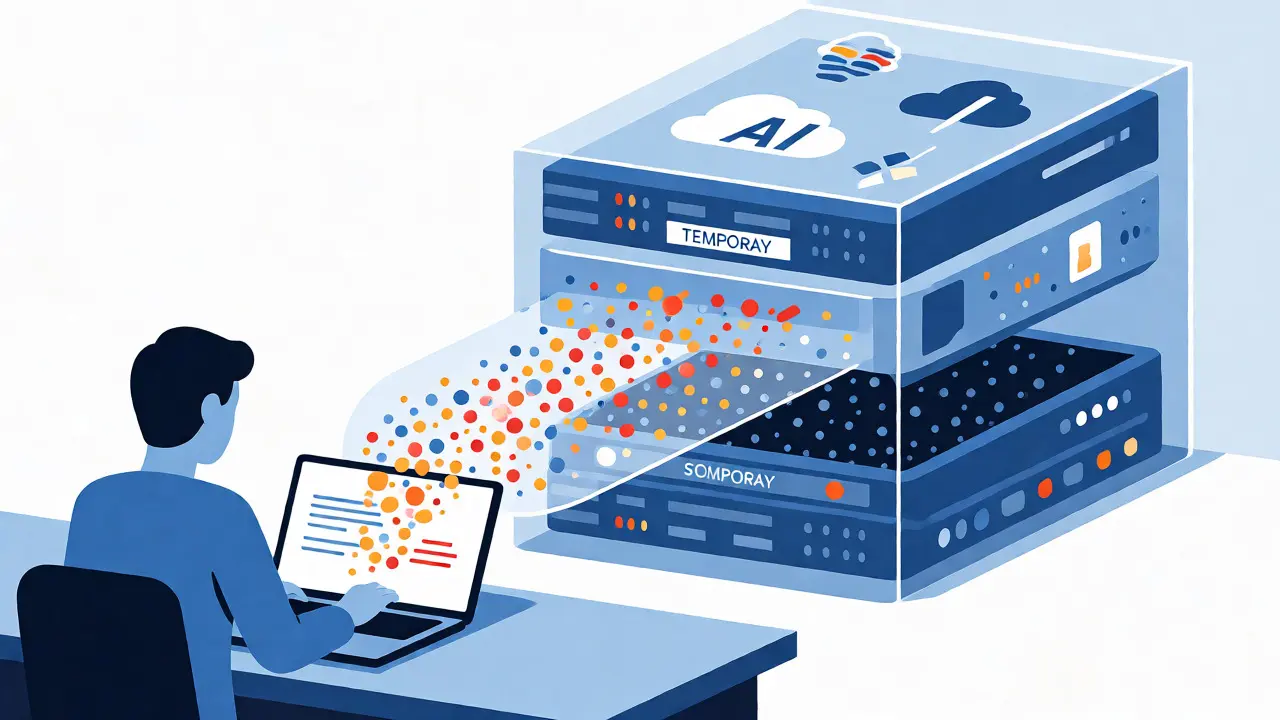
You just typed a sensitive question into an enterprise AI tool. Maybe it contained a client’s salary, a proprietary code snippet, or a medical symptom. Now, where does that text go? Does it vanish the moment you close the tab? Or does it sit in a server somewhere for years, potentially training the next version of the model?
This isn’t just a philosophical worry. It’s a massive operational headache for companies deploying Large Language Models (LLMs). If you get retention wrong, you risk GDPR fines, data leaks, or accidentally leaking trade secrets to a public model. If you delete too aggressively, you lose valuable feedback loops that help improve your AI.
Here is the reality: managing LLM prompt retention is harder than standard database cleanup because prompts are unstructured, often contain Personal Identifiable Information (PII), and interact with complex legal holds. Let’s break down how to actually handle this without losing your mind.
Why Standard Data Rules Don’t Apply to Prompts
Most companies have existing data retention policies for emails or SQL databases. You might think, "Just apply the same rules." But LLMs introduce unique risks. When a user submits a prompt, they aren’t just storing data; they’re interacting with a probabilistic engine. That interaction can reveal intent, context, and hidden relationships between data points that a simple log file wouldn’t capture.
Consider the concept of "memorization." Research shows that LLMs can inadvertently memorize PII if it appears frequently in training data. If you retain prompts indefinitely and use them for fine-tuning, you risk baking sensitive customer info directly into the model weights. Once it’s in the weights, deleting the original log doesn’t remove the knowledge from the model. This creates a compliance nightmare known as the "right to be forgotten" conflict. You can delete the record, but can you delete the memory?
Furthermore, prompts are often transient. A user might ask three follow-up questions to clarify a single point. Storing each fragment separately creates noise. Storing the whole conversation thread provides context but increases storage size and privacy exposure. Your policy needs to decide: do you keep the raw input, the generated output, or the entire session state?
The Mechanics of Deletion: It’s Not Instant
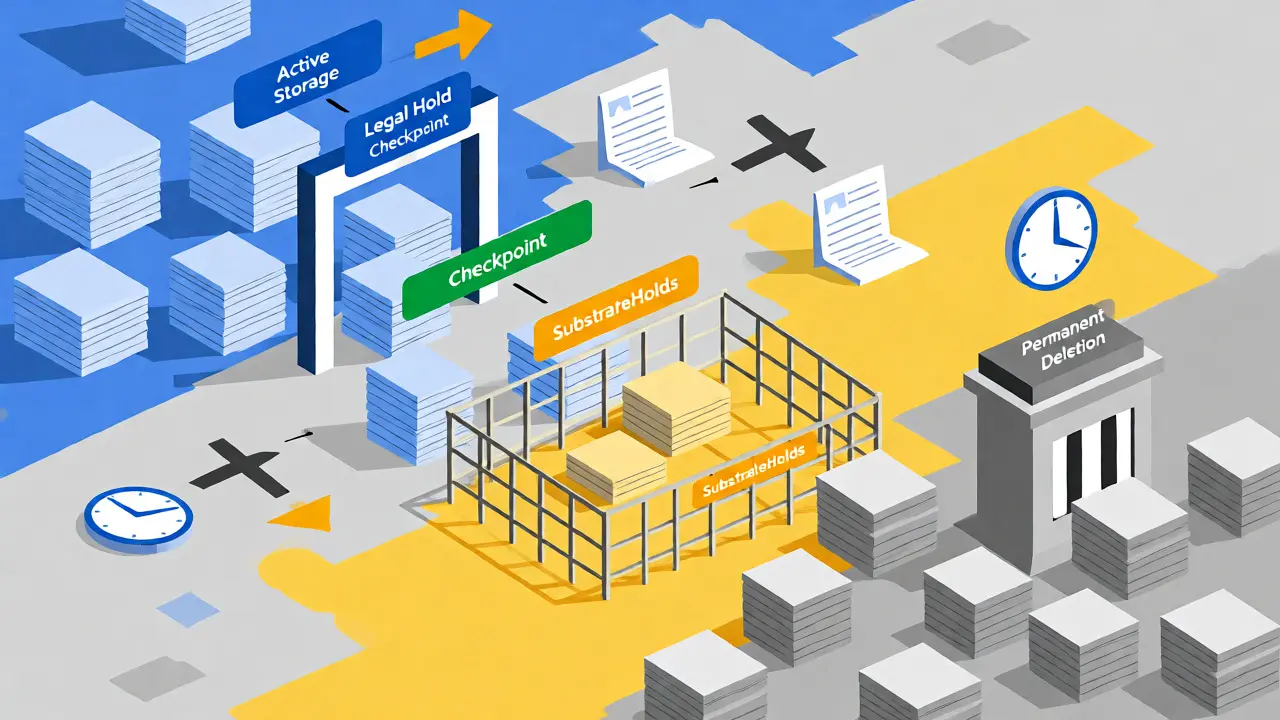
When you hit "delete," nothing happens immediately. In enterprise environments like Microsoft 365 Copilot or Azure OpenAI Service, deletion is a multi-stage process designed to prevent accidental loss during legal disputes.
Take Microsoft’s implementation as a concrete example. When a retention period expires, messages don’t disappear. They move to a special folder called SubstrateHolds. This is a holding pen. The system checks if any other legal holds, litigation freezes, or eDiscovery requests apply to that data. Only after these checks pass-typically within 1 to 7 days-does a timer job permanently scrub the data.
Why so slow? Because compliance requires proof. If you delete data instantly, you can’t prove it was deleted correctly later. The staged approach ensures that if a lawyer demands evidence of a specific chat from six months ago, and a hold was active, the data survives. If no hold existed, it gets purged. For a strict "delete-only-after-1-day" policy, the total time until physical removal can stretch up to 16 days due to these verification steps. You need to communicate this lag time to your security team so they don’t panic when data lingers slightly longer than expected.
Regulatory Landmines: GDPR and Beyond
If you operate in Europe, California, or Brazil, you’re under strict scrutiny. The European Union’s General Data Protection Regulation (GDPR) mandates that data retention must align with the purpose of processing. You can’t keep prompts forever "just in case." You need a defined reason.
Here’s a practical checklist for regulatory alignment:
- Purpose Limitation: Can you explicitly state why you are keeping this prompt? Is it for billing support? Model improvement? Legal defense? If not, delete it.
- Data Minimization: Are you storing more than you need? Do you really need the full conversation history for a billing dispute, or just the final invoice-related message?
- Encryption Everywhere: Prompts at rest and in transit must be encrypted. Use format-preserving encryption for fields that need validation, like credit card numbers inside a prompt.
- Audit Trails: Who accessed this prompt? When? Why? Immutable logs are non-negotiable for proving compliance.
The EU Data Protection Board emphasizes automated deletion policies. Manual cleanup fails. Humans forget. Scripts fail silently. You need automated workflows that trigger deletion based on timestamp and category tags.
Designing Your Retention Policy Framework
Don’t try to build one policy for all LLM interactions. Segment your data. Here is a framework that works for most enterprises:
| Data Category | Retention Period | Primary Purpose | Deletion Method |
|---|---|---|---|
| Debugging Logs | 30-90 Days | Troubleshooting errors, latency analysis | Automated purge after expiry |
| User Feedback/Ratings | 1-2 Years | Model performance tracking, RLHF (Reinforcement Learning from Human Feedback) | Anonymized aggregate storage |
| Sensitive Customer Queries | Duration of Contract + 1 Year | Customer support history, legal protection | Soft delete -> Hard delete after legal hold check |
| Training Data Candidates | Indefinite (with consent) | Fine-tuning future models | Manual review required before ingestion |
Note the distinction between "soft delete" and "hard delete." Soft delete marks the data as invisible to users but keeps it in the database for potential recovery. Hard delete physically removes the bytes. For GDPR compliance, hard delete is the end goal, but soft delete is often the first step in the workflow.
Handling Multi-Cloud Complexity
If you use multiple providers-say, AWS Bedrock for some tasks and Azure OpenAI for others-you face fragmentation. Each cloud provider has different APIs for deletion and different regional data residency rules.
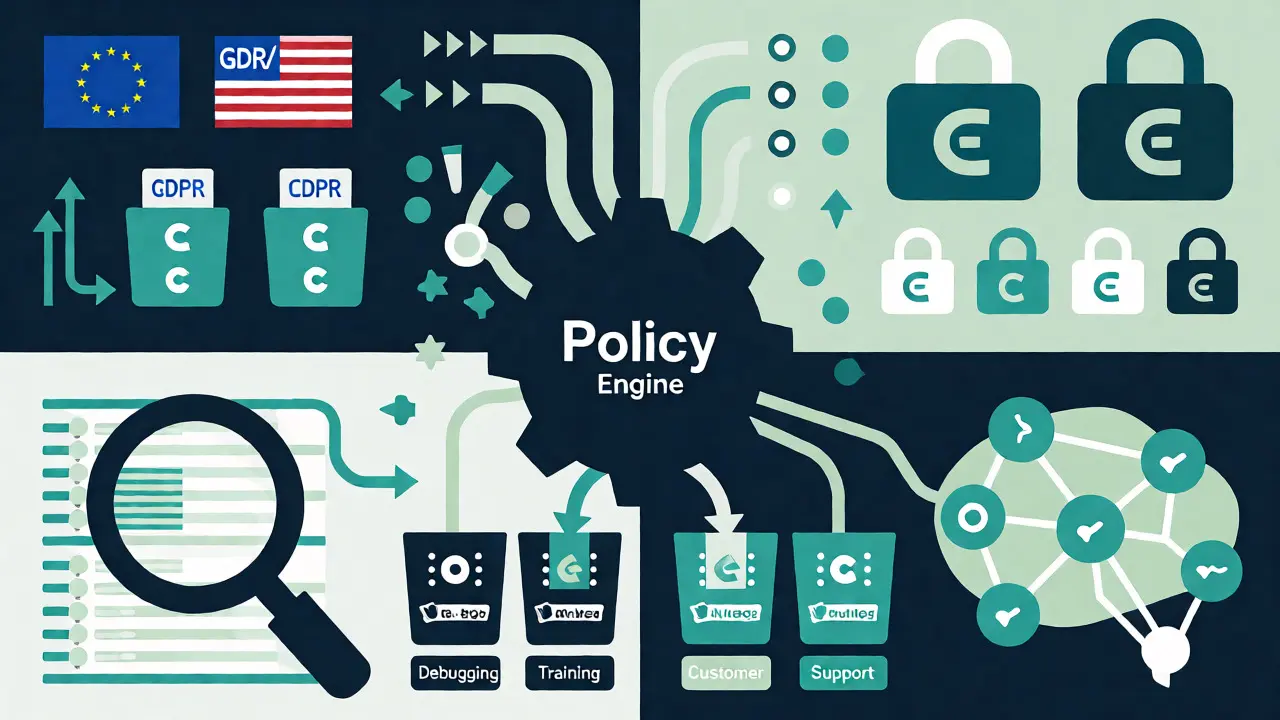
In the EU, data might need to stay within EU borders. In the US, HIPAA rules might apply to healthcare prompts. Your central policy engine must map these geographic constraints. A common pitfall is assuming that deleting a prompt from your application layer deletes it from the vendor’s backend. It doesn’t always. You must verify via API calls or contractual guarantees that the vendor honors your deletion requests.
Additionally, consider "model artifacts." When you retire a custom LLM instance, you don’t just stop serving it. You must securely decommission the underlying infrastructure. Delete associated vector embeddings, temporary cache files, and any intermediate tensors stored during inference. Residual data in temporary storage is a frequent leak source that audits miss.
Best Practices for Implementation
How do you actually roll this out without disrupting operations?
- Classify Before You Store: Use lightweight NLP classifiers to tag incoming prompts for PII. If a prompt contains a Social Security Number or email address, flag it for shorter retention or immediate redaction.
- Implement Time-Boxed Access: Even if data is retained, access should expire. Grant analysts access to recent prompts for 30 days. After that, require re-requesting access, which triggers a fresh audit log entry.
- Test Deletion Regularly: Run quarterly "deletion drills." Pick random records from the past year, request deletion, and verify they are gone from backups, caches, and search indices. Don’t wait for an auditor to find gaps.
- Document the "Why": Every retention rule needs a documented business justification. "We keep this for 7 years because tax law requires it" is valid. "We keep it because we might want it someday" is not.
Remember, the goal isn’t zero data. It’s controlled data. You need enough history to detect bias in your model outputs and to debug weird hallucinations. But you need to shed the dead weight quickly.
What Happens When Things Go Wrong?
Imagine a breach occurs. Attackers exfiltrate a month’s worth of prompts. If your retention policy was clear and enforced, you can confidently say, "We only held data for 90 days, and here is the audit trail proving deletion of older records." This limits your liability window.
Conversely, if you hoarded data for five years "just in case," you now have five years of exposed PII to notify customers about. The cost of notification, credit monitoring, and legal fees scales with the volume of retained data. Aggressive, well-defined retention is a financial hedge, not just a compliance checkbox.
Finally, consider the human factor. Developers often bypass retention rules by exporting logs to local CSV files for quick analysis. These ad-hoc copies exist outside your governance perimeter. Ban local exports for sensitive data, or provide secure, sandboxed analytics environments where data is automatically scrubbed upon exit.
Does deleting a prompt remove it from the LLM's training data?
Not necessarily. If the prompt was used to fine-tune a private model, the information may be embedded in the model weights. Deleting the log removes the reference, but not the learned pattern. To fully remove influence, you may need techniques like machine unlearning or retraining the model on sanitized datasets.
How long should I retain LLM logs for debugging purposes?
A common industry standard is 30 to 90 days. This window allows developers to reproduce issues and analyze performance trends while minimizing privacy risks. For critical production incidents, extend this to 6 months, but ensure strict access controls are applied.
What is the difference between retention and archiving?
Retention implies the data is still accessible and relevant for active use or recent compliance checks. Archiving moves data to cheaper, slower storage tiers for long-term preservation, often with restricted access. Archived data still counts toward your total data footprint and privacy obligations unless specifically anonymized.
Do I need separate policies for inputs and outputs?
Yes, often. Inputs (prompts) contain user-provided PII and are high-risk. Outputs (responses) are generated by the model and may contain less sensitive data, though they can still reflect biases or errors. Treat inputs with stricter privacy controls and shorter default retention times than outputs.
How do legal holds affect LLM data deletion?
Legal holds suspend automatic deletion. If a specific user or dataset is under investigation, the retention policy pauses, and data remains intact regardless of its age. Once the hold is lifted, the normal deletion timer resumes. Systems like Microsoft SubstrateHolds manage this by checking for active holds before executing permanent deletion.
Marilyn wiilliams
November 26, 2026 AT 03:37Finally!! Someone actually explains the mess instead of just throwing around buzzwords... seriously, thank you for breaking down the SubstrateHolds thing because I was losing my mind trying to figure out why data lingers. It is NOT instant deletion, people! Get it through your heads that compliance requires proof and proof takes time. We need to stop pretending that hitting a button wipes the slate clean immediately. The lag time is real and we have to plan for it or else our security teams are going to have heart attacks over nothing. This guide is exactly what the industry needed to stop the panic buying of 'instant delete' promises from vendors who clearly haven't read the fine print.
A Gift Shop
November 26, 2026 AT 06:24The memorization issue is the absolute killer here.
You can scrub the logs all day long but if those weights remember the SSN then good luck explaining that to a regulator. It is not just storage it is architecture failure. Most companies ignore this completely until they get fined into oblivion. You cannot unlearn easily without retraining which costs a fortune. So technically you are never truly deleting anything if you used it for training. That is the harsh truth nobody wants to admit in board meetings because it ruins their ROI projections on AI efficiency. They want magic deletion buttons but physics and math say no.
adam pohan
November 27, 2026 AT 10:28I find it deeply troubling that we continue to normalize the idea that corporations can hoard our personal thoughts and queries under the guise of improving services while simultaneously claiming they care about privacy as a core value proposition. When you look at the sheer volume of data being collected by these large language models, it becomes painfully obvious that the primary motivation behind retention policies is rarely user benefit but rather corporate greed and the insatiable desire to train models on every possible interaction regardless of whether that interaction contains sensitive medical symptoms or proprietary business secrets that should have remained confidential. The fact that legal holds can suspend deletion for months or even years means that our right to be forgotten is essentially an illusion designed to make us feel better while the data sits in cold storage waiting for a lawsuit or a marketing campaign. We must demand stricter enforcement of purpose limitation because keeping data just in case it might be useful someday is not a valid justification when that data belongs to the individual who created it and not the corporation that processed it. If we do not stand up against this creeping surveillance capitalism disguised as convenience then we will wake up one day to find that every question we ever asked has been indexed sold and analyzed without our explicit informed consent in a way that benefits shareholders more than citizens. The moral hazard here is enormous and we are ignoring it at our peril because once the data is baked into the model weights there is no going back and no amount of policy tweaking can undo the damage done to individual autonomy in the digital age. We need to stop accepting half measures and start demanding true transparency and control over our digital footprints before it is too late to reclaim any sense of privacy in an increasingly connected world where silence is no longer golden but merely temporary.
Annabel Lee
November 27, 2026 AT 16:07it’s honestly laughable how much energy we spend worrying about GDPR fines when the real threat is domestic complacency and the utter lack of American innovation in secure data handling standards that actually protect the average citizen from foreign surveillance interests masquerading as cloud providers
we keep letting these multinational tech giants dictate terms because we’re too lazy to enforce strict sovereignty rules that would force them to build infrastructure here and play by our rules instead of treating our data like some kind of colonial resource to be extracted and shipped overseas for processing in jurisdictions with weaker protections
the article touches on multi-cloud complexity but misses the point entirely that relying on fragmented APIs from different providers is just another layer of obfuscation hiding the fact that no one is actually accountable for the integrity of the data once it leaves the application layer
if we had a unified national standard enforced with teeth rather than these patchwork state laws and international treaties we wouldn’t be having this endless debate about soft deletes and hard deletes because the default would be destruction upon completion of service and anything retained beyond that would require a warrant signed by a judge not just a checkbox ticked by a product manager looking to hit quarterly metrics
we need to stop apologizing for wanting control over our own information and start demanding that technology serves the nation’s interest in security and privacy rather than serving the bottom line of venture capital firms that view deregulation as their primary growth strategy
this isn’t just about compliance it’s about maintaining the social contract between the governed and the governors in an era where algorithms know more about us than our spouses do and we still treat data rights as optional extras rather than fundamental human necessities