Managed APIs vs Self-Hosted Models: The Real Cost & Control Trade-off
 Nov, 5 2026
Imagine you've built a killer feature for your app using an LLM. It works great in development. Then, one Tuesday morning, the provider updates their model, changes the rate limits, or quietly tweaks the safety filters. Your output quality drops, costs spike, and your support tickets flood in. You didn't change a line of code, but your product broke. This isn't hypothetical; it's the daily reality of building on managed APIs.
On the flip side, consider the startup that spent six months fine-tuning a Llama 3 model on their proprietary legal documents. They own the weights, they control the hardware, and no third party can shut them down. But they also carry the weight of MLOps engineers, GPU maintenance, and the constant race to keep up with open-source releases.
The debate between self-hosted models and managed services isn't just about price tags. It's about risk tolerance, strategic control, and where you want your engineering team to spend their time. Are you renting a supercomputer, or are you building your own engine? Let's break down what actually matters when choosing your Large Language Model (LLM) strategy in late 2026.
The Core Difference: Renting Power vs. Owning Infrastructure
At its simplest, this choice is about who owns the metal. When you use a managed API from providers like OpenAI or Anthropic, you're paying for access to massive, pre-trained models running on someone else's infrastructure. You send text out, get text back, and pay per token. You don't care if their servers are in Virginia or Virginia Beach. You don't manage the GPUs. You don't worry about CUDA driver updates at 3 AM.
Self-hosted models mean you download open-source weights-like those from Meta's Llama series, Mistral, or DeepSeek-and run them on your own servers or private cloud instances. You might rent A100s from AWS, buy H100s for your basement server room, or use specialized inference platforms. Here, you own the deployment pipeline. You decide how the model behaves, how it scales, and crucially, where your data goes.
Why does this matter now? Because the gap has closed. Five years ago, only trillion-parameter models could hold a coherent conversation. Today, a well-tuned 7B or 8B parameter model can outperform general-purpose giants in specific tasks. If you're processing customer support tickets for a plumbing company, do you really need a model trained on the entire internet's poetry and physics? Probably not. You need something fast, cheap, and good at fixing leaks.
Follow the Money: Cost Structures That Bite Back
Cost is usually the first question people ask, but they often get the math wrong. Managed APIs look cheap because there's no upfront capital expenditure (CapEx). You start paying as you go. For a prototype or a low-volume internal tool, this is unbeatable. Why buy a $10,000 GPU when you can pay pennies per query?
But scale changes everything. Usage-based billing is linear. If your traffic doubles, your bill doubles. There's no discount for volume unless you negotiate enterprise contracts, which take time. Meanwhile, self-hosting involves high fixed costs. You pay for the GPU whether it's idle or working. However, once you cover that fixed cost, marginal costs drop near zero.
| Factor | Managed API (e.g., GPT-4o) | Self-Hosted (e.g., Llama 3 70B) |
|---|---|---|
| Upfront Investment | $0 | $5k - $50k+ (Hardware/Setup) |
| Marginal Cost per Token | High ($0.005 - $0.03) | Near Zero (Electricity + Depreciation) |
| Engineering Overhead | Low (API Integration) | High (MLOps, DevOps, Tuning) |
| Break-even Point | N/A | Typically ~50% utilization capacity |
A common rule of thumb: if your self-hosted model runs at less than 50% capacity, you're likely burning money compared to an API. If you're pushing millions of tokens daily, self-hosting often wins by a wide margin. But don't forget the hidden cost: people. You need engineers who know how to optimize inference engines like vLLM or TGI. That salary adds up faster than you think.
Data Privacy: The Non-Negotiable for Regulated Industries
If you work in healthcare, finance, or government, this section is probably why you clicked. Sending sensitive patient records or proprietary financial algorithms to a third-party API means your data leaves your firewall. Even with SOC2 compliance and encryption, some CISOs simply won't allow it.
With self-hosting, data never leaves your environment. You can deploy a model inside a VPC or even on-premise air-gapped servers. This gives you total control over data retention policies. Did the provider log your prompt? With self-hosting, you decide. Do they use your data to train future versions? You say no.
For many B2B SaaS companies, this control becomes a selling point. "We don't train on your data" is a powerful promise, but it's much easier to prove when you control the entire stack. If your competitive advantage relies on unique, private datasets, keeping that data in-house prevents leakage and ensures your customizations stay yours.

Control and Customization: Breaking Free from the Black Box
Have you ever noticed your chatbot suddenly getting dumber? Or refusing to answer questions it used to handle fine? That's the black box problem. Managed API providers update their models silently. They tweak safety guardrails, adjust temperature defaults, or deprecate older versions. You wake up to broken functionality without warning.
Self-hosting puts you in the driver's seat. You choose the model version. You decide when to upgrade. You can fine-tune the model on your specific domain data using techniques like LoRA (Low-Rank Adaptation), which allows you to adapt a large model to new tasks without retraining the whole thing. This level of customization lets you squeeze out performance that generic models can't match.
Consider a legal tech firm. A general-purpose model might struggle with obscure case law nuances. By fine-tuning a smaller, efficient model on their specific corpus of legal briefs, they can achieve higher accuracy and lower latency than a massive, generalist API. Plus, they can implement custom logic for citation formatting that an API provider would never build for them.
Performance and Latency: Who Wins the Speed Race?
Latency matters. In real-time applications like voice assistants or interactive coding tools, every millisecond counts. Managed APIs depend on network round-trips. Your request travels to the provider's data center, queues behind other users, gets processed, and returns. Network jitter and provider load can cause unpredictable spikes.
Self-hosted models, especially when deployed close to your users or within your own infrastructure, offer predictable latency. You can optimize the inference engine for speed, quantize the model to reduce memory footprint, and batch requests efficiently. While you lose access to the absolute largest models (which require clusters of GPUs), you gain consistency.
However, raw power still favors managed APIs for complex reasoning tasks. If you need a model to solve advanced math problems or write complex code, the sheer parameter count of frontier models like GPT-4 or Claude 3 Opus is hard to beat with a single consumer-grade GPU. But for 90% of business applications-summarization, classification, extraction-smaller self-hosted models are fast enough and often more consistent.
The Hybrid Approach: Why Not Both?
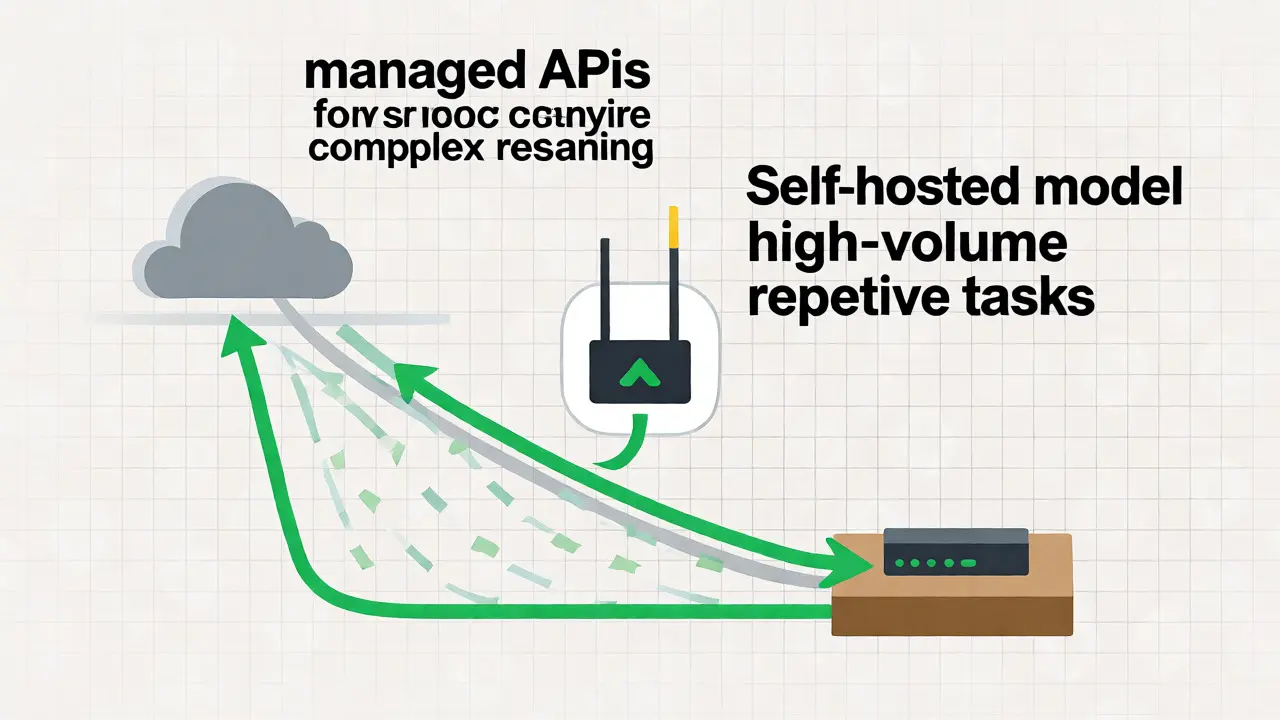
Here's the secret most vendors won't tell you: you don't have to pick one forever. Smart organizations use a hybrid strategy. They use managed APIs for prototyping, edge cases, and highly complex reasoning tasks where cost-per-call is justified. Then, they migrate high-volume, repetitive tasks to self-hosted models to save money.
For example, you might use a managed API to generate initial summaries of long documents. Once the user accepts the summary format, you route subsequent interactions through a fine-tuned, self-hosted model that understands your specific tone and style. This balances the ease of development with the economics of scale.
Another pattern is using self-hosted models for "drafting" and managed APIs for "polishing." The cheaper model handles the bulk of the generation, while the premium API reviews critical outputs for safety or factual accuracy. This optimizes both cost and quality.
How to Decide: A Simple Framework
Still stuck? Ask yourself these three questions:
- Is AI core to your product or just a feature? If it's core, invest in control and self-hosting. If it's a nice-to-have, rent via API.
- Do you have strict data privacy needs? If yes, self-hosting or private cloud deployment is almost mandatory.
- What is your expected volume? Low volume? Stick to APIs. High volume? Calculate the break-even point for self-hosting immediately.
There is no silver bullet. The best strategy depends on your specific constraints. But understanding the trade-offs-cost vs. control, simplicity vs. customization-puts you ahead of competitors who treat AI as a magic button rather than a strategic asset.
Is self-hosting always cheaper than using APIs?
No. Self-hosting has high upfront and operational costs. It only becomes cheaper than managed APIs when you reach significant volume (often tens of millions of tokens per month) or when you can keep your hardware utilized above 50%. For startups or low-volume apps, APIs are almost always cheaper due to zero infrastructure overhead.
Can I fine-tune models via managed APIs?
Yes, providers like OpenAI and Anthropic offer fine-tuning services. However, these are often limited in scope compared to self-hosting. You typically cannot change the architecture, and you remain subject to the provider's pricing and availability. Self-hosting offers deeper customization, including full weight adjustment and custom training loops.
What happens if my self-hosted model crashes?
You are responsible for uptime. Unlike managed APIs, which have SLAs (Service Level Agreements) and redundant infrastructure, self-hosting requires you to build your own redundancy, monitoring, and failover systems. This increases the complexity of your DevOps practices significantly.
Are open-source models as good as GPT-4?
For general knowledge and complex reasoning, top-tier managed models still lead. However, for specific tasks like summarization, translation, or domain-specific Q&A, fine-tuned open-source models (like Llama 3 or Mistral) often match or exceed managed models' performance while being much faster and cheaper to run.
Do I need a huge GPU cluster to self-host?
Not necessarily. Small models (7B-13B parameters) can run on single consumer GPUs or even high-end CPUs with quantization. Only larger models (70B+) require multi-GPU setups. Start small with smaller models to test viability before investing in heavy infrastructure.