Multimodal LLMs for Document Processing: OCR, Tables & Visual Reasoning
 Aug, 25 2026
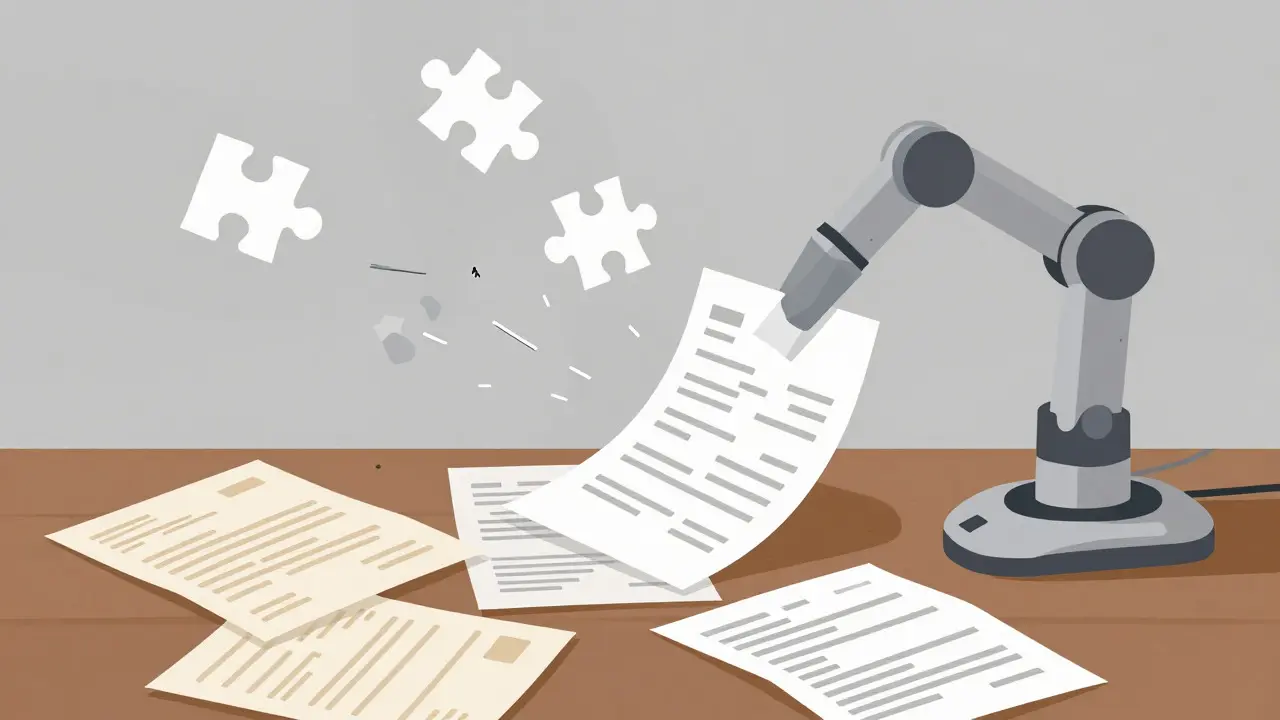
Imagine handing a crumpled, coffee-stained invoice to an AI and asking it not just to read the numbers, but to explain why the total is wrong. For decades, Optical Character Recognition (OCR) was the only option, treating documents as flat sheets of text where images were useless noise. Today, Multimodal Large Language Models are changing that game entirely. These systems don't just recognize characters; they understand the spatial logic of a page, linking a chart in the corner to the narrative in the center. This shift moves us from simple data extraction to true semantic comprehension, allowing machines to reason about what a document actually means rather than just what it says.
Key Takeaways
- Multimodal LLMs process text and images simultaneously, overcoming the limitations of traditional OCR which treats graphics as inert pixels.
- Models like dots.mocr and GPT-4o can reconstruct tables and charts into reusable code formats like HTML or SVG, enabling better downstream analysis.
- Vision encoders allow these models to handle degraded scans, handwriting, and complex multi-column layouts with significantly higher accuracy than legacy pipelines.
- The technology enables "visual question answering," where users can ask natural language questions about document content without pre-defining extraction rules.
- Enterprise adoption is accelerating because these models reduce the need for custom coding per document type, offering a unified approach to diverse file formats.
Why Traditional OCR Falls Short
To appreciate the leap multimodal models provide, you have to look at how standard OCR works. Traditional systems scan a page, identify character shapes, and output a string of text. It’s fast and cheap, but it’s blind to context. If a table has merged cells, a rotated header, or a logo overlapping a number, the OCR engine often gets confused. It outputs a jumbled mess of strings that requires heavy post-processing to make sense. Worse, any graphical element-a pie chart, a signature, a barcode-is either ignored or saved as a separate image file with no connection to the surrounding text.
This creates a fragmented workflow. You end up using one tool for text, another for tables, and a third for charts. Each step introduces potential errors, and the final result lacks the structural integrity of the original document. The problem isn’t just technical; it’s semantic. A human reader understands that a bolded number under the word "Total" is the sum of the column above it. Standard OCR sees two independent pieces of text. It doesn’t know they are related. This gap between recognition and understanding is exactly where multimodal large language models shine.
The Architecture Behind Visual Understanding
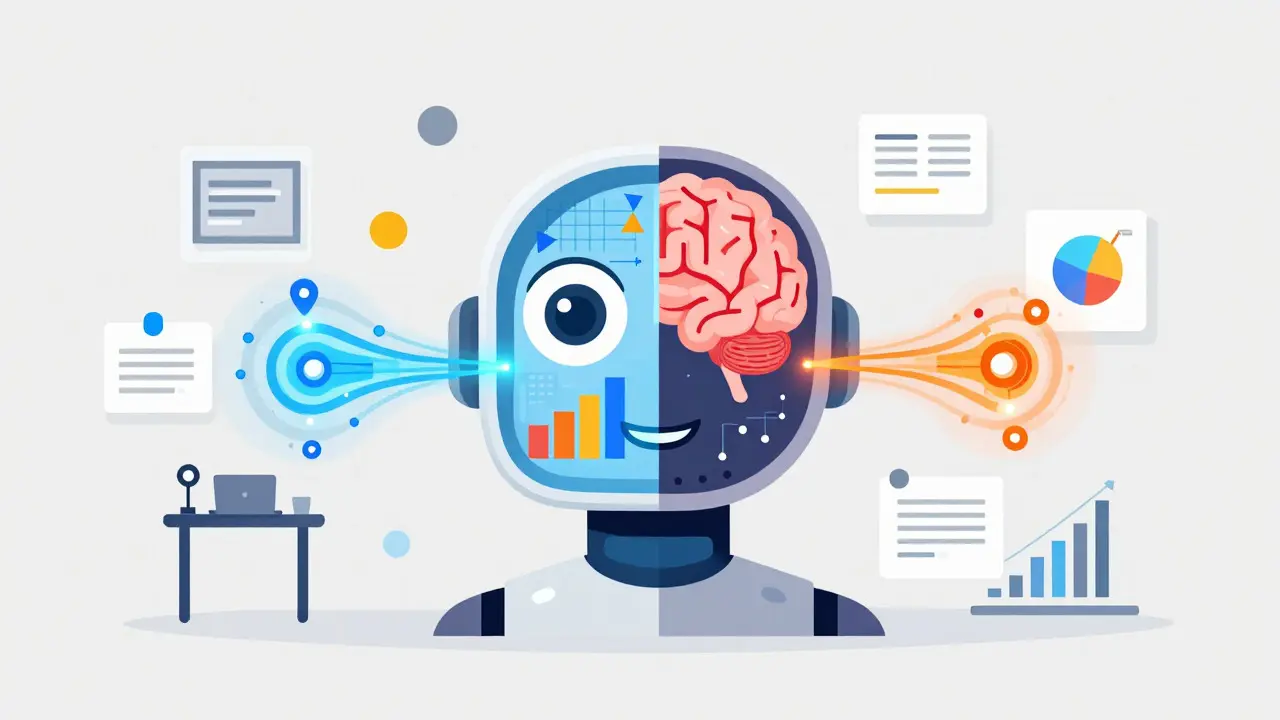
At the core of modern document processing lies the vision-language architecture. Unlike older systems that use separate modules for seeing and thinking, these models integrate both functions. A vision encoder decodes shapes, lines, and colors from the input image, while a language model processes the textual tokens. Crucially, these two streams are fused during training. The model learns that a horizontal line below a set of numbers likely indicates a subtotal, or that a shaded cell highlights a key metric.
This integration allows for end-to-end learning. Instead of hard-coding rules for specific layout types, the model generalizes across thousands of document variations. It recognizes headers, footnotes, callouts, and forms as distinct semantic entities. This layout intelligence is what allows a system to group elements by meaning rather than just position. For example, if a footnote appears at the bottom of the page but references a sentence in the middle of a paragraph, a multimodal model can link them based on contextual cues, something a positional-only OCR engine would miss entirely.
Leading Models in Document Parsing
The market for specialized document models is crowded, but a few stand out for their specific strengths. GPT-4o is a general-purpose powerhouse that handles a wide variety of inputs with high flexibility, making it ideal for unstructured or novel document types. However, for dedicated document tasks, specialized fine-tunes often outperform generalists due to their targeted training data.
| Model Name | Primary Strength | Output Format | Best Use Case |
|---|---|---|---|
| dots.mocr | Reconstructs graphics as code (SVG/HTML) | Structured Markdown, Code | Faithful document reconstruction |
| Nanonets-OCR2-3B | Lightweight, efficient inference | Structured Markdown | High-volume batch processing |
| DeepSeek-OCR | Strong reasoning capabilities | Text + Analysis | Complex logical deduction |
| Qwen3-VL | Supports ancient scripts/handwriting | All-format outputs | Historical or non-standard docs |
Among these, dots.mocr represents a significant paradigm shift. While most models output plain text or basic markdown, dots.mocr recovers document graphics as renderable code. This means if your invoice contains a bar chart, the model doesn't just describe it; it generates the SVG code to redraw it. This capability turns previously discarded visual data into reusable, machine-readable assets. Similarly, Nanonets-OCR2-3B focuses on efficiency, offering structured markdown generation that is fast enough for real-time applications without sacrificing too much accuracy.
Handling Complex Structures: Tables and Charts
Tables are the bane of traditional OCR. Merged cells, nested headers, and irregular spacing break standard parsers. Multimodal models tackle this by treating the table as a visual grid rather than a sequence of text lines. They analyze the alignment of rows and columns to infer structure. If a cell spans two columns, the model detects the missing vertical divider and infers the span based on the surrounding geometry.
Charts present an even greater challenge. A bar chart conveys information through height, color, and position. A multimodal model can interpret these visual cues to extract the underlying data points. Tools like DEPLOT, often integrated into these workflows, convert charts into text-based tabular representations. This allows the LLM to perform calculations on the data. For instance, you can ask, "Which quarter showed the highest growth?" and the model will analyze the bar heights, compare them, and return the answer with confidence. This transforms static images into queryable databases.
Visual Reasoning and Question Answering
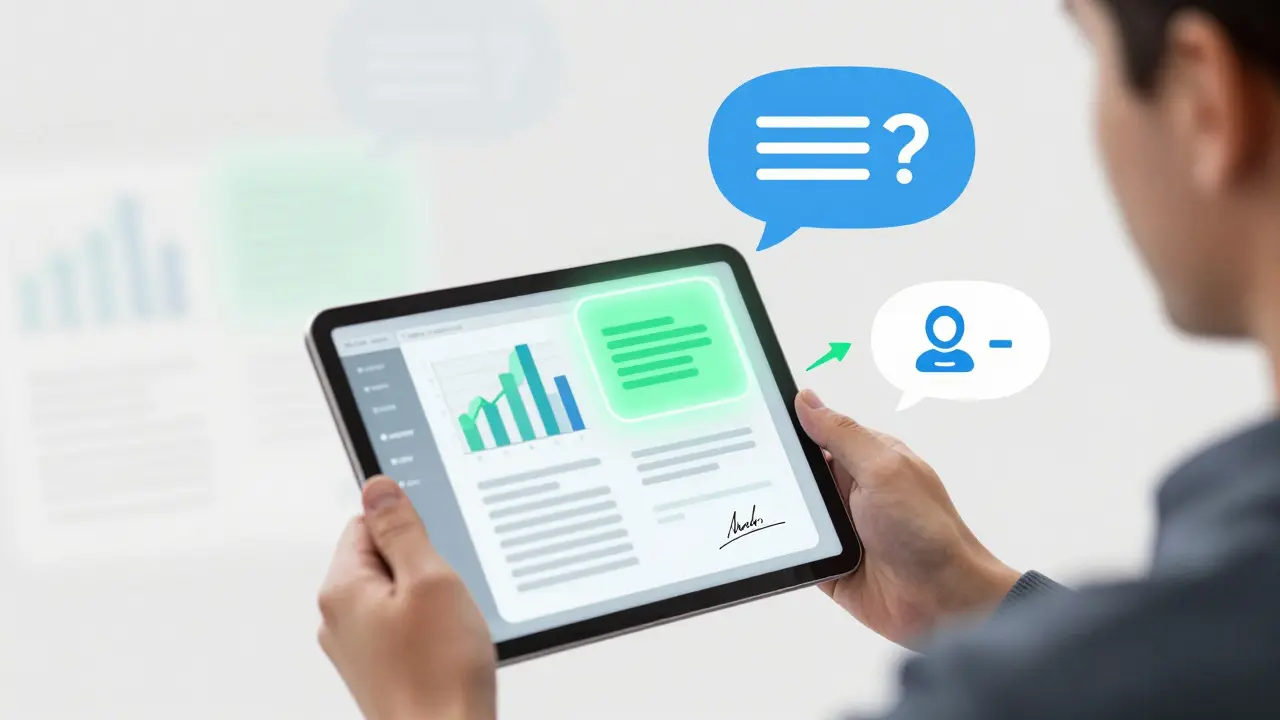
The true power of these systems emerges in visual question answering (VQA). Instead of extracting all data first and then searching through it, you can ask specific questions directly about the document image. "Is there a warning sign on this safety manual page?" or "What is the date on the contract signature?" The model performs a targeted search within the visual field, ignoring irrelevant parts of the page. This reduces computational overhead and improves relevance.
This reasoning extends to detecting anomalies. If a form field is left blank where a value is expected, or if a stamp obscures critical text, the model can flag these issues. It uses its understanding of typical document structures to identify deviations. This makes multimodal LLMs excellent candidates for quality assurance in document intake workflows, catching errors before they propagate into downstream systems.
Implementation Considerations and Pitfalls
While the technology is powerful, implementation requires care. One major pitfall is over-reliance on the model's hallucinations. Like all LLMs, multimodal versions can invent details if the input is ambiguous. Always implement verification steps for critical data fields. Another consideration is latency. General-purpose models like GPT-4o may be slower than specialized lightweight models like Nanonets-OCR2-3B. For high-throughput environments, choosing the right model size is crucial for balancing cost and speed.
Additionally, prepare your data carefully. While these models handle degraded scans well, extreme distortions can still confuse them. Pre-processing steps like deskewing and contrast enhancement can improve results, though less so than in traditional OCR pipelines. Finally, consider the output format. If you need to edit the extracted content, ensure the model outputs structured formats like JSON or HTML rather than raw text, preserving the hierarchy and relationships you identified.
Frequently Asked Questions
Can multimodal LLMs read handwritten notes?
Yes, many advanced models like Qwen3-VL have been trained on datasets including handwriting samples. While accuracy varies depending on legibility, these systems generally outperform traditional OCR engines which struggle significantly with cursive or informal script.
How do these models handle multilingual documents?
Multimodal LLMs are typically trained on multilingual corpora, allowing them to switch between languages seamlessly within a single document. They can detect language changes based on character shapes and context, making them suitable for international business documents containing mixed text.
Is it cheaper to use a multimodal LLM than traditional OCR plus post-processing?
For complex documents, yes. While per-page API costs for LLMs might be higher than basic OCR, the reduction in development time for custom parsing rules and the decrease in error correction labor often lead to lower total operational costs. For simple, uniform documents, traditional OCR remains more cost-effective.
What is the difference between VQA and standard OCR?
Standard OCR extracts all text from a page indiscriminately. Visual Question Answering (VQA) allows you to ask specific questions about the document content, and the model retrieves only the relevant information. VQA leverages semantic understanding to filter out noise, whereas OCR provides a raw dump of recognized characters.
Do I need to fine-tune a model for my specific industry?
Not always. General-purpose models handle many common document types well. However, if your documents contain highly specialized terminology, unique layouts, or rare symbols, fine-tuning a smaller open-source model can significantly improve accuracy and reduce inference costs compared to relying solely on general-purpose APIs.