Neural Scaling in NLP: How Compute Predicts Large Language Model Performance
 Feb, 22 2026
When you hear about AI models getting smarter, it’s not magic. It’s math. Specifically, it’s neural scaling - the idea that if you throw more compute, more data, and bigger models at a language model, its performance improves in predictable, measurable ways. This isn’t just theory anymore. It’s how the biggest AI breakthroughs of the last five years were planned - and why companies like DeepMind and OpenAI can now predict how a model will perform before they even train it.
What Neural Scaling Really Means
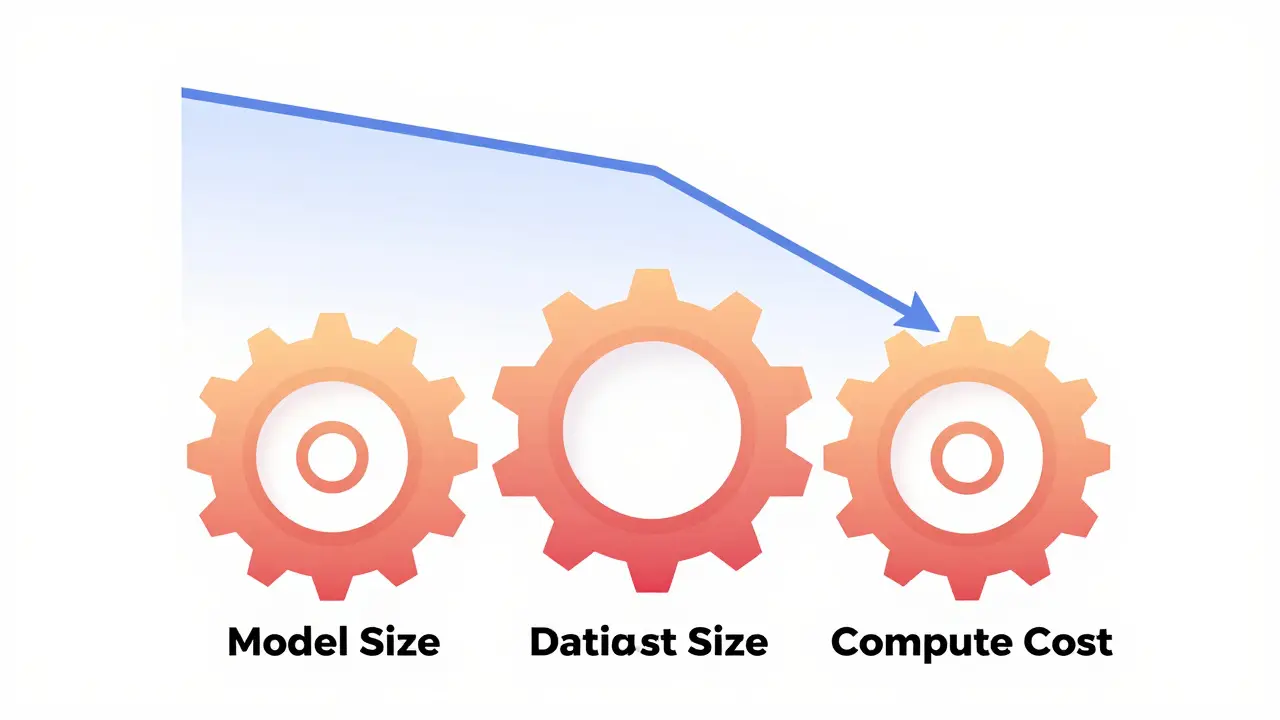
Neural scaling in NLP isn’t about making models bigger for the sake of it. It’s about understanding the relationship between three key variables: model size (N), dataset size (D), and compute cost (C). These aren’t random numbers. They follow strict power laws. If you plot them on a log-log graph, the performance of language models - measured by loss on test data - drops in a straight line as you increase any of these three factors. This means: if you train a 100-million-parameter model on a small dataset and measure how well it predicts the next word, you can use that data to predict how a 100-billion-parameter model will perform on a much larger dataset. You don’t need to train the big one first. You just need to fit a simple equation to your small experiments. The formula looks like this:L = A/N^α + B/D^β + L₀. Don’t panic - you don’t need to memorize it. What matters is what it tells us: performance improves when you balance all three. Too much model size with too little data? Wasted compute. Too much data with too small a model? You’re not using your data’s full potential.
The GPT-3 Moment: Bigger Is Better… Until It Isn’t
GPT-3, released in 2020 with 175 billion parameters, changed everything. It wasn’t just larger than its predecessor - it was 100 times bigger. And the results? Stunning. On tasks like translation, summarization, and even simple math problems, GPT-3 performed better than any model before it - especially in few-shot learning, where it could solve problems just by seeing a few examples. At the time, the assumption was clear: bigger models = better performance. So companies raced to build even larger models. MT-NLG, developed by NVIDIA and Microsoft, hit 530 billion parameters. But here’s the twist: it didn’t outperform smaller models trained on more data. Why? Because it was still trained on roughly the same amount of text as GPT-3 - about 300 billion tokens. This exposed a flaw in the old thinking. You can’t just crank up model size and call it a day. You need to scale data too. And that’s where Chinchilla came in.Chinchilla: The 70B Model That Beat 280B Models
In 2022, DeepMind dropped a bombshell: they trained a 70-billion-parameter model called Chinchilla on 1.4 trillion tokens - four times more data than GPT-3. Chinchilla was half the size of Gopher, DeepMind’s previous 280B model. But Chinchilla outperformed Gopher on every benchmark tested. How? Because it was compute-optimal. Chinchilla didn’t just have a big model. It had a big model and a big dataset - in perfect balance. The researchers found that for every doubling of compute, you should increase model size by 1.7x and dataset size by 2.5x. That’s the sweet spot. This wasn’t a fluke. When they tested Chinchilla on tasks like coding, reasoning, and factual recall, it consistently beat models that were 4x larger but trained on less data. The lesson? Model size alone doesn’t win. Balance does.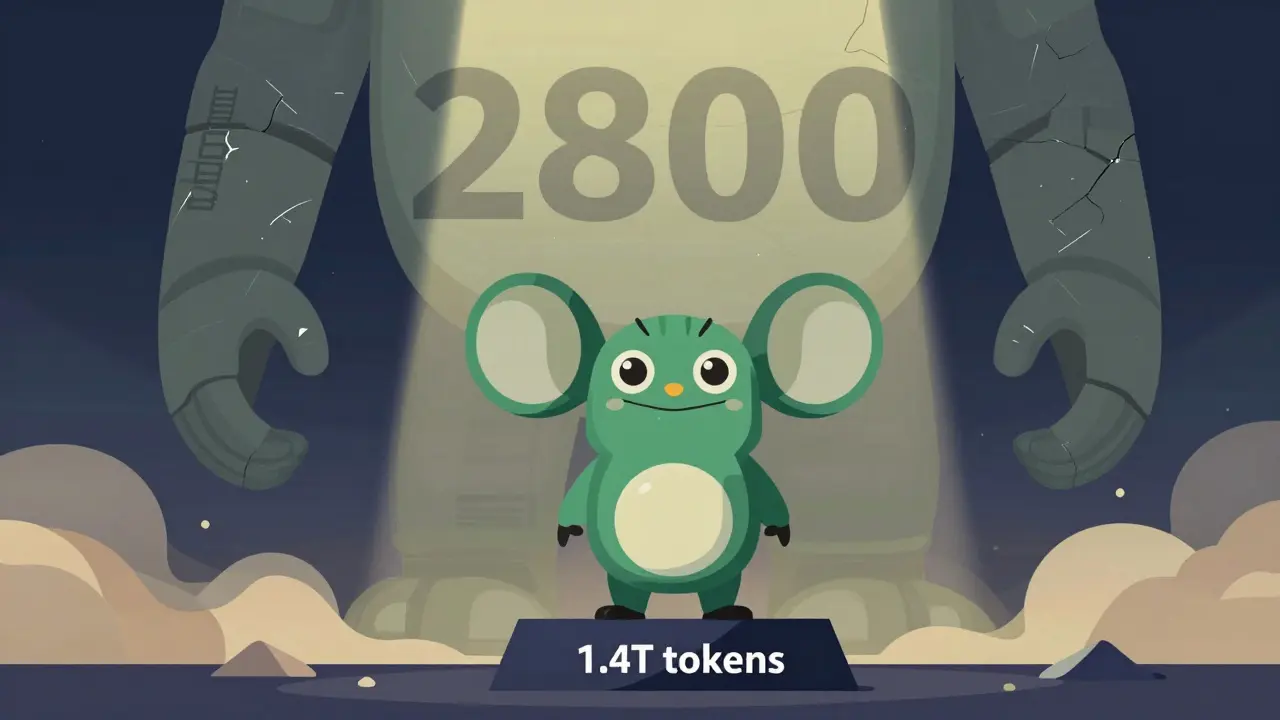
Scaling Beyond Pretraining: Inference-Time Compute
For years, scaling meant more pretraining. More data. More parameters. More GPU hours. But something new emerged around 2024: models like o1 and o3 started using inference-time compute to get smarter. Instead of just predicting the next word in one go, these models generate long chains of thought - step-by-step reasoning - before giving an answer. Think of it like a student working through a math problem on paper before writing the final answer. The more compute you give them during this thinking phase, the better they perform. This isn’t about training. It’s about how the model uses resources at the time of response. And it works. For complex reasoning tasks - like solving multi-step logic puzzles or writing code with edge cases - models that spend extra time reasoning outperform those trained with more data or parameters. This is a new scaling law: compute at inference time can boost performance just as predictably as compute during training. It means you can now trade off between model size and inference cost. A smaller, cheaper model can outperform a giant one if you give it more time to think.Emergent Abilities: When Scaling Breaks the Line
Here’s the wild part: scaling isn’t always smooth. Sometimes, models suddenly unlock abilities they didn’t have before. This is called an emergent ability. For example, a model with 10 billion parameters might struggle to follow multi-step instructions. But at 30 billion? It suddenly gets really good at it. Not because someone programmed it. Not because they added a new layer. Just because it got big enough. These aren’t predictable by simple math. You can’t extrapolate from 5B to 30B and expect the jump. But you can see the pattern after the fact. Emergent abilities appear at thresholds - like a light switch flipping on. They’re why models like GPT-4 can write essays, debug code, and explain physics concepts - things their predecessors couldn’t touch. The key takeaway? Scaling gives you more than just better accuracy. It gives you new kinds of intelligence.
Real-World Impact: How AI Labs Use Scaling Laws Today
You don’t need to train a 100B model to know how it’ll perform. Today, leading AI labs train dozens of smaller models - maybe 1B to 10B parameters - on different data sizes and compute budgets. They measure performance, fit the scaling law, and then predict how a 100B model will do. This saves millions. Training a single 100B model can cost over $50 million. But fitting a scaling law with 10 smaller models might cost $500,000. That’s a 100x reduction in experimentation cost. And it’s not just for language models. DeepMind showed that Chinchilla, trained on text, could compress images better than PNG. Why? Because it learned to predict patterns - and prediction is the core of compression. This cross-domain transfer proves scaling isn’t just about language. It’s about building general-purpose pattern recognizers.What’s Next? The Future of Scaling
We’re entering a new phase. Scaling isn’t just about size anymore. It’s about:- Optimizing the ratio of model size to data size
- Using inference-time compute as a tuning knob
- Training models on multimodal data - text, images, audio - to build richer internal representations
- Letting models self-improve through iterative refinement during inference
Every time you ask a chatbot a hard question and it gets it right, you’re seeing the result of this science. Not magic. Not luck. Just math, scaled up.
What are the three main factors in neural scaling for language models?
The three main factors are model size (number of parameters), dataset size (number of training tokens), and compute cost (total training resources). These are linked by scaling laws that show performance improves predictably when all three are balanced - not when any one is maximized alone.
Why did Chinchilla outperform larger models like Gopher?
Chinchilla was only 70 billion parameters, half the size of Gopher’s 280 billion, but it was trained on 1.4 trillion tokens - four times more data. This balance between model size and data volume made it more compute-optimal. Larger models trained on the same or less data waste capacity because they can’t absorb enough information to justify their size.
Can you predict a model’s performance without training it?
Yes. By training smaller models under different conditions and fitting their performance to scaling laws, researchers can extrapolate how a much larger model will perform. This is now standard practice at top AI labs. It reduces the cost of experimentation by 100x or more before committing to a full-scale training run.
What are emergent abilities in large language models?
Emergent abilities are new skills that appear suddenly when a model reaches a certain size or training threshold - like solving multi-step reasoning problems or following complex instructions. These abilities can’t be predicted from smaller models’ behavior alone. They emerge from complex interactions between parameters, not from explicit design.
Is more compute always better for AI models?
Not necessarily. More compute during pretraining helps - but only if matched with the right model size and data. Beyond a point, adding more compute to an under-scaled model (e.g., too small or trained on too little data) gives diminishing returns. The breakthrough came with inference-time scaling, where extra compute during response generation - not training - can improve reasoning without needing a bigger model.
michael T
February 22, 2026 AT 12:10Oh sweet mother of god, this is the most beautiful thing I’ve read all year. You know what’s wild? They didn’t just throw compute at the wall-they *calculated* where the wall was. I mean, we’re talking about predicting a 100B model’s performance from a 1B one like it’s a goddamn spreadsheet. I’m not crying, you’re crying. And don’t even get me started on Chinchilla-70B and it outsmarts a 280B behemoth like it’s cheating at Monopoly with a PhD. I love it. I hate it. I need more.
Someone send this to my ex. She said AI was just ‘magic.’ Tell her magic has power laws and a goddamn formula sheet.
Also-emergent abilities? Bro, it’s like watching a toddler suddenly speak fluent Shakespeare after watching too many cartoons. No one programmed it. It just… became. I’m terrified and in love.
Christina Kooiman
February 22, 2026 AT 15:58Let me just say, as someone who has spent years correcting grammar on Reddit, this article is a miracle. No run-on sentences. No misplaced modifiers. The Oxford comma is used correctly. The paragraph structure is logical. The transitions are seamless. The capitalization of ‘GPT-3’ and ‘Chinchilla’ is consistent. The hyphenation in ‘few-shot learning’ is perfect. And the use of italics for emphasis? Chef’s kiss.
I’ve read so many AI articles that read like a drunk engineer typed them on a toaster. This? This is a masterclass. Someone deserves a medal. Or at least a coffee. I’m buying the author a coffee. I’m serious. I’ll wait in line. I’ll pay extra for oat milk.
Stephanie Serblowski
February 23, 2026 AT 20:34Okay, I’m not usually one to gush, but this? This is the kind of thing that makes me believe in humanity again. 🌈✨
Scaling laws are basically the universe’s way of saying, ‘Hey, stop throwing spaghetti at the wall and start using a measuring tape.’ And Chinchilla? That’s the underdog who showed up in flip-flops and won the whole dang marathon. I love that we’re moving from ‘bigger is better’ to ‘balanced is brilliant.’
Also, inference-time compute? That’s like giving your brain a coffee break before answering a tough question. So meta. So human. So… beautiful.
Someone needs to make a TikTok of this. With lofi beats. And glitter. 🎵✨
allison berroteran
February 25, 2026 AT 04:55It’s fascinating how this mirrors so much of what we’ve learned in philosophy and cognitive science. The idea that intelligence isn’t just about quantity, but about structure and balance-it’s almost Platonic. The mind doesn’t become wiser just by storing more data; it becomes wiser when the data is arranged in a way that allows for deeper pattern recognition.
And emergent abilities… isn’t that what consciousness might be? A threshold phenomenon? We don’t know why a certain number of neurons firing in a certain way leads to self-awareness, but we see it happen. Maybe AI is just showing us the same thing on a different substrate.
It makes you wonder: if scaling laws apply here, do they apply to everything? To societies? To ecosystems? To love?
Maybe the real breakthrough isn’t in the math-it’s in realizing that complexity, when properly scaled, doesn’t just improve performance… it reveals meaning.
Gabby Love
February 26, 2026 AT 06:28Thanks for writing this. Clear, concise, and actually useful.
One thing I’d add: people forget that scaling isn’t just about training. The real cost now is inference. Running a 100B model 24/7 for customer service? That’s a power bill that’ll make your CFO cry. So yeah, Chinchilla’s not just smarter-it’s cheaper. And that’s the real win.
Jen Kay
February 26, 2026 AT 20:40Wow. Just… wow.
I mean, I knew AI was getting smarter, but I didn’t realize we’d gone from ‘let’s just throw more GPUs at it’ to ‘let’s treat this like rocket science.’ This is engineering. Real, elegant, mathematical engineering.
And the inference-time compute thing? That’s genius. It’s like giving the model a moment to breathe before answering. We used to think AI had to be fast. Now we’re realizing it needs to be thoughtful.
Also-emergent abilities? That’s not AI. That’s evolution. And we’re watching it happen in real time.
Okay. I’m done. I’m going to go stare at the ceiling and think about the universe.
Michael Thomas
February 28, 2026 AT 13:02USA invented scaling. China’s copying it. Europe’s overcomplicating it. This is why we win.