On-Device Generative AI: Boosting Privacy and Cutting Latency at the Edge
 Apr, 14 2026
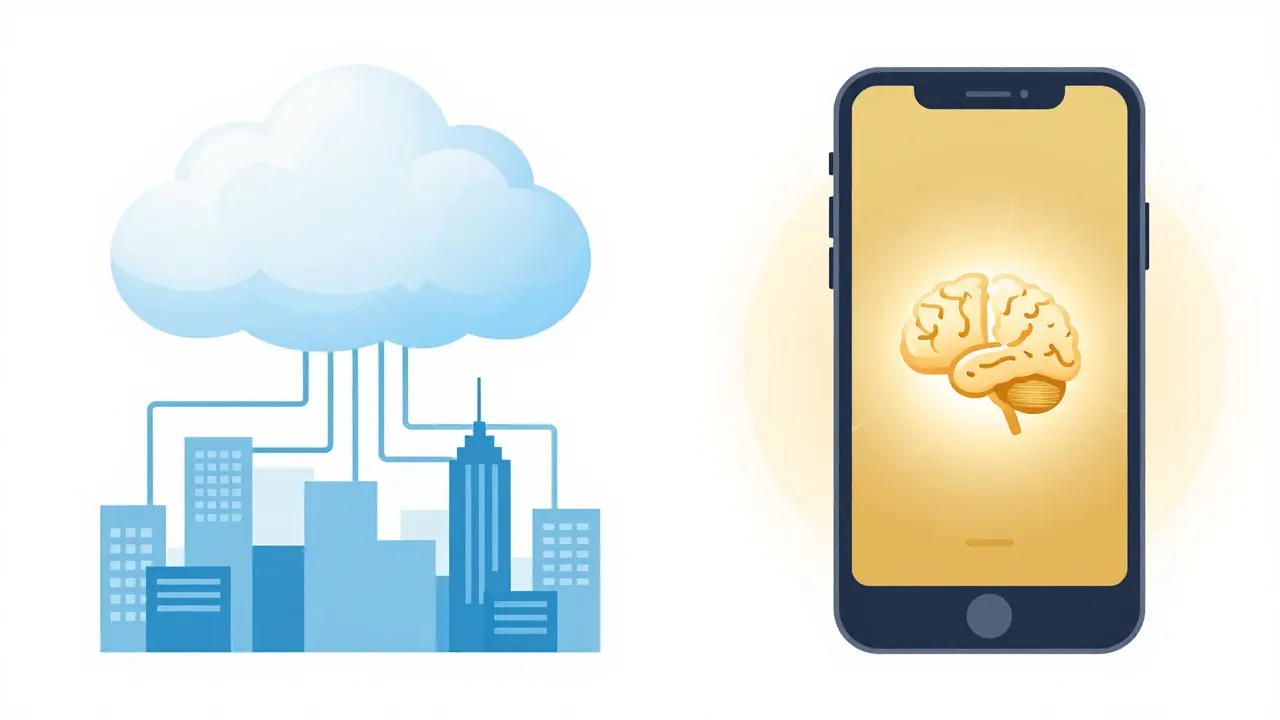
Imagine a world where your smartphone doesn't need to "think" by talking to a server thousands of miles away. Right now, most AI interactions involve a round trip: you ask a question, the data flies to a massive data center, a giant model processes it, and the answer flies back. But what if the intelligence lived entirely inside your pocket? That is the promise of on-device generative AI is the deployment of artificial intelligence models directly on local hardware like smartphones, wearables, and IoT devices to enable real-time processing without cloud reliance. This shift isn't just a technical tweak; it's a fundamental change in how we interact with machines, moving from centralized "brains" in the cloud to distributed intelligence at the edge.
The Great AI Split: Frontier Models vs. SLMs
We are seeing a clear bifurcation in AI development. On one side, you have the "frontier models"-behemoths like GPT-4 that require thousands of H100 GPUs and endless electricity. These are designed for maximum accuracy and complex reasoning, but they are far too heavy for a phone to run. On the other side, we have Small Language Models (or SLMs), which are designed to be lean, fast, and efficient. These models don't try to know everything about the universe; instead, they are optimized for specific tasks and local execution.
The goal here isn't to replace the cloud, but to create a hybrid system. You use the cloud for the heavy lifting-like training the model on massive datasets using tools like Google Vertex AI or AWS SageMaker-and then you deploy a compressed version of that intelligence to the device. This means your device can handle the immediate, personal tasks while the cloud handles the deep, complex research.
Killing the Lag: Why Latency Matters
If you've ever used a voice assistant and experienced that awkward two-second pause before it responds, you've felt latency. In a casual chat, that's annoying. In a self-driving car, it's fatal. When a vehicle needs to generate a synthetic scenario to navigate a sudden obstacle, it cannot afford to wait for a 5G signal to reach a server and come back. Edge AI eliminates this round-trip delay by processing data exactly where it is captured. By analyzing sensor data locally, the system can react in milliseconds, making a life-saving decision before the cloud would have even received the request.
This near-instant response is also what makes augmented reality (AR) actually feel real. If digital objects in your glasses lag behind your head movements by even a fraction of a second, you get motion sickness. By running generative models on-device, the AI can update the visual overlay in real-time, keeping the experience seamless and immersive.
Privacy That Actually Works
Most of us click "Accept" on privacy policies without reading them, but the reality is that sending your most intimate data-medical records, private conversations, or biometric scans-to a remote server is always a risk. On-device AI flips the script. Instead of moving the data to the model, we move the model to the data.
When your AI processes a voice command or analyzes a health metric on your wrist, that information never leaves the device. This is a game-changer for healthcare. Imagine a wearable that monitors a patient's heart rhythm and uses generative AI to flag anomalies instantly. Because the processing happens locally, the sensitive medical data stays encrypted on the hardware, satisfying strict regulations and giving users peace of mind.

Solving the Bandwidth Crunch
Generative AI is hungry for data. As more people use these tools, the pressure on global networks is skyrocketing. Every single prompt sent to a cloud AI consumes bandwidth. By offloading inference to the edge, we drastically reduce the amount of data traveling across the internet. This isn't just about saving money on data plans; it's about preventing network congestion. When the processing happens locally, the connection is freed up for other critical tasks, and the device remains fully functional even in "dead zones" where there is no internet at all.
Hyper-Personalization: An AI That Knows You
Cloud models are built to be generalists; they serve billions of people and provide an "average" response. But an on-device model can be a specialist. Because it lives on your device, it can learn your specific vocabulary, your unique speech patterns, and your daily habits without needing to upload that personal profile to a corporate server.
Think of a smart thermostat that doesn't just follow a schedule but learns exactly how you react to different temperatures based on the local weather and your current health data. Or a voice assistant that recognizes the difference between your voice and a stranger's, tailoring its responses based on who is actually speaking. This level of contextual awareness is only possible when the AI is deeply integrated into the local environment.
| Feature | Cloud-Based AI | On-Device (Edge) AI |
|---|---|---|
| Processing Power | Massive (GPU/TPU Clusters) | Limited (Mobile SoC/NPU) |
| Latency | High (Network Dependent) | Ultra-Low (Near-Instant) |
| Privacy | Data sent to external servers | Data stays on local hardware |
| Connectivity | Requires Constant Internet | Works Offline |
| Model Size | Large Frontier Models | Optimized SLMs |
Making the Impossible Possible: The Tech Behind the Shrink
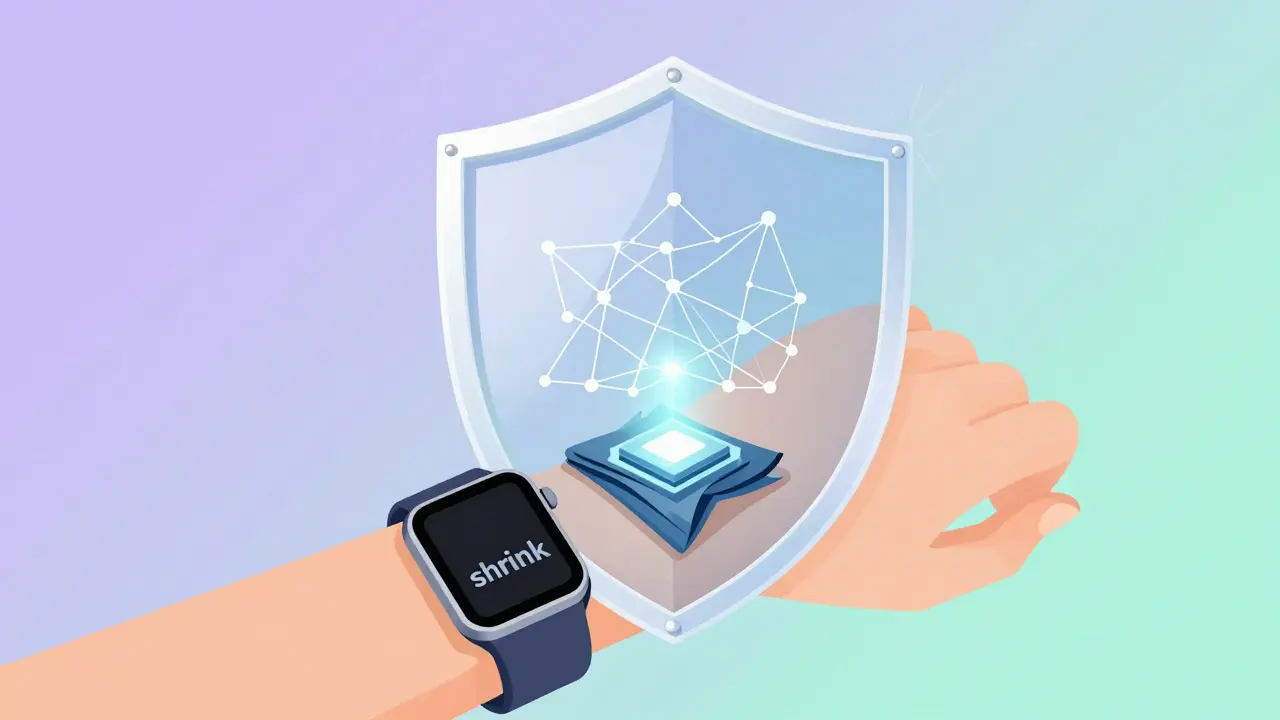
You might wonder how a model that normally requires a room full of servers can fit on a chip the size of a fingernail. The secret lies in a few key optimization techniques. First, there is Model Pruning, which involves cutting out the "dead weight"-neurons and connections in the neural network that don't contribute significantly to the output. It's like trimming a hedge to make it fit in a smaller space without losing its shape.
Then there is Quantization. Normally, AI models use high-precision numbers to do their math. Quantization reduces that precision (for example, moving from 32-bit floats to 8-bit integers). It's a bit like rounding 3.14159 to 3.14; you lose a tiny bit of accuracy, but the calculations happen much faster and take up far less memory.
Finally, developers use Knowledge Distillation. This is where a giant "teacher" model trains a tiny "student" model. The student learns to mimic the teacher's behavior, capturing the essence of the intelligence without needing the massive parameter count. Using tools like LiteRT or NVIDIA TensorRT, these optimized models are then packaged to run on the specific Neural Processing Units (NPUs) found in modern chips.
Real-World Deployments Today
This isn't sci-fi; it's already in your pocket. Google's Gemini Nano is a prime example of an SLM running directly on Android devices. Apple uses its Neural Engine to handle local Transformer models for things like autocorrect and live dictation. We're even seeing this in audio gear, where high-end earbuds can perform real-time language translation without needing to ping a server every time a word is spoken.
Does on-device AI mean my battery will drain faster?
Initially, running complex models can be power-intensive. However, modern chips include dedicated NPUs (Neural Processing Units) specifically designed to handle AI math efficiently. In many cases, processing locally is actually more energy-efficient than powering a high-speed 5G modem to send and receive massive amounts of data from a cloud server.
Will edge AI be as smart as GPT-4?
Not in a general sense. Frontier models have a vast amount of knowledge and reasoning capabilities that require massive scale. Edge AI is designed for "narrow" intelligence. While it won't write a PhD thesis on quantum physics as well as a cloud model, it will be faster and more accurate at tasks specific to you, like managing your calendar or controlling your home.
What happens if I lose internet connection?
That is one of the biggest wins. Since the model is stored locally on your device's flash memory, the AI continues to work. You can translate a phrase in a foreign country or control your smart home devices even if your router is down.
Is my data really safer on-device?
Yes, because the attack surface is smaller. Instead of your data traveling across the open web and sitting on a corporate server, it stays within the secure enclave of your device's hardware. While no system is 100% unhackable, removing the transmission phase eliminates a huge category of privacy leaks.
How do these models get updated?
They use a hybrid approach. The heavy retraining happens in the cloud using anonymized or aggregated data. Once the developers create a better version of the SLM, they push it to your device as a software update, similar to how your OS or apps are updated.
What to Expect Next
Looking ahead, we'll see a deeper integration of AI into the physical world. Robotics will move away from "cloud-brains" to fully autonomous local processing to ensure safety and speed. Your home security system will stop just "detecting motion" and start understanding complex scenes-like distinguishing between a delivery driver and a neighbor-entirely on the doorbell's chip.
The transition to edge computing is a structural shift. We are moving toward a future where intelligence is as ubiquitous as electricity-always there, always local, and completely invisible.
Elmer Burgos
April 15, 2026 AT 10:38it is really cool to see how the tech is moving toward more privacy and less lag. definitely feels like we are heading in a good direction for everyone
Honey Jonson
April 16, 2026 AT 07:02totally agree!! its just way better when stuff works offline. imagine being in the mountains and still havin your ai help u out without needin signal lol
Sally McElroy
April 17, 2026 AT 13:28The obsession with efficiency is merely a symptom of our cultural decay... we prioritize speed over the profound contemplation that true intelligence requires!!! It is a tragedy that we wish to shrink the mind just to fit it into a pocket!!!
Sara Escanciano
April 19, 2026 AT 09:54The absolute arrogance of thinking a "secure enclave" is enough is staggering. Corporate entities will find a way to scrape this data regardless of where it is processed. It is morally bankrupt to suggest that this solves the privacy crisis when the hardware itself is owned by the same people who want your data.
Destiny Brumbaugh
April 20, 2026 AT 08:34USA needs to lead this tech race or we're toasted!! Keep the chips and the SLMs made in America so we dont let other countries steal our edge. GOD BLESS THE US AND OUR TECH!!) USA USA USA!!