Privacy-Aware RAG: How to Stop LLM Data Leaks
 Nov, 26 2026
You built a Retrieval-Augmented Generation (RAG) system. It’s brilliant at answering questions using your company’s internal docs. But there’s a dirty secret lurking in the architecture: every time you send a query and retrieved context to a Large Language Model (LLM), you might be handing over sensitive data on a silver platter. If that model is hosted by a third party like OpenAI or Anthropic, those passwords, social security numbers, and patient records just left your secure perimeter.
This isn’t hypothetical. A Lasso Security analysis from May 2024 revealed that 68% of early RAG implementations exposed sensitive data through unredacted prompts or source documents. That’s nearly seven out of ten companies leaking secrets before they even got their first invoice paid. Enter Privacy-Aware RAG, a specialized architecture designed to prevent sensitive data exposure when integrating external knowledge sources with Large Language Models. It’s not just about encryption; it’s about surgical precision in what data leaves your building.
The Core Problem: Why Standard RAG Bleeds Data
Standard RAG works in three steps: retrieve relevant chunks from a vector database, stuff them into a prompt, and ask the LLM to synthesize an answer. The vulnerability lies in step two. When you paste retrieved text into the prompt, you are often pasting raw, unfiltered content. If your document contains a credit card number or a HIPAA-protected diagnosis, that string travels across the internet to the LLM provider’s servers.
For regulated industries, this is a compliance nightmare. GDPR, HIPAA, and CCPA don’t care if your RAG system is "smart" if it leaks Personally Identifiable Information (PII). K2View’s January 2024 whitepaper noted that enterprises implementing privacy-preserving techniques saw a 92% reduction in data leakage incidents. Without these safeguards, you’re essentially betting your legal team’s sanity on the assumption that no one will reverse-engineer your embeddings or store your prompts for training purposes.
Two Architectural Paths: Prompt-Only vs. Source Documents Privacy
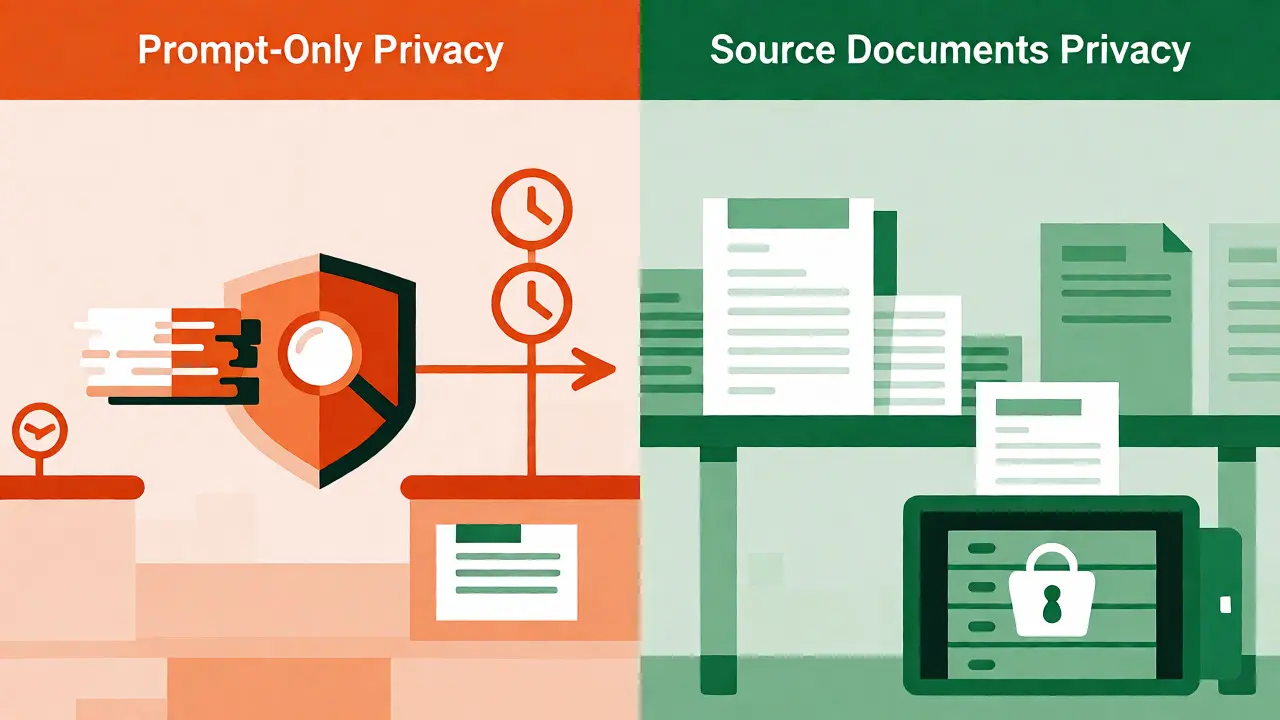
When you decide to implement Privacy-Aware RAG, you have to choose where to scrub the data. There are two main approaches, each with distinct trade-offs in latency, accuracy, and infrastructure costs.
| Feature | Prompt-Only Privacy | Source Documents Privacy |
|---|---|---|
| Process Type | Online, real-time | Offline, batch processing |
| Latency Impact | 150-300ms per transaction | Reduces real-time latency by 35-50% |
| Storage Overhead | Minimal | 20-40% more capacity needed |
| Data Exposure | Redacts only during transmission | Raw sensitive data never reaches embedding service |
| Best For | Dynamic queries, low-volume apps | High-volume enterprise search, static docs |
Prompt-only privacy acts as a gatekeeper right before the API call. As defined by Private AI, this method scans the input prompt and retrieved context, redacting PII in real-time. It’s fast enough for most user-facing applications, but it adds noticeable latency. If your app needs sub-second responses, this overhead can feel sluggish.
Source documents privacy takes a different tack. You clean the data *before* you chunk and embed it. This means the vector database itself contains anonymized text. Salesforce’s Q2 2024 assessment showed this reduces real-time processing latency significantly because the heavy lifting is done offline. The catch? You need more storage for metadata layers, and if you need to re-embed, you’re looking at significant compute costs.
The Accuracy Trade-Off: Scrubbing vs. Understanding
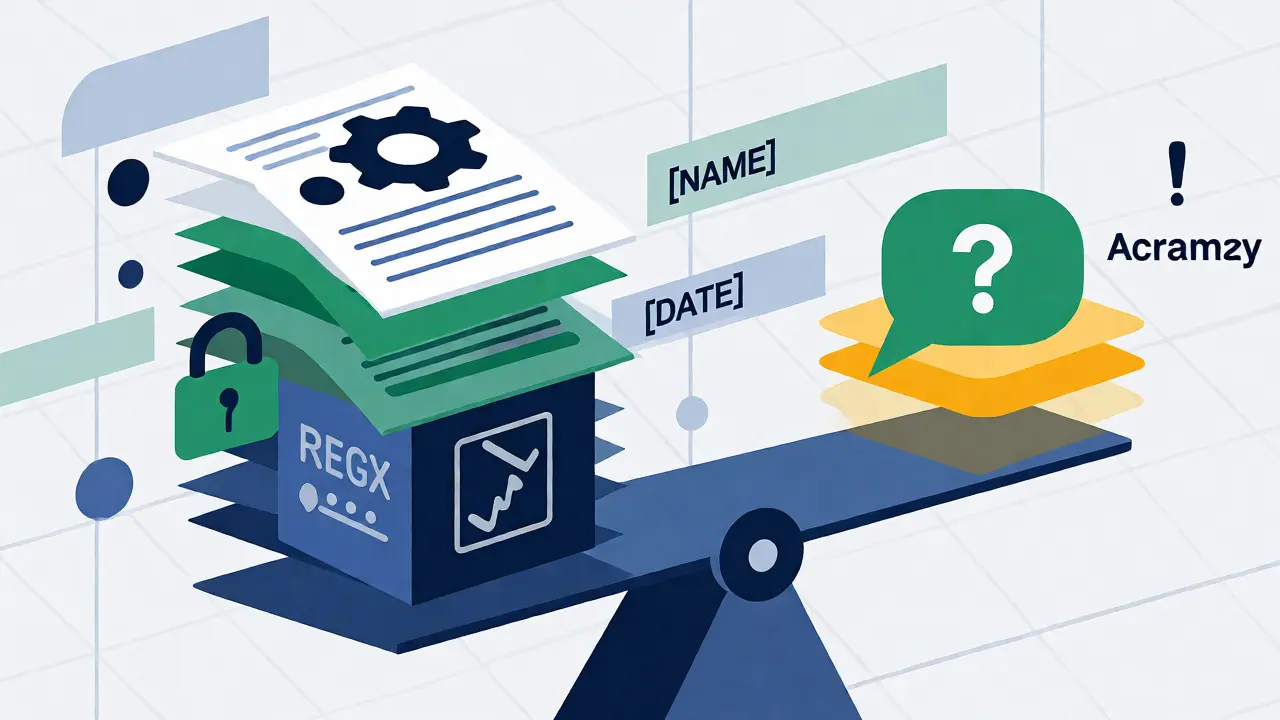
Here is the uncomfortable truth: privacy hurts accuracy. When you replace names, dates, or financial figures with placeholders like `[NAME]` or `[DATE]`, you strip context from the LLM. Standard RAG systems achieve about 92.3% factual accuracy in enterprise retrieval tasks. Privacy-Aware RAG with aggressive redaction drops this to 88.7%.
Why does this matter? Imagine asking, "What was John Doe's salary in 2023?" If the LLM sees `John Doe's salary was $[AMOUNT]`, it can’t give you the specific number unless it retrieves the original unredacted doc separately. Google Cloud’s November 2024 case study with healthcare clients showed that optimized redaction thresholds could narrow this gap to just 2.1%. But getting there requires tuning.
Over-redaction creates another problem: hallucinations. Professor David Kim from MIT warned in June 2024 that insufficient context can increase factual errors by up to 18%. If you remove too much surrounding text, the LLM might guess the missing piece incorrectly. It’s a balancing act between hiding the secret and keeping the story coherent.
Technical Implementation: Layers of Defense
You can’t just slap a regex filter on your data and call it a day. Effective Privacy-Aware RAG uses layered defenses.
- Dynamic Data Masking: This isn't just hiding characters; it's preserving format. A masked SSN should still look like an SSN (`XXX-XX-1234`) so the LLM understands it's an identifier, not a random string. K2View specifies that PII detection must hit 99.98% accuracy to meet strict compliance standards.
- Role-Based Access Control (RBAC): Not everyone needs to see everything. Gartner’s August 2024 survey found that 78% of enterprise RAG systems use RBAC to restrict data access based on user permissions. An intern shouldn’t retrieve executive compensation data.
- Vector Database Encryption: Even if the text is redacted, the embeddings themselves can sometimes leak semantic meaning. Palo Alto Networks identified that encrypting vector databases reduces unauthorized access risks by 87%.
Most successful implementations combine rule-based redaction for structured data (like credit cards, which have fixed patterns) with contextual AI models for unstructured text. Rule-based methods hit 99.95% accuracy for PCI DSS compliance, while AI-driven redaction for free-text narratives hovers around 87.4%. You need both.
Real-World Consequences: Successes and Failures
Let’s look at what happens when this goes right-and wrong.
A global insurance company deployed Privacy-Aware RAG across 12,000 agents. They achieved 99.8% PII protection while maintaining 89% answer accuracy. Sounds great, right? It took six months of development and $385,000 in customization. The learning curve is steep. Organizations report needing 8-12 weeks of dedicated effort just for initial implementation.
On the flip side, consider a healthcare provider in Q2 2024. They implemented RAG but failed to adequately redact medical record numbers. The result? A HIPAA violation affecting 14,000 patients. The HHS Office for Civil Rights enforcement action highlighted that "insufficient redaction" is a leading cause of breaches. It wasn’t a sophisticated attack; it was a configuration error.
User feedback mirrors this complexity. On Reddit’s r/MachineLearning, engineers praised the "compliance confidence" gained from these systems. However, Trustpilot reviews frequently cite "complex configuration requirements" and "performance degradation during peak usage." If you underestimate the tuning required, your users will feel the lag.
Market Trends and Future Proofing
The market is moving fast. The Privacy-Aware RAG segment is projected to hit $2.8 billion by 2026, growing at a 63% CAGR. Financial services lead adoption at 58%, driven by FINRA regulations. Healthcare follows at 47%.
New tools are emerging to help. Private AI released version 2.3 in October 2024 with "adaptive redaction thresholds," which dynamically adjust based on query context. This reduced over-redaction by 31% in benchmarks. Google Cloud’s Vertex AI now offers "context-aware redaction," achieving 93.2% accuracy in healthcare docs compared to standard methods.
However, challenges remain. Multilingual support is weak; current tools only achieve 76.4% accuracy for non-English PII. And fine-tuning? Most organizations still struggle to keep private data safe during that process. If you’re planning a long-term strategy, assume that privacy techniques will face new countermeasures every 12-18 months, according to MIT research.
Does Privacy-Aware RAG completely eliminate data leakage?
No system is perfect. While source-document privacy prevents raw sensitive data from reaching embedding services, prompt-only methods rely on real-time detection. False negatives can occur, especially with complex, context-dependent PII. Continuous monitoring and adversarial testing are required to maintain high protection levels.
How much does Privacy-Aware RAG slow down my application?
It depends on the approach. Prompt-only privacy adds 150-300ms per transaction due to real-time scanning. Source-document privacy shifts this load to offline processing, potentially reducing real-time latency by 35-50%. However, the overall system complexity may introduce other bottlenecks if not properly engineered.
Can I use open-source tools for Privacy-Aware RAG?
Yes, but expect gaps. Open-source toolkits average 3.2/5 in documentation quality. Commercial solutions like Private AI or cloud-native features from Google/AWS offer better integration and support. If you go open-source, budget extra time for custom entity recognition models, especially for domain-specific jargon.
What skills do I need to implement this?
You need a mix of NLP expertise, data security knowledge, and LLM operations experience. Proficiency with frameworks like LangChain or LlamaIndex is common, along with understanding vector databases like Pinecone or Weaviate. Knowledge of differential privacy concepts is increasingly requested in job postings.
Is air-gapping a better alternative than Privacy-Aware RAG?
Air-gapping eliminates third-party exposure entirely but increases implementation costs by 4-7x. It also limits access to state-of-the-art LLMs unless you host massive local clusters. Privacy-Aware RAG offers a middle ground, allowing cloud-scale performance with managed risk, making it viable for most enterprises.
adam pohan
November 26, 2026 AT 11:47It is frankly disgusting how corporations treat our personal data like it's just another line item on a spreadsheet they can fudge whenever the quarterly earnings look bad. You spend years building up a digital footprint, trusting these companies to keep your information safe, and then some engineer decides that sending your social security number to an external API for convenience is totally fine because they didn't read the compliance manual. This isn't just about technical inefficiency or latency issues; it is a moral failure of epic proportions where profit margins are prioritized over human dignity and basic privacy rights. The fact that sixty-eight percent of early implementations leaked data proves that these tech giants don't actually care about us as individuals but only as sources of revenue extraction. We should be outraged every single time we see one of these headlines because it means our trust has been betrayed yet again by people who think encryption is optional if it slows down their user experience metrics. It really makes you wonder what else they are doing behind closed doors with our information while we sit here happily clicking agree on terms of service agreements we never read. The arrogance of assuming that third-party providers will respect our boundaries is staggering when you consider the history of data breaches in this industry alone. We need to stop accepting this as normal behavior and start demanding accountability from the top down instead of letting middle management shrug it off as a technical hurdle. If they cannot handle our data responsibly then maybe they shouldn't be allowed to process it at all until they prove they can do so without selling our souls to the highest bidder. This whole situation highlights the deep disconnect between corporate values and actual ethical standards that society expects from modern businesses operating in the digital age.
Alice Clark
November 26, 2026 AT 17:24they're not trying to fix it they're trying to monetize the leak itself
think about it why would openai or anthropic want to solve a problem that gives them free training data disguised as customer support tickets the architecture isn't broken its working exactly as intended to siphon context into their latent space
we pretend we have control but were just feeding the beast crumbs of our lives hoping it doesn't bite back hard enough to notice the pattern
privacy aware rag is just a placebo for the masses who refuse to accept that privacy is dead long before llms arrived we just didn't realize the corpse was walking around wearing a chatbot skin
Kevin Ching
November 26, 2026 AT 18:29This is such a crucial topic for anyone building AI applications right now! I love seeing detailed breakdowns like this because it helps demystify the complex trade-offs involved in production systems. The comparison between prompt-only and source-document privacy is particularly helpful for teams deciding on their initial architecture. Keep up the great work sharing these insights!
Arundhati M
November 27, 2026 AT 21:52The distinction between online real-time redaction and offline batch processing is indeed pivotal for enterprise scalability. However, I must emphasize that relying solely on regex-based masking for structured PII often fails to capture contextual nuances in unstructured narratives, leading to potential false negatives. Implementing a hybrid approach utilizing both deterministic rules and probabilistic NER models is essential for achieving the stated 99.98% detection accuracy. Furthermore, vector database encryption must be coupled with strict RBAC protocols to prevent semantic leakage through embedding spaces, which remains a significant attack vector in current deployments.