Procurement of AI Coding as a Service: Contracts and SLAs
 Jul, 24 2026
Buying software used to be simple. You picked a vendor, signed a contract, and hoped the code worked. Today, when you buy AI Coding as a Service (AI CaaS), cloud-based artificial intelligence solutions that provide automated code generation, debugging, optimization, and documentation capabilities, you are buying a black box that writes your mission-critical infrastructure. For government agencies and large enterprises, this shift has turned procurement from a clerical task into a high-stakes negotiation over security, accuracy, and intellectual property.
The landscape changed drastically in August 2025 when the General Services Administration (GSA) added major players like OpenAI, Google, and Anthropic to its Multiple Award Schedule. This move streamlined access to tools like GitHub Copilot and Vertex AI for civilian agencies, but it also raised the stakes. With the federal AI contracts market hitting $20 billion by late 2025, the old playbook no longer works. If you are drafting a contract for AI-generated code today, you need more than just standard IT clauses. You need specific Service Level Agreements (SLAs) that address hallucination rates, data privacy, and compliance with frameworks like the NIST AI Risk Management Framework.
Defining the Scope: What Are You Actually Buying?
Before writing a single clause, you must define what "AI Coding" means in your context. AI CaaS is not a monolith. It ranges from simple autocomplete features in an Integrated Development Environment (IDE) to complex backend systems that generate entire microservices. The Department of Defense’s Chief Digital and Artificial Intelligence Office (CDAO) reported in April 2025 that AI tools accelerated contract drafting by 67%, but that speed comes with complexity.
Your scope of work should explicitly state whether the AI is acting as a co-pilot (assisting human developers) or an autopilot (generating deployable code with minimal oversight). Most government contracts currently favor the co-pilot model due to liability concerns. Brian Esposito, Deputy Secretary of Procurement for the Pennsylvania Department of General Services, noted in StateTech Magazine that AI helps streamline scopes of work, but only if those scopes are technically sound. Ambiguity here leads to integration failures later. Be specific about the programming languages involved-Python, Java, C++, etc.-and the expected output format. Vague requests lead to vague results.
Critical SLA Metrics for AI Code Generation
Traditional IT SLAs focus on uptime and response time. AI CaaS SLAs must go further. You cannot measure success solely by whether the server is online; you must measure whether the code is correct. Based on GSA guidance and OMB Memorandum M-25-22, here are the non-negotiable metrics you should include in your contracts:
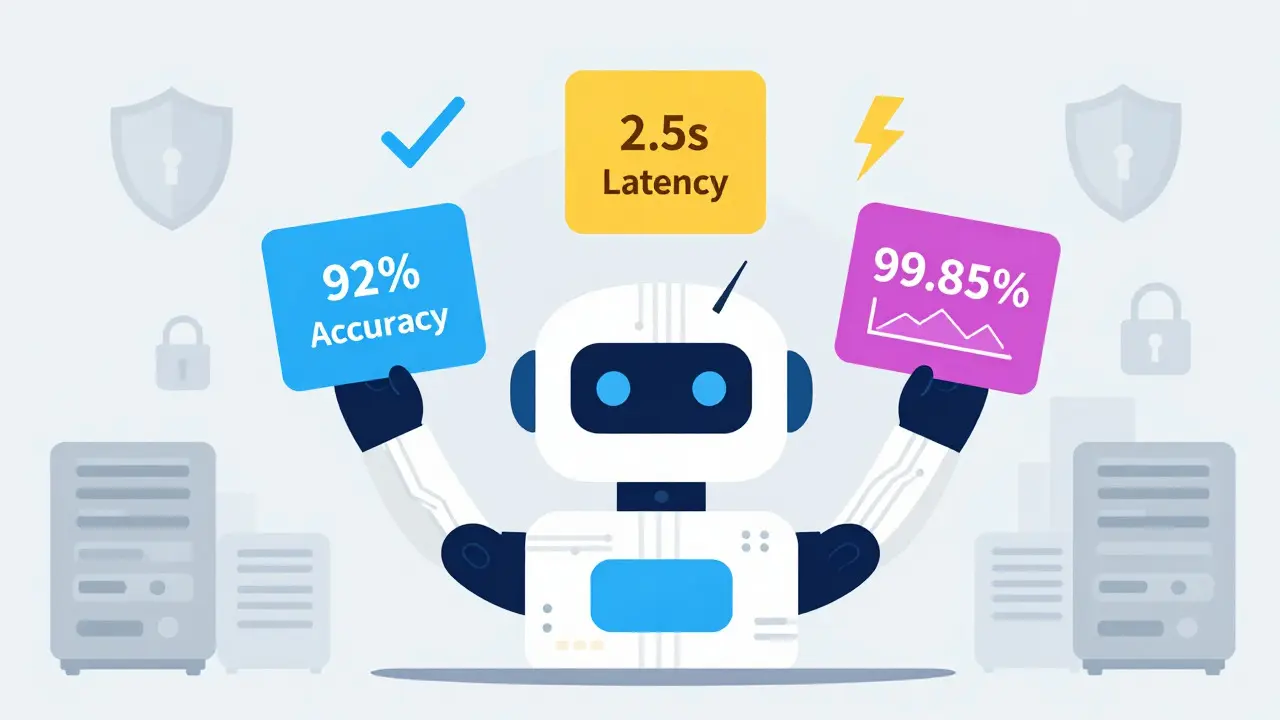
- Code Output Accuracy: Require a minimum 92% accuracy rate for generated code snippets, verified through third-party testing. This isn't just about syntax; it's about functional correctness against defined test cases.
- Latency Constraints: Set a maximum response time of 2.5 seconds for 95% of code generation requests. Slow AI breaks developer flow, reducing adoption and productivity.
- Uptime and Availability: Demand at least 99.85% availability. Include financial penalties, such as 0.5% of monthly contract value for every 0.1% drop below this threshold.
- Bias Detection: Mandate regular audits for algorithmic bias in code suggestions, particularly in algorithms affecting public services or hiring processes.
These numbers aren't arbitrary. They come from real-world assessments where agencies found that lower accuracy rates led to hours of manual debugging, negating any time savings. Without these hard metrics, vendors can claim success while delivering mediocre, error-prone code.
Security and Compliance: The FedRAMP Factor
Security is the biggest hurdle in AI CaaS procurement. Unlike commercial SaaS products, government contracts require rigorous validation. Your contract must mandate adherence to the NIST AI Risk Management Framework. This framework provides guidelines for managing risks associated with AI systems, ensuring they are safe, trustworthy, and reliable.
Specifically, ensure the following security protocols are embedded in the agreement:
- FedRAMP Moderate Compliance: The AI service must operate within a FedRAMP Moderate environment. As of 2025, GSA assessments showed that government-specific AI contracts achieve 100% FedRAMP Moderate compliance, compared to only 63% for general commercial alternatives.
- Data Isolation: Prohibit the vendor from using your agency’s code to train their foundational models without explicit written consent. This prevents sensitive government logic from leaking into public models.
- Encryption Standards: Require end-to-end encryption for all code snippets in transit and at rest. Quarterly penetration testing by accredited third parties should be mandatory.
- Air-Gapped Options: For highly sensitive projects, demand air-gapped deployment options where the AI runs locally without internet connectivity.
The Government Accountability Office warned in September 2025 that many proposals fail to address legacy system integration, leading to issues in 43% of initial deployments. Your security clause must account for how the AI interacts with older, mainframe-based systems common in federal agencies.
Intellectual Property and Liability Clauses
Who owns the code the AI writes? This question keeps legal teams up at night. In traditional contracting, the buyer owns the deliverables. In AI CaaS, the line blurs. If the AI generates code based on training data from open-source repositories, does your agency inherit licensing obligations? Does the vendor retain rights to the optimized patterns?
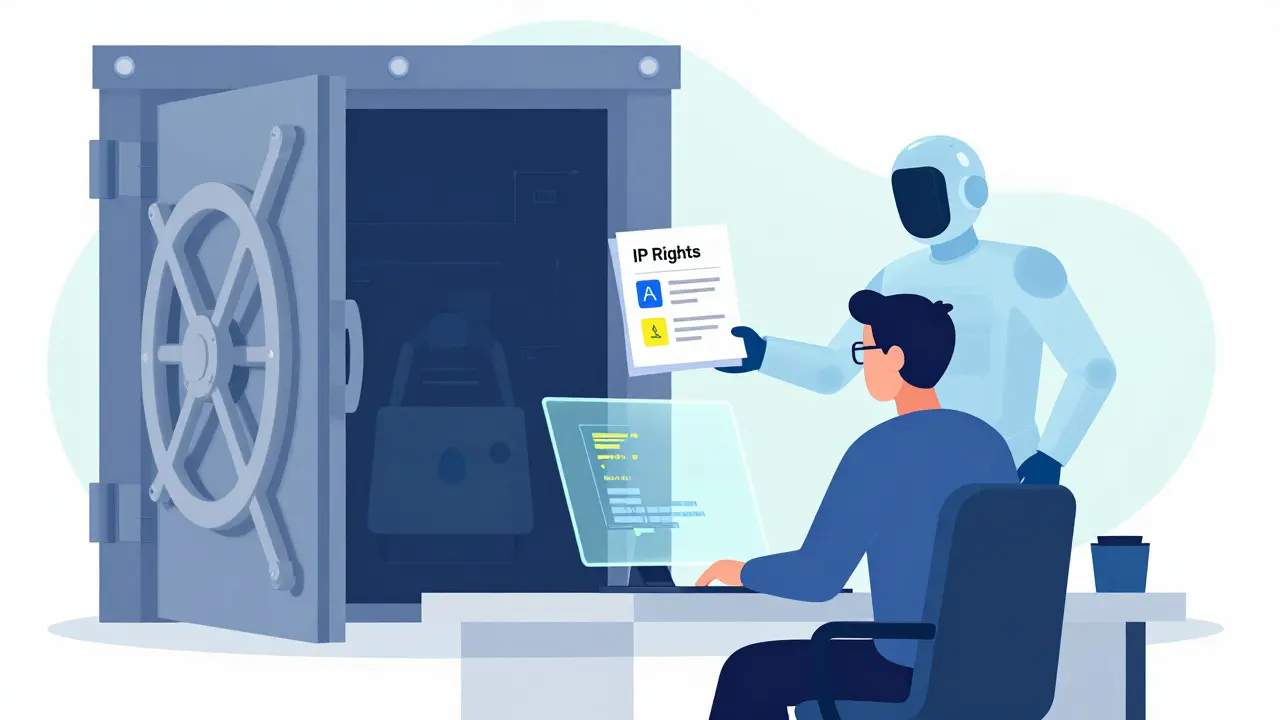
Your contract must clearly assign intellectual property (IP) rights. A standard approach is to stipulate that the government owns all outputs generated during the contract period, free of third-party claims. Reference FAR clauses 52.227-14 and 52.227-17 regarding restricted rights and technical data. Additionally, include a warranty clause where the vendor indemnifies the agency against IP infringement lawsuits arising from AI-generated code. Without this, your agency could face costly litigation if the AI inadvertently reproduces proprietary code from another source.
Liability for "hallucinations" is another critical area. If the AI suggests a vulnerable code pattern that leads to a breach, who pays? While most vendors try to limit liability, push for shared risk models where significant negligence in model maintenance triggers vendor responsibility. The Congressional Budget Office noted in November 2025 that resolving these IP ambiguities is key to the long-term viability of AI CaaS in government.
Comparing Commercial vs. Government AI CaaS Models
Understanding the difference between off-the-shelf commercial tools and government-tailored contracts helps set realistic expectations. Here is how they stack up:
| Feature | Commercial Offering (e.g., GitHub Copilot) | Government Contract (GSA Schedule) |
|---|---|---|
| Pricing Model | Per-user subscription ($10/user/month) | Fixed-price or Time-and-Materials via SIN 54151-9 |
| Compliance | Varies (63% FedRAMP Moderate) | Mandatory 100% FedRAMP Moderate |
| Update Velocity | Fast (1.7 months between updates) | Slower (4.2 months between updates) |
| Implementation Time | Quick (~28 days) | Extended (~117 days) |
| Support | Standard customer service | 24/7 with Security+ certified staff |
While commercial tools offer faster feature updates, government contracts prioritize stability and security. Do not expect the rapid iteration cycles of Silicon Valley in a federal contract. Instead, plan for longer implementation timelines but gain peace of mind through rigorous compliance checks.
Implementation Challenges and Mitigation Strategies
Even with a perfect contract, implementation can stumble. The Deltek Government Contracting Survey found that 52% of agencies cited challenges with AI hallucinations requiring extensive human review. To mitigate this, build a "human-in-the-loop" requirement into your operational procedures. No AI-generated code should reach production without peer review by certified developers.
Training is another hidden cost. Contracting officers need 8.2 weeks on average to become proficient in evaluating AI CaaS proposals. Invest in early training for your team on AI model validation techniques and code quality metrics. Use resources like the GSA’s AI Vendor Assessment Toolkit, released in October 2025, to pre-screen vendors before issuing Requests for Proposals (RFPs).
Finally, monitor performance continuously. Don’t wait until the annual review. Implement real-time dashboards that track the SLA metrics we discussed earlier-accuracy, latency, and uptime. If a vendor consistently misses the 92% accuracy mark, trigger corrective action plans immediately. The Partnership for Public Service warns that contractors relying solely on compliance are being outpaced by those offering deployable, use-case-specific solutions. Stay agile, even within rigid contractual frameworks.
What is the minimum code accuracy rate required for government AI CaaS contracts?
Based on GSA guidance and OMB Memorandum M-25-22, the recommended minimum code output accuracy rate is 92%. This metric should be verified through third-party testing to ensure the generated code is functionally correct and secure.
How do I protect my agency's intellectual property when using AI coding tools?
Include explicit clauses in your contract stating that the government owns all AI-generated outputs. Prohibit the vendor from using your agency's code to train their foundational models without written consent. Reference FAR clauses 52.227-14 and 52.227-17 to secure restricted rights and indemnify against third-party IP claims.
Is FedRAMP compliance mandatory for AI CaaS providers?
Yes, for federal agencies handling moderate-level data. Your contract should mandate FedRAMP Moderate compliance. As of 2025, government-specific AI contracts aim for 100% compliance, significantly higher than the commercial average of 63%.
What are the typical SLA penalties for downtime in AI CaaS contracts?
A common penalty structure is a reduction of 0.5% of the monthly contract value for every 0.1% the provider falls below the 99.85% uptime threshold. These financial incentives ensure vendors prioritize system availability.
How long does it take to implement an AI CaaS solution in a government agency?
Government implementations typically take around 117 days, compared to 28 days for commercial deployments. This longer timeline accounts for rigorous security reviews, FedRAMP authorization, and integration with legacy systems.