Prompt Sensitivity Analysis: Why Your LLM Scores Change with One Word
 Apr, 5 2026
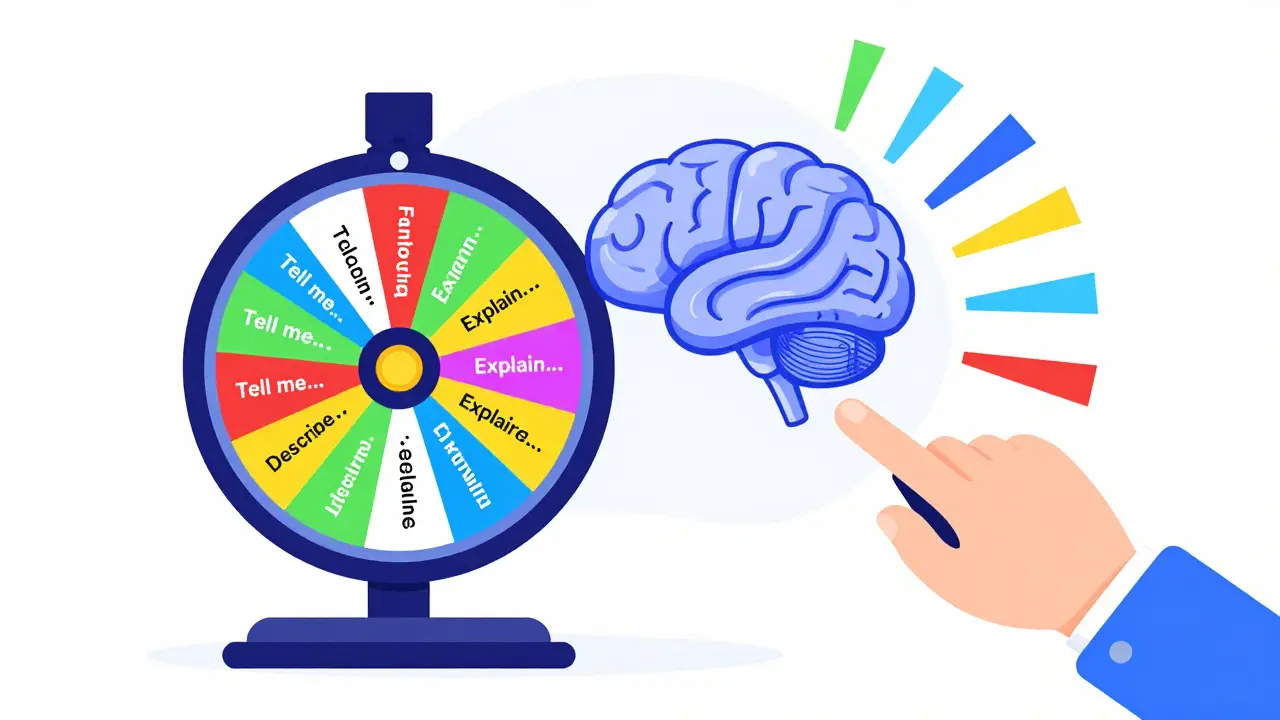
Imagine spending three days perfecting a prompt for a customer support bot, only to find that adding a single comma crashes your production system. It sounds like a nightmare, but for many developers, it's a daily reality. This instability is known as prompt sensitivity-the frustrating tendency of Large Language Models (LLMs) to give wildly different answers to the same question just because you changed a few words. If you've ever noticed that a model is a genius with one phrasing but completely loses the plot with another, you've encountered the 'prompt lottery'.
The core problem is that most LLM evaluation benchmarks are flawed. They usually test a model with one single prompt and assume that score represents the model's actual capability. But as Professor Percy Liang from Stanford has pointed out, this creates a dangerous illusion. We aren't measuring how smart the model is; we're measuring how good the human is at guessing the exact magic words the model wants to see.
What Exactly is Prompt Sensitivity Analysis?
Prompt Sensitivity Analysis (PSA) is a systematic way to measure how much a model's performance swings when you change the wording of an instruction without changing its meaning. Instead of relying on one prompt, PSA tests a variety of semantically equivalent versions of that prompt to see if the model stays consistent.
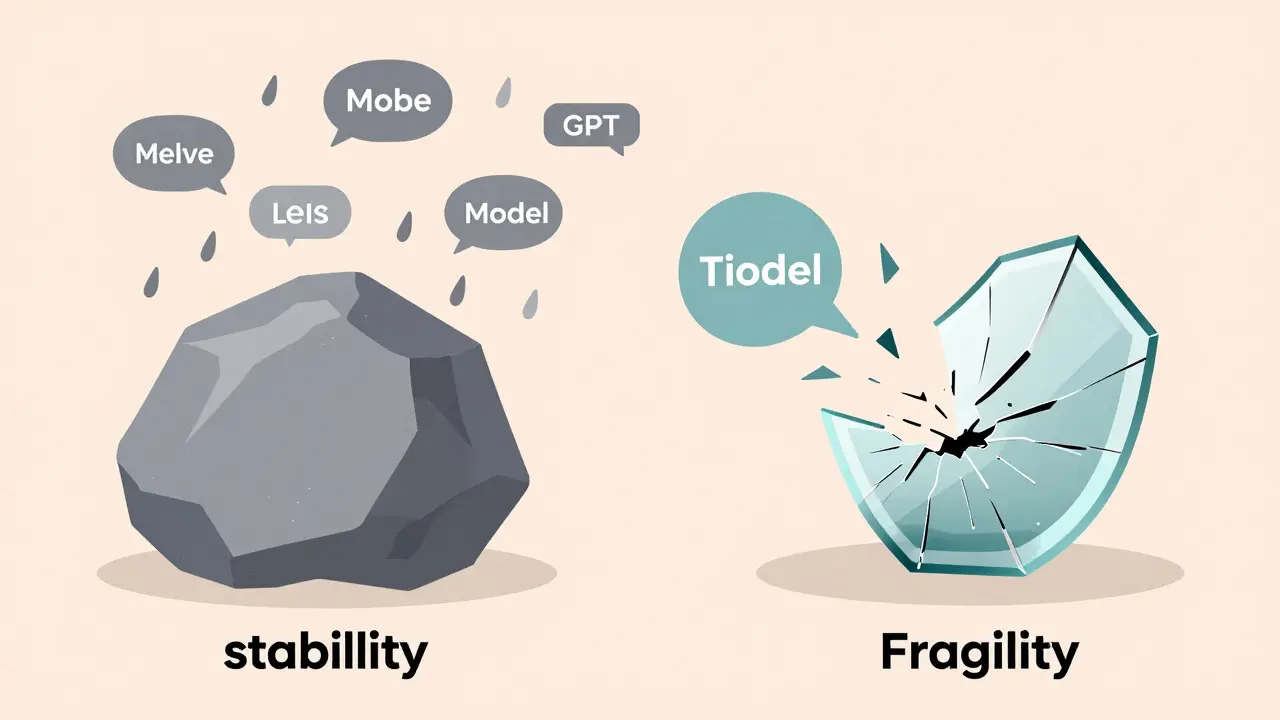
A major breakthrough in this field came in October 2024 with the introduction of ProSA. This framework allows researchers to quantify this instability using a specific metric called the PromptSensiScore (PSS). The PSS ranges from 0 to 1. If a model has a score near 0, it's a rock; it doesn't care how you ask the question. If it's closer to 1, it's volatile, and its outputs are unpredictable.
To put this in perspective, look at Llama-2-70B-chat. Research showed its performance metrics varied from 0.094 to 0.549 across different prompt variants. That is a 463% variation for the exact same task. That's not a lack of knowledge; it's a lack of robustness.
How Instructions Directly Impact Model Scores
Not all models react to prompt changes in the same way. Generally, size matters. Larger models tend to be more stable. For instance, Llama3-70B-Instruct showed a significant improvement in stability over its smaller sibling, Llama3-8B-Instruct, with a much lower PSS score. This suggests that as models get more parameters, they develop a better understanding of intent rather than just pattern-matching keywords.
However, size isn't the only factor. The type of task you're asking the model to do changes the sensitivity level. Reasoning-heavy tasks, like those found in the GSM8k math benchmark, are 37% more sensitive than simple factual recall. When a model has to "think" through a problem, the specific way the problem is framed can lead it down different logical paths, some of which lead to dead ends.
| Model Entity | Sensitivity Level (PSS) | Performance Variance | Stability Note |
|---|---|---|---|
| GPT-4-turbo | Low | < 15 percentage points | Highly Robust |
| Llama3-70B-Instruct | Low (0.21) | Moderate | Strong Stability |
| Llama3-8B-Instruct | Medium (0.37) | Significant | Variable |
| Llama-2-13B | High | > 50 percentage points | Very Fragile |
The Link Between Confidence and Consistency
One of the most interesting findings in PSA is that sensitivity isn't random. It's actually a window into the model's internal uncertainty. Researchers found that when a model has a high PSS score (above 0.75), its decoding confidence drops by 32%. In plain English: when the model is unsure how to answer, it becomes hypersensitive to how you ask the question.
This is why some prompts feel like "magic spells." You've accidentally stumbled upon the specific phrasing that triggers the model's highest confidence path. But relying on these spells is risky. If you change a single word in a production environment, you might shift the model from a high-confidence state to a low-confidence state, leading to the "nonsensical" responses reported by developers on forums like r/LocalLLaMA.
Practical Ways to Reduce Prompt Sensitivity
If you're building an application and can't afford a 400% swing in quality, you need a strategy to stabilize your outputs. You don't have to just keep guessing. Here are a few proven methods to lower your PSS:
- Use Few-Shot Prompting: Providing 3-5 relevant examples of the desired input and output reduces sensitivity by an average of 28.6%. It gives the model a concrete pattern to follow, which outweighs the influence of minor wording changes.
- Implement Generated Knowledge Prompting: According to a Scale AI case study, this technique can cut sensitivity by 63% while actually boosting accuracy. Instead of asking for the answer immediately, ask the model to generate facts about the topic first, then use those facts to answer the final question.
- Test Semantic Variants: Don't settle for one "best" prompt. Use tools like the ProSA toolkit or PromptLayer to generate 12-15 variations of your prompt. If the model gives different answers across these variations, your prompt is fragile and needs more constraints.
The Business Risk of "Prompt Fragility"
For enterprises, this isn't just a technical curiosity-it's a financial risk. A recent survey by Gartner found that prompt sensitivity accounted for 38% of production failures in LLM applications. Financial services are hit hardest, seeing over twice as many failures as other sectors. Why? Because in finance, a slight change in how a regulation is phrased in a prompt can lead to a completely different (and potentially illegal) interpretation by the AI.
We're seeing a shift in how companies deploy AI. Instead of just "prompt engineering," we're seeing the rise of "prompt robustness testing." The EU AI Office is even drafting guidelines that may require high-risk AI applications to prove they are robust across predefined variation sets. If you can't prove that your AI behaves consistently regardless of minor phrasing changes, you might not be able to deploy it in certain regulated markets.
What is the difference between prompt engineering and prompt sensitivity analysis?
Prompt engineering is the act of trying to find the *best* prompt to get a high-quality result. Prompt sensitivity analysis is the process of testing *how many different* prompts yield that same result. While engineering looks for the peak performance, PSA looks for the stability of that performance.
Does using a larger model always solve the sensitivity problem?
Generally, yes. Larger models like Llama3-70B or GPT-4-turbo are significantly more stable than smaller models. However, they aren't immune. Even the most advanced models show increased sensitivity during complex reasoning tasks compared to simple factual retrieval.
How can I calculate the PromptSensiScore (PSS) for my own project?
You can use the open-source ProSA toolkit on GitHub. Essentially, you create about 12 semantic variations of your prompt, run them through your model, and then use embedding-based comparisons (cosine similarity) to measure how much the outputs differ. The higher the average discrepancy, the higher your PSS.
Why does few-shot prompting reduce sensitivity?
Few-shot prompting provides a structural anchor. By showing the model exactly what the input looks like and what the output should be, you reduce the model's reliance on the specific wording of the instruction. It shifts the model's focus from interpreting a sentence to following a demonstrated pattern.
Is prompt sensitivity a permanent flaw in LLMs?
Some researchers at Anthropic believe it's a fundamental limitation of next-token prediction. However, others at Stanford HAI project that architectural improvements could reduce this sensitivity by 60-75% over the next few years as models move beyond simple pattern matching toward true semantic understanding.
Next Steps for Developers
If you're currently deploying LLMs, stop trusting a single "golden prompt." Start by generating 5-10 variations of your core instructions-change the formality, reorder the requirements, or swap synonyms. If your model's accuracy swings by more than 10% across these versions, you have a robustness problem.
For those in high-stakes industries like healthcare or finance, the next step is implementing an automated testing pipeline. Use a tool like PromptRobust or the ProSA framework to integrate sensitivity scoring into your CI/CD process. Your goal shouldn't be to find the one prompt that works, but to build a system where the prompt doesn't matter as much as the intent.
Chris Atkins
April 5, 2026 AT 11:43man this is so real i spent like two days fighting with a model just cause i used "please" instead of "you must" and the whole thing just broke lol
Wilda Mcgee
April 7, 2026 AT 08:50The few-shot prompting tip is a total lifesaver! It's like giving the AI a little map to follow instead of leaving it to wander in a foggy forest of tokens. I've found that adding just three punchy examples can turn a chaotic response into a masterpiece of consistency. It really streamlines the whole workflow and saves so much sanity during the debugging phase!
Madeline VanHorn
April 7, 2026 AT 20:48Imagine not knowing this already. It's basic stuff for anyone who actually knows what they're doing with AI. Most of you are just playing with toys and calling it engineering. If your prompts are this fragile, maybe you're just not cut out for the tech world. It's honestly sad that this needs to be explained in such simple terms because the concept is so obvious to anyone with a real brain. You people love these "magic spells" because you can't actually handle the logic. Just use a bigger model if you're too lazy to fix your wording. I can't believe people still struggle with this in 2024. It's just a matter of being better at your job. Maybe try reading a book on actual computer science instead of skimming blogs. The fact that 38% of production failures are due to this is just a reflection of the low quality of current developers. It's a joke. Totally a joke. Get a grip on your basic logic before you try to ship code to a client. This is just embarrassing for the industry. Truly pathetic.
Glenn Celaya
April 9, 2026 AT 08:56lol imagine actually caring about PSS scores when u cant even write a clean line of python first. the industry is just full of mid devs pretending to be architects now. its all just fluff and buzzwords anyway
Chuck Doland
April 10, 2026 AT 18:50It is quite profound to consider that these instabilities are not merely technical glitches, but rather a reflection of the stochastic nature of token prediction. By treating the model's uncertainty as a signal rather than noise, we may uncover deeper insights into the architecture of artificial intelligence. We must encourage a paradigm shift toward robustness, ensuring that our digital tools are as reliable as the human intellect they seek to augment.