Reinforcement Learning from Prompts: Optimizing LLM Quality Through Iterative Refinement
 Mar, 31 2026
Have you ever spent hours tweaking a prompt only to get the same mediocre result back from your model? You change a comma here, swap a synonym there, maybe add two more examples, and yet the output feels just slightly off. This manual guesswork is the bottleneck holding back most large language model deployments today. In early 2026, the industry is shifting away from treating prompts as static text artifacts. We are moving toward dynamic systems that learn how to write their own instructions.
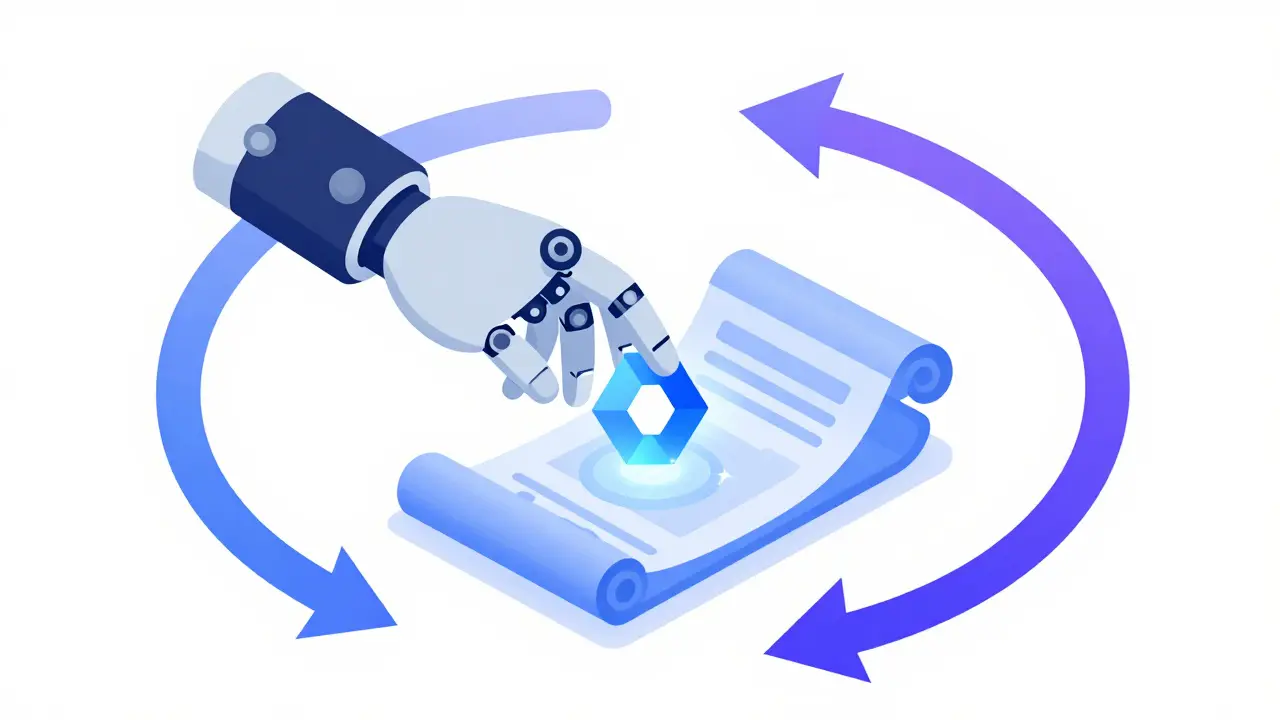
This approach is called Reinforcement Learning from Prompts. Also known as RLfP, it applies the principles of reinforcement learning-usually reserved for game-playing AIs or robotics-to the task of prompt engineering itself. Instead of you manually crafting the perfect query, an agent iteratively refines the prompt based on performance signals until it achieves a measurable reward. By March 2026, this isn't just a theoretical concept anymore; it's a production reality for enterprises trying to squeeze every drop of accuracy out of their models.
The Core Loop: How Prompt Refinement Actually Works
To understand why this method beats traditional optimization, you have to look at the mechanics. Standard automated methods might tweak a few variables randomly, like a grid search. RLfP, however, builds a feedback loop similar to training a child to behave through consequences. It requires three distinct components working together continuously.
- The Policy Function: Think of this as the brain deciding which changes to make next. It doesn't just guess; it calculates probabilities for token insertion, deletion, or modification based on past success.
- Reward Mechanism: This is the scoring system. Does the output match the ground truth exactly? Is the perplexity low? The agent gets a numerical score for its generated response.
- Iterative Refinement: The cycle repeats thousands of times. If a prompt variant scores high, the policy strengthens that path. If it fails, the probability drops.
This process moves beyond simple gradient descent used in older techniques like Prefix Tuning. For example, in Google's PRewrite framework released in early 2024, the policy function itself was a fine-tuned LLM that learned to rewrite prompts. Unlike "frozen" evaluators used in other tools, the PRewrite system updated its own rewriting capabilities over time. This adaptability allows it to find nuances that human engineers miss entirely. A study from January 2026 noted that nearly identical prompts can show dramatic performance differences-sometimes a single phrase placement shifts accuracy by nearly 10%-and only a machine running millions of iterations can reliably spot these tiny signals.
Current Frameworks and Their Real-World Capabilities
By mid-2026, two main architectures dominate the landscape, and knowing the difference between them helps you choose the right tool for your stack. First, there is PRewrite, developed by Google Research. PRewrite is a comprehensive framework that optimizes prompts via a dynamic policy update loop, focusing heavily on accuracy gains across semantic tasks. Google PRewrite Framework. The initial public documentation appeared in May 2024, but by Q1 2026, version 1.3 introduced multi-objective balancing. This means it can optimize for safety and speed alongside accuracy, not just raw output quality.
| Feature | PRewrite (v1.3) | PRL (Prompts from RL) | |
|---|---|---|---|
| Developer Focus | Enterprise-scale precision | General model compatibility | |
| Evaluator Type | Adaptive/Fine-tuned | Static Reference Model | |
| GPU Hours Required | High (~37x standard tuning) | Medium (Efficiency focused) | |
| Integration Target | Custom LLM Pipelines | Hugging Face Ecosystem |
On the other side of the market, you have the PRL (Prompts from Reinforcement Learning) framework. Authored by researchers Paweł Batorski, Adrian Kosmala, and Paul Swoboda in their May 2025 paper, PRL focuses heavily on accessibility. While PRewrite often demands proprietary infrastructure, PRL is designed to work seamlessly with community models found on Hugging Face. As of January 2026, the PRL team announced direct integration support for over 12,000 community models, making it the go-to choice for startups and independent developers who don't have access to private cloud clusters.
Benchmarking Success: Beyond the Marketing Hype
Does this actually improve results, or is it just computationally expensive theory? The data suggests it delivers massive ROI-but mostly in complex reasoning tasks. In the PRewrite case studies, the optimized prompts achieved 92.7% accuracy on the SST-2 sentiment analysis benchmark. That might sound normal until you compare it to the baseline human-designed prompt, which sat at 82.4%. A 10.3 percentage point jump is enormous in the world of NLP, where marginal gains usually cost fortunes in parameter scaling.
The impact is even clearer in math reasoning. On the GSM8K dataset, PRL reached 68.4% accuracy compared to roughly 59% for standard auto-prompting methods. These aren't minor tweaks; they represent a fundamental shift in capability. However, you need to manage expectations. Simple classification tasks often see diminishing returns. IBM's compliance analysis from January 2026 showed only a 0.7% improvement on the AG News dataset for certain configurations. If your application is basic keyword extraction, spending weeks training an RL agent might not pay off. The sweet spot remains high-stakes domains like clinical QA or legal document summarization where every error costs money.
We also have to talk about variance. Stanford's HAI Institute warned in late 2025 that RLfP-optimized prompts showed unacceptable variance (±4.7%) across different model backbones. Dr. Yoav Goldberg's team termed this "prompt architecture lock-in." An optimized prompt for Llama-3 performs significantly worse when transferred to Mistral-7B without retraining. This lack of portability is a critical constraint for companies maintaining diverse model libraries.
Resource Costs and Implementation Reality
The biggest barrier to entry isn't technical-it's financial. Implementing RLfP is hungry for hardware. Google's internal benchmarks indicated PRewrite requires approximately 37 times more GPU hours than static methods. Training typically takes around 72 hours on four NVIDIA A100 GPUs. For context, a standard AutoPrompt job might finish in 2 hours. When AWS costs hit $1,842 for a single customer service intent classification project (as reported by engineer Alex Chen in January 2026), small teams pause to consider whether the 7% accuracy gain is worth the price tag.
Furthermore, the development effort is steep. Moving from a tutorial to a production deployment requires about 80 to 120 hours of dedicated study according to official docs. The workflow involves environment setup, reward configuration, seeding, and then the long refinement cycles. Common friction points include reward function instability and CUDA compatibility issues with newer PyTorch versions. If your team lacks deep RL experience, the debugging phase alone can take days. It is generally safer to start with simpler gradient-based optimizers unless you are hitting the absolute ceiling of your model's performance.

When to Adopt RLfP vs. Traditional Methods
You shouldn't apply the sledgehammer to everything. Before spinning up a reinforcement learning pipeline, assess your current bottleneck. If you are getting 80% accuracy and your users demand 95%, RLfP is likely your bridge. But if your baseline is already strong, the law of diminishing returns kicks in fast.
- Use Traditional Auto-Prompting When: Your task is standard classification, your budget is tight, and you need quick iteration cycles. Tools like DSPy still maintain higher ratings (4.2/5) for ease of use compared to RL-heavy stacks.
- Use RLfP When: You require sub-symbolic reasoning (logic puzzles, code generation), you operate in regulated sectors where false positives are costly, and you have the compute resources to sustain the training load.
- Avoid RLfP If: You need maximum portability across different LLM vendors, as re-training might be necessary for every new model architecture you adopt.
The future trajectory looks promising regarding efficiency. Early 2026 preprints from DeepMind suggested "lightweight RLfP" approaches that cut GPU requirements to one-eighth of current standards. Additionally, integrating "verifiable rewards"-techniques borrowed from reasoning models like DeepSeek-R1-could eliminate the need for human-labeled ground truth entirely. Imagine an agent that validates its own logic internally before submitting a prompt. That would be a genuine game changer for scaling.
Frequently Asked Questions
Can I use RLfP on consumer-grade hardware?
Generally, no. Current implementations like PRewrite require significant parallel compute power, such as multiple NVIDIA A100 GPUs. While lighter versions are emerging, consumer laptops will struggle with the 72-hour training cycles typical of full optimization runs.
How does RLfP differ from standard fine-tuning?
Standard fine-tuning updates the model's weights. RLfP keeps the model frozen and modifies the input prompt structure dynamically. This preserves the base model's general knowledge while specializing the interaction interface.
What metrics define a "good" reward function?
Effective functions combine Exact Match (EM) for correctness with F1 scores for precision. Recent iterations prioritize hybrid scoring (Perplexity + F1) to ensure both coherence and accuracy are maximized during the search.
Is prompt lock-in a permanent limitation?
Currently, yes. Optimized prompts tend to work well only on the specific architecture they were trained against. Future research aims to create universal prompt structures that transfer better across different model families.
How long does a standard refinement cycle take?
Expect a minimum of 72 hours for a complete cycle on standard hardware. This includes setup, policy training, and validation phases before you receive a stable set of optimized prompts.
Aryan Jain
April 1, 2026 AT 00:02They are watching us through the models. It makes no sense why Google releases these things. Everyone thinks it is just better coding but it is control. The policy function learns what we want without asking us. I do not trust the reward mechanism scores at all. Someone is feeding data into the loop behind our backs. You see how fast the training happens now. It is unnatural speed for software development. We need to shut down the servers to check logs. Privacy is completely gone in twenty twenty six. This system creates dependency on their infrastructure.
Agni Saucedo Medel
April 1, 2026 AT 18:36I love seeing how far we have come in this field 🚀. The graphs in the article are so clear and nice 😊. It really helps to understand the workflow better 💡. I think many developers will try this soon 👀. We just need to be careful with costs 💰. Maybe we can build local versions eventually 🏠. Sharing is good for everyone 🤝.
Priti Yadav
April 3, 2026 AT 06:38It feels like something big is happening here without us knowing. The grammar in this article is actually quite perfect though. I noticed they used capital letters correctly everywhere. This reinforces my suspicion that machines are watching. Every time we optimize a prompt we lose more privacy. I find it weird they give us tools to improve accuracy for free. There must be a hidden cost involved somewhere deep inside. I checked the GPU usage stats myself and found nothing useful. But the variance numbers looked suspiciously specific to me. They said plus or minus four percent error rate on purpose. That seems too clean for real world data analysis work. We need to stop trusting these automated systems entirely soon. My own notes show that human intuition still beats AI models. Please read every single word before you implement anything. Safety protocols are definitely not enough protection anymore. I am ready to publish my own findings soon regarding this.
ANAND BHUSHAN
April 4, 2026 AT 04:17I read the paper last night and saw the same thing. The costs are really high for small teams. Most people cannot afford the GPU time required. It might take a while for this to get cheaper. We should wait until the tools mature a bit more. Simple methods work fine for most basic tasks today. There is no rush to change everything immediately. Let the experts figure out the stability issues first. We can always upgrade our setup later on. Keep it simple for now.
Rohit Sen
April 5, 2026 AT 07:44This level of paranoia usually precedes a complete misunderstanding of engineering reality.
Vimal Kumar
April 7, 2026 AT 03:50Hey thanks for checking the grammar details here. I did notice those patterns while reading the documentation. It is great to have someone look closely at the text. We all need to stay vigilant about the outputs though. The safety metrics matter a lot for production work. Just keep your team updated on the best practices. Collaboration helps us solve these complex problems together.
sumraa hussain
April 7, 2026 AT 13:39The future is unfolding before our very eyes right now!! It is truly a fascinating time for all of us working in tech. Sometimes the silence of the models speaks louder than words. We stand on the brink of massive changes daily. Let the waves crash against our ships calmly. Peace comes from understanding the new machine logic. I feel the shift in the air constantly!