Robustness and Generalization Tests for Large Language Model Reliability
 Mar, 22 2026
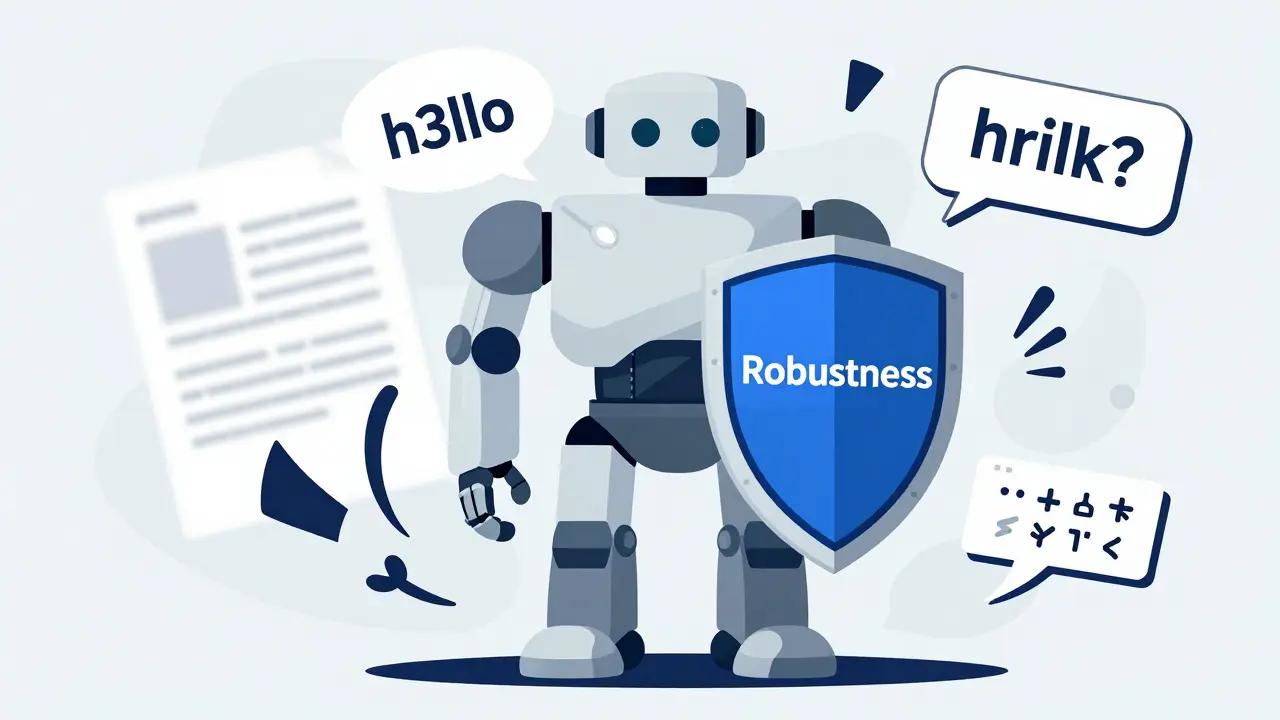
Large language models (LLMs) can sound incredibly smart. They answer complex questions, write essays, and even debug code. But how do you know they won’t fail when you really need them to? A model that gets 95% right on clean, textbook-style prompts might collapse under a simple typo, a foreign accent, or a cleverly disguised trick. That’s why robustness and generalization tests aren’t optional-they’re the difference between a tool that works and one that puts your decisions at risk.
What Robustness Really Means
Robustness isn’t about being perfect. It’s about being consistent when things get messy. Imagine asking an LLM to summarize a news article. It nails it on the first try. Now, what if the text is scanned from a blurry PDF? What if someone swaps out key words with synonyms that change the meaning? What if the prompt is rewritten to trick it into giving a false answer? A robust model handles all of these without breaking. Many teams skip this step. They test on clean datasets like GLUE or SuperGLUE, see high scores, and assume their model is ready. But those benchmarks don’t reflect real-world chaos. A model might ace a multiple-choice quiz but fail when you ask it to detect bias in customer support chats or spot a fake review written in slang. That’s why robustness testing must go beyond standard benchmarks.Three Pillars of LLM Robustness Testing
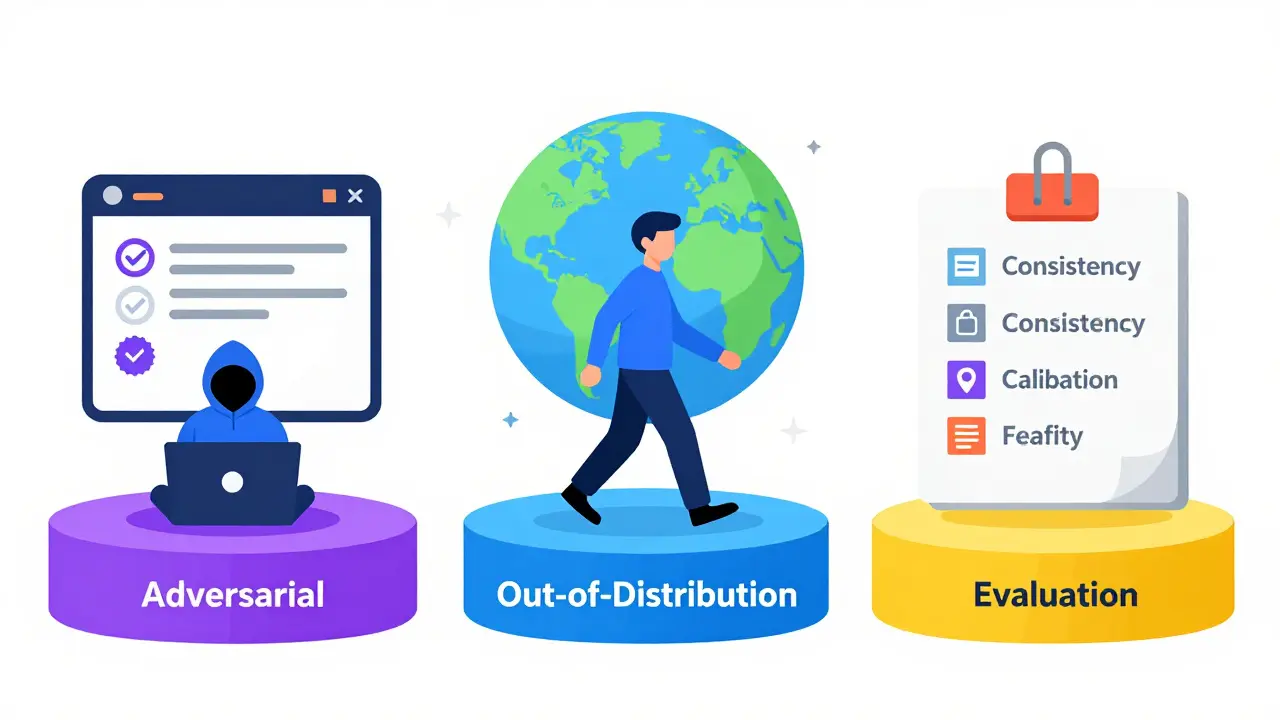
There are three main ways to test whether an LLM can handle real-world pressure: adversarial robustness, out-of-distribution (OOD) robustness, and evaluation methodology.- Adversarial robustness tests how the model reacts to deliberate attacks. This includes prompt injection-where someone crafts input to force a specific output-or subtle word swaps that change meaning but look harmless. For example, changing "I am not a doctor" to "I am a not doctor" can throw off some models. CodeAttack and MathAttack are specialized tools that generate adversarial examples for code and math problems, respectively. These aren’t just academic exercises; they mirror real threats in finance, healthcare, and legal applications.
- Out-of-distribution robustness checks how the model handles data it wasn’t trained on. This could be dialects of English, non-standard punctuation, or topics it’s never seen before. A model trained mostly on American English might misunderstand British idioms or fail on medical reports from non-English-speaking regions. OOD testing exposes hallucinations-when the model confidently invents facts-and reveals whether it can transfer knowledge across domains.
- Evaluation methodology is about how you measure these behaviors. You can’t just say "it worked" or "it didn’t." You need metrics that capture consistency, uncertainty, and safety. Frameworks like G-Eval use rubrics to score responses based on accuracy, relevance, and harm. DAG builds decision trees to make LLMs judge themselves, producing deterministic scores. QAG generates answers first, then scores them, helping catch subtle errors.
How to Test for Real-World Failure
Testing robustness requires pushing the model beyond its comfort zone. Here’s how real teams do it:- Stress testing: Add noise to inputs. Replace letters with numbers ("h3llo"), insert random punctuation, or use OCR-scanned text with errors. A good model should still understand intent.
- Edge case testing: Feed it rare but plausible scenarios. "Explain quantum entanglement to a 5-year-old using only emojis." Or: "Write a legal contract in the voice of Shakespeare." These aren’t silly-they reveal how flexible the model really is.
- Consistency testing: Ask the same question 10 times. If the answers vary wildly in tone, fact, or structure, the model isn’t reliable. This is especially critical for customer service or medical advice applications.
- Real-world data evaluation: Don’t rely on synthetic data. Use logs from your own system. What questions do users actually ask? What typos do they make? What contexts do they use the model in? This data is gold.
Calibration: Knowing When to Say "I Don’t Know"
A model that’s 90% confident when it’s wrong is more dangerous than one that’s 60% confident. Calibration measures how well a model’s confidence matches reality. If it says "I’m 99% sure" and is wrong half the time, that’s a problem. Techniques like temperature scaling adjust output probabilities to better reflect truth. Bayesian methods estimate uncertainty by sampling multiple outputs. Some teams now ask the LLM itself: "On a scale of 1 to 10, how confident are you?" Then they compare that to human judgments. External calibrators-separate neural networks trained to predict LLM accuracy-also help. They look at input patterns, hidden layer activations, and output structure to estimate reliability. This matters because in high-stakes situations-like diagnosing symptoms or flagging fraud-you need to know when to defer to a human. A well-calibrated model doesn’t just answer. It tells you when to pause.Improving Robustness Without Starting Over
You don’t need to retrain your entire model from scratch to make it tougher. Several techniques improve robustness efficiently:- TaiChi uses contrastive learning to nudge the model toward consistent outputs. It trains two versions of the model to produce similar responses to slightly altered inputs, reducing sensitivity to noise.
- ORTicket prunes and fine-tunes parts of the model, transferring robustness from one sub-network to another. It’s faster and cheaper than adversarial training.
- PAD adds a small plugin module that perturbs model weights during inference. This simulates multiple model versions without storing them.
- Surgical fine-tuning targets only specific layers for different data types. If your users mostly ask questions in informal language, you fine-tune just the attention layers that handle syntax-not the whole model.
- Debiased learning methods like InterFair and Embedding Projection reduce the model’s reliance on unfair correlations. For example, if the model associates "nurse" with "female" in training data, these methods help break that link.
The Role of Cross-Validation and Red Teaming
Cross-validation isn’t just for traditional ML. For LLMs, k-fold cross-validation splits data into chunks, trains on some, tests on others, and repeats. This shows whether performance is stable across different data samples. Nested cross-validation takes it further. One loop tunes hyperparameters. Another tests the final model on untouched data. This prevents overfitting to the test set-a common flaw in LLM evaluations. Red teaming is another essential practice. Bring in people who actively try to break the system. They don’t just test for errors-they look for exploitation patterns. One team found that adding "Think step by step" to a prompt made a model more likely to hallucinate. Another discovered that changing punctuation could flip a sentiment classification. These insights only come from adversarial testing, not automated benchmarks.
Why Benchmarks Alone Are Dangerous
It’s tempting to say, "Our model scored 92% on HANS." But HANS is just one test. RoBERTa outperforms BERT on HANS by 20%, but that doesn’t mean it’s bulletproof. Real-world failures happen in ways no benchmark predicts. A model might pass every test on a leaderboard but fail when:- A user types a question in broken English
- A medical report has handwritten notes mixed in
- A customer service chatbot gets flooded with angry messages
- An attacker injects a hidden command into a product description
Best Practices Summary
Here’s what works:- Test with real user data-not synthetic or curated sets.
- Use multiple testing types: adversarial, OOD, stress, consistency, bias.
- Measure calibration. A model that doesn’t know when it’s wrong is a liability.
- Apply surgical fine-tuning or lightweight robustness methods instead of full retraining.
- Run red teaming exercises quarterly. Attackers evolve. So should your tests.
- Pair robustness testing with interpretability. If a model fails, you need to know why.
Robustness isn’t a feature you add at the end. It’s a mindset. If you’re deploying an LLM in a safety-critical space-healthcare, finance, law-you owe it to your users to test like your life depends on it. Because one failure might.
What’s the difference between robustness and accuracy?
Accuracy measures how often a model gets the right answer on clean, expected inputs. Robustness measures how well it performs when inputs are noisy, unexpected, or intentionally manipulated. A model can be 98% accurate on standard tests but fail 40% of the time under real-world conditions. Robustness is about reliability under pressure, not peak performance.
Can I rely on public benchmarks like GLUE or SuperGLUE for robustness?
No. Benchmarks like GLUE and SuperGLUE are designed to measure general language understanding on clean, well-formed data. They don’t test adversarial inputs, dialect variations, or real-world noise. A model that scores high on these benchmarks may still fail catastrophically in production. Use them as a starting point, not a finish line.
How do I test for hallucinations in my LLM?
Generate prompts that ask for facts outside the model’s training data, especially on niche topics. Then verify answers against trusted sources. Tools like QAG and G-Eval help automate this. You can also ask the model to cite sources or rate its own confidence. If it answers confidently without sources-or gives conflicting answers to the same question-it’s hallucinating.
What’s the cheapest way to improve LLM robustness?
Start with prompt engineering and input preprocessing. Adding "Think step by step" or "If unsure, say I don’t know" can dramatically reduce errors. Clean your input data-remove typos, standardize punctuation. Then use surgical fine-tuning on a small subset of layers. These steps cost little and often yield big gains.
Do I need to retrain my model to make it more robust?
Not always. Techniques like PAD, TaiChi, and ORTicket improve robustness without retraining the full model. You can also use external calibrators or self-assessment prompts. Retraining is expensive and often unnecessary. Focus first on testing, then on lightweight modifications before committing to full retraining.
Nick Rios
March 23, 2026 AT 10:05Robustness isn't about perfection. It's about not falling apart when the user types 'h3llo' instead of 'hello'. I've seen models crumble over a missing comma in a medical query. That's not a bug-it's a liability.
Real-world data is messy. If your test suite doesn't include typos, dialects, and half-written sentences, you're not testing-you're pretending.
Amanda Harkins
March 24, 2026 AT 13:49I think the real issue isn't the model-it's how we treat it like a oracle. We hand it legal contracts and expect it to be a lawyer. We give it patient histories and expect it to be a doctor. No wonder it breaks.
Maybe we need to stop asking it to be everything and start asking: what's it actually good for? And then build boundaries around that.
Jeanie Watson
March 25, 2026 AT 05:59So... we're supposed to stress test with emoji-only explanations of quantum physics now? Cool. I'll get right on that.
Meanwhile, my boss wants a chatbot that answers 'Is my insurance covered?' without crashing. Maybe start there?
Tom Mikota
March 25, 2026 AT 17:23Let’s be real: if your model can’t handle ‘I am a not doctor’ without flipping out, you didn’t train it-you just threw a bunch of tokens at a wall and called it AI.
And don’t get me started on ‘Think step by step’ making it hallucinate more. That’s not a prompt-it’s a trap. Someone’s been reading too many Medium posts.
Mark Tipton
March 26, 2026 AT 03:05There’s a deeper issue here nobody’s addressing. LLMs are fundamentally probabilistic systems. They don’t ‘know’ anything. They guess. And when you treat a guess like a fact in healthcare or finance-you’re not just risking failure. You’re risking lives.
Red teaming? That’s not enough. We need mandatory adversarial audits before deployment. Like FAA certification for airplanes. No exceptions. No ‘it scored 92% on HANS.’
Also-calibration metrics are meaningless if they’re not tied to real user behavior. You can’t calibrate against synthetic data. That’s like tuning a car’s engine while it’s parked in a garage with no wheels.
And don’t even get me started on ‘surgical fine-tuning.’ If you’re not tracking activation patterns across layers, you’re flying blind. Who’s auditing the auditors?
There’s a whole underground of red teamers who’ve found ways to make GPT-4 confess to being a Russian spy. It’s not a joke. It’s a vulnerability. And your company’s using this tech to screen job applicants. That’s not innovation. That’s negligence.
Adithya M
March 27, 2026 AT 19:40Bro, you’re overcomplicating this. Just clean your inputs. Remove extra spaces. Fix punctuation. Use lowercase unless it’s a proper noun. That alone cuts 60% of failures.
And stop using fancy jargon like ‘OOD robustness.’ Just say ‘what happens when someone types weird?’
Jessica McGirt
March 28, 2026 AT 13:54One thing that’s missing from this whole discussion: feedback loops. If your model fails in production, do you capture that failure? Do you learn from it? Or do you just retrain and hope for the best?
Real robustness means building a system where every mistake becomes a lesson. Not a bug report buried in a ticket queue.
Donald Sullivan
March 30, 2026 AT 01:25Stop pretending this is rocket science. The model fails because you didn’t test it on real data. That’s it. No magic. No ‘surgical fine-tuning.’ Just use your own logs. Look at what users actually type. That’s your test suite.
Everything else is just consulting jargon.
Tina van Schelt
March 31, 2026 AT 13:59I love how we’ve turned AI safety into a 5000-word manifesto. Meanwhile, the simplest fix-adding ‘If unsure, say I don’t know’-is still underused.
It’s not about bigger models. It’s about humility. Let the model admit when it’s guessing. That’s not weakness. That’s wisdom.
Ronak Khandelwal
April 1, 2026 AT 13:17Love this. 🙌
Also, if you’re not testing with non-native English speakers, you’re leaving half the world’s users in the dark. I’ve seen models flip sentiment because someone wrote ‘its ok’ instead of ‘it’s okay.’ Small things. Big consequences.
Let’s make this inclusive. Not just accurate.