Scenario Modeling for Generative AI Investments: Best, Base, and Worst Cases
 May, 14 2026
Traditional financial planning often feels like guessing the future with a blurry map. You run a few static spreadsheets, maybe tweak some variables, and hope you haven’t missed a black swan event. But in 2026, that approach is dangerously outdated. Generative AI scenario modeling is a dynamic financial forecasting method that uses artificial intelligence to create probabilistic projections of investment outcomes across multiple potential futures. Instead of three rigid scenarios, this technology processes thousands of variables-from social media sentiment to macroeconomic indicators-to generate nuanced, real-time outlooks. This isn't just about faster calculations. It’s about seeing patterns human analysts miss. Goldman Sachs’ 2025 Asset Management Insight report highlights that AI is creating opportunities for 'up-skilling and more human-generated value creation,' shifting the role of the analyst from number-cruncher to strategic overseer. If you are investing in or managing portfolios with generative AI tools, understanding how to model the best, base, and worst cases is no longer optional-it is the difference between resilience and ruin.
The Shift from Static Spreadsheets to Dynamic Probabilities
For decades, investors relied on Monte Carlo simulations and bootstrapping. These methods were powerful but limited by manual effort. You could typically model only three to five scenarios because each required days of work. Generative AI changes the math entirely. By leveraging Large Language Models (LLMs) and Variational Autoencoders, systems can now process unstructured data-like earnings call transcripts or news articles-and identify non-obvious correlations in seconds.
Consider the speed difference. Bridgewise’s 2025 assessment shows that generative AI accelerates portfolio iteration by 70%. What used to take hours now takes seconds. This allows firms to run thousands of potential outcomes simultaneously. Oxford Economics’ 2025 Generative AI Economic Model illustrates this by establishing three distinct adoption scenarios for the industry itself: low (25% adoption by 2027), middle (45%), and high (65%). For your own investments, this means you aren't just looking at 'what if interest rates rise?'; you are asking 'what if interest rates rise while supply chain disruptions hit and consumer sentiment drops?' all at once.
The key advantage here is dynamic adaptation. Traditional models are snapshots; they become stale the moment market conditions change. Generative AI models are living systems. As seen in Acme Solar Technologies' implementation in Q4 2024, the ability to adjust scenarios in real-time during policy shifts allowed them to achieve 22% better risk-adjusted returns than industry benchmarks. They didn't just predict the storm; they navigated it as it formed.
Modeling the Three Core Scenarios
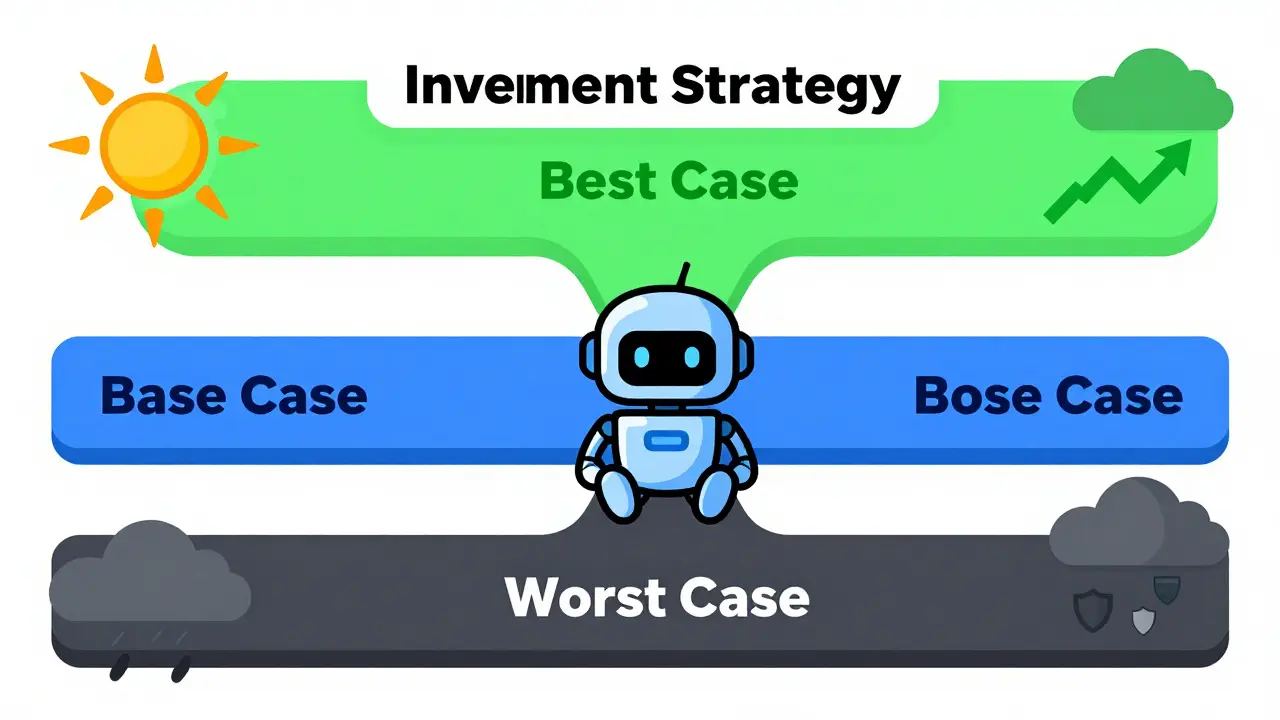
To make sense of the chaos, you need structure. Even with advanced AI, the framework remains rooted in three classic buckets: Best Case, Base Case, and Worst Case. However, the definition of these cases has evolved significantly.
- Best Case: In traditional modeling, this might mean 'revenue grows 10%.' With generative AI, the best case includes identifying hidden tailwinds. The AI might detect a subtle shift in regulatory language or a surge in positive sentiment on niche forums that signals an upcoming boom. It identifies opportunities before they hit mainstream news.
- Base Case: This is no longer just an average of past performance. It is a probabilistic median derived from thousands of simulated paths. The AI weights current market volatility, geopolitical tensions, and historical anomalies to give you a realistic 'most likely' outcome, rather than a hopeful guess.
- Worst Case: Here lies the true value. Generative AI excels at stress-testing. It doesn't just ask 'what if we lose money?'; it asks 'what combination of events causes us to lose money?' It synthesizes disparate risks-like a cyberattack coinciding with a liquidity crunch-to show you vulnerabilities you didn't know existed.
A CFA Institute RPC report from March 2025 documented a case study where synthetic financial text data improved the performance of fine-tuned LLMs for sentiment analysis by 9.8 percentage points. This precision matters. A slightly inaccurate sentiment reading in the 'worst case' model could mean missing a critical warning sign.
Technical Foundations: How It Works Under the Hood
You don't need to be a coder to use these tools, but understanding the infrastructure helps you trust the output. The backbone of modern generative AI scenario modeling is often platforms like NVIDIA NIM (NVIDIA Inference Microservices). This platform bridges the gap between quantitative experts and AI systems, allowing large language models to integrate with complex financial models seamlessly.
The system employs several generative approaches:
- Generative Adversarial Networks (GANs): These create synthetic datasets that mimic real market behavior, allowing you to test strategies against 'fake' but highly realistic market conditions.
- Diffusion Models: Originally used for image generation, these are now applied to time-series data to smooth out noise and reveal underlying trends.
- LLMs: These process textual data, extracting sentiment and intent from vast amounts of unstructured information.
System requirements have dropped significantly. While early implementations needed massive server farms, current setups require secure cloud environments with high-performance data pipelines and minimum 16GB RAM for basic implementations. For large-scale modeling, specialized GPU infrastructure is still preferred. Compatibility extends across major financial data platforms including Bloomberg, FactSet, and Refinitiv, with Python and R serving as the dominant programming languages for integration.
The Hidden Risks: Hallucinations and Data Quality
Here is where most investors get burned. Generative AI is not magic; it is a sophisticated pattern-matching engine. And it can lie. Early 2024 implementations saw hallucination risks documented at 8-12% error rates. An AI might confidently predict a correlation between two assets that simply does not exist.
Bridgewise reports that 63% of failed implementations traced issues directly to poor data quality. If you feed garbage into the model, you get garbage out-but it will look like sophisticated garbage. The CFA Institute warns that 'ensuring synthetic data quality is critical,' recommending both qualitative visualizations and quantitative statistical tests. You must validate the AI's output against real-world results regularly.
Regulatory uncertainty also plays a huge role. SEC Commissioner Jaime Lizárraga’s March 2025 speech cautioned that 'firms must implement robust validation frameworks before relying on AI-generated scenarios for investment decisions.' The SEC’s proposed Regulation AI requires standardized validation frameworks, audit trails, and explainable reasoning by Q3 2026. If you cannot explain why the AI made a specific prediction, you should not bet on it.
| Feature | Traditional Modeling | Generative AI Modeling |
|---|---|---|
| Scenarios per Run | 3-5 | Thousands |
| Data Types | Structured (Numbers) | Unstructured (Text, Sentiment) + Structured |
| Update Frequency | Manual (Days/Weeks) | Real-time (Seconds) |
| Error Source | Human Bias/Omission | Model Hallucination/Data Quality |
| Complexity Handling | Low (Linear correlations) | High (Non-linear, multi-variable) |

Implementation Strategy: Start Small, Scale Smart
Jumping in headfirst is a recipe for disaster. Bridgewise’s client survey of 47 financial institutions showed an 82% success rate for firms that started small with pilot projects, compared to just 31% for those attempting enterprise-wide rollouts immediately.
Follow these three steps:
- Pilot Projects: Test generative workflows on a single asset class or a small subset of your portfolio. Don't replace your entire risk management system overnight. Use it alongside your existing tools to compare outputs.
- Invest in Data Pipelines: Clean, structured financial data is non-negotiable. Successful firms dedicate 15-20% of their implementation budgets to data quality assurance. If your data is messy, the AI will struggle.
- Align with Compliance Early: Involve your legal and risk teams from day one. Understand the regulatory landscape in your jurisdiction. Ensure you have the audit trails required by emerging standards like the SEC’s Regulation AI.
The learning curve varies. Quantitative analysts typically need 4-6 weeks of specialized training, while portfolio managers need 2-3 weeks to effectively interpret AI-generated scenarios. Documentation quality matters here too. NVIDIA's NIM platform receives high marks for technical documentation, while custom enterprise solutions often lag behind.
Market Adoption and Future Outlook
We are in the early majority phase of adoption. Celent estimates that 58% of asset managers with $50B+ AUM had implemented some form of AI-powered scenario modeling by Q1 2025, up from 22% in Q1 2024. Hedge funds lead the pack at 67% implementation, followed by private equity (52%) and traditional long-only equity managers (41%).
The global market for AI in investment management reached $4.7 billion in 2024, with scenario modeling representing 32% of that segment. Oxford Economics predicts that under a high-adoption scenario, generative AI scenario modeling could contribute $237 billion annually to global investment management efficiency by 2027.
However, challenges remain. There is a 43% deficit in professionals skilled in both finance and AI scenario modeling, according to the CFA Institute. Talent shortages will drive up costs for expertise. Additionally, the technology is expected to evolve toward deeper integration with real-time market data streams by 2027 and the emergence of specialized scenario modeling marketplaces by 2028, where institutions can share validated synthetic scenarios using federated learning to maintain privacy.
Don't wait for perfection. The goal isn't to build a crystal ball; it's to build a better compass. By combining the creative thinking of experienced professionals with AI's computational power, you create a collaborative framework that outperforms either approach alone.
What is the biggest risk in using generative AI for scenario modeling?
The biggest risk is model hallucination combined with poor data quality. Early implementations showed 8-12% error rates where the AI created false correlations. Bridgewise reports that 63% of failures stem from bad data inputs. Always validate AI outputs against real-world benchmarks and maintain strict data hygiene.
How much does it cost to implement generative AI scenario modeling?
Costs vary widely based on scale. Basic implementations require cloud infrastructure and minimum 16GB RAM. However, successful firms dedicate 15-20% of their total implementation budget specifically to data quality assurance. Enterprise solutions with specialized GPU infrastructure and custom integrations can cost hundreds of thousands to millions, depending on the complexity of the data pipelines.
Is generative AI scenario modeling regulated?
Regulation is evolving rapidly. The SEC issued guidance in February 2025 requiring audit trails, explainable reasoning, and transparent data lineage for AI-generated investment scenarios. Proposed Regulation AI aims to standardize validation frameworks by Q3 2026. Firms must ensure their models are interpretable and compliant with local financial regulations.
Can small investors use generative AI scenario modeling?
Yes, though access differs. While 79% of current implementations are at institutions managing $1B+ in assets, retail platforms like Betterment began offering simplified AI scenario tools to individual investors in Q2 2025. These tools provide less granular control but offer valuable insights into base and worst-case scenarios for personal portfolios.
What skills do I need to manage generative AI scenario models?
You need a blend of financial expertise and technical literacy. Quantitative analysts typically require 4-6 weeks of specialized training to understand the models, while portfolio managers need 2-3 weeks to interpret the outputs. Key skills include data validation, understanding of LLM limitations, and proficiency in Python or R for integration tasks.
Vishal Gaur
May 15, 2026 AT 02:48i mean look at this whole thing and its just so much text to read about how ai is gonna save the day or whatever but honestly i think most people are just too lazy to actually learn how to use these tools properly because why bother when you can just guess right?
the article talks about all these complex models like gan and diffusion models which sound super fancy but in reality if your data is bad then the ai is just gonna hallucinate some crazy correlation that doesnt exist and you will lose money anyway so maybe we should just stick to spreadsheets because at least those dont lie to you even if they are slow
also the part about needing 16gb ram seems kinda low for what they are claiming it can do but i guess cloud computing fixes that issue for rich companies while small investors get left behind with their basic laptops trying to run python scripts that crash every five minutes
it is funny how they say analysts need to upskill but really they just need to stop trusting the black box outputs without checking them first because humans are still better at spotting obvious nonsense than a machine learning algorithm trained on noisy financial news articles from the internet
Nikhil Gavhane
May 16, 2026 AT 15:35This is such an important discussion for anyone managing assets today. I really appreciate how the post highlights the shift from static guesses to dynamic probabilities because it gives us a much clearer picture of where the industry is heading. It is encouraging to see that firms are starting to prioritize data quality and validation frameworks as essential steps rather than afterthoughts.
Rajat Patil
May 18, 2026 AT 07:37I believe that the integration of artificial intelligence into financial planning requires careful consideration of both technical capabilities and ethical responsibilities. The potential for error through hallucination is significant and must be addressed with robust validation protocols before any decisions are made based on these outputs.
deepak srinivasa
May 19, 2026 AT 08:13How exactly does the system handle conflicting signals from different data sources when generating the base case scenario?
pk Pk
May 20, 2026 AT 01:12We all have a role to play in shaping how this technology evolves in our workplaces. Let us start by taking small pilot projects seriously and ensuring our teams are trained not just on the software but on critical thinking skills needed to interpret results correctly. Success comes from collaboration between human insight and machine speed so let us build those bridges together now.